Malaysian mystery tiles, part 2½
>From: Philip
>Sent: Sunday, January 31, 2010 4:19 AM
>Subject: Malaysian Mystery - Thanks
>Many thanks Michael for your speedy response. I have looked again very carefully at the second column of tiles and fully agree with what you say. The first tile clearly shows the fisherman's rod and basket; the second picture remains enigmatic; the third appears to depict the handles of a couple of scythes; and the fourth shows an open book with the western letters S and W on the pages.
>I had been thrown by the difficult to make out characters; but, under a magnifying glass, these are indeed Yue for the Fisher, Chiao for the Woodcutter, Keng for the Farmer and Ta for the Scholar. What on earth the significance of the western letters S and W are beggars belief, given the fact that these are the only two tiles in the whole box to have western letters on!
>In the fifth column the Tiger, the Hare and the Dragon are three of the Chinese Years. What I thought was the devil at the bottom of column 8 is in fact more like a Monkey - another Chinese Year; so I have now moved him to column 5. The box has space for a sixth tray of 36 tiles - now missing. Eight of these could well have been the other 8 Chinese Years (Rat, Ox, Serpent, Horse, Goat, Cock, Dog and Pig). I have moved the ?Crane tile (or is it in fact another Cock for the year?) to column 7, where I now believe the ?Frog to be the 3 Legged Toad and the ?Mollusc to be an Oyster. This quartet may be another Malaysian 'Animals' set.
>The solitary Street Performer?? is now looking for another three colleagues to complete his set. The Sun and Moon are looking for Earth & Stars or other planets. The other favorite Chinese numbered set of 1. "Wind" (Feng), 2. "Flower" (Hwa), 3. "Snow" (Hserh) and 4. "Moon" (Yuerh) could well have featured too. A handwritten card in the box spells out the tiles needed for 3 handed Malaysian Mah Jongg and mentions two tiles called 'Tim Yong'; are these perhaps the square 'tokens' in the box? Also the 8 'Fly' tiles have a pair of red characters on them rather than the single red character shown on your webpage.
>What is, for the moment, one of the largest Mah Jongg sets ever noted - must be similar to Tine Willis's 200 tile set in Kuala Lumpur (bulletin board May 31, 2007), but with slightly different tiles - looks set to become a real record breaker if tray no. 6 ever existed. Are you still there Tine? Can we compare notes?
>I do hope other members of the bulletin board will feel able to add further comment.
>Regards, Philip.
 Hi Philip, you wrote: Hi Philip, you wrote:
 What on earth the significance of the western letters S and W are beggars belief What on earth the significance of the western letters S and W are beggars belief
 That I can answer. I see that in FAQ 7e I only briefly mentioned Roman wind letters on flower tiles twice: in the 3rd paragraph and in the exchange with Johni and Lori, from early September 2008 (much farther down near the bottom of the FAQ). I need to add the info to FAQ 7e. That I can answer. I see that in FAQ 7e I only briefly mentioned Roman wind letters on flower tiles twice: in the 3rd paragraph and in the exchange with Johni and Lori, from early September 2008 (much farther down near the bottom of the FAQ). I need to add the info to FAQ 7e.
Those who use flowers in the traditional Chinese way are already familiar with the fact that the 1 flower is the East seat flower, the 2 flower is the South seat flower, the 3 flower is the West seat flower, and the 4 flower is the North seat flower. Most of the time, our flower tiles just have numbers on them, but sometimes our flowers instead have season names on them (many times, but not always, numbers too) -- OR Roman wind letters.
If you are playing and using flowers in the traditional Chinese way, you would see Roman wind letters as very convenient, and you would instinctively know why they are so marked.
As I mentioned in FAQ 7e as regards to the picture from Colin Bisasky (way down the FAQ), Spring = E, Summer = S, Autumn = W, Winter = N. The winds correspond to the seasons that way in Chinese tradition.
the ?Crane tile (or is it in fact another Cock for the year?)
It sure looks like a crane.

This quartet may be another Malaysian 'Animals' set.
The Malaysian animals usually (if not always) come in one-eats-the-other pairs. There's even an ongoing discussion about that on the mahjong newsgroup (news:rec.games.mahjong, accessible via groups.google.com). The 3-legged frog would be a Chinese legend, and it would be captured by Liu Hai (the so-called "street performer," as discussed in FAQ 7e).
The solitary Street Performer?? is now looking for another three colleagues to complete his set.
No, Liu Hai goes with the 3-legged frog, as in FAQ 7e. BTW, just now I fixed the image -- it erroneously referred to Liu Hai as a street performer. It doesn't anymore.
A handwritten card in the box spells out the tiles needed for 3 handed Malaysian Mah Jongg and mentions two tiles called 'Tim Yong'; are these perhaps the square 'tokens' in the box?
Sorry, I don't know. I'd have to see what the card says about them. Those two tokens might possibly be comparable to wind indicators. Your photo only showed one side of them -- do they perhaps have different writing on the other side?
Also the 8 'Fly' tiles have a pair of red characters on them rather than the single red character shown on your webpage.
Okay. Don't be surprised when different mahjong sets differ from other mahjong sets.
I do hope other members of the bulletin board will feel able to add further comment.
Michael will probably have something to say in response to your latest.
May the tiles be with you.
Tom Sloper
Author of "The Red Dragon & The West Wind," the definitive book on Mah-Jongg East & West.
Los Angeles, CA (USA)
January 31, 2010
If I'm playing a concealed hand...
>From: Shelly
>Sent: Saturday, January 30, 2010 6:24 PM
>Subject: Mah-Jongg Q+A
>My mah-jongg question or comment is: If I'm playing a concealed hand, can I still exchange a tile for a joker? I wanted to discard it and block the others from taking it but they said it wasn't allowed. I argued that it was not for an exposure. Please settle.
Hello Shelly, you asked:
If I'm playing a concealed hand, can I still exchange a tile for a joker?
You have asked Frequently Asked Question #19BD. Please scroll up and look for the blue and yellow flashing arrow, emblazoned "READ 1ST," like this  ). Find the link to FAQ #19 (it's marked with a red, white, and blue flashing arrow, emblazoned "AMERICAN," like this ). Find the link to FAQ #19 (it's marked with a red, white, and blue flashing arrow, emblazoned "AMERICAN," like this  ) and click it. ) and click it.
After you've landed at the FAQ 19 page, please bookmark it so you can easily return to it anytime you have a mah-jongg question. Answers to all of the most frequently-asked questions about American (NMJL) mah-jongg are found in FAQ 19. Please always check the FAQs first, before asking a question. Thanks!
I wanted to discard it and block the others from taking it
That isn't necessarily great strategy. If you just discard the tile, nobody can use it, and if you want to tweak the other players, that's good enough. They'll all start tearing their hair out and shrieking, "OH! I WANTED THAT!" But now they can't have it. (If you don't follow me, you should read FAQ 19G.)
One exception is if the exposure is a pung. If the exposure is a pung with one joker, then there are two natural tiles that could be used to redeem that joker -- and if you have one of them, redeeming that joker does prevent somebody else from doing that. Of course, if the exposure is a kong, then there's only one natural that can be used, and you can just discard it. That has the same useful effect of blocking/tweaking other players from ever getting that joker.
The other exception is if the exposure is flowers. Since there are 8 flowers, redeeming one could be a good strategy to prevent someone else from doing so.
But the other edge of the sword is that by redeeming the player's joker, you might be making her jokerless. So the strategy of redeeming a joker just to discard it might backfire on you -- she might win and it would cost you (and everyone) double.
but they said it wasn't allowed.
That's an entirely differently thing from what you asked above. You asked if you can exchange a joker while playing a concealed hand. You're telling me that your other players told you that you couldn't discard the exchanged joker. Or that's the way I read what you've written.
Besides, how do THEY know that you're playing a concealed hand? Are they reading your mind? Are they cheating with mirrors?
I argued that it was not for an exposure. Please settle.
Redeeming a joker is never "for an exposure." How could it be? Sounds to me like you all need to have a copy of the rules, written down in full. Every table should have that! When you have a rulebook, this sort of argument is easily and immediately resolvable. In my opinion, my book is the best thing to have (since it's more complete than the NMJL rulebook).
May the tiles be with you.
Tom Sloper
Author of "The Red Dragon & The West Wind," the definitive book on Mah-Jongg East & West.
Los Angeles, CA (USA)
January 30, 2010
Where can I get drawer pulls, part 2
>From: Claire
>Sent: Saturday, January 30, 2010 10:07 AM
>Subject: RE: Question: 1920's drawer pulls?
>Thanks Tom, I will remove the bone rings from my set and will try to find a "cannibalized" drawer pull. Thanks for the advice!!
>-Claire
Where can I get drawer pulls?
>From: Claire
>Sent: Friday, January 29, 2010 10:35 PM
>Subject: Question: 1920's drawer pulls?
>Hi Tom,
>Is there a source for a 1920's "Chinese jewelry box" style drawer pulls? My mahjong set is missing one drawer pull!
>Thanks,
>-Claire
Hi Claire,
I can only tell you what I would try. As I told Paul yesterday, I would try actually contacting the vendors who've listed on the Accessories For Sale BB, the Sets For Sale BB, and the Tiles For Sale BB. Especially the latter.
Vendors who sell loose tiles have essentially cannibalized sets in order to sell off the parts. They probably have all kinds of useful parts.
After you've contacted all those vendors and have failed to find what you're looking for, you can post an announcement on the Accessories Wanted BB.
And of course, with your question, drawer pulls, you could try hardware stores. You might find something close enough to make for a satisfactory result, unless you have an unusually valuable set and/or you are a particularly finicky collector or an antique dealer. But if you were an antique dealer, you'd already know that one more thing you could try would be an antique repairman.
Good luck!
By the way, those bone or ivory ring thingies (that you mentioned 2 weeks ago) should be separated from your old mahjong set, since they have nothing to do with mahjong, and probably have some value of their own.
May the tiles be with you.
Tom Sloper
Author of "The Red Dragon & The West Wind," the definitive book on Mah-Jongg East & West.
Los Angeles, CA (USA)
January 30, 2010
Answers to some of the mysteries
>From: Michael Stanwick
>Sent: Fri, January 29, 2010 2:35:54 PM
>Subject: Re: replies to a couple of posts.
>Hello Tom. I had a very quick scan of two of two posts on your bulletin board and I have partial answers for both, if you want to post them.
>For the post 'Malaysia Mystery Tiles' - the 2nd column appears to be the symbols of the 4 Callings of Mankind - Fisherman, Woodcutter, Farmer and Scholar. Columns 5 - 8 are symbols that probably spell out a blessing or proverb etc. See Eberhard and Williams.
>For the post 'Mystery Thingies' - the 2nd column of tiles are also found in set # 226 under 'Unique Sets' on Jim May's site. The Chinese characters (words) are the same and Jim has given a translation. The characters (words) in the 1st column I cannot read. The human figures have the appearance of depictions of personages from Chinese dramas - but I cannot be sure. Depictions of this sort are highly varied.
>Cheers
>Michael
That's great information, Michael! I hope that those two posters come back and see the info.
May the tiles be with you.
Tom Sloper
Author of "The Red Dragon & The West Wind," the definitive book on Mah-Jongg East & West.
Los Angeles, CA (USA)
January 29, 2010
Where can I get an un-American case?
>From: Wm. Paul
>Sent: Fri, January 29, 2010 1:30:20 PM
>Subject: Mah-Jongg Q+A
>My mah-jongg question or comment is:
>Hello Tom,
>Newbie to Mah Jongg but have already bought a couple sets from eBay.
>One was a set with slightly torn vinyl case but with tiles in
>excellent condition that was too good to pass up. It is the smaller
>Japanese size with snap front lid closure that has a rectangular
>cut-out for access to handle, no trays inside.
>I have been all over the Internet, checked your site plus Q&As there
>with no success in finding any source for smaller (non-American sized)
>Chinese or Japanese style empty cases.
>Any suggestions for where to look for a replacement cases, short of
>having one built would be gratefully welcomed at this point. I am not
>really desirous of any of the American sized cases.
>TIA,
>Paul
>Tampa, Florida / Alajuela, Costa Rica
>==
Hi Paul,
You should try actually contacting the vendors who've listed on the Accessories For Sale BB, the Sets For Sale BB, and the Tiles For Sale BB. Especially the latter. After you've contacted all those vendors and have failed to find what you're looking for, you can post an announcement on the Accessories Wanted BB. Good luck!
May the tiles be with you.
Tom Sloper
Author of "The Red Dragon & The West Wind," the definitive book on Mah-Jongg East & West.
Los Angeles, CA (USA)
January 29, 2010
Malaysian mystery tiles
>From: Philip
>Sent: Fri, January 29, 2010 7:24:37 AM
>Subject: Malaysian Mystery Tiles
>Dear Tom
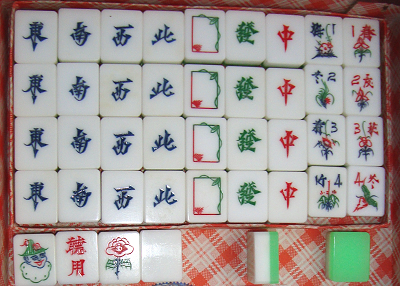
>I have been shown a splendid Mah Jongg set by a friend. It was sold by Mee Lee Cheong of 459 North Bridge Road, Singapore 7 probably some time in the 1960s and you will note their rubber stamp on the decorative paper lined box. The tiles are translucent green backed plastic and the box currently contains 200 tiles, although I believe there were originally 204. Certainly one each of the 7 & 9 of dots are missing - and it would appear from what you can see below a couple of the "extra" tiles have also gone walkabout.
>I have not photographed the three "suits". The top case contains the usual winds, dragons, flowers and seasons. Nothing special here.
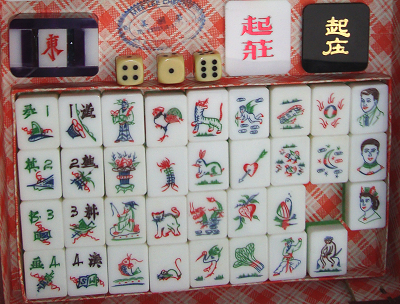
>In the middle is the 'wind of the round' indicator, three dice and two 'tokens', whose purpose is unknown to me. There are here too examples of 8 Jokers, 8 ?Flies, 4 Roses and 4 blanks.
>The bottom case contains 34 only (of ?36) of the most interesting selection of "extra" tiles I have seen.
>These appear to comprise no fewer than nine sets of 4 as follows:-
>1. Zither 2. Board Game 3. ?Calligraphy 4. ?Painting
>1. thru 4. To be identified
>1. Rich Man 2. Crock of Gold 3. Fisherman 4. Fish
>1. Cockerel 2. Worm/Centipede 3. Cat 4. Mouse
>1. Tiger 2. Hare 3. Dragon 4. ?Crane
>1. Cupid 2. Love 3. Fruit 4. Cabbage [The four ages of man?]
>1. ?Frog 2. Chicks 3. ?Mollusc 4. ??Scholar or Street Performer??
>1. Sun 2. Moon [3. ?Stars] 4. Devil
>1. Man 2. Boy 3. Woman [4. ?Girl]
>As you can see I still need positive identifications for several of these - indeed some are probably misplaced as well.
>I do hope that either you or others may be able to throw more light on this interesting and unusual collection.
>Regards
>Philip.
Hi Philip,
I'm not sure I fully understand your question:
I still need positive identifications for several of these
You mean you want to know if the calligraphy tile really is calligraphy? And what your 2nd column of flowers are? And if the crane is really a crane? Stuff like that?
All I can do is suggest a close study of FAQ 7e (which it sounds like you have already visited), and that you also see http://www.sloperama.com/mahjongg/malaysian.htm where the Malaysian style of play is described.
I myself am not as enamored as some people are by knowing what the symbols on mahjong flower tiles are supposed to represent. I provided FAQ 7e to give people hints about how to get started researching their own flower tiles. But I'm sorry, I can't offer much more than that. Your 2nd column might be "flowers," but FAQ 7e could tell you if so, and if not, then you'd need to look up the Chinese characters -- and I won't do that for you. I just don't have the time or the interest for that. Good luck, and enjoy the research!
Tom Sloper
Author of "The Red Dragon & The West Wind," the definitive book on Mah-Jongg East & West.
Los Angeles, CA (USA)
January 29, 2010
Can the last S&P hand (the one with two 2009s) be made in 1 suit?
>From: "Bobarbtoo2
>Sent: Tue, January 26, 2010 7:54:44 AM
>Subject: Mah-Jongg Q+A
>My mah-jongg question or comment is:
>On the 2009 card, the last hand in Singles and Pairs,
>FF 2009 NEWS 2009 (1 or 2 Suits, 2 and 9 same Suit)
>Could both 2009's be the same, both Bams or Craks or Dots? On the card one 2009 is green and one is red.
>Bobbie
Hello Bobbie,
The answer is right there in what you wrote: "(1 or 2 Suits," you wrote. That means it CAN be made in 1 suit (and not only in 2 suits). The words in the parenthetical are important! The color-coding can't always say it all! The words in the parenthetical (when present) trump the color-coding (if there seems to be a conflict between the color-coding and the parenthetical). I wrote about this quite a bit in FAQ 19 (you can access the FAQs above left).
May the tiles be with you.
Tom Sloper
Author of "The Red Dragon & The West Wind," the definitive book on Mah-Jongg East & West.
Los Angeles, CA (USA)
January 26, 2010
I need "pushers" that work with "vintage" racks
>From: Lee
>Sent: Saturday, January 23, 2010 2:44 PM
>Subject: Mah-Jongg Q+A
>My mah-jongg question or comment is:
>Hi, Tom,
>I have a vintage 70's mah-jongg set with the typical bakelite racks in five different colors...and need pushers.
>Everywhere online, that I see this pushers, there is the caveat that they might not fit vintage racks.
>I can't believe that with all the vintage sets still around, and being sold on ebay and other places, that no company had thought to make a pusher for these racks.
>I would prefer to get the clear Lucite ones that I have seen online... but at this point would settle for any color, if only they were designed to fit a bakelite rack from the 70's. ( M & L Manufacturing )
>Do you know where I might be able to obtain such a pusher?
>Thanks for any help you can give me.
>BTW.. my racks are approximately 18 1/4" from the tip of the brass plate for the betting coins to the end of the rack.
>the rack itself is 15 3/4' long.. but if you add that end tap that the betting coin rack is attached to that would make it more like 15 7/8" long
>Thank you so much for anything you can share with me to help.
>Best wishes,
>Lee
Hi Lee,
There are two different things you might be talking about when you use the word "pushers." One is, as you suggest, the type with a hole that fits over a rack's coin pin and pivots (swings) a wall out into the table. That type is usually referred to as "Helping Hands." The other type does not have to fit over a coin pin, because it doesn't swing -- you use it to push a wall into place. I haven't actually seen this latter type, unless it is just what Chinese players call "rulers" (because they're shaped like a measuring stick). Take a look at FAQ 7d to see what I'm talking about.
I see that you have now also sent me a post for the Accessories Wanted board. And that's good, because that's what I was going to suggest that you do (that, and of course check the Accessories For Sale board, and FAQ 4a for vendors). I was also going to suggest that if your husband has tools, he might have drill bits, and he might be able to widen the hole in the end of Helping Hands -- if needed. I have Helping Hands and antique racks, and my Helping Hands fit just fine on all my racks that have coin pins.
May the tiles be with you.
Tom Sloper
Author of "The Red Dragon & The West Wind," the definitive book on Mah-Jongg East & West.
Los Angeles, CA (USA)
January 23, 2010
What can I say?
>From: Sue
>Sent: Saturday, January 23, 2010 1:31 PM
>Subject: Mah-Jongg Q+A
>My mah-jongg question or comment is: when calling for a discarded tile for exposure do you have to call “chow, pung, kong, quint or sextet” or do you call the tile by name ie “call 5 crak”
Hi Sue,
Well, if you want it for a chow, you have to say "chow." If you want it for a quint or a sextet, you can say pretty much anything. Most people say "I want that." But the question as to what you say if you want it for a pung or kong... well, that depends on what kind of mah jongg you play. People who play Asian variants are required to say the name of the grouping that is to be formed: "chow" or "pung" or "kong." But Americans don't do that. They just say any old thing that informs the other players that they want the discard. Most people say "I want that." Some say "call" or "take." If you want to say "call 5 crak," nobody will object. Assuming you play American mah jongg.
May the tiles be with you.
Tom Sloper
Author of "The Red Dragon & The West Wind," the definitive book on Mah-Jongg East & West.
Los Angeles, CA (USA)
January 23, 2010
The writing on the poetry-ribbon hanafuda cards
>From: Samuel
>Sent: Saturday, January 23, 2010 10:42 AM
>Subject: akayoroshi
>Hi,
>I happened to stumble upon your site again. Jeroen (http://www.sloperama.com/hanafuda/koikoi.htm) is completely right. I had been too used to reading one particular person's script, and that person tends to make his 'ka's more like little squiggles (almost just a little dot) than the more clearly defined two-part marks on the cards.
>I mistook it for a mark closer to http://hikog.gokenin.com/hentaika%5B1%5D.gif (but shorter, and attached to "a"), when in fact it's actually F281 on this chart, http://www10.plala.or.jp/koin/koinhentaigana.html#03. The way it's written on the February card makes it clearer that what looks like a "no" is not actually a "no," but the bottom part of "ka." I'd also imagine that if it was indeed "ka no" like I initially thought, the line would have connected between "ka" and "no" anyway, instead of cutting off like it does.
>So to clarify, it actually is "akayoroshi."
>Apologies for the confusion I'm sure to have caused!
>Best,
>Sam

Hi Sam,
Cool.
May the cards be with you.
Tom Sloper
Author of "The Red Dragon & The West Wind," the definitive book on Mah-Jongg East & West.
Los Angeles, CA (USA)
January 23, 2010
Looking for a good mahjong program
>From: Danny
>Sent: Saturday, January 23, 2010 5:53 AM
>Subject: Closest program to your Shanghai Dynasty 1.21
>Tom, I understand you are the programmer who created the excellent Shanghai Dynasty 1.21 for Activision. My CD version is corrupted and will still play on occasion, but I know its time is limited.(No legitimate copies can be found on Ebay) Could you recommend another version that you feel is comparable to yours, especially from a graphics point of view? I need to find one that will preferably work on the new Windows 7, since I plan on getting a new computer in the next 3-4 months.
>Thanks for your advice.
>Sincerely,
>Danny
Hi Danny, you wrote:
I understand you are the programmer who created the excellent Shanghai Dynasty
No. I was the designer and producer. I am not a programmer.
Could you recommend another version that you feel is comparable to yours, especially from a graphics point of view?
Sorry, I don't make specific recommendations. You'll have to do what everybody else does -- try out some until you find one you like. Use FAQ 5 for a starting point. Every mahjong computer game I know of is listed there. You get to FAQ 5 by clicking the link above left.
May the tiles be with you.
Tom Sloper
Author of "The Red Dragon & The West Wind," the definitive book on Mah-Jongg East & West.
Los Angeles, CA (USA)
January 23, 2010
How to improve FAQ 19L, part 2
From: "Chris S
Sent: Thursday, January 21, 2010 11:20 AM
Subject: FAQ 19L
> Howzat? Awesome by me. Thanks!
How to improve FAQ 19L
From: "Chris
Sent: Wednesday, January 20, 2010 1:00 PM
Subject: Mah-Jongg Q+A
> My mah-jongg question or comment is about FAQ 19L.
> I know it's been asked a thousand times (hence it being a FAQ), so it
> might help to add a note that an EXPOSED set cannot be all jokers
> because an exposed set always has a claimed tile, and you cannot claim a
> joker. A set of all jokers would have to be concealed in the hand.
> Chris
Hi Chris,
Okay, so here's what FAQ 19L says right now:
 Q: Do I have to have a natural* tile to expose? Q: Do I have to have a natural* tile to expose?
A: When claiming a discarded tile to make an exposure, the exposure can contain multiple jokers (in fact, you do not have to have any "natural"* tiles in the hand in order to make an exposure). For example, if you have two jokers and someone discards a tile, you may claim it and expose a pung with the discard and your two jokers. When you go maj, it is perfectly OK to have a pung, kong, quint, or sextet that is nothing but jokers (containing no natural tiles at all).
* A "natural" tile is a non-joker tile.
For further reading:
RDWW - p. 57 (rule 82), p. 90
NMJL - 2006
I could change it to:
Q: 1. Do I have to have a natural* tile to expose? 2. Can I have a set that's all jokers?
* (A "natural" tile is a non-joker tile.)
A: 1. No, you don't have to have a natural concealed within your hand prior to claiming a discarded natural for exposure.
When claiming a discarded tile to make an exposure, the exposure can contain any number of jokers. For example, if you have three jokers and someone discards a tile, you may claim it and expose a kong with the discard and your three jokers.
A: 2. Yes, you can have a concealed set in your hand that is all jokers.
So when you go maj, it is perfectly OK to have a pung, kong, quint, or sextet that is nothing but jokers (containing no natural tiles at all).
Of course, you can't make an exposure comprised of nothing but jokers, because you can only claim a non-joker for exposure. See FAQ G1. Someone has to discard a natural (a non-joker; not a joker) in order for you to be able to claim it. The rest of your tiles for that subsequent exposed set can be all jokers, as stated above.
For further reading:
RDWW - p. 57 (rule 82), p. 90
NMJL - 2006
Howzat? Better? May the tiles be with you.
Tom Sloper
Author of "The Red Dragon & The West Wind," the definitive book on Mah-Jongg East & West.
Los Angeles, CA (USA)
January 20, 2010
Do I have to have a natural tile to expose? (FAQ 19L)
>From: Susan
>Sent: Tue, January 19, 2010 9:04:01 AM
>Subject: Mah-Jongg Q+A
>My mah-jongg question or comment is:
>I am a new Mah Jongg player. I have looked at questions regarding jokers, especially FAQ 19, but I'm not completely sure of the answer to my question. It seems that (given that jokers are allowed in a hand or segment) anything beyond a singleton or a pair can include one or more jokers and, from pung upwards, a segment can be all jokers. Therefore, I assume but am not completely certain that a person can claim a tile for a segment of 3 or more tiles even if he has only jokers to go with it. For example, if a player needs 3 #7 dots for a segment and has no dots but has 2 jokers, the player can claim the newly discarded #7 and expose it with the 2 jokers. Is this the case? I would greatly appreciate an answer.
Hi Susan,
That's great that you checked FAQ 19 -- but you didn't find FAQ L, perhaps because you just didn't know the term "natural" meaning "non-joker tile." Wish I could make that question easier to find in FAQ 19, but I would probably have to reorganize all the items in FAQ 19, and that's a really big job!
Anyway, please go back to FAQ 19 (I guess you know where to find it) and see FAQ 19L: "Do I have to have a natural to expose?"
May the tiles be with you.
Tom Sloper
Author of "The Red Dragon & The West Wind," the definitive book on Mah-Jongg East & West.
Los Angeles, CA (USA)
January 19, 2010
I have an ivory mahjong set
>From: camille
>Cc: camille
>Sent: Mon, January 18, 2010 7:31:02 PM
>Subject: mahjong question
>I have an ivory mahjong set purchased around 1970, the name of the
>company is Cardinal In. Inc from Brooklyn,NY. I am interested in
>selling it and would like to know what it is worth. Any info would be
>appreciated. Thanking you in advance.
Hello Camille, you wrote:
I have an ivory mahjong set purchased around 1970, the name of the
>company is Cardinal In. Inc from Brooklyn,NY.
I have to tell you that I sincerely doubt that it's made of ivory (elephant tusk). Cardinal is well known as a manufacturer of plastic sets. That's not to say that they never made ivory sets -- I don't know, I'm not an expert on manufacturers. You need to read FAQs 7c, 7c2, and 7c3 and you may need to readjust your thinking as to what your set is made of.
I am interested in
>selling it
Read FAQ 7n.
and would like to know what it is worth.
Read FAQ 7h.
Any info would be
>appreciated.
Read FAQ 7p.
Please scroll up and look for the blue and yellow flashing arrow, emblazoned "READ 1ST," like this ). Find the link to the Frequently Asked Questions, and click whichever one you want to read first.
Please always check the FAQs first, before asking a question. Thanks!
Tom Sloper
Author of "The Red Dragon & The West Wind," the definitive book on Mah-Jongg East & West.
Los Angeles, CA (USA)
January 18, 2010
Where can I get stickers?
>From: Linda
>Sent: Monday, January 18, 2010 3:45 PM
>Subject: mah jong stickers
>Other than Charli can you suggest some sites where I can buy mah jong stickers. I've seen some that several different designs and colors for about $6.00 but I can't find them now.
>Thanks
>Linda
Hi Linda,
You didn't say what kind of stickers you want, but I assume you mean joker stickers. I have some of the biggest mah jong vendors listed in FAQ 4a ("Selected Links"). You can scroll up and look for the blue and yellow flashing arrow, emblazoned "READ 1ST," like this ). Find the link to FAQ #4a and click it.
Also I offer a couple of types of joker stickers at http://www.sloperama.com/mahjongg/merchandise.htm
May the stickers be with you.
Tom Sloper
Author of "The Red Dragon & The West Wind," the definitive book on Mah-Jongg East & West.
Los Angeles, CA (USA)
January 18, 2010
Mysterious black specks, part 2
>From: Judith
>Cc: Judith
>Sent: Mon, January 18, 2010 12:52:47 PM
>Subject: mahjongg tiles
>A member of my MahJongg group has a fairly new set (about a year old). About 3 months ago pin head size black specks started appearing on the tiles. She has tried to wash the tiles, but the specks reappear. Any thought or suggestions.
>[EMAIL ADDR DELETED]
Hi Judith,
I already answered your question last Friday. I replied to your previous email with instructions about where to find this bulletin board and use it to read the reply I wrote. I see now that you have used a different email address this time (you have two email addresses, and didn't check the one you used last Friday). So now I'm writing to both of them to make sure you receive those instructions. My reply of last Friday is below. I hope you can find your way here and scroll down to read it.
Tom Sloper
Author of "The Red Dragon & The West Wind," the definitive book on Mah-Jongg East & West.
Los Angeles, CA (USA)
January 18, 2010
Mystery thingies, part 2
>From: Claire
>Sent: Sunday, January 17, 2010 8:13 AM
>Subject: RE: Photo of unusual season & flower tiles plus "mystery rings"
>Thanks Tom! :-)
 Sorry I wasn't more help, Claire. Sorry I wasn't more help, Claire.
May the tiles be with you.
Tom Sloper
Author of "The Red Dragon & The West Wind," the definitive book on Mah-Jongg East & West.
Los Angeles, CA (USA)
January 17, 2010
Mystery thingies
>From: Claire
>Sent: Sat, January 16, 2010 9:52:47 PM
>Subject: Photo of unusual season & flower tiles plus "mystery rings"
>Hello,
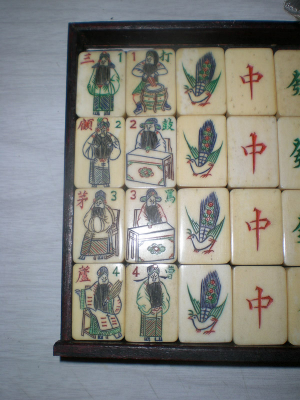
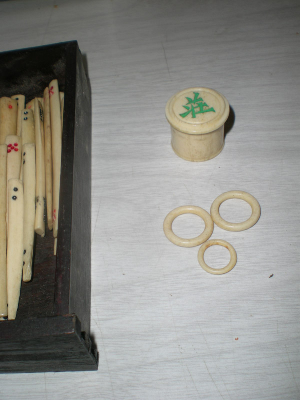
>Your site is terrific and very informative! I've got a 1920's (box/front panel/drawer type) bone and bamboo mahjong set that came with unusual flower and season tiles- Are these the scholars mentioned on your site? The set also included three bone rings in with the wind direction indicator disks and holder. Any idea what these rings might be? They are bone like the rest of the set. Here are links to the photos:
>Here are the flower and season tiles:
>Here are the "mystery rings"
>Any thoughts on these?
>Thanks,
>Claire
Hi Claire, you wrote:
Are these the scholars mentioned on your site?
Sure looks like it to me. If you want to know more about those personages, see those books listed in FAQs 3 and 7e. I haven't studied up on them myself.
Any idea what these rings might be?
Nope. Sorry.
May the tiles be with you.
Tom Sloper
Author of "The Red Dragon & The West Wind," the definitive book on Mah-Jongg East & West.
Los Angeles, CA (USA)
January 17, 2010
What are they made of?
>From: Frank
>Sent: Saturday, January 16, 2010 9:30 AM
>Subject: Mah Jongg Q & A
>Dear Tom,
>I am a budding Mah Jongg enthusiast here in NYC. I have your book, and have found it to be really helpful in learning the game..Thanks for being there. My question: I have been given a gift of a beautiful mah jongg set made in Italy by Dal Negro Company. The tiles have a very nice feel and are superbly crafted. Would you know what material they might be made from. They are ivory colored, and alomost have the feel of ceramic. I thought perhaps you might be familiar with that company.
>Thanks,
>Frank from NYC
Hi Frank,
That's great that you have my book! \(^_^)/
Your saying that your tiles seem "ceramic" sounds very much like one of the plastics I described in Frequently Asked Question #7c3, the Plastics FAQ. Please scroll up and look for the blue and yellow flashing arrow, emblazoned "READ 1ST," like this ). Find the link to FAQ #7c3 and click it. Then search the page for the word "ceramic." Polystyrene, maybe? I don't remember exactly (one of the reasons I wrote the FAQs is so I wouldn't have to remember).
Tom Sloper
Author of "The Red Dragon & The West Wind," the definitive book on Mah-Jongg East & West.
Los Angeles, CA (USA)
January 16, 2010
Mysterious black specks
>From: "Judith
>Sent: Friday, January 15, 2010 7:02 PM
>Subject: Mah-Jongg Q+A
>> My mah-jongg question or comment is A member of my mah jongg group
>> has a fairly new set (about one year old). All the tiles appear to
>> have black speck marks on them. She has tried to wash them but the
>> specks reappear.
>> It does not look like ordinary grime that you would normally see on
>> a set. Any thoughts? We live in Florida. Could it possibly be some
>> sort of mold? HELP!
Hi Judith,
So you're saying that the black specks were not on the tiles before, and they do wash off, but then they come back? If they come back, do they come back in the exact same places?
I never heard of this particular affliction. What I know about tile care and cleaning is all in FAQ 7o.
I think I might have a set that has fine black specks on it -- it's part of the tiles, the way they always looked and always will.
If your friend can remember where she bought the set, maybe she could contact the seller and inquire about the specks.
Tom Sloper
Author of "The Red Dragon & The West Wind," the definitive book on Mah-Jongg East & West.
Los Angeles, CA (USA)
The Ides of January, 2010
Frequently Asked Question 19G(2). PS, I think you're great!
>From: Jody
>Sent: Friday, January 15, 2010 1:46 PM
>Subject: Mah-Jongg Q+A
>My mah-jongg question or comment is: one player has three 7 bams and a joker exposed for a kong. Another player discards a 7 bam. May the player w/ the exposure call the 7 bam and exchange it for the joker in her kong?
>Thanks-
>I think you’re great!
>Jody
Hi Jody,
Thanks so much for the compliment!
You have asked Frequently Asked Question #19G(2).
Please scroll up and look for the blue and yellow flashing arrow, emblazoned "READ 1ST," like this ). Find the link to FAQ #19 (it's marked with a red, white, and blue flashing arrow, emblazoned "AMERICAN," like this ) and click it.
After you've landed at the FAQ 19 page, please bookmark it so you can easily return to it anytime you have a mah-jongg question. Answers to all of the most frequently-asked questions about American (NMJL) mah-jongg are found in FAQ 19. Please always check the FAQs first, before asking a question. Thanks!
May the tiles be with you.
Tom Sloper
Author of "The Red Dragon & The West Wind," the definitive book on Mah-Jongg East & West.
Los Angeles, CA (USA)
The Ides of January, 2010
Jokerlessness and the alternate AMJA card
>From: Robert Betty [LAST NAME DELETED]
>Sent: Wednesday, January 13, 2010 7:58 AM
>Subject: American Mah Jongg
>In recent years some of the combinations on the American [Mah-Jongg Association] card call for Jokers to be used in the combinations. EX: Under Lauren's Fine there are two combinations that call for Jokers. Also, there are hands that require jokers to make the combination, such as the quints and the 6 X 8 hands. Question: If the player Mah Jonggs on these hands and only uses Jokers where they are required, does she get to double her points? We are an open club at the Senior Center. Anyone can come in to play with us. Since we have a diverse group of players, we teach and play by tournament rules and do not allow table rules for obvious reasons. We have some ladies who have been doubling points and others who have not been doubling points ..... going strictly by the instructions on the back of the card that says jokerless hand...It appears that those hands in question have a higher point score, so maybe it has been factored in already..What is the correct tournament ruling on this? In the last couple of years there seems to be more and more questions about the card(s) by experienced players. We are about to have a tournament and need this info before we make up the rules sheet. Thank you, Betty [LAST NAME DELETED], [HOMETOWN DELETED]
Hi Betty, you wrote:
In recent years some of the [hands] on the [AMJA] card call for [pairs made of] Jokers
Actually, it's not only in recent years. That's been a differentiating feature of the AMJA card since 2000 when the Association was created.
Also, there are hands that require jokers to make the combination, such as the quints and the 6 X 8 hands.
THAT is NOT a point of differentiation from the NMJL card. In fact, somebody asked your question about the NMJL card (not the AMJA card) just recently. You can scroll down and read "Can jokers be used in a jokerless hand?"
From: Robert Betty (OH! That's YOU!) on Tuesday, December 29. Did you not read that reply? You're a return visitor, so you shouldn't expect a notification whenever one of your questions is answered here.
It appears that those hands in question have a higher point score, so maybe it has been factored in already.
Point value is a factor of difficulty. An AMJA hand requiring a joker pair is inherently harder to make, so is worth more. A quint hand or a math hand requiring 5 of a kind (or a 2009 hand requiring six zeroes) -- whether AMJA or NMJL -- is inherently harder to make and is worth more. It doesn't have anything to do with whether or not it can be jokerless.
What is the correct tournament ruling on [whether "jokerless" status can be used in these special hands]?
There are two different questions you're asking here.
 The matter of the "jokerless" question in quint hands (and in any hand that requires more than four of a particular tile, like a math hand or a 2009 hand requiring two pungs of zeroes) is a matter that applies to both the NMJL and AMJA cards (and also, presumably, the Marvelous Mah Jongg card), and I already answered this question for you on December 29. However, I am not the authority on this. The NMJL is. You can get a definitive official answer if you send a self-addressed stamped envelope to the National Mah Jongg League, 250 West 57th Street, NY NY 10107. I strongly recommend that you get the answer in writing, not over the telephone. I do not recommend that you include the information that you're playing the AMJA card and not the NMJL card (or that you mention the issue of joker pairs)! The matter of the "jokerless" question in quint hands (and in any hand that requires more than four of a particular tile, like a math hand or a 2009 hand requiring two pungs of zeroes) is a matter that applies to both the NMJL and AMJA cards (and also, presumably, the Marvelous Mah Jongg card), and I already answered this question for you on December 29. However, I am not the authority on this. The NMJL is. You can get a definitive official answer if you send a self-addressed stamped envelope to the National Mah Jongg League, 250 West 57th Street, NY NY 10107. I strongly recommend that you get the answer in writing, not over the telephone. I do not recommend that you include the information that you're playing the AMJA card and not the NMJL card (or that you mention the issue of joker pairs)!
 The matter of joker pairs (a matter that is specific to the AMJA card only) can really only be answered by the AMJA. I did ask this question of the AMJA back in 2000 but I'm not 100% certain that I remember the answer correctly. But by applying the same reasoning that the NMJL uses in number 1 above, I'd guess that the logical answer is no -- that you can't count a hand as jokerless if its only jokers are in the required joker pair (assuming that my understanding of the NMJL jokerless quint rule is correct). But the only way to get the official answer would be by writing to the American Mah-Jongg Association, 8605 Snowreath Ct. LL, Baltimore, MD 21208. I recommend you get the answer in writing, not over the phone. The matter of joker pairs (a matter that is specific to the AMJA card only) can really only be answered by the AMJA. I did ask this question of the AMJA back in 2000 but I'm not 100% certain that I remember the answer correctly. But by applying the same reasoning that the NMJL uses in number 1 above, I'd guess that the logical answer is no -- that you can't count a hand as jokerless if its only jokers are in the required joker pair (assuming that my understanding of the NMJL jokerless quint rule is correct). But the only way to get the official answer would be by writing to the American Mah-Jongg Association, 8605 Snowreath Ct. LL, Baltimore, MD 21208. I recommend you get the answer in writing, not over the phone.
May the tiles be with you.
Tom Sloper
Author of "The Red Dragon & The West Wind," the definitive book on Mah-Jongg East & West.
Los Angeles, CA (USA)
January 13, 2010
Of death and tournaments
>From: Chris
>Sent: Tue, January 12, 2010 11:09:45 AM
>Subject: Mah-Jongg Q+A
>My mah-jongg question or comment is:
>Are there styles of mahjong that both allow for chows and for dead hands where the player stops playing? (I know MCR players have to play, and American doesn't allow for chows.) If so, can the person after the now-dead hand claim for chow from their new upper seat, or do they just have to suffer the penalty of not being able to chow?
>If you were running a tournament, and had a shortage of players so the last table wasn't full, what rules would you institute to try to be fair to those players and to everyone else? Would it depend on the style of play?
>In your experience, what happens in tournaments if someone is called away and cannot continue, for the rest of the hand, the rest of the round and the rest of the tournament? Would you change anything to try to be more fair?
>Thanks,
>Chris
Hi Chris, you wrote:
Are there styles of mahjong that both allow for chows and for dead hands where the player stops playing?
I don't know of any variant that has a death penalty like the rule used in American mah-jongg. If anyone hears of one, I'd appreciate the information.
If you were running a tournament, and had a shortage of players so the last table wasn't full, what rules would you institute to try to be fair to those players and to everyone else? Would it depend on the style of play?
It would likely depend on that and also the purpose of the tournament, and other things. I have never organized a tournament myself, and if I did, then I would definitely need to come up with a plan (in advance) for how to handle this. I would probably need extra tournament personnel available, to sit in the empty seat and play (not to compete but to give the players a full table).
In your experience, what happens in tournaments if someone is called away and cannot continue, for the rest of the hand, the rest of the round and the rest of the tournament?
Although I have attended tournaments in which a player dropped out, I don't know what the organizer(s) did. I assume the same answer to your previous question would kick in.
May the tiles be with you, Chris.
Tom Sloper
Author of "The Red Dragon & The West Wind," the definitive book on Mah-Jongg East & West.
Los Angeles, CA (USA)
December 12, 2009
Change of heart (FAQ 19AM)
>From: lcculp
>Sent: Monday, January 11, 2010 7:34 PM
>Subject: (No Subject)
>When a tile has been discarded, and a player says "call" (as opposed to "thinking"), is she required to rack it, or can she change her mind.
Hello lccupl,
Welcome to my website. You have asked Frequently Asked Question #19AM.
Please scroll up and look for the blue and yellow flashing arrow, emblazoned "READ 1ST," like this ). Find the link to FAQ #19 (it's marked with a red, white, and blue flashing arrow, emblazoned "AMERICAN," like this ) and click it.
After you've landed at the FAQ 19 page, please bookmark it so you can easily return to it anytime you have a mah-jongg question. Answers to all of the most frequently-asked questions about American (NMJL) mah-jongg are found in FAQ 19. Please always check the FAQs first, before asking a question. Thanks!
May the tiles be with you.
Tom Sloper
Author of "The Red Dragon & The West Wind," the definitive book on Mah-Jongg East & West.
Los Angeles, CA (USA)
01/11/10
Oopsie! Now what?
>From: Lynn
>Sent: Saturday, January 09, 2010 3:48 PM
>Subject: Mah-Jongg Q+A
>My mah-jongg question or comment is:
>I called a discard of 5crak to add to my 5 crak and joker already in my hand and as I displayed the 3 tiles I called MJ but realized I only had 3 9 craks instead of 4. Right away the next player claimed my joker from the 5 crak suit before I had even discarded. I said she couldn't take that joker since it was dead. I also question that since I had NOT yet discarded (the window of opportunity was open) when I realized I had too few tiles to call MJ, could I have reracked the few tiles that I had exposed (I had not exposed all my tiles) and continued playing maybe using the exposed 3 5 craks for another hand or eventually getting the other 9 crak since no one had seen those tiles? Lynn
Hi Lynn, you wrote:
Right away the next player claimed my joker from the 5 crak suit before I had even discarded.
Oopsie! That lady needs a copy of the official rules! Or at least she needs to read the back of the card.
I said she couldn't take that joker since it was dead.
Oopsie! No, that's not why she can't have that joker. She can't take that joker because it's not her turn -- she doesn't have 14 tiles in her hand. You do, though, because it's your turn. Read the back of the card. And read FAQ 19M. The FAQs are above left.
could I have reracked the few tiles that I had exposed
No. Once you have exposed tiles from your hand, you have committed to making that exposure. Read FAQ 19AM.
and continued playing maybe using the exposed 3 5 craks for another hand
Yes. That's what you would have to do. The hand isn't dead (the 5C pung is not an instant death exposure).
or eventually getting the other 9 crak since no one had seen those tiles?
You can go for any hand that needs a 5C pung. You have complete freedom to play the hand any way you'd like, since you are not dead.
May the tiles be with you.
Tom Sloper
Author of "The Red Dragon & The West Wind," the definitive book on Mah-Jongg East & West.
Los Angeles, CA (USA)
January 9, 2010
Blind pass vs. courtesy pass vs. stealing
>From: Gracie
>Sent: Thursday, January 07, 2010 2:01 PM
>Subject: Mah-Jongg Q+A
>My mah-jongg question or comment is: Could you please explain the difference between the “blind pass” and the “courtesy pass:” as noted in the instructions concerning the Charleston directions. We have always referred to the last pass as a “courtesy” pass but not as a “blind” pass. This question was raised by a member who was also questioning when “stealing” was allowed, and was not convinced that our answer of “first left and last right” (of the Charleston) was correct.
>Thank you,
>Gracie
Hi Gracie,
Please scroll up and look for the blue and yellow flashing arrow, emblazoned "READ 1ST," like this ). Find the link to FAQ #19 (it's marked with a red, white, and blue flashing arrow, emblazoned "AMERICAN," like this ) and click it.
After you've landed at the FAQ 19 page, please bookmark it so you can easily return to it anytime you have a mah-jongg question. Answers to all of the most frequently-asked questions about American (NMJL) mah-jongg are found in FAQ 19.
FAQ 19AG - The various steps of the Charleston explained
FAQ 19AH - Courtesy pass explained
FAQ 19AW - Blind Pass explained
Column 353 - "Stealing" defined
Please always check the FAQs first, before asking a question. Thanks!
Oh, wait. I just noticed that you said you have a Doubting Thomasina in your group. You could always print those FAQs for her, or buy my book for her, or just have her read the back of the card. And she can always send a stamped self-addressed envelope to the League with her question. The address is on the card.
May the tiles be with you.
Tom Sloper
Author of "The Red Dragon & The West Wind," the definitive book on Mah-Jongg East & West.
Los Angeles, CA (USA)
January 7, 2010
Where to buy a mahjong set? (Frequently Asked Question #7k)
>From: imbuzz
>Sent: Wednesday, January 06, 2010 7:05 AM
>Subject: Chinese Mahjong Set Info?
>Hi Tom,
>I found your contact info here: http://www.sloperama.com/majexchange/links.htm
>I was wondering if you could suggest a good place to purchase a HK/Classical Chinese set? I don't really have a preference of plastic or bone as long as the tiles feel good and aren't too small. I live in Ellington, CT and I don't see anything in shops around here, so I'm guessing I'll have to go online.
>I'm new to the game, but I've seen it played before, specifically the Chinese and Japanese versions. I really don't like the American version (although I'm born and raised here), as I don't like the idea of those cards that come out each year defining new sets of winning hands. I first found out about the game from Scott Nicholson in his video on Chinese Mahjong.
>http://www.youtube.com/watch?v=ooY4Ylz0WNQ
>I found an online site called MahjongTime (http://mahjongtime.com/index.aspx) which is fine, but I'd like to find a real set to play with friends at home. I found this video about the 2007 World Championship and it seems like these tiles are a nice size, and I guess they are the "official" size. What I can find online however, are smaller than those dimensions.
>Any help would be appreciated!
>Thanks,
>Buzz
Hi Buzz,
You are correct that you'll have to buy it online. But there is no one "official" size. I played in the 2007 Championship (you can link to my photos of the 2007 WMJC above left). The tiles used in that event were larger than the usual tiles used by American players (they were a little larger than the tiles used in the European championship that year).
Please read my Frequently Asked Question #s 7a, 7k, & 4a. Please scroll up and look for the blue and yellow flashing arrow, emblazoned "READ 1ST," like this ). After you've looked at that information, if you have follow-up questions, you're welcome to ask them.
May the tiles be with you.
Tom Sloper
Author of "The Red Dragon & The West Wind," the definitive book on Mah-Jongg East & West.
Los Angeles, CA (USA)
January 6, 2010
Is a hand considered not-jokerless if it previously had a joker in it?
>From: Bob and Laurie
>Sent: Wednesday, January 06, 2010 6:13 AM
>Subject: Mah-Jongg Q+A
>My mah-jongg question or comment is:
>Does this make the hand “jokerless”?
>An exposure was made using a joker and which was claimed by another. Hand subsequently had mahjongg.
>The question came up because a lady said that once you expose with a joker, you cannot claim your hand jokerless.
>Thank you.
>Laurie
Hi Laurie,
That used to be the rule, but it's not anymore. While it's not bad to know the history of the rules, it's most important to be up on the current rules. You should buy a copy of my book for your friend. (^_^)
May the tiles be with you.
Tom Sloper
Author of "The Red Dragon & The West Wind," the definitive book on Mah-Jongg East & West.
Los Angeles, CA (USA)
January 6, 2010
Is having no naturals always OK in a pung, or is there a codicil to the rule?
>From: Jean
>Sent: Wednesday, January 06, 2010 8:07 AM
>Subject: Mah-Jongg Q+A
>My mah-jongg question or comment is: Ann has exposed three “2-dots”. The fourth “2-dot” has already been discarded and is on the table. Beth needs three “2-dots” for mahjongg, and has three jokers. Can she use them for the three dots? We know you can use three jokers and no natural tiles for a pung, but wondered if this was allowed if the actual natural tiles are already exposed.
>Thanks,
>Jean
Hi Jean, your question is:
We know you can use three jokers and no natural tiles for a pung, but wondered if this was allowed if the actual natural tiles are already exposed.
The thing you know is correct (that you can have a pung containing no natural tiles), so Beth is fine.
The thing you wonder (whether there's a special exception to the natural pung rule) is not correct. You can stop wondering. Beth is good to go with her all-joker pung. Period. Even if it's a Tuesday, even if the moon is full, even if the two-dots are dancing a jig, and even if there are peanut butter sandwiches on the side table.
May the tiles be with you.
Tom Sloper
Author of "The Red Dragon & The West Wind," the definitive book on Mah-Jongg East & West.
Los Angeles, CA (USA)
January 6, 2010
Melds order, part 2
>From: Anne
>Sent: Tuesday, January 05, 2010 5:43 PM
>Subject: RE: Mah-Jongg Q+A
>Thank you!
I love thank-you's! (^_^)
Tom Sloper
Author of "The Red Dragon & The West Wind," the definitive book on Mah-Jongg East & West.
Los Angeles, CA (USA)
January 5, 2010
Melds order
>From: Anne
>Sent: Tuesday, January 05, 2010 1:19 PM
>Subject: Mah-Jongg Q+A
>My mah-jongg question or comment is:
>When several chows, pungs or kongs are exposed, must the exposure be arranged in the order of the hand they are playing, or can they be "out of order" to confuse opponents?
Hi Anne,
I've never had anybody ask this about Asian mahjong before. It's a Frequently Asked Question about American-style mahjong, though, so I do have an FAQ on that. You can go to FAQ 19Z and get the American answer -- it also applies to Asian mahjong (or any form of mahjong).
When you see the phrase "card order" just change that to "hand order" in your mind, and it'll make perfect sense.
You can link to FAQ 19 above left.
May the tiles be with you.
Tom Sloper
Author of "The Red Dragon & The West Wind," the definitive book on Mah-Jongg East & West.
Los Angeles, CA (USA)
January 5, 2010
Why won't the computer let me win? (Frequently Asked Question #25)
>From: Nancy
>Sent: Saturday, January 02, 2010 7:26 PM
>Subject: Mahjong Q&A
>I would be pleased if you could answer this question on Japanese Mahjong...I have been playing it over the internet.
>When I think I have a winning hand and the winning tile comes up, showing "ron or tusmo" it then comes up "no multiplier".
>Please what does that mean!
>Look forward to your answer
>Nancy
Hi Nancy,
I assume you can read Japanese? I've never seen an English-language game use the word "multiplier" like that. Anyway, I'm guessing that the word actually ought to be "fan" (han) or (more likely) "yaku" or maybe even "dora." And I assume you are asking Frequently Asked Question #25 (I assume you are saying the computer wouldn't let you win on that tile).
Please scroll up and look for the blue and yellow flashing arrow, emblazoned "READ 1ST," like this ). Find the link to FAQ #25 and click it. If that FAQ doesn't answer your question (if I've misunderstood your question) then you're welcome to try asking again, but I'd need more information -- what most players of Japanese mahjong computer games do is make a screen shot at the moment that the game won't let you have a tile. That way I could see if you have no yaku or dora, or (even worse) you have furiten.
May the tiles be with you.
Tom Sloper
Author of "The Red Dragon & The West Wind," the definitive book on Mah-Jongg East & West.
Los Angeles, CA (USA)
0102 / 2010 <-- Palindromic date, thank goodness somebody asked a question today!
This is a great discovery!
>From: Jimi
>Sent: Thu, December 31, 2009 5:10:27 PM
>Subject: Mah-Jongg Q+A
>My mah-jongg question or comment is:
>This is so very cool. Your book has been my guide while trying to learn American and Chinese Mah Jong; but now looking at all your FAQ, I can introduce my friends to Chinese mah jong via your simple rules.
>I totally enjoy the humor you bring to your postings. In China, this is a very fun game; for my American friends, well we wrinkle our brows way too much.
>Thank you. This is a great discovery!
>Jimi
Cool, Jimi!
Happy New Year!
May the tiles be with you.
Tom Sloper
Author of "The Red Dragon & The West Wind," the definitive book on Mah-Jongg East & West.
Los Angeles, CA (USA)
December 31, 2009 - 22 minutes to midnight
Can jokers be used in a jokerless hand?
>From: Robert Betty
>Sent: Tuesday, December 29, 2009 11:14 AM
>Subject: Re: question
>A question about the 3rd and 4th lines under Winds - Dragons on the National Card..... We had a player who had no jokers except the two jokers that she needed to make 2 pungs of the same number. Should she receive double points even tho the back of the card states 'jokerless hand' receives bonus points? There are hands on the American Card that require jokers....they pay more than the other hands....but if the only jokers used are those that are required in the hand, is this considered a jokerless hand for point purposes? Thank you....Betty [LAST NAME DELETED], [HOMETOWN DELETED] . PS: We play at a Senior Center w/ any players who want to play w/ us....so we try to adhere to Tournament rules to keep down confusion.....no table rules.
Hi Robert Betty, you asked:
if the only jokers used are those that are required in the hand, is this considered a jokerless hand
No. The "jokerless" rule is very simple and does not contain any quirky loopholes like that. "Jokerless" means "no jokers." Period.
May the tiles be with you.
Tom Sloper
Author of "The Red Dragon & The West Wind," the definitive book on Mah-Jongg East & West.
Los Angeles, CA (USA)
December 29, 2009
Museum-quality Duke/Marshal/Marquis/Premier set, part 9
From: "Peter
Sent: Tuesday, December 29, 2009 7:36 AM
Subject: Duke Marquis Marshal Premier set
> Dear Tom,
> Thanks for posting your comments on the 17th December and Michael Stanwick's
> on the 18th. In this email I will try to deal with points left outstanding.
> (1) I am pleased that it is not unusual to have 16 picture tiles in a set
> and that Michael feels all the mah jong tiles are likely to come from the
> same set. The more I look at these tiles, the more it seems to me that the
> western numerals have been added in a pretty amateurish manner. My guess is
> that when the set left the manufacturer, no tile bore a western numeral
> (2) You asked me to clarify which surfaces I meant when I referred to top
> surfaces being curved. I was referring to the faces of the tiles and attach
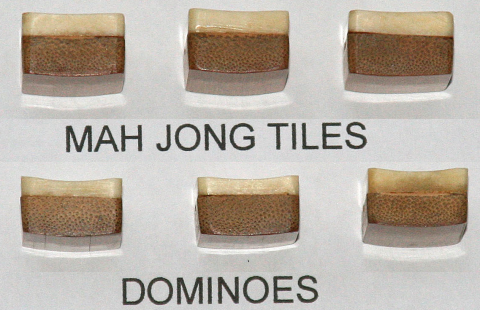
> a photo (rather a poor one, I'm afraid, because of the flash but I hope
> clear enough for present purposes) showing the ends of some mah jong tiles
> and some domino tiles, all picked out at random. You will see that, in all
> cases there is a slight curvature of the bamboo bases, perhaps slightly more
> pronounced in the mah jong tiles than the dominoes. I had assumed that
> curvature of bamboo bases was normal. There is slight curvature of the
> faces of the mah jong tiles but you can see this is more pronounced in the
> case of the dominoes
> (3) Michael asked where I acquired the set. I bought it only a few months
> ago in the UK.
> I really am most grateful to you and Michael for all your help in
> identifying the set. Having bought it in complete ignorance, (your response
> to my original posting was a total surprise), I have found the comments very
> helpful, and extremely interesting and now have a much better understanding
> of my set. I shall remain a regular visitor to your bulletin board. The
> only remaining problem, in view of what I have learned, is whether I now
> dare play with the set!
> Best regards
> Peter
Hi Peter,
I think it's okay to play with the set. (^_^) And this new info doesn't change my previous assessment of the set. Can't speak for Michael, of course.
May the tiles be with you in the new year.
Tom Sloper
Author of "The Red Dragon & The West Wind," the definitive book on Mah-Jongg East & West.
Los Angeles, CA (USA)
December 29, 2009
Why was mahjong revived just after the Cultural Revolution, part 2
>From: jefferson
>Sent: Monday, December 28, 2009 7:26 PM
>Subject: Mah-Jongg Q A
>My mah-jongg question or comment is:
>Thanks for the prompt response.
>Apologies for the ambiguity, I meant that mahjong was revived in the late 1970's. The sites I consulted stated that mahjong was revived during the Cultural Revolution (1966-1976 as you say). However I asked my dad who lived in China at the time and he told me that this isn't true, and that it was in the late 1970's when it was revived.
>Cheers, Jeff
Hi Jeff,
One person's experience of a trend (which is what we're talking about here, as opposed to a solitary event) inevitably differs from the experiences of others.
That said, I doubt that many people would have been willing to incur the wrath of Mao and play outlawed mahjong while intense vigilance and tattling was the rule of the day.
May the tiles be with you.
Tom Sloper
Author of "The Red Dragon & The West Wind," the definitive book on Mah-Jongg East & West.
Los Angeles, CA (USA)
December 28, 2009
Why was mahjong revived just after the Cultural Revolution
>From: jefferson
>Sent: Monday, December 28, 2009 2:01 AM
>Subject: Mah-Jongg Q A
>My mah-jongg question or comment is:
>Hi, I have been searching on the Internet for several days and I haven't been able to find a satisfactory answer to this question - Why was mahjong revived just after the Cultural Revolution in the late 1970's even though it was banned at the time?
>Thanks, Jeff
Hi Jeff, you wrote:
mahjong [was] revived just after the Cultural Revolution in the late 1970's
Interesting. I never heard this before. What's your source of information? In your days-long search, did you find any sites that discuss a mahjong revival in China during the late 1970's? I wasn't sure if you were saying that the revival occurred during the late seventies or that's when the cultural revolution occurred. So I searched just now and found a Harvard page that says the cultural revolution lasted from 1966 to 1976, and I gather you're saying that this revival occurred between 1976 and 1980.
Why...?
Beats me. I can only guess. And my guess would be that mahjong never died -- that it stayed popular as a banned activity, that it just went underground.
And if mahjong came aboveground during the late 1970's, as you say, that it did so because it could. Because now the pressures keeping it underground were released.
In my limited China mahjong experience, the game still had a stigma attached to it as late as 2002. Even today, it bears an odor due to its primarily being used as a gambling activity. The creators of the Mahjong Competition Rules (MCR) in the late 1990's took great pains to position the rules as non-gambling rules to be used for competition purposes only.
Today mahjong is played a bit more openly, but that's something that has been growing over the past decade... as far as I can tell.
I have always held that although the game was made illegal under Mao's rule, it was impossible to kill. A long time ago, I even said that the government finally (in the 1990's) realized that they couldn't kill mahjong, so the MCR was created from the proposition, "if you can't beat'em, join'em." That claim was based on the possibly flawed notion that the MCR creators were aligned with the government. I'd heard that the rules were created under an effort through the sports ministry or something. Or maybe I just assumed it since the MCR was originally published by the "People's Sports Publishing House."
You could go through http://www.chinamajiang.com and see if the history of the creation of the rules is given there. Many parts of the site have not been translated into English, so if you can read Chinese you might find information that isn't available to non-readers of Chinese. But note that the original creators of the MCR have broken up into two factions -- Chinamajiang.com is controlled by the larger group, and the smaller group might also have an online presence somewhere.
Two other places worth checking out are the museum in Ningbo and the new one in Chengdu. You might find information related to your search there.
May the tiles be with you.
Tom Sloper
Author of "The Red Dragon & The West Wind," the definitive book on Mah-Jongg East & West.
Los Angeles, CA (USA)
December 28, 2009
If I'm playing a concealed hand... part 2
>From: LARRY
>Sent: Thursday, November 19, 2009 1:56 PM
>Received: Friday, December 25, 2009 6:55 AM
>Subject: Mah-Jongg Q+A
>My mah-jongg question or comment is:
My mah-jongg response is:
Ain't it amazing how a 5-week-old email showed up in my inbox today. I hope you found your answer last November. Scroll down, if you hadn't yet. It's entitled "If I'm playing a concealed hand..." and it's blue.
Merry Christmas, by the way. May the tiles be with you.
Tom Sloper
Author of "The Red Dragon & The West Wind," the definitive book on Mah-Jongg East & West.
Los Angeles, CA (USA)
Christmas Day, 2009
Museum-quality Duke/Marshal/Marquis/Premier set (was "mystery tiles"), part 8
>From: Michael Stanwick
>Sent: Friday, December 18, 2009 4:13 AM
>Subject: Re: Mah-Jongg Q+A
>Peter wrote:
>>> sadly I have not
>>> been able to find over here any publicly available copy of the Illustrated
>>> Book of the Mah-Jongg Museum which, in view of all the references to it,
>>> is a shame.
>
>This is not unexpected. It is, to my knowledge, not available any more (But see end of this reply for an alternative!). I obtained my copy from one of the Museums researchers who I was in contact with at the time.
>Further, I have written five articles on the subject of Mahjong - all in the Playing-card. The relevant ones for this occasion would be 'Mahjong(g), before and after Mahjong(g): Part 2' in; The Playing-Card, Volume 35, Number 1., and 'Flowers and Kings: A Hypothesis of their function in early ma que' in; The Playing-card, Volume 37, Number 1.
>
>>> If the tiles and the box are
>>> not contemporary, there seems to be no evident way of showing whether the
>>> current box contained all the same tiles as were in the previous container
>>> or whether it was newly made to contain tiles that came from different
>>> sources.
>
>I would agree with Tom's comments. I do not think the box is original to the tile set.
>
>>> Now to the mah jong tiles themselves. As I have not been able to find any
>>> Schreger lines, I would guess that they are of bone but of good quality
>>> since there are relatively few Haversian marks, particularly on the
>>> picture tiles.
>
>Actually, quite a few of the tiles show the presence of the Haversian System and so are clearly bone. Further, there is also the presence of fat staining - clearly evident in the pics showing the tiles on their sides. This may come about through incomplete boiling of the bone to remove the fat and also it may be due to the bone has been taken from very close to the marrow. These two observations suggest to me that the bone is of good/poor quality.
>
>>> The engraving appears to be very fine - clean, crisp and
>>> confident - particularly on the picture tiles. The engraving would seem to have been
>>> done by hand as there are minor differences between 'identical' tiles.
>>> The tiles measure 23mm long x 19mm wide x 11mm high. Michael Stanwick has
>>> asked for a photo of the tiles on their sides so that he can compare the
>>> dovetailing and the next two photos show this.
>
>Yes, the MJ tiles are hand engraved. IMO, they are all from the same set. I base this observation on the dimensions of the dovetail - the width of the dovetail neck and the width of its widest part plus the length of its two sides. There is bound to be slight variation of course but no gross variation in their dimensions.
>
>>> It will be seen from the photo of
>>> these that eight tiles (those in the first two columns) carry western numerals
>>> but the tiles in the third and fourth columns don't. It was for this reason
>>> that I separated the two sets of eight tiles in an earlier posting. I was
>>> puzzled as to why only the eight tiles in the first two columns out of the
>>> total of 186 in the box should contain western numerals.
>
>There can be many reasons for this. Obviously, tile sets for the Chinese market did not require arabic numerals or English letters.
>IMO, the set was intended for Chinese consumption.
>Was the tile set acquired outside of China and if so, where?
>The position of the numerals on each tile is somewhat disturbing. The engravers/manufacturers of exported sets were very careful to place the sinogram and the arabic numerals in identical postions on each tile in each set of four. However, in this set, those two sets of four tiles that have numbers, the numbers are not in identical positions on some tiles in each of the two sets of four. Coupled with the engraving style, I think there are good grounds for thinking that the numbers were added later.
>IMO, when adding these 8 tiles - but excluding the other Flowers tiles, as shown in one of the pics- turns this set into a conventional tile set conforming to those exported to the West from China.
>Adding the other 8 Flowers tiles enables the player to use the total as sixteen Outer Flowers - these tiles are exposed immediately once obtained(please refer to the 'Flowers and Kings...' article mentioned above).
>
>>> Not having found a copy of the Mah-Jongg Museum book which might possibly
>>> explain it, I wonder why my set contains 16 picture tiles. Their size,
>>> appearance and dovetails would suggest that they come from the same set
>>> but do any historical sets contain as many picture tiles?
>
>As Tom said, yes. In fact, there were bakelite tile sets made in the 30's that contained 16 Flowers tiles. A picture of one of these appears on the covers of the Playing-card, Volume 37, Number1. (July - September 2008).
>
>>> You will see that my set
>>> contains all the 32 required dominoes save only one (the 1-1) which
>>> presumably was lost at some time past. Possibly one of the blank tiles
>>> could have been used instead. The domino tiles are not quite identical in
>>> form to the mah jong tiles, their top surfaces are somewhat more deeply
>>> curved and they are smaller by about 1mm on each of their length, width
>>> and height dimensions.
>
>Excellent. I had noticed that there were discrepencies in the width of their dovetail necks. Even so, the dominoes do not belong to the MJ set in any way.
>However, they may come from the same manufacturer.
>I had noticed straight away that both sets of tiles are concave on there faces. This is a particularly old feature and was noted, by the Japanese MJ Museum, to be a feature of tiles coming out of Suzhou.
>Quite a few of the tiles have part (all all?) oftheir dovetails missing.
>That is rather unusual. I have seen on ebay tile sets purporting to be from the 20's, but clearly very modern and hence are fakes, to have some of the their dovetails missing.
>Hence, for this set, at 1st glance I thought they had taken old tiles, removed the bamboo bases and then rammed the bone into new bamboo bases and in that process, losing a part of the dovetail joint. However, judging from the rest of the tiles, it seems to me that they may have broken off due to the thinness of the bone, the poor quality of some of the bone at its base, plus the delicate form of the dovetail coupled with the bamboo drying out and warping slightly and hence breaking the dovetail off.
>
>This tile set closely resembles the type of symbols found on other Duke, Marquis, Marshal, Premier tile sets and so may be regarded as belong to a 'type' of tile set that has its own conventionalised engravings.
>
>Based on the evidence we have, this tile set could date from between 1915 and 1940.
>
>You may be interested to know that there is a hard cover Japanese MJ Museum book recently published. It has some of the pics from the old book but but covers new ground - that is, it shows the quality of the materials in the Japanese museum, rather than showing the breadth and historical significance of the sets and card games in their possession. Most of the text is in Japanese but the photos of the sets and furniture and boxes are glorious. It has the ISBN 4-8124-2365-1. One web site that has it is http://mah-jongg-shop.de/ Look under Literature.
>Regards
>Michael
What do you do when your hand is complete but not legal? (conclusion)
>From: Helen
>Sent: Thursday, December 17, 2009 6:47 PM
>Subject: RE: Mah-Jongg Q+A
>Thank you for a quick response.
>Regards,
>Helen
You're very welcome, Helen. Happy holidays!
May the tiles be with you.
Tom Sloper
Author of "The Red Dragon & The West Wind," the definitive book on Mah-Jongg East & West.
Los Angeles, CA (USA)
December 17, 2009
What do you do when your hand is complete but not legal?
>From: Helen
>Sent: Thursday, December 17, 2009 1:23 PM
>Subject: Mah-Jongg Q+A
>My mah-jongg question or comment is: Under Australian Rules……What does a player who has a COMPLETED hand do when, under the rules, the player cannot call Out BUT the player’s hand is a completed Mah Jong hand. E.g. The hand is an allowed mixed suit hand BUT the rules says no mixed suits in a winning hand. In other words, we have a COMPLETED hand but not a permitted Winning hand.
Hi Helen,
Ain't that a killer, though? The hand is complete but if you show it, you're screwed.
When this happens, you have the following choices:
Show it and accept the punishment. You know you have to be punished if you do that -- you've already told me so.
Try to rescue the hand -- discard something that will make you closer to a legal hand.
 Play defensively -- discard tiles you believe nobody needs. Play defensively -- discard tiles you believe nobody needs.
Those are your only choices, Helen. And it doesn't matter what rules you're playing. Australian, Japanese, American... the same 3 choices still apply.
May the tiles be with you.
Tom Sloper
Author of "The Red Dragon & The West Wind," the definitive book on Mah-Jongg East & West.
Los Angeles, CA (USA)
December 17, 2009
Museum-quality Duke/Marshal/Marquis/Premier set (was "mystery tiles"), part 7
From: "Peter
Sent: Thursday, December 17, 2009 7:27 AM
Subject: Mah-Jongg Q+A
> Dear Tom,
> Here are some miscellaneous thoughts, and some more photos, on what you have
> termed a museum-quality set. At this stage, I have read the earlier
> postings from you and Michael Stanwick but have not yet been able to do much
> other reading on the subject. I write from the UK and although I have found
> tracked down copies of The Playing Card (for Michael Stanwick's 'Mahjong(g)
> Before Mahjong(g)') and of Eberhard's Dictionary of Chinese Symbols (all of
> which I hope to be able to get hold of during January), sadly I have not
> been able to find over here any publicly available copy of the Illustrated
> Book of the Mah-Jongg Museum which, in view of all the references to it, is
> a shame.
>
> However, let's start at the beginning. When I bought the set, it came in a
> box with four racks. I attach a photo of the exterior of the box. If the
> tiles are antique, it seems to me that the box is unlikely to be
> contemporary with the tiles as it is not like any other old one that I have
> been able to find online and neither the exterior nor the interior seem to
> show the age that one might expect. The same applies to the racks which
> have a finish similar to that of the box. If the tiles and the box are not
> contemporary, there seems to be no evident way of showing whether the
> current box contained all the same tiles as were in the previous container
> or whether it was newly made to contain tiles that came from different
> sources.
>
> The next two photos shows the interior of the box with its fittings in place
> and the box empty but with its fittings separate. You will see that there
> are four trays, three of which are wide and shallow, the fourth (the only
> one with a lid) being narrow and deep. Each of the shallow trays contains
> 48 tiles and the deep one contains 42 tiles. There is no space in any of
> the four trays (or elsewhere in the box) for any more than these 186 tiles.
>
> Finally, just for the sake of completeness, I should add that the box does
> not contain any gaming chips/tallies but does contain three glass dice, four
> card wind discs and one engraved piece of mother of pearl which I imagine
> are of no significance.
>
> Now to the mah jong tiles themselves. As I have not been able to find any
> Schreger lines, I would guess that they are of bone but of good quality
> since there are relatively few Haversian marks, particularly on the picture
> tiles. The engraving appears to be very fine - clean, crisp and confident -
> particularly on the picture tiles. The engraving would seem to have been
> done by hand as there are minor differences between 'identical' tiles. The
> tiles measure 23mm long x 19mm wide x 11mm high. Michael Stanwick has asked
> for a photo of the tiles on their sides so that he can compare the
> dovetailing and the next two photos show this. One photo shows only mah
> jong tiles in 18 rows (the top 4 being the bam tiles, then 4 rows of crak
> tiles, 4 of dot tiles, 2 of the Duke, Marquis, Marshall, Premier tiles, 1 of
> red and green dragons, 1 of blanks, 1 of the unnumbered picture tiles and
> the last of the numbered picture tiles). The next photo shows the same 4
> rows of bam tiles at the top and 4 rows of the domino tiles below.
>
> The set contains 16 picture tiles. It will be seen from the photo of these
> that eight tiles (those in the first two columns) carry western numerals but
> the tiles in the third and fourth columns don't. It was for this reason
> that I separated the two sets of eight tiles in an earlier posting. I was
> puzzled as to why only the eight tiles in the first two columns out of the
> total of 186 in the box should contain western numerals. I then noticed
> that the figure 3 on the tile in the third row of the second column was not
> terribly clear so I examined all of the western numbers under 15x
> magnification. I found that the engraving of the western numerals is not of
> such high quality as that of the characters and designs on the other tiles
> in the set. The 1 in the first column is clear if somewhat simple but the
> numeral on its neighbour is not the same size nor as clear. The 2s are
> different in shape, the 3s are not identical, nor are the 4s. The engraving
> of all the other mah jong tiles in the box is crisp and quite deep and the
> tiles have very largely retained their paint. The engraving of the western
> numerals is less precise and shallower and they are losing their paint. No
> having found a copy of the Mah-Jongg Museum book which might possibly
> explain it, I wonder why my set contains 16 picture tiles. Their size,
> appearance and dovetails would suggest that they come from the same set but
> do any historical sets contain as many picture tiles?
>
> One of the photos with my posting of the 23rd November showed the domino
> tiles from the box. You will see that there are 31 of them. I googled
> "Chinese dominoes" and many results (e.g.
> ) refer to Chinese sets
> having 32 dominoes, the numbers of which differ from western dominoes. This
> confirms Michael Stanwick's latest posting. You will see that my set
> contains all the 32 required dominoes save only one (the 1-1) which
> presumably was lost at some time past. Possibly one of the blank tiles
> could have been used instead. The domino tiles are not quite identical in
> form to the mah jong tiles, their top surfaces are somewhat more deeply
> curved and they are smaller by about 1mm on each of their length, width and
> height dimensions.
> I would be grateful for any more explanations, comments or thoughts that you
> or Michael Stanwick might have.
> With best wishes
> Peter
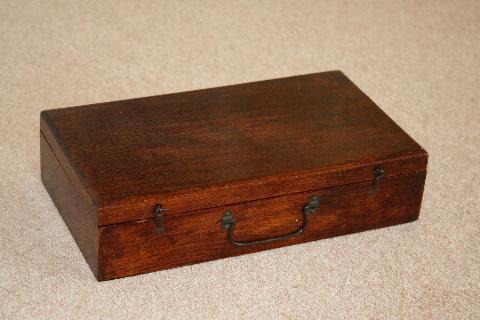
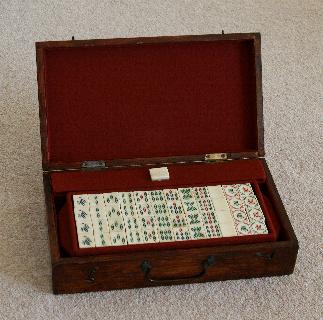
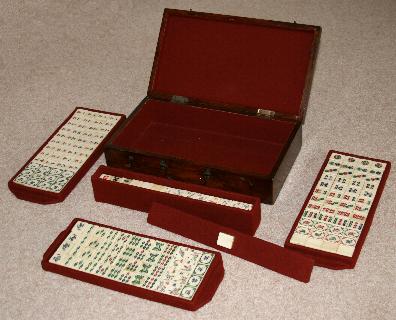
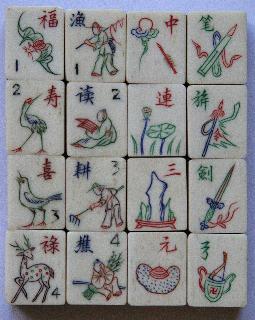
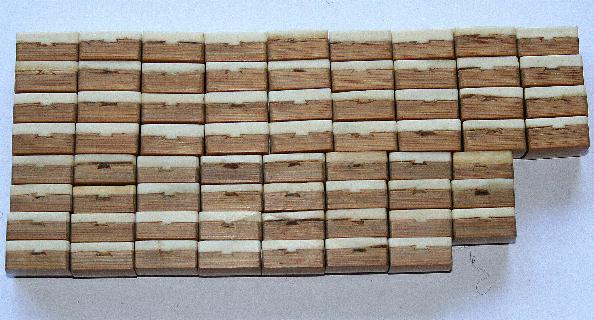
Hi Peter,
My selected comments:
 If the If the
> tiles are antique, it seems to me that the box is unlikely to be
> contemporary with the tiles as it is not like any other old one that I have
> been able to find online and neither the exterior nor the interior seem to
> show the age that one might expect. The same applies to the racks which
> have a finish similar to that of the box. If the tiles and the box are not
> contemporary, there seems to be no evident way of showing whether the
> current box contained all the same tiles as were in the previous container
> or whether it was newly made to contain tiles that came from different
> sources.
 Your thinking seems sound. I can't make any judgment re the racks since I have not seen them. If not only the mahjong tiles but also the dominos all fit snugly in the one box, then it's likely a newly made box since the dominos clearly don't belong in the set. Your thinking seems sound. I can't make any judgment re the racks since I have not seen them. If not only the mahjong tiles but also the dominos all fit snugly in the one box, then it's likely a newly made box since the dominos clearly don't belong in the set.
Finally, just for the sake of completeness, I should add that the box does
> not contain any gaming chips/tallies but does contain three glass dice, four
> card wind discs and one engraved piece of mother of pearl ...
I cannot comment on any of these things sight unseen.
One photo shows only mah
> jong tiles...The next photo shows the same 4
> rows of bam tiles at the top and 4 rows of the domino tiles below.
[Edit] I am only showing the comparative photo above.
The set contains 16 picture tiles. It will be seen from the photo of these
> that eight tiles (those in the first two columns) carry western numerals but
> the tiles in the third and fourth columns don't.
This is not unusual. But the presence of Western indices does call the set's age into question. The Duke/Marquis/Marshal/Premier set in the Mahjong Museum book does not have any Western indices. That set (the one in the book) appears to be from several years before 1920 (and even before 1911). It does seem likely, though, that (as you suggest) the indices on your set were added later by an owner of the set.
I wonder why my set contains 16 picture tiles...
> do any historical sets contain as many picture tiles?
Yes. I thought I mentioned in FAQ 7e that it's not unusual for sets to have varying numbers of flower tiles. The image in FAQ 11e (my "artist's rendition" of the Duke/Marquis set) was inaccurate in showing only 8 flower tiles. The one in the MJM book has 16, some of them looking like yours. I'm amending that image in FAQ 11e today.
their top surfaces are somewhat more deeply
> curved
Is the top surface the face of the tile? And if so, is that curvature concave or convex? (Or are you just referring to the natural convex curvature of the bamboo back?)
May the tiles be with you.
Tom Sloper
Author of "The Red Dragon & The West Wind," the definitive book on Mah-Jongg East & West.
Los Angeles, CA (USA)
December 17, 2009
The MahjongMuseum.com collection is for sale
>From: Jim May
>Sent: Thursday, December 17, 2009 9:43 AM
>Subject: www.mahjongmuseum.com
>Tom,
>Just a note to let you know that I've recently decided to put my mah jong collection up for sale, all items are for sale through my website at www.mahjongmuseum.com if you know anyone that might be interested.
>Thanks, Jim May
We seem to be playing two different NMJL games...?
>From: Theresa
>Sent: Wednesday, December 16, 2009 6:05 PM
>Subject: Mah-Jongg Q+A
>My mah-jongg question or comment is: we have been playing what I believe is the official American version using the NMJL card and your book as the definitive answer guide, as well as the FAQ’s from your site that I downloaded. Recently an elderly lady who plays 6 days a week joined our group and she has us play the game by holding 14 tiles in the rack, discarding first then drawing, she also did some weird thing with not looking at the tile she draws and discarding that or even passing it. Totally confused us but she swears it’s the way to play American mahjongg and she uses the official card. She also said she calls NYC to the national headquarters and they answer her questions thus further “proving” that she is playing American mahjongg. Please help clarify this style of play for us. Thanks!
>Terri
Hi Theresa,
I described her way of playing in my book, on page 121. I also mentioned her way of playing here on my site, in FAQ 19R. The NMJL also mentions her way of playing, on the back of the card -- turn the card over and look at the lower left corner. There you'll see rule #1 written in all capital letters.
Check FAQ 14 again. If you are playing at her house, you should play by her rules. If she is playing at your house, she doesn't get to tell you how to play. If you really want to press the issue, you can send a stamped, self-addressed envelope to the League and ask them if the "future tile" is the proper NMJL rule, then give her the reply.
May the tiles be with you.
Tom Sloper
Author of "The Red Dragon & The West Wind," the definitive book on Mah-Jongg East & West.
Los Angeles, CA (USA)
December 2, 2009
Change of heart (Frequently Asked Question #19AM)
>From: Robert Betty
>Sent: Wednesday, December 16, 2009 1:23 PM
>Subject: question
>When a player calls for a discard, picks up the discard, places it on her rack, then decides she does not need the tile, can she then return the claimed tile to the table? She has not put any of her tiles to the exposure. I have always played that once claimed and placed on your rack, you cannot change your mind. The claim is like a draw from the wall....you cannot take it and then decide you do not want it. However, another player showed me in her rule book under "Change of Mind' an entry that looks as if the player can change her mind even after placing the claimed tile on her rack. We are confused.....which is correct. We both agree that some changes can be made in the exposure before she ends her turn by discarding. But I disagree that she could put the claimed tile back on the table. Please help us on this one. Thank you, Betty
Hi Betty,
Your question for me is:
When a player calls for a discard, picks up the discard, places it on her rack, then decides she does not need the tile, can she then return the claimed tile to the table?
This is Frequently Asked Question 19AM. You're a return visitor. You know where the FAQs are. (Scroll up and look at the left side.)
another player showed me in her rule book under "Change of Mind'
I'm guessing that's MY book, "The Red Dragon & The West Wind." I think my book is the only one that has a section like that.
I have always played [rule X]... However... in her rule book under "Change of Mind' an entry that looks as if [rule Y]. We are confused.....which is correct.
So you're asking me if what I wrote in my book is wrong! (^_^) Well, actually, the NMJL recently came out with a schizophrenic ruling on this precise "change of heart" question. Read FAQ 19AM. I hope you will read it.
May the tiles be with you.
Tom Sloper
Author of "The Red Dragon & The West Wind," the definitive book on Mah-Jongg East & West.
Los Angeles, CA (USA)
December 16, 2009
A teahouse in Sarasota FL where you can play
From: "AsianArtSRQ@aol.com"
Sent: Mon, December 14, 2009 4:28:10 PM
Subject: Find Players/Teachers
Location (city and zip code):
My kind of mah jongg is:
Sarasota, FL
American or any other
We have a Teahouse where you can play and have lunch 6 days a week.
We also teach every wednesday
The Teahouse at Asian Arts
5437 Fruitville Road
Sarasota, FL 34232
941-343-9727
AsianArtSRQ@aol.com
www.AsianArtsTeahouse.com
If a person makes a fatal error, is she dead?
>From: weeziejen
>Sent: Friday, December 11, 2009 1:48 PM
>Subject: Mah Jongg Q&A
>Hi, Tom,
>If a person discards a 9 crack and someone calls for it thinking she said 1 crack and exposes her tiles before realizing her error, is she dead?
>Thanks,
>Louise
Hi Louise,
Please bear with me while I repeat some important general principles already stated in the FAQs. Most of these come from Frequently-Asked Question #9.
If a person makes an error, she is the one who should suffer its consequences, not everybody else at the table. An erring player can ask for, but not demand, a second chance. There is no rule that says, "mistakes must be forgiven by the other players."
When a player makes a mistake that messes up her own hand, and realizes it immediately (before discarding a tile, thus ending her turn), it is not too late to rectify the error. Do it now! (This is not an NMJL rule -- this is just a Tom Sloper principle of fairness.)
When a player makes a mistake that messes up her own hand, and realizes it after discarding, then it's too late, and she must live with the mistake.
 When a player makes a mistake that messes up the game, and it is realized immediately, the mistake must be rectified on the spot. When a player makes a mistake that messes up the game, and it is realized immediately, the mistake must be rectified on the spot.
 When a player makes a mistake that messes up the game, and it is not realized immediately (thus cannot be rectified), sometimes it is best for all players to just throw in their hands and start over. When a player makes a mistake that messes up the game, and it is not realized immediately (thus cannot be rectified), sometimes it is best for all players to just throw in their hands and start over.
 A mistake is committed to (and cannot be taken back) when an action has occurred. Merely voicing an intent to do an action does not commit to the action. Beginning to do an action, without completing the action, probably does not commit to the action - depending on what steps the player has performed (as regards to American mah-jongg, see FAQ 19AM for some specific instances in which a change of heart may or may not be forgiven). Completing an action commits one to that action, and may not be undone (with certain trumping exceptions; see the above). (Note: yes, this is vague. It's not a rule; it's merely a philosophical principle to be considered when contemplating whether or not a mistake can be undone.) A mistake is committed to (and cannot be taken back) when an action has occurred. Merely voicing an intent to do an action does not commit to the action. Beginning to do an action, without completing the action, probably does not commit to the action - depending on what steps the player has performed (as regards to American mah-jongg, see FAQ 19AM for some specific instances in which a change of heart may or may not be forgiven). Completing an action commits one to that action, and may not be undone (with certain trumping exceptions; see the above). (Note: yes, this is vague. It's not a rule; it's merely a philosophical principle to be considered when contemplating whether or not a mistake can be undone.)
 A rule can be trumped by another rule. A rule can be trumped by another rule.
 A rule may be more strictly enforced in a tournament setting than in a "friendly" home game. See FAQ 21. A rule may be more strictly enforced in a tournament setting than in a "friendly" home game. See FAQ 21.
 It is not unusual for a group to make up its own "table rules." See FAQ 14. It is not unusual for a group to make up its own "table rules." See FAQ 14.
Now that I've expounded ad nauseam, let's take a look at your particular question, shall we?
If a person discards a 9 crack and someone calls for it thinking she said 1 crack and exposes her tiles before realizing her error, is she dead?
Who made the error? The person who exposed tiles from her hand. (She who acted without looking at the discard.)
Is this a fatal error? It depends on how strictly you adhere to the rules. Read FAQ 19AM. You know where the FAQs are.
May the tiles be with you.
Tom Sloper
Author of "The Red Dragon & The West Wind," the definitive book on Mah-Jongg East & West.
Los Angeles, CA (USA)
December 11, 2009
A Frequently Asked Question about the NMJL card
>From: DALE
>Sent: Wednesday, December 09, 2009 5:51 PM
>Subject: Mah-Jongg Q+A
>In playing the 1123 can this be called for or is it only for Mah Jongg
>My mah-jongg question or comment is:
Hello Dale,
You can find the answer to this question in "Frequently Asked Question" #16. Please scroll up and look for the blue and yellow flashing arrow, emblazoned "READ 1ST," like this ). Find the link to FAQ #16 (it's marked with a red, white, and blue flashing arrow, emblazoned "AMERICAN," like this ) and click it. Please always check the FAQs first, before asking a question. Thanks!
May the tiles be with you.
Tom Sloper
Author of "The Red Dragon & The West Wind," the definitive book on Mah-Jongg East & West.
Los Angeles, CA (USA)
December 9, 2009
Why do some older sets have 5 racks instead of 4?
>From: "SWisner102
>Sent: Wed, December 9, 2009 7:13:56 AM
>Subject: Mah-Jongg Q+A
>My mah-jongg question or comment is:
>I am wondering why some older sets have 5 racks instead of 4.
>Thanks, Suzan
Hi Suzan,
This question is answered in Frequently Asked Question #7D. Please scroll up and look for the blue and yellow flashing arrow, emblazoned "READ 1ST," like this ). Find the link to FAQ #7d, and click it.
May the tiles be with you.
Tom Sloper
Author of "The Red Dragon & The West Wind," the definitive book on Mah-Jongg East & West.
Los Angeles, CA (USA)
December 9, 2009
Mystery tiles, part 7
>From: Michael Stanwick
>Sent: Friday, December 04, 2009 1:44 PM
>Subject: Re: Museum-quality set on the bulletin board
>Hello Tom.
>On further reflection, the set of 31 domino tiles may also belong to the game of tian jiu. Tian jiu uses a set of 32 dominos.
>Cheers
>Michael
what is the penalty if you Mah Jongg a concealed hand after claiming a discard
>From: Mary Ann
>Sent: Thursday, December 03, 2009 8:06 PM
>Subject: Mah-Jongg Q+A
>My mah-jongg question or comment is: what is the penalty if you Mah Jongg a concealed hand after claiming a discard and all three players realize the error?
Hi Mary Ann,
You will find your answer in Frequently Asked Question #19AA, "Under what circumstances can a player be called 'Dead'?"
Please scroll up and look for the blue and yellow flashing arrow, emblazoned "READ 1ST," like this ). Find the link to FAQ #19 (it's marked with a red, white, and blue flashing arrow, emblazoned "AMERICAN," like this ) and click it.
After you've landed at the FAQ 19 page, please bookmark it so you can easily return to it anytime you have a mah-jongg question. Answers to all of the most frequently-asked questions about American (NMJL) mah-jongg are found in FAQ 19. Please always check the FAQs first, before asking a question. Thanks!
May the tiles be with you.
Tom Sloper
Author of "The Red Dragon & The West Wind," the definitive book on Mah-Jongg East & West.
Los Angeles, CA (USA)
December 3, 2009
What if there's no parenthetical?
>From: Don
>Sent: Thursday, December 03, 2009 7:33 PM
>Subject: Mah-Jongg Q+A
>My mah-jongg question or comment is: Regarding hands 222 44 666 888 888 (any 3 suits, Pung 8s only) and FF 333 666 999 999 (any 3 suits)
>Because the first hand was specific about the 8s, a player thought that in the 3 6 9 hand, because it wasn't specific, they could use any like numbers and used 3s instead of 9s. We called her incorrect. Who is correct? (Don't scold me! I told them I'd ask. )
Hi Don,
You have asked Frequently Asked Question #19AJ: "What if there's no parenthetical?"
Please scroll up and look for the blue and yellow flashing arrow, emblazoned "READ 1ST," like this ). Find the link to FAQ #19 (it's marked with a red, white, and blue flashing arrow, emblazoned "AMERICAN," like this ) and click it.
After you've landed at the FAQ 19 page, please bookmark it so you can easily return to it anytime you have a mah-jongg question. Answers to all of the most frequently-asked questions about American (NMJL) mah-jongg are found in FAQ 19. I'm not scolding! (^_^) Just asking that you please always check the FAQs first, before asking a question, that's all!
May the tiles be with you.
Tom Sloper
Author of "The Red Dragon & The West Wind," the definitive book on Mah-Jongg East & West.
Los Angeles, CA (USA)
December 3, 2009
How much should I ask for this set on eBay, part 2
>From: LARodefeld
>Sent: Thu, December 3, 2009 11:46:14 AM
>Subject: Mah-Jongg Q+A
>My mah-jongg question or comment is:
>Hello Mr. Sloper;
>Thanks for the compliment on the photographsÉI did take them myself (decent digital camera and tripod).
>Anyway, thank you very much for your time and information. I'm actually going to put the set in a local auction (with a 'Reserve' price)
>and see what happens. If that fails, then we may try e-Bay after all.
>Thanks again!
>Lisa J
Hi Lisa,
You're welcome. Lately I've been having second thoughts about my bad habit of being a little snippy to suspected eBay sellers. (^_^)
Anyway... May the tiles be with you.
Tom Sloper
Author of "The Red Dragon & The West Wind," the definitive book on Mah-Jongg East & West.
Los Angeles, CA (USA)
December 3, 2009
Five players
>From: Lauren & Lowell
>Sent: Wed, December 2, 2009 7:28:58 AM
>Subject: Mah-Jongg Q+A
>My mah-jongg question or comment is:
>Besides having one player sit out and bet, is there any way to play with 5 people? Since it is more fun to play than just bet, we were hoping there would be a good solution. Thanks.
Hi Lauren & Lowell,
The only other way I have heard of is for the fifth player to sit out and NOT bet.
May the tiles be with you.
Tom Sloper
Author of "The Red Dragon & The West Wind," the definitive book on Mah-Jongg East & West.
Los Angeles, CA (USA)
December 2, 2009
Mystery tiles, part 6
>From: Michael Stanwick
>Sent: Tue, December 1, 2009 12:45:15 PM
>Subject: Re: Museum-quality set on the bulletin board
>Hello Tom.
>Your poster's tiles read Duke, Marshal, Marquis, Premier.
>The MJM Book reads Duke (gong), Marquis (hou), Marshal/General (jiang), Premier(xiang).
>The eight picture tiles, separated to the right of the tile set, are not from a wa hua domino set. Wa hua is a domino game and it has domino dots on all the tiles. On some of the tiles there are engravings of flowers and other objects in addition to the domino dots.
>The picture of the complete ma que/mahjongg tile set indeed shows us that this set belongs to the Duke, Marquis, Marshall, Premier type of tile set. All the characteristics are there - but I will not go into this at this point.
>One of the set of separated picture tiles to the right of the main tile set are also identical to those in the tile set shown in the Japanese MJ Museum book, so I would be interested to know why your poster has separated them out.
>It would also be useful if he could put all the tiles on their long sides, up against each other so we may see all the dovetail joints.
>Whenever I am asked about a tile set I always ask for this as it tells us if all the tiles are original to the set or not.
>Tiles may look identical when viewed face up and they may have identical bone and bamboo thicknesses - but different dovetail joint dimensions.
>Regards
>Michael
Mystery tiles, part 5
>From: Peter
>Sent: Tue, December 1, 2009 7:13:56 AM
>Subject: Museum quality set
>Dear Tom,
>I attach one photo of the whole set of my tiles and another showing the 1-bam, 1-crak and 1-dot tiles.
>I'll explain in a later email why I've separated the eight picture tiles into a separate set at the top right of the first photo.
>All best
>Peter
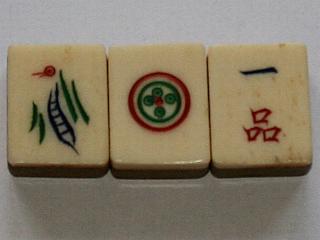
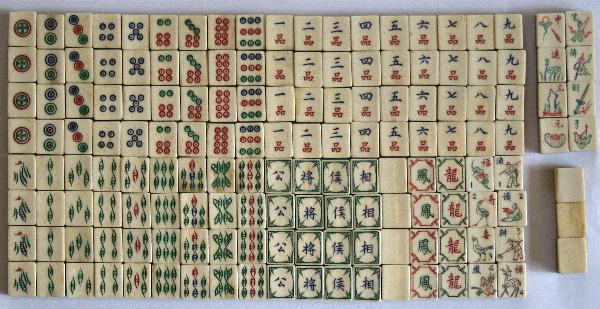
Hi Peter,
It's a beautiful set. Very much like the "famous" Duke, Marquis, Marshal, Premier set shown in the Mahjong Museum book. I assume you've seen the similarity with the illustration in FAQ 11e.
I'm guessing that your reason for separating the 8 flower tiles is that perhaps they are not an exact match for the rest of your set. Maybe they belong to the wa hua set, as Michael suggested. It seems that you have not one, but two museum quality sets of tiles. Congratulations!
May the tiles be with you.
Tom Sloper
Author of "The Red Dragon & The West Wind," the definitive book on Mah-Jongg East & West.
Los Angeles, CA (USA)
December 2, 2009
Color key
Blue = an FAQ, a question that's been asked frequently.
Purple = an angry email from a disgruntled reader.
Green = a happy email from a grateful reader.
Red = a technical support question about a computer game.
Orange = a weird or off-topic email.
Black = none of the above. Regular question or comment.
MORE Q&A!!
 OLDER postings! -- and NEWER ones OLDER postings! -- and NEWER ones 
|


 SITE LINKS


