Web page wider than the monitor
>From: "jackie.b
>Sent: Mon, March 28, 2011 10:57:28 AM
>Subject: Mah-Jongg Q+A
>My mah-jongg question or comment is:
>Hi Tom I love reading your Q & A's but I can no longer read the text without scrolling all the way to the
>right and back all the way to the left. Do you think it's a user problem? Has anyone else complained?
>By the way I did not check the FAQ's. Love your knowledge of the game and especially your insane wonderful sarcasm!!!!
>From: "jackie.b
>Sent: Mon, March 28, 2011 11:03:45 AM
>Subject: Mah-Jongg Q+A
>My mah-jongg question or comment is:
>Hi I opened your site in a different browser and it's working properly. Who knows it's all
>A big mystery.
 Hi Jackie, Hi Jackie,
That sometimes happens if I include a very long URL. I think what happened this time is I had a wide picture in the ES Lowe evaluation post (it was 811 pixels wide). I reduced the size of that photo to 600 pixels to account for low-res monitors. If you visit the page in that first browser and the problem still exists, then I don't know what's causing it. Thanks for the heads-up!
May the tiles be with you.
Tom Sloper
Author of "The Red Dragon & The West Wind," the definitive book on Mah-Jongg East & West.
Los Angeles, CA (USA)
March 28, 2011
Mishing and schmoozing
>From: Lynn P
>Sent: Mon, March 28, 2011 8:30:41 AM
>Subject: Mah-Jongg Q+A
>My mah-jongg question or comment is: Re: Lynn P's "A Tail of Three Players" on March 27. Please now use this title "A Tale of the Mah Jongg Tail" since I have some additional information. The mah jongg players numbered 4 and they did put the extra tiles from their racks next to another rack to form the dragon's tail as you explained and that is a great idea.
>My new question is about the players' discarding their courtesy tiles to the middle of the table, mixing them and then picking the number of tiles they had previously discarded. (Hopefully they will remember.) Is this an optional way to end the Charleston? We ask the player opposite us how many she wants to exchange and agree on a number from 0 to 3 as explained in your book "Red Dragon & West Wind". By just discarding the number we want, we don't have to agree with the opposite player which seems like a good idea. Any objections or problems to above?
>On p. 84 of "RD&WW" you say, "It is a very good practice to announce, "first left", when passing tiles to the left which is an excellent idea. I just mentioned last week that we need an announcer to say which way we pass since sometimes conversation gets in the way of passing and we forget which way we are going. I think the hardest part of playing mah jongg is remembering who is next in turn whether doing the Charleston or playing the game. Maybe the dealer should also be the announcer. Thanks for your quick response especially on a Sunday. Lynn P.
Hi Lynn, you wrote:
 The mah jongg players numbered 4 The mah jongg players numbered 4
 I just reread your last email, and it definitely says there were 3 players. I just reread your last email, and it definitely says there were 3 players.
about the players' discarding their courtesy tiles to the middle of the table, mixing them and then picking the number of tiles they had previously discarded.
They're not discarding! Not if they're taking tiles back. Some people call this maneuver a "mish." See page 239 of "The Red Dragon & The West Wind." I list the term in the glossary.
(Hopefully they will remember.)
One could always count her tiles and figure out how many she's missing. Non-dealers are supposed to hold 13 tiles. Dealer holds 14. Or she could wait until everybody else has her tiles, then take what's left. (I won't go into a needless point about someone whose memory is so limited and what a disadvantage she has playing a mind-intensive game like mah jongg.)
Is this an optional way to end the Charleston?
Read FAQ 14 and FAQ19BK. If you don't see a rule listed in my book or in the FAQs, it's probably something somebody made up (i.e. it's a table rule).
By just discarding the number we want,
You're not "discarding"! That's a misuse of the word.
we don't have to agree with the opposite player which seems like a good idea.
The end result is the same (you still aren't exchanging any more tiles than you want to). And what's the big deal anyway? "Want three?" "I've only got two." "Okay." By the end of the 2nd Charleston, what are your chances of getting anything good anyway? You've surely already seen all the tiles that are going around by then.
Any objections or problems to above?
Read FAQ 14 again, and see the definition of "Mish" on page 239.
we need an announcer to say which way we pass... Maybe the dealer should also be the announcer.
Or maybe the person who remembers to announce could do it. Or maybe everybody could announce her current position in the dance. Some people are ditzes and can't be counted on to assume announcer duties every fourth deal. At my table, I'm the one who announces "first left," "second left" -- but only because I appointed myself the job.
May the tiles be with you.
Tom Sloper
Author of "The Red Dragon & The West Wind," the definitive book on Mah-Jongg East & West.
Los Angeles, CA (USA)
March 28, 2011
A tail of three players
>From: "Lynn P
>Subject: Mah-Jongg Q+A
>Date: Sun, 27 Mar 2011 11:05:54 -0400
>My mah-jongg question or comment is: Re: American mah jongg. A friend watched a group of 3 ladies playing American mah jongg. They put 6 tiles in the middle of the table and called these tiles the Dragon tail. After the Charleston instead of doing courtesy they put the tiles they wanted to exchange in with the tail, mixed them up and then took turns drawing the number of tiles they had put in. I checked in your book, "Red Dragon & West Wind" and could find no mention of this dragon tail in there. When questioned by my friend they said this is how they always play. Could this be a table rule when playing with 3 players? Can you shed any light on this procedure? It seems that since these 6 tiles were dealt from the 4th wall that there was a chance a player could pick a joker which, of course, they wouldn't get from a Charleston courtesy. Thanks again for any information. Lynn P.
Hi Lynn,
There are two entirely separate things going on here. The "tail" is a practice that some tables like to use for dealing, and some groups of three like to use a Charleston despite the fact that it isn't necessary.
 The "tail." You have probably noticed that the wall of 19 tiles is longer than the rack. Many players struggle with serving the wall due to this length discrepancy, so what some people do is take the extra 2 tiles from the end of every wall and stick them perpendicular to the wall of the player to the left of the dealer. Then when dealing, those "tail" tiles are dealt after the dealer's wall has been depleted (except for the remainder left by the dice roll, of course). Subsequently, when any player has to serve a wall, she only has to struggle with serving a wall of tiles the same length as the rack. The "tail." You have probably noticed that the wall of 19 tiles is longer than the rack. Many players struggle with serving the wall due to this length discrepancy, so what some people do is take the extra 2 tiles from the end of every wall and stick them perpendicular to the wall of the player to the left of the dealer. Then when dealing, those "tail" tiles are dealt after the dealer's wall has been depleted (except for the remainder left by the dice roll, of course). Subsequently, when any player has to serve a wall, she only has to struggle with serving a wall of tiles the same length as the rack.
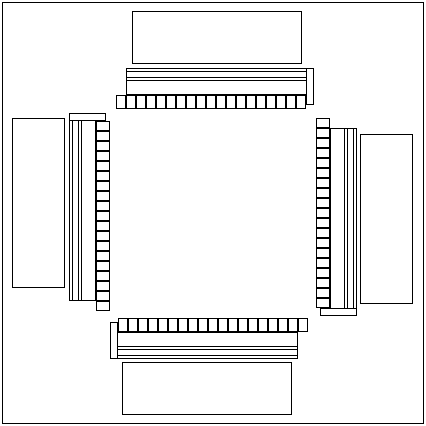
See how the walls are one tile too long for the racks
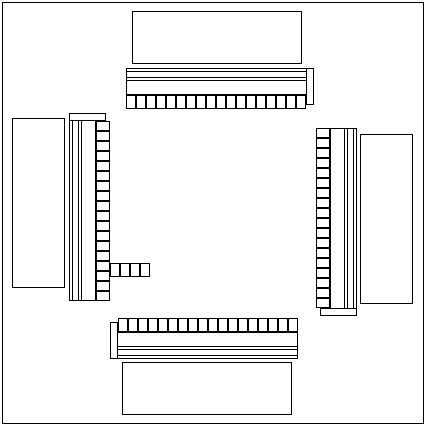
The last stack from each wall is placed to the left of the dealer's seat
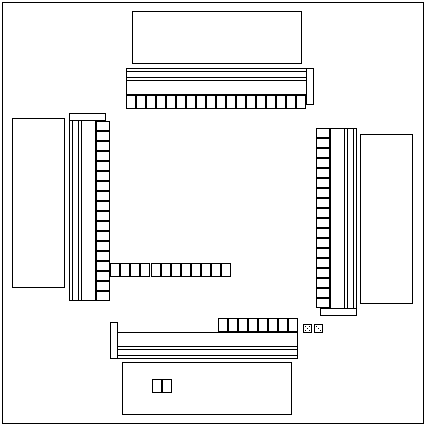
After breaking the wall, dealer's tiles extend the tail; players take tiles as usual
 A three-person Charleston. Most dances (the Charleston being no exception) are intended for even numbers of participants. The official NMJL rule is that when fewer than four people play, no Charleston is to take place (see FAQ 13a). But many players want to dance anyway, so they come up with all kinds of weird practices (see FAQ 14). A three-person Charleston. Most dances (the Charleston being no exception) are intended for even numbers of participants. The official NMJL rule is that when fewer than four people play, no Charleston is to take place (see FAQ 13a). But many players want to dance anyway, so they come up with all kinds of weird practices (see FAQ 14).
May the tiles be with you.
Tom Sloper

Author of "The Red Dragon & The West Wind," the definitive book on Mah-Jongg East & West.
Los Angeles, California, USA
March 27, 2011
es lowe set age & value
>Date: Sat, 26 Mar 2011 11:10:24 -0700 (PDT)
>From: Vicki M
>Subject: age & value of my es lowe mah jongg set
>Dear Sir:
>The set I am inquiring about was purchased by my mother sometime between 1952 and 1960. She played Mah Jongg during that time and then the set was stored away and not used for the next 40 years. I acquired it after her death in 1999 and I have now begun to play myself and I am very curious about the value and age of her set.
>I've listed the items as you requested on your web sight but if anything else is needed to help determine the age and value of the set please let me know.
>Thank you,
>Vicki
>01. Contents
> a. 2 dice
> b. 110 Chips
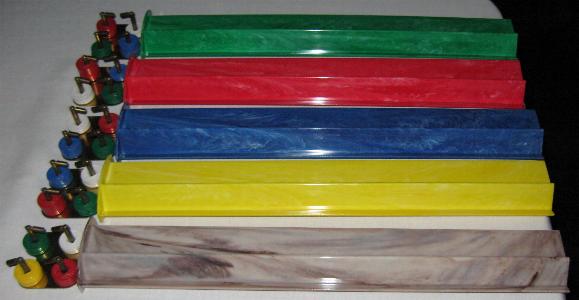
> c. 5 Racks
> d. 1 bettor
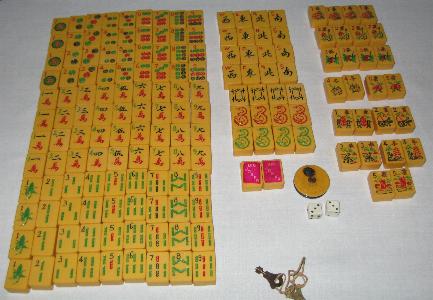
> e. 164 tiles - Dots, Craks & Brams complete. 12 Dragons, 16 Winds, 26 Flowers, 2 Blanks.
> f. 1 faux alligator case with 2 keys
>02. Condition - No defects. Like New
>03. Made Of - Bakelite ?? - butterscotch in color
>04. Purchased - Early 1950's
>05. Dimensions - 1 1/8 x 78" x 1/2"
>06. 164 tiles
>07. Other pieces: 2 dice; 110 round chips with sq centers; 1 round bettor & 2 keys to the case, 5 racks, blue, yellow, green, brown and red. 2 wooden trays.
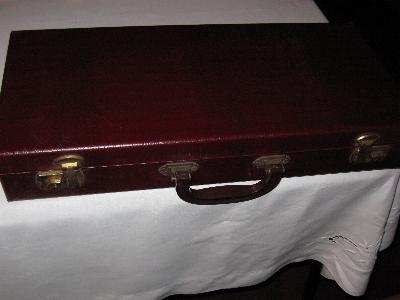
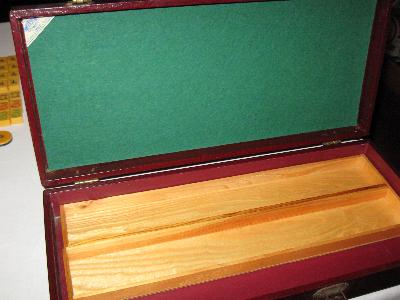
>08. Container: reddish brown faux alligator case with plastic handle. Green felt in the top. Two closures either side of the handle with locks.
>09. Condition of the case is excellent. No tears, dents or scratches. The hinges are scratched and discolored. The locks are in working order, but appear fragile.
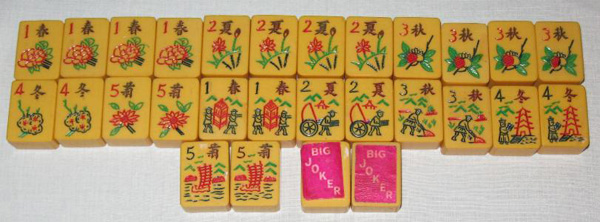
>10. 2 Big Joker Stickers along with 4 each National League Mah Jongg cards. 4 from 1960-61 and 4 from 1967-68.
>11. Craks - More elaborate style.
>12. See Attached Photos of 1 Brams
>13. See Attached Photos of dragons
>14. See Attached Photos of flowers
>15. No Jokers in the set
Dear Madam,
It's safe to assume and believe that the set was new when purchased (that the set is therefore between 50 and 60 years old). The wooden trays look suspiciously new; I don't know if these sets came with wooden trays.
Any player of modern American mah-jongg would be able to sticker some of the flowers and play today's rules. The condition of the case is amazing. If the tiles and racks are in that kind of condition too, then the set should be moderately valuable: maybe $200, maybe more. Probably not as much as $300, since it has no manufactured jokers.
Tom Sloper
Author of "The Red Dragon & The West Wind," the definitive book on Mah-Jongg East & West.
Los Angeles, California, USA
March 26, 2011
She called herself dead because my hand looked too dangerous
>Date: Fri, 25 Mar 2011 18:45:38 +0000 (UTC)
>From: weeziejen
>Subject: Mah Jongg Question
>Vikki, Charlotte and I were playing yesterday (no fourth player). I was playing FF NNNN EE WW SSSS. I had NNNN SSSS exposed. Charlotte called for a 3 crak that Vikki threw. She exposed her threes, then said "that's not what I wanted to do." We said she had to because she already exposed the tiles. She then said she was dead and stopped playing. Vikki and I said she didn't have to do that, just keep playing. She didn't want to. Vikki and I finished the game, which I won. After the game was over, Charlotte said the reason she called herself dead and stopped playing was because she wasn't sure which tile I needed and she had both the reds and the wests and didn't want to give me what may have been the winning tile. Vikki and I both said we didn't think that was "kosher."
>As an aside, looking back, I think Charlotte could have changed her mind about the threes because she hadn't discarded yet, but the main question is about calling herself dead because she didn't want to throw me the winning tile. What say you?
>Weeziejen
Hello Weeziejen, you wrote:
Charlotte called for a 3 crak that Vikki threw. She exposed her threes, then said "that's not what I wanted to do." We said she had to because she already exposed the tiles.
You were correct.
She then said she was dead and stopped playing. Vikki and I said she didn't have to do that, just keep playing. She didn't want to.
Her selfish desire does not give her the right to call herself dead.
After the game was over, Charlotte said the reason she called herself dead and stopped playing was because she wasn't sure which tile I needed and she had both the reds and the wests and didn't want to give me what may have been the winning tile. Vikki and I both said we didn't think that was "kosher."
Absolutely not kosher. She is not permitted to bow out of a game anytime she perceives another player's hand is too dangerous. That's an extremely self-serving act. She has to decide whether to play defensively or go for the win. Defensive play is an important part of the game.
I think Charlotte could have changed her mind about the threes because she hadn't discarded yet
No. You were right the first time -- exposing tiles from her hand committed her to the call.
May the tiles be with you.
Tom Sloper
Author of "The Red Dragon & The West Wind," the definitive book on Mah-Jongg East & West.
Los Angeles, California, USA
March 25, 2011
WWYP2
>From: Donna M
>Sent: Wed, March 23, 2011 3:06:38 PM
>Subject: your answer
>Hi Tom,
>Thanks for your prompt answer. To answer your question I did pass the 9Bam! Not sure if there is a way to post directly so forgive me if I didn't respond correctly.
>Love your informative site!
>P.S. Wish the NMJL would hire you to rewrite their Mah Jongg book (?)pamphlet. I could say more but will not.
>Glad we have you as the expert.
Great minds think alike, Donna! (^_^)
May the tiles be with you.
Tom Sloper
Author of "The Red Dragon & The West Wind," the definitive book on Mah-Jongg East & West.
Los Angeles, California, USA
March 23, 2011
The AMJA card
>From: Vicki Davis - vickser
>Sent: Wed, March 23, 2011 11:54:01 AM
>Subject: Mah-Jongg Q+A
>My mah-jongg question or comment is:
>What is the American Mah Jongg Associate card like? Is it the same game as the NMJL's card? Why don't more people use it?
>Sent from my iPhone
Hello Vicki,
The AMJA card is an "alternate" card for playing American-style mah jongg. It's played using the same rules as the NMJL card. The NMJL was founded in 1937 and since that time has grown its membership to three or four hundred thousand players. The AMJA was founded in 1999, so has not had time to grow its membership that large.
May the tiles be with you.
Tom Sloper
Author of "The Red Dragon & The West Wind," the definitive book on Mah-Jongg East & West.
Los Angeles, California, USA
March 23, 2011
WWYP?
>From: Donna M
>Sent: Wed, March 23, 2011 9:44:27 AM
>Subject: Strategy question
>Hi Tom,
>Would love your opinion on this:
>I'm East sitting with the following and have only two unneeded tiles to pass on a mandatory across on the second Charleston, what would suggest should the third be?
>N,N, E,W,S 9C,9C, 9B, 9B. 9B, J, J, two uneeded X,X
>You'll be happy to know I did make the hand!
>Mahjonggly,
>Donna
Hi Donna,
You're working on the concealed W-D hand with like number pungs (2010 card). I certainly wouldn't pass E, W, or S. You don't want to give up any needed singles, and if you pass your only S then you force the usage of the jokers. Passing 9B maintains maximum flexibility.
Glad you made the hand. So which tile did you pass?
May the tiles be with you.
Tom Sloper
Author of "The Red Dragon & The West Wind," the definitive book on Mah-Jongg East & West.
Los Angeles, CA (USA)
March 23, 2011
Water damage
>From: Al B
>Sent: Mon, March 21, 2011 2:20:04 PM
>Subject: Water damage question
>I have a circa 1920's/30's bone and bamboo mah jongg set that received some water damage recently.
>The moisture has affected the set for about seven weeks.
>I have three concerns:
>First of all, there appears to be some mold in the box itself. Can this be cleaned and how should I do it?
>Can the pieces that are wet dry out sufficiently, and if so, any time estimate? I have them setting on, bamboo side up, not touching each other.
>Several of the pieces have discoloration on the bamboo, because of the wetness. Will the discoloration go away if the bamboo properly dries?
>Thanks,
>Al
Hello Al,
I don't know what your box is made of, Al.
I suppose so!
I don't know where you live, Al. Here in L.A. they would probably dry out fairly quickly (but not this week, since we're in a rain cycle) (then again, when I have the heat turned on, things dry out fairly quickly even if it's humid outdoors).
 Maybe not. Have you checked FAQ 7o? (That's seven-oh, not seventy). The FAQ links are above left. Maybe not. Have you checked FAQ 7o? (That's seven-oh, not seventy). The FAQ links are above left.
May the tiles be with you.
Tom Sloper
Author of "The Red Dragon & The West Wind," the definitive book on Mah-Jongg East & West.
Los Angeles, CA (USA)
March 21, 2011
MCR fine points
>From: Elizabeth U
>Sent: Mon, March 21, 2011 5:16:43 AM
>Subject: questions regarding WMO MCR fans
>Dzien Dobry Tom,
> I was going to write in Polish but seeing that your French is 'high school basic', I assume that your Polish is at the 'daj mi buzi' level. French is much easier, I can assure you.
>Here are three questions regarding the Chinese International rules.
>1.) With regard to the concealed patterns (fans: Lesser honors, 7 pairs, Greater Honors, Four concealed pungs, Nine Gates, Seven shifted pairs and Thirteen orphans ALL the tiles are drawn from the wall though the winning tile may be from a discard. But, in the case of 4 concealed pungs, if you are waiting for the winning tile while holding 2 pairs, one of which will be the fourth pung, can that fourth pung be made from a discard or must you draw it yourself? Or, must you be holding 4 concealed pungs in your hand and be waiting to complete the pair? Per MCR rules (2006) (p.6 paragraph 3.4.10 Concealed tiles "...The tiles which have not been melded prior to declaring mahjong (hu) are called 'concealed' ". So it sounds as if that 4th pung can be made from a discard if you are waiting to go out while holding 2 pairs.
>2.)With regard to the Knitted straight (12 points), I understand that the straight is concealed (self-drawn) but does the whole hand have to be concealed or can the fourth set (either a pung or chow) be taken from a discard? This is not clear in any of the books that I have. I assume that the hand can be completed with 5 miscellaneous honors in which case the whole hand would be concealed and can 'combine' with the points for lesser honors.
>3.) Is there an update or correction/clarification of the 2006 WMO Mahjong Competition Rules?
>Dziekuje, merci, thank you,
>Elizabeth U, Warsaw, Poland
Hello Elizabeth,
My Polish is at the "Google Translate" level. I was in Poland only one time, for one day, five years ago.
That's a very good question. Although the freshly-completed pung is technically "exposed," the wording you quote indicates that it is permissible to declare four concealed pungs when you win on a discard when waiting with three concealed pungs and two pairs. In case it means anything, I should mention that I was involved in the writing of that wording, based on a translation provided by the WMO.
There is no rule that a hand containing Knitted Straight must be fully concealed. You can expose a pung or chow prior to winning.
Not in print that I am aware of.
May the tiles be with you.
Tom Sloper
Author of "The Red Dragon & The West Wind," the definitive book on Mah-Jongg East & West.
Los Angeles, California, USA
March 21, 2011
Scoring Japanese mahjong, part 3
>From: anthony l
>Sent: Sun, March 20, 2011 9:41:03 PM
>Subject: question about Reach Mahjong (japanese mahjong) #3
>Hello, Tom
>I am already get what do you say.
>thank you.
>by the way, I have problem about round up/down of endgame score.
>According this site (http://www.japanesemahjong.com/reachmahjong/game_progression/finishing.htm),
>"Players below 30,000 round up to the nearest 1,000." and "If they are above 30,000, round down to the nearest 1,000."
>I am little confused with this.
>Thank you.
>Anthony
Hi Anthony,
As you've seen, the Japanese game uses scores in the thousands, then converts down to double digits by dividing by 1,000. So it's no good to have numbers that can't be evenly divided by 1,000, so "rounding" has to be used. Under that site's rules, a score of 29,900 would be rounded down to 29,000 and a score of 30,300 would round up to 31,000.
May the tiles be with you.
Tom Sloper
Author of "The Red Dragon & The West Wind," the definitive book on Mah-Jongg East & West.
Los Angeles, California, USA
March 21, 2011
Scoring Japanese mahjong, part 2
>From: anthony l
>Sent: Sat, March 19, 2011 5:35:20 PM
>Subject: question about Reach Mahjong (japanese mahjong) #2
>Thank you for your answer, Tom.
>I play japanese mahjong from www.gamedesign.jp/flash/mahjong/mahjong_e.html
>Initial score: 25.000
>my score is 31600 (+12 point) 2nd
>Computer 1: 46700 (+57 point) 1st
>computer 2: 2400 (-48 point) 4th
>computer 3: 19300 (-21 point) 3rd
>I wonder how to get +12 point, +57 point, -48point, and -21 point?
>I am already see your faqs #25 but when i try calculate to get that point (refer to +12 point), it is no same. could you help me?
>thank you.
>Anthony
>note: I still have a lot of question. i will ask later when this is clear.
Hi Anthony,
Okay, so you've seen this table:

And you know your line 1 is 25,000, 25,000, 25,000, 25,000.
Line 2 - this is probably 30,000 with the game you're playing.
Line 3 - if so, this would be 5,000 across the board.
Line 4 - 46,700, 2,400, 19,300, 31,600. These probably have to be rounded, so:
Line 4 - 47,000, 2,000, 19,000, 32,000
Line 5 is explained in FAQ 25:
1. Players' final scores are compared with the goal of 30,000 and it is determined how far off the mark they are. For example, if a player winds up with 35,000, then he's 5,000 ahead; if a player winds up with 24,000, then he's minus 6,000.
2. The player with the highest score is awarded the difference between the start points and goal for each player around the table (20,000 is added to his score).
3. Each player's score is divided by 1,000. If a score is not evenly divisible by 1,000 then the score has to be rounded first. If the "fraction of 1,000" is 500 or more, round up. If 400 or less, round down. For example, if a player had end score of 35,000 and then was awarded 20,000, his final score is +25 (20,000 winnings added to the amount of points over 30,000).
4. Now the player's final scores are compared to determine who is the Top player, who is 2nd, who is 3rd, and who is Last.
Line 4 - 47,000, 2,000, 19,000, 32,000
Line 5, then, is +17,000, -28,000, -11,000, +2,000
You said your game turned this into +57, -48, -21, +12 (that's 57,000, -48,000, -21,000, and 22,000, all divided by 1,000).
The differences, then, are as follows: +40,000, -20,000, -10,000, +10,000 - so a spread (uma) of 10-20 must be in use, as explained below.
After line 5, 20,000 is added to the top winner's score. Then the spread points are applied, as explained in FAQ 25. 20,000 is added to #1 score, and subtracted from #4 score. 10,000 is added to #2 score, and subtracted from #3 score.
If you still don't understand it, use a spreadsheet program, read FAQ 25 and this explanation very carefully, and keep working at it until you figure it out. I really won't be able to add to the explanation I have given here. I understand it, and I hope I've imparted that understanding to you. Standing by for those further questions!
May the tiles be with you.
Tom Sloper
Author of "The Red Dragon & The West Wind," the definitive book on Mah-Jongg East & West.
Los Angeles, California, USA
Vernal Equinox, 2011
Atomic
>Date: Sun, 20 Mar 2011 16:03:43 -0400
>From: Marianne
>Subject: Mah-Jongg Q+A
>My mah-jongg question or comment is: When a player states she is going "Atomic" what does this mean, and what is the advantage of doing this? Thanks, Marianne
Hi Marianne, you wrote:
what does this mean
It means she's playing an unofficial rule. Presumably, the whole table has already agreed to use this "table rule." (But apparently not, if you were playing at that table -- if you were playing with her, why didn't you ask her what it meant? And why were you never informed that everybody else was using this made-up rule? Are they using other rules they've never told you about?)
Read Frequently Asked Question #14.
Please scroll up and look for the blue and yellow flashing arrow (emblazoned "READ 1ST," like this  ). ).
what is the advantage of doing this?
She wins a high score, IF she succeeds in making it, and IF the other players at the table agree to using this made-up rule. Read Frequently Asked Question #19AZ.
Answers to all of the most frequently-asked questions about American (NMJL) mah-jongg are found in FAQ 19. Please always check the FAQs first, before asking a question. Thanks!
May the tiles be with you.
Tom Sloper
Author of "The Red Dragon & The West Wind," the definitive book on Mah-Jongg East & West.
Los Angeles, California, USA
Vernal Equinox, 2011
Interested in teaching Mah Jonng, parrt 2
Carla,
This is a follow-up to my initial response to your question (below). I got curious and Googled "books on how to teach." This book looks like it might be what you're looking for:
http://www.lyceumbooks.com/HowToTeachEffectively.htm
May the tiles be with you.
Tom Sloper
Author of "The Red Dragon & The West Wind," the definitive book on Mah-Jongg East & West.
Los Angeles, California, USA
March 18, 2011
Scoring Japanese mahjong
>Date: Fri, 18 Mar 2011 20:05:46 -0700 (PDT)
>From: anthony l
>Subject: question about Reach Mahjong (japanese mahjong)
>Hello Tom
>first, thank you about your site, I got lot of information about mahjong.
>thank you.
>second, I have questions final score of japanese mahjong.
>I confused how to get that number.
>I Upload one picture if still dont get my question.
>http://img44.imagevenue.com/img.php?image=04134_japanesemahjong_122_530lo.jpg
>I am sorry about my english >_>Anthony
Hi Anthony,
Your English is fine, but I don't know what number you are asking about. If you want to ask me a question about a picture, you have to email the picture to me. Have you looked at FAQ 25? Scroll up and look for the FAQs at the left side of the monitor window. At the bottom of FAQ 25 (when you get to FAQ 25, scroll way down) there is a lot of information about scoring Japanese mahjong.
After you have read the bottom of FAQ 25, if you still have a question, try again to express the question to me. "I won a hand that had Yaku X and Yaku A and Yaku G, the computer game said it was worth 24,000 points, then the game results showed I'd added X. How the heck did the game go from 24,000 to X?" That would be a good question.
May the tiles be with you.
Tom Sloper
Author of "The Red Dragon & The West Wind," the definitive book on Mah-Jongg East & West.
Los Angeles, California, USA
March 18, 2011
Interested in teaching Mah Jonng
>From: "cmeyer"
>Subject: Teaching Mah Jongg
>Date: Fri, 18 Mar 2011 16:25:37 -0700
>Hi Mr. Sloper,
>I love the game of Mah Jonng and I am interested in teaching beginning Mah Jongg part-time.
>Do you have any advice on how to get started?
>Can you recommend any books that specialize in teaching methods?
>Many thanks,
>Carla Meyer
Hello Carla,
No, I don't have any advice on how to get started -- I'm a good teacher, but I don't get very many students. You want advice from someone who's got a better "practice" going.
And I can't recommend any books about teaching. I suppose if you Google, you can find books about how to teach.
I have one request: please please please, if you teach American mah jongg, teach the official rules, not your own special table rules. A lot of us have to undo the bad teaching people get from teachers unfamiliar with the official rules.
May the tiles be with you.
Tom Sloper
Author of "The Red Dragon & The West Wind," the definitive book on Mah-Jongg East & West.
Los Angeles, California, USA
March 18, 2011
Pinfu with dora, part 2
>Date: Fri, 18 Mar 2011 10:02:46 -0500
>From: Chris Schumann
>Subject: Pinfu
>Hi Tom,
>To Linda who just asked about pinfu, you might add a note about fu, or points. After all, pin fu means "no fu." Only triplets and kong get fu points, along with two points for a middle-, single-, edge- wait, or a value pair. If you have none of those, you qualify for pinfu, which is worth one han, along with any dora and other yaku such as riichi, any yaku involving sequences, or even chinitsu (one suit only).
>The EMA riichi rule book is pretty clear that pinfu means no minipoints, but the terminology in that book is confusingly different from other sources (and not always consistent), and 20 pages of fine detail is quite a slog.
>Chris
Thanks, Chris!
May the tiles be with you.
Tom Sloper
Author of "The Red Dragon & The West Wind," the definitive book on Mah-Jongg East & West.
Los Angeles, California, USA
March 18, 2011
Pinfu with dora
From: Linda E
Cc: Susan F; Elaine S; Cathy H
Sent: Thu, March 17, 2011 6:47:35 AM
Subject: Pinfu scoring with EMA rules
> Hi Tom,
> While the EMA rules for scoring a Pinfu expressly state a valueless hand, the rules are silent on red fives and Dora. Can a player declare a legal MahJong if his hand is Pinfu in all regards and contains red fives and/or Dora? If yes, are the red fives and Dora points scored or ignored?
> In my little example East is prevailing, North is the Seat wind and the 8 Dot is the called tile to make MahJong:
> Thanks so much,
> Linda E
> Haymarket Va.
>14 Files View Slideshow Download All
>bamboo3.png (4KB); bamboo4.png (4KB); red-dora-bamboo5.png (4KB); red-dora-man5.png (5KB); man6.png (5KB); man7.png (5KB); man4.png (5KB); man5.png (5KB); man6.png (5KB); wind-west.png (4KB); wind-west.png (4KB); pin6.png (5KB); pin7.png (6KB); pin8.png (5KB)
Hi Linda, you wrote:
the [European Mahjong Association's] rules [for Japanese mahjong] are silent on red fives and Dora [as regards to Pinfu]... Can a player declare a legal MahJong if his hand is Pinfu in all regards and contains red fives and/or Dora?
Yes.
are the red fives and Dora points scored or ignored?
Scored. The Japanese themselves splay fingers for each fan while reciting all the score doublers, starting with the pinky finger and ending with the thumb: "riichi, pinfu, dora, dora, dora - mangan!" (A red five is counted as dora when doing this. And a Japanese speaker might say "dora san" rather than "dora, dora, dora.")
In my little example
You sent me 14 pictures of tiles as attachment files (not a picture of an example, and not the 14 pictures pasted directly into the email). But reading the list of attachments above, one can determine that the example is:

Happy Saint Patrick's Day!
Tom Sloper
Author of "The Red Dragon & The West Wind," the definitive book on Mah-Jongg East & West.
Los Angeles, California, USA
Je cherche des tuiles
>From: stephane trovati
>Email: chungfapai sfr.fr sfr.fr
>Sent: Thu, March 17, 2011 6:30:51 AM
>Subject: SOS Tuiles de MahJong
>Bonjour.
>J'ai perdu des tuiles mon Mah Jong et je cherche des tuiles blanches pour les refaires ou alors commander directement mes tuiles manquantes.
>Je vous joint des photos de mes tuiles qui me manque :
>2 x 5 caractères
>1 x 6 caractères
>1 vent d' Est
>1 vent du Nord
>1 fleur ou saison n° 2 ( noir )
>Pourriez vous m'aider à les retrouver.
>Merci
>Cordialement
>Stéphane
>
3 Files View Slideshow Download All
>IMG_0016.JPG (105KB); IMG_0008.JPG (110KB); IMG_0023.JPG (198KB)
Bonjour, Stéphane.
S'il vous plaît, readez-vous le FAQ 7Q (le link c'est above gauche). Il probably would be un good idée to make any further enquiries en anglais! Oh, et sorry, mais nous ne post pas les Tiles Wanted photos pour vous. You can just email them to anyone who thinks il might be able to aid vous.
May les tuiles be avec vous.
Tom Sloper
Author of "The Red Dragon & The West Wind," the definitive book on Mah-Jongg East & West.
Los Angeles, California, USA
St. Patrick's Day, 2011
Must I Rack, part 3
>From: Lynn P
>Sent: Mon, March 14, 2011 5:40:38 AM
>Subject: Mah-Jongg Q+A
>My mah-jongg question or comment is: Re: 1. Email from Tom & Chris G. on 3/10, "Must I Rack"; I don't understand why anyone would risk exposing his/her tiles so other players can see them by putting the tiles on table between them and their rack. It is the same as racking your tiles as they are dealt to you instead of waiting until all tiles have been dealt before racking. I was told when I started playing mah jongg to not even separate the tiles into groups on my rack by leaving spaces between them since some experienced players could figure out what hand I was playing after I exposed a set on the top rack. In my group some players lay tiles on their long side for some reason and some do group their discards at either end of their rack. I am so busy watching for tiles I need that I don't pay much attention to other players unless of course they expose a joker or have enough tiles exposed to point to a particular hand. 2. We have some players, who when they expose a set, turn the tiles to face the rest of the players instead of facing them toward themselves. One player said it was to help the other players see the exposure especially when there is a joker. Do you have any pros or cons on #2? My group is getting tired of the 2010 card and looking forward to the 2011 card. I hope they printed the concealed hands at the bottom of each grouping. You would be surprised how many players expose tiles on a concealed hand and just kept playing since fellow players say, "I didn't want to embarrass "player" by calling her dead!!" Duh!! Isn't that how you play the game?? Oh well it's only a game and those jokers have been hiding from me again. I went home with an empty purse last Friday but was ahead $1.55 this week so I guess it will all even out. Shucks, It's only a game!!! Thanks again & again, Lynn P.
Hi Lynn, you wrote:
I don't understand why anyone would risk exposing his/her tiles so other players can see them by putting the tiles on table between them and their rack.
Many beginners have difficulty reading (interpreting) the tiles when they're all on the rack.
It is the same as racking your tiles as they are dealt to you instead of waiting until all tiles have been dealt before racking.
I don't see any similarity.
I was told when I started playing mah jongg to not even separate the tiles into groups on my rack by leaving spaces between them since some experienced players could figure out what hand I was playing after I exposed a set on the top rack.
Yes. Carding the tiles is very much akin to separating groups on the rack. It's why I called it a "beginner habit" and suggested that Chris may not have been up to tournament speed yet.
In my group some players lay tiles on their long side for some reason and some do group their discards at either end of their rack.
That's the same as what Chris does -- some sort of visual separation. But an unfortunate choice, in that these methods are not hidden from the other players. Very bad habits! I have a trick. I use easy-to-spot "separator tiles," like an unused dragon, or a joker, or sometimes a flower. I know my real hand is on one side of the separator, and my junk tiles are on the other. But nobody else can see the separation.
We have some players, who when they expose a set, turn the tiles to face the rest of the players instead of facing them toward themselves. One player said it was to help the other players see the exposure especially when there is a joker. Do you have any pros or cons on #2?
It's very "viewer-friendly," to be sure. But it doesn't matter what you do. If the player on the other side of the table can't read your tiles, she'll probably ask what they are. The main advantage of making your exposures viewer-friendly is that it might prevent having to hear the question and answer it. There's no particular strategic aspect to this issue.
I hope they printed the concealed hands at the bottom of each grouping. You would be surprised how many players expose tiles on a concealed hand
Really? Weird.
fellow players say, "I didn't want to embarrass "player" by calling her dead!!" Duh!! Isn't that how you play the game??
Some people get angry when they're called dead, so there might be some a bit of a harmony benefit in not calling someone dead. And "I didn't want to embarrass her" might be code for "I didn't want to embarrass myself if I was wrong." But sure, it's just good strategy to call someone dead when you know she's dead. Unless it's near the end of the hand, you think it's a wall game, or you don't think you can win and you don't have many safe tiles to discard so would rather reduce the number of times you have to play until the end.
May the tiles be with you.
Tom Sloper
Author of "The Red Dragon & The West Wind," the definitive book on Mah-Jongg East & West.
Los Angeles, California, USA
Pi Day (3.14), 2011
Does a 2001 have to be made with dots only?
>From: Glenna B
>Sent: Mon, March 14, 2011 5:15:33 AM
>Subject: Mah-Jongg Q+A
>My mah-jongg question or comment is: my Mahjong group was playing the 2001card in honor of our 10 years as a club. One member played the first hand in the doubles, I think it was N EE WW DD DD 2DD1. Question is: it says any 2 and 1 but the group says no it had to be dots only. Can you help me?
>Sent from my iPaq
Hello Glenna, you wrote:
N EE WW DD DD 2DD1
No. It was not "2DD1," it was "2001." The zero can't be just any old dragon; it must be only "soap" (white dragon).
it says any 2 and 1 but the group says no
So the group thinks the NMJL made a mistake on the card? If so, they've been making the same mistake every year since 2001.
but the group says no it had to be dots only. Can you help me?
Read FAQ 16. You can link to the Frequently Asked Questions above left; please scroll up and look for the blue and yellow flashing arrow (emblazoned "READ 1ST," like this ).
Answers to all of the most frequently-asked questions about mah-jongg are found in the FAQs; please always check the FAQs first, before asking a question. Thanks!
May the tiles be with you.
Tom Sloper
Author of "The Red Dragon & The West Wind," the definitive book on Mah-Jongg East & West.
Los Angeles, California, USA
Pi Day (3.14), 2011
Must I rack? (part 2)
>From: "Tom & Chris G
>Subject: Re: Re:
>Date: Thu, 10 Mar 2011 23:23:29 -0500
>thx for your quick response and opinion--u r a kind player. wish some of the women i play with at tournaments were.
Hi Chris,
So you were asking about something that happened at a tournament? I wish you would have said so in the first place. My responses are usually better (more to the point) when I get complete information.
When you are at a tournament, you definitely need to be on your best "most commonly accepted etiquette." And that means no beginner habits, such as you described. Maybe you weren't quite ready yet for the strict expectations of tournament players. But yes, sometimes tournament players can be ill-behaved (such as it sounds like what you experienced from someone at a tournament). I would have accepted without comment your quirky way of tile-viewing, but many tournament players would not.
May the tiles be with you.
Tom Sloper
Author of "The Red Dragon & The West Wind," the definitive book on Mah-Jongg East & West.
Los Angeles, California, USA
March 10, 2011
Must I rack?
>From: "Tom & Chris G
>Subject:
>Date: Thu, 10 Mar 2011 15:28:22 -0500
>re: american mj--i can't find a rule in "mj made easy" booklet that states i must have all my tiles in the rack at all times. when beginning the game, all my tiles are racked. when i draw a new tile, i rack it immediately, too. but during the play, particularly at the outset, i like to bring several tiles down from the rack and place them in front of the rack which still has some tiles on it. is there an official rule that i must have all 13 tiles on the rack at all times?
>thx for your help!
>chris
Hi Chris,
Wow -- so many people have asked me "must I rack" in the past week (you can scroll down and read what I told those people) that I'm adding it to the FAQs right now...
There, it's done. It's now Frequently Asked Question #19BL. Please scroll up and look for the blue and yellow flashing arrow (emblazoned "READ 1ST," like this ). Find the link to FAQ #19 (it's marked with a red, white, and blue flashing arrow, emblazoned "AMERICAN," like this  ) and click it. After you've landed at the FAQ 19 page, please bookmark it so you can easily return to it anytime you have a mah-jongg question. Answers to all of the most frequently-asked questions about American (NMJL) mah-jongg are found in FAQ 19. Please always check the FAQs first, before asking a question. Thanks! ) and click it. After you've landed at the FAQ 19 page, please bookmark it so you can easily return to it anytime you have a mah-jongg question. Answers to all of the most frequently-asked questions about American (NMJL) mah-jongg are found in FAQ 19. Please always check the FAQs first, before asking a question. Thanks!
May the tiles be with you.
Tom Sloper
Author of "The Red Dragon & The West Wind," the definitive book on Mah-Jongg East & West.
Los Angeles, California, USA
March 10, 2011
Handling of tiles
>Date: Thu, 10 Mar 2011 13:55:33 -0800 (PST)
>From: Lisa G
>Subject: MJ
>Hi Tom!
>We had 2 questions arise today.
>1) If player 'one' is waiting for a tile to give her a pair and another player puts 3 of the four up on the wall with a joker, can player 'one' ADD a joker to the wall and take the tile she needs just like you would take a joker and replace a tile you don't need?
>2) When looking at the tiles on the table to see what is already down, is it permissible to touch the tiles and move them around so you can see them if you don't pick them up?
>Thank you!
>Lisa G
Hi Lisa,
Please read the answer to Frequently Asked Question #19AL.
Please scroll up and look for the blue and yellow flashing arrow (emblazoned "READ 1ST," like this ). Find the link to FAQ #19 (it's marked with a red, white, and blue flashing arrow, emblazoned "AMERICAN," like this ) and click it. After you've landed at the FAQ 19 page, please bookmark it so you can easily return to it anytime you have a mah-jongg question. Answers to all of the most frequently-asked questions about American (NMJL) mah-jongg are found in FAQ 19. Please always check the FAQs first, before asking a question. Thanks!
People do that all the time. If other people are complaining, you are probably doing it too much for table harmony. Try being apologetic about it: "Sorry, ladies, I just need to see if... okay, I'm done. Sorry."
May the tiles be with you.
Tom Sloper
Author of "The Red Dragon & The West Wind," the definitive book on Mah-Jongg East & West.
Los Angeles, California, USA
March 10, 2011
Three players
>Date: Thu, 10 Mar 2011 17:33:13 -0500 (EST)
>From: DORIS M
>Subject: Charleston
>If we have 3 players, do we need to do a charleston?
>Thanks.
>crm36
Hello Doris,
You have asked
Frequently Asked Question #13A.
Please scroll up and look for the blue and yellow flashing arrow (emblazoned "READ 1ST," like this ).
Answers to all of the most frequently-asked questions about mah-jongg are found in the FAQs. Please always check the FAQs first, before asking a question. Thanks!
May the tiles be with you.
Tom Sloper
Author of "The Red Dragon & The West Wind," the definitive book on Mah-Jongg East & West.
Los Angeles, California, USA
March 10, 2011
I have nothing to say
>Subject: Mah-Jongg Q+A
>From: Lwhaggerty
>Date: Thu, 10 Mar 2011 16:50:13 -0500
>My mah-jongg question or comment is:
>Sent from my iPad
Hi L.W.,
If you had a question for me, it didn't come through. You're welcome to try again.
May the tiles be with you.
Tom Sloper
Author of "The Red Dragon & The West Wind," the definitive book on Mah-Jongg East & West.
Los Angeles, California, USA
March 10, 2011
Korean Go-Stop, part 2
>Date: Tue, 9 Mar 2011
>Subject: Re: Heungdahn, Chungdahn
>From: Evan M
>There's also a phrase they would use when things were going in their favor. "Kurochi" cooruhchee. Which loosely translatea to "hell yeah!"
>Not in any official sense part of the game but fun to add in for some gusto.
>Sent from my Samsung Captivate(tm) on AT&T
 Cool, thanks. Cool, thanks.
May the cards be with you.
Tom Sloper

Author of "The Red Dragon & The West Wind," the definitive book on Mah-Jongg East & West.
Los Angeles, California, USA
March 10, 2011
Korean Go-Stop
>Date: Tue, 8 Mar 2011 02:22:13 -0800
>Subject: Heungdahn, Chungdahn
>From: Evan M
>I spent almost half a year with Koreans in HI and traveling in northern China, needless to say we had a lot of time we spent together and our favorite time passer was Go-Stop. Those are the correct names for the flags and I can add, that they called the third flag family "Chodahn" Cho as in row, show et cetra, no idea what it means though.
>Also the all the names for the flag familes
>JANUARY – PINE (Sol)
>JULY – BUSH CLOVER (HungSaRi)
>FEBRUARY – PLUM BLOSSOM (MaeJo)
>AUGUST – MOON (PalGong)
>MARCH – CHERRY BLOSSOM (Sakura)
>SEPTEMBER – CHRYSANTHEMUM (GukHwa)
>APRIL – WISTERIA (HukSaRi)
>OCTOBER – MAPLE (Pung)
>MAY – IRIS (NanCho)
>NOVEMBER – PAULOWNIA (Dung)
>JUNE – PEONY (MokDan)
>DECEMBER – RAIN (Bi)
Great stuff, Evan! Thanks! I'll add this info to the site.
May the cards be with you.
Tom Sloper
Author of "The Red Dragon & The West Wind," the definitive book on Mah-Jongg East & West.
Los Angeles, California, USA
March 9, 2011
Don't you have to rack it immediately?
>From: barb s
>Sent: Mon, March 7, 2011 2:23:40 PM
>Subject: tile racking question
>When it is your turn to pick a tile, isn't it correct to immediately rack it in your rack?
>I questioned a lady who had the tile in her hand on the table between her and the rack and I called for it because I needed it and it wasn't in her rack. She said it is racked by laying it on the table in front of her with her hand on it.
>Please help.
>Barb
Hello Barb, you wrote:
When it is your turn to pick a tile, isn't it correct to immediately rack it in your rack?
No, you don't have to. An awful lot of people have asked this exact same question recently.
Scroll down and read "Can't find this Window of Opportunity rule under the Change of Heart section of your book" From: Lynn P, Sent: Mon, February 28 -- and see what I told PatWTS on Wed, 16 Feb 2011 19:25:00 -0500 ("Can't find this rule in your book"), -- and see my Feb. 20 column. I've explained numerous times recently that when you pick a tile from the wall there is no rule that says you must rack it.
I questioned a lady who had the tile in her hand on the table between her and the rack and I called for it because I needed it and it wasn't in her rack. She said it is racked by laying it on the table in front of her with her hand on it.
She's wrong. It should be self-evident what "racking" means, but since a lot of people ask this, I wrote an FAQ on it. It's FAQ 19AD. Please scroll up and find the links to the Frequently Asked Questions (look for the blue and yellow flashing arrow, emblazoned "READ 1ST," like this ). Find the link to FAQ #19 (it's marked with a red, white, and blue flashing arrow, emblazoned "AMERICAN," like this ) and click it.
After you've landed at the FAQ 19 page, please bookmark it so you can easily return to it anytime you have a mah-jongg question. Answers to all of the most frequently-asked questions about American (NMJL) mah-jongg are found in FAQ 19. Please always check the FAQs first before asking a question. Thanks!
Since she had not racked the tile, the window of opportunity was not closed, so you were in the right calling for the previous discard.
May the tiles be with you.
Tom Sloper
Author of "The Red Dragon & The West Wind," the definitive book on Mah-Jongg East & West.
Los Angeles, CA (USA)
March 7, 2011
What the heck is it, part 3
>Date: Sun, 06 Mar 2011
>From: Chris Schumann
>Subject: More on Joker
>http://cgi.ebay.com/ws/eBayISAPI.dll?ViewItem&item=300530034370
>That's the auction I snagged the image from. It recently closed. If you hurry, you might get the maker from the seller. I suspect it's in Japanese, but he or she might capture some images for you.
>Chris
Hi Chris,
Excellent. Yes, it does seem to be Japanese (I could see Japanese writing on some of the paper materials in the set). That tells me enough.
May the tiles be with you.
Tom Sloper
Author of "The Red Dragon & The West Wind," the definitive book on Mah-Jongg East & West.
Los Angeles, California, USA
March 6, 2011
The "What If" game
>From: "Judy O
>Subject: What if.....?
>Date: Sun, 6 Mar 2011 11:13:21 -0500
>Ok. I have read the FAQ's. I understand the rules about being dead, being called dead, incorrect exposures, and redeeming jokers. But something like the following happened the other night and it led to the following questions:
>What if.......
>A player legally calls for a discarded North. She racks it, adding a joker and a second North, thereby exposing a pung from a closed hand. For a variety of reasons, no one *immediately* catches her blunder. The next player draws from the wall and discards. The next player exchanges a North for the exposed joker, racks it and then realizes that she now has Maj Jongg.
>Q1:Before she exposes her hand, what happens if at this point, one of the other players realizes the blunder and calls the NJN hand dead?
>Q2:What happens if she exposes her hand, and *then* the NJN hand is called dead?
>Q3:What, other than personal ethics, will stop a player from not calling a hand dead so that she may utilize the joker?
>Q4: What if a North is exchanged for the joker, racked, and a MJ is exposed, at which point it is discovered that the NJN hand was dead and the joker was therefore not valid when called.
>TIA.
>Judy O.
Thanks for numbering your questions for me, Judy.
Then she'd have to put the joker back (she would be required to undo the undoable -- to rectify that which can still be rectified -- as per my philosophies in FAQ 9).
Too late. The error wasn't discovered in time to undo it. See FAQ 9. And remember that "maj trumps everything."
Nuttin', honey.
 How is this different from number 2? How is this different from number 2?
Tom Sloper
Author of "The Red Dragon & The West Wind," the definitive book on Mah-Jongg East & West.
Los Angeles, California, USA
March 6, 2011
What the heck is it, part 2
>Date: Sun, 06 Mar 2011 08:04:58 -0600
>From: Chris Schumann
>Subject: Joker Tile Image
>I found this image while browsing eBay. It looks very much like the current American-style joker, but is in color. I can see how this became the joker we have today.
>Chris

Hi Chris,
Thanks. Would be good to know more about the set you found that joker in (especially, how old that set is, information about the manufacturer). But you are right, it does help understand the monochromatic version. I'll add this to FAQ 7e, thanks to you.
May the tiles be with you.
Tom Sloper
Author of "The Red Dragon & The West Wind," the definitive book on Mah-Jongg East & West.
Los Angeles, California, USA
March 6, 2011
You must read the comics
>From: Lynn P
>Sent: Fri, March 4, 2011 7:34:01 PM
>Subject: Mah-Jongg Q+A
>My mah-jongg question or comment is: I see you must read the comics "Arlo a & Janis" since you signed "March Forth" in your email today. Very good wording especially on March Fourth!! A faithful follower; Lynn P.
Hi Lynn,
I am an avid reader of comics, but I'm a bit old-fashioned, I guess; I read them in the paper (the actual paper made of paper). Hadn't read Arlo & Janis before. I checked it out just now, and could only find yesterday's comic (couldn't find one in which someone says "March forth"). I only said "March forth" because today is the fourth, and I'm punny that way. (I did that last year too -- you can scroll back a year and see.)
May the comics be with you.
Tom Sloper
Author of "The Red Dragon & The West Wind," the definitive book on Mah-Jongg East & West.
Los Angeles, CA (USA)
Now March Forth, 2011
When you don't want to pass 3 tiles
>From: Ginnie
>Sent: Fri, March 4, 2011 8:46:02 AM
>Subject: Mah Jongg Question
>I totally know that the game can be stopped after the first "DANCE" but is there some unwritten rule as to when it's appropriate?
> ie not able to pass 3 tiles for completion of 1 hand??? Some have 2 or 3 hands and don't want to go on....Thank you Ginnie
Hi Ginnie,
It's "appropriate" to stop the Charleston when the rules say it is "permitted."
"Appropriateness" of stopping the Charleston is a non-issue when stopping the Charleston is "prohibited."
In other words, when it is "mandatory" to pass three tiles (whether or not you WANT to -- whether or not you say you are "able" to), it is "inappropriate" to refuse to pass three tiles.
...Do you totally get it yet, or does that somehow still miss your question?
May the tiles be with you.
Tom Sloper
Author of "The Red Dragon & The West Wind," the definitive book on Mah-Jongg East & West.
Los Angeles, California, USA
Now March Forth, 2011
Can I redeem a joker on my own rack?
>From: "BHoward336
>Sent: Wed, March 2, 2011 8:26:23 PM
>Subject: Mah-Jongg Q+A
>My mah-jongg question or comment is:
>Under 13579 I was playing
>FF 55 77 99 555 555
>I had exposed on my rack
>55Joker
>I soon realized the 9's had been discarded and needed to change my hand to
>Like numbers
>55 DD 555 DDD 5555
>At this time may I exchange a 5 in my hand and take the joker
>Thanks,
>Barbara
Hello Barbara,
I think you are asking
Frequently Asked Question #19M3.
Please scroll up and look for the blue and yellow flashing arrow (emblazoned "READ 1ST," like this ). Find the link to FAQ #19 (it's marked with a red, white, and blue flashing arrow, emblazoned "AMERICAN," like this ) and click it.
After you've landed at the FAQ 19 page, please bookmark it so you can easily return to it anytime you have a mah-jongg question. Answers to all of the most frequently-asked questions about American (NMJL) mah-jongg are found in FAQ 19. Please always check the FAQs first, before asking a question. Thanks!
May the tiles be with you.
Tom Sloper
Author of "The Red Dragon & The West Wind," the definitive book on Mah-Jongg East & West.
Los Angeles, California, USA
March 2, 2011
I don't understand FRIENDS (I don't know what "D" means on a mah-jongg card)
>Date: Wed, 2 Mar 2011 19:37:06 -0500
>Subject: AMJA hand
>From: gail d
>Hi Tom,
>Please, could you provide an explanation of the AMJA hand: FF RR II EE NN DD SS. I can't recall what the 2- DD's stand for?
>Thanks,
>Gail
>P.S. Thanks for posting the Chinese New Year hand: EEE 2011 2012 WWW, we used this as a special hand for a recent tournament and our players really enjoyed trying to make the hand.
Hello Gail,
That hand says:
FF RR 11 EE NN DD SS
(DD's any D; M.J. Friends; 1 - any suit)
So here's a couple of ways you might make the hand:

As for what the letter D stands for on the card? That's indicated on the back of the card. (It's the same thing D stands for on the NMJL card.)
As it says in the parentheses, the 1's can be any suit, and the dragons can be in any suit (the dragons that are not indicated by the letter R, of course). The hand can be one suit, two suits, or three suits.
I'm glad you're having fun with the Year of the Rabbit hand. My group is enjoying it too. Until the new card comes out, at least.
May the tiles be with you.
Tom Sloper
Author of "The Red Dragon & The West Wind," the definitive book on Mah-Jongg East & West.
Los Angeles, California, USA
March 2, 2011
My mother's missing tiles
>From: mark weinstein
>Email: hedmar1溌msn,com
>Sent: Tue, March 1, 2011 10:06:56 AM
>Subject: missing tiles
>My mother is trying to replace/match missing tiles from an older set. Please see attached. Any help or suggestions would be welcomed.
>Mark

Mark,
Look at the Tiles for Sale BB and post on the Tiles Wanted BB. Please scroll up and look for the blue and yellow flashing arrow (emblazoned "READ 1ST," like this ) at the left side of the screen. The BBs are above it.
Enrobed tiles like these are extremely rare and high-priced, so "lots of luck!"
May the tiles be with your mother.
Tom Sloper
Author of "The Red Dragon & The West Wind," the definitive book on Mah-Jongg East & West.
Los Angeles, California, USA
March 1, 2011
Can't find this Window of Opportunity rule under the Change of Heart section of your book
>From: Lynn P
>Sent: Mon, February 28, 2011 7:04:52 PM
>Subject: Mah-Jongg Q+A
>My mah-jongg question or comment is: 1. While playing American mah jongg, I drew a tile from the wall, looked at it, then clicked it on the table and said its name but I still had my fingers on it when another player said she wanted the previous discard. I said my tile was down so previous discard was dead since my tile had touched the table and I had said its name but she said I didn't rack it. I quoted "RD & WW" p. 99 under "Change of Heart" "...if she has said the tile's name in full or touched the tile to the table. "Down is down." but I know there is another reference to discarding a tile in the book but I can't find it. Can you find this reference so I can bookmark it? It is mentioned on your first FAQ too. I also said a player does not have to rack every tile she picks. She can just discard it after she picks it.
>2. Another time a player held her tile and started to say its name but didn't touch the table and then said, "Never mind." and she took the tile back since she said she didn't say the full name like "7 dot" but only said "7". The players let it go since she was still holding the tile which hadn't touched the table. I quoted the above page again in "RD & WW". Thanks for your help. Looking forward to receiving the new 2011 card and playing your "Year of the Rabbit" hand. Lynn P.
Hi Lynn, you wrote:
I quoted "RD & WW" p. 99 under "Change of Heart" "...if she has said the tile's name in full or touched the tile to the table. "Down is down."
The reason that's under "Change of Heart" is because this illustrates a time when the player may NOT change her mind and take the tile back. Touching or naming -- either way -- the tile is down.
but I know there is another reference to discarding a tile in the book but I can't find it.
Look under "Window of Opportunity." It's earlier in the chapter. When the picked tile has been discarded and is "down," the window of opportunity has closed on the previous discard. Now the window of opportunity is open for the newest discard only.
Opening the window for someone to take the discard SIMULTANEOUSLY CLOSES the window for the discarder to take it back, AND closes the window for anyone to claim the previous discard.
Can you find this reference so I can bookmark it?
You can use the index in the back. Look for Window of Opportunity.
It is mentioned on your first FAQ too.
The FAQs give page numbers in RDWW.
I also said a player does not have to rack every tile she picks. She can just discard it after she picks it.
As I told PatWTS on Wed, 16 Feb 2011 19:25:00 -0500 (EST) ("Can't find this rule in your book") and as I wrote in my latest column, yes. I also said in the column that when picking, you should pause a beat, so the window of opportunity is not open an unfairly short time -- it's important to allow another player enough time to call the discard.
a player held her tile and started to say its name but didn't touch the table and then said, "Never mind." and she took the tile back since she said she didn't say the full name like "7 dot" but only said "7".
That's correct. Read the Window of Opportunity rule again. Saying "Seven" does not close it. Read the Change of Heart rule again. She can take the tile back if she has not completely said its name and has not touched the tile to the discard floor. I hope I've written those rules clearly enough. Perhaps you should read them aloud to your group.
Looking forward to receiving the new 2011 card and playing your "Year of the Rabbit" hand.
My group has been playing the Year of the Rabbit hand. I actually made it once. You don't think that hand is on the official NMJL card that's coming out in a month, do you? Because it isn't. For my group, I made little hand labels and we stuck them on our 2010 cards.
May the tiles be with you.
Tom Sloper
Author of "The Red Dragon & The West Wind," the definitive book on Mah-Jongg East & West.
Los Angeles, California, USA
February 28, 2011
What glue to use on Bakelite, part 2
>From: "Michael Stanwick"
>Subject: Re: What glue to use on Bakelite?
>Date: Sun, 27 Feb 2011 14:46:53 -0000
>Hello Tom.
>Gerry F has a problem common to MJ set collectors.
>I have checked the post of 21/4/2008 and entirely agree with your response.
>I have used Superglue with no ill effects at present. But take heed of the advice Tom gave in that early post.
>The warping of the plastic slips may be due to differential heating . If one side of the piece has been exposed to sunlight or some other energy source then the differential heating can warp the plastic.
>It would be helpful if Gerry could provide some pictures of his set.
>Regards
>Michael Stanwick
Thanks, Michael. We'll see if Gerry comes back.
Cheers.
Tom Sloper
Author of "The Red Dragon & The West Wind," the definitive book on Mah-Jongg East & West.
Los Angeles, California, USA
February 27, 2011
Can't find this rule
>From: Jamie L. P
>Sent: Sat, February 26, 2011 7:44:19 AM
>Subject: Payment on a concealed hand.
> It was asserted that payment when mah jongg occurs on a concealed hand is to be doubled. Is this correct? We know that jokerless hands are doubled.
Hi Jamie,
Well, let's see. It's not on the back of the NMJL card. It's not in the official NMJL rulebook. It's not in my book, and it's not in my FAQs. Here's the deal: When you can't find a rule in writing anywhere, that usually means it's not a rule! (Hint: it's not a rule.)
May the tiles be with you.
Tom Sloper
Author of "The Red Dragon & The West Wind," the definitive book on Mah-Jongg East & West.
Los Angeles, California, USA
February 26, 2011
What glue to use on Bakelite?
>From: Gerry F
>Sent: Sat, February 26, 2011 3:46:25 AM
>Subject: Mah-Jongg Q+A
>My mah-jongg question or comment is:
>I have a similar or same set as Jay Davis (JMd5)(signed Kim) Question 21-04-2008 and think that it is a Chinese se as it has no western characters on the faces and from all the reading it is Bakelite material. The colour is the dark orange with the green backing. I have tried a number of glues to re-stick the backs of the tiles and have found most glues ineffective. I have tried a PVC glue which is used for pvc plumbing pipes,
>model glue for plastic models to no avail. I have had no success in acquiring information about what type of chemical is a solvent for Bakelite as this will be the glue to fuse together the pieces. I have enquired with expert plastics companies and no one seems to have the answer.
>Interestingly enough, the backs that have come off the seem to have altered shape to be a slight concave, so leaving a pocket between the orange tile and the backing piece. I wonder if this comes from a reaction between the original glue and the backing piece. Although Bakelite is one of the least heat sensitive plastics it can still be unstable as most plastics.
>I am very keen to repair the set in the original method and wonder if Jay has found any answer in the meantime. Maybe you could forward his email address to me. My set has has 148 pieces and has complete suites including 4 jokers. The tiles are all in excellent condition with no chips whatsoever, only some of the backs loosening. I live in South Africa, Durban and am amased to see what a international following Mah-jongg has. I hope some one can help me. Maybe NASA can help as they must still use Bakelite for its great heat resistant properties.
>Gerry F
Hello Gerry,
Making a stab in the dark, I checked FAQ 7o and found JMd5's post. All I can tell you is the same thing I told Jay Kim Davis, sorry. Feel free to try contacting NASA if you like. (^_^)
May the tiles be with you.
Tom Sloper
Author of "The Red Dragon & The West Wind," the definitive book on Mah-Jongg East & West.
Los Angeles, California, USA
February 26, 2011
Western indices
>Date: Thu, 24 Feb 2011 17:48:59 -0800 (PST)
>From: Kathryn A
>Subject: Western Markings might NOT always be determinative
>Hi,
>I love your web site and have enjoyed reading the information. I saw several questions and answers about western markings on sets, and I think you should know something because it will effect some people's games - especially the older ones made prior to the mass imports to the states. My mother took my set (which I received as a being born gift in Japan) to a local engraver right outside Clark Air Base in the Philippines and had numbers placed on the character tiles and directions letters placed on the winds (no other engraving). The numbers are very small and in script. She chose them. My father had the back of my Judo medals engraved by the same guy.
>My mother showed my grandmother when they came for a visit, and later, my grandmother had my grandfather's game engraved so she could use it. My mother got the idea from our neighbor in the PI who had come from Hawaii and had done it to her older game so she could use it. This was just a game - a toy and keepsake. People didn't think about preserving them in the exact way they received it. It was more fun to use them.
>Anyway, if someone has actual family history that suggests that the set is very old, having Western numbers isn't ALWAYS determinative because it became a common thing to have the sets engraved. One "flag" might be to see if the numbers & letters were engraved using a template (are they all exactly the same size and shape) where the rest of the set was hand carved.
>Kathryn
Which just goes to show, "there's an exception to every rule." Thanks for pointing out that a closeup of the indices might be called for in some cases, Kathryn.
May the tiles be with you.
Tom Sloper
Author of "The Red Dragon & The West Wind," the definitive book on Mah-Jongg East & West.
Los Angeles, California, USA
February 24, 2011
Has it always been piddling dimes and quarters? Really?
>From: Vicki D
>Subject: Mah-Jongg Q+A
>Date: Wed, 23 Feb 2011 20:16:59 -0800
>My mah-jongg question or comment is:
>Hi Tom: I hope I'm asking a question that you haven't been asked before. Have the monetary amounts connected to each hand ever been changed due to inflation? I mean, come on, twenty-five cents?
>Thanks,
>Vicki
Hi Vicki,
Wow, you must be rich.
But to answer your question: I don't have the time to study and calculate maximum and minimum values of the 1938-39 NMJL rules, but the 1941-42 card is fairly easy to read. Minimum value: 10 points. Maximum value: 100 points.
I do not know if those points were converted to cents.
May the tiles be with you.
Tom Sloper
Author of "The Red Dragon & The West Wind," the definitive book on Mah-Jongg East & West.
Los Angeles, California, USA
February 23, 2011
Multiple claims for a discarded redeemable tile
>From: "Anne M
>Subject: Mah-Jongg Q+A
>Date: Tue, 22 Feb 2011 10:41:03 -0500
>My mah-jongg question or comment is: who gets a discard when two people want it for replacing a tile in an exposed hand and wanting the joker. Is it the person to the right of the discarder, or does the person who has the joker on top of her rack get priority the same as the rule for the person needing the tile for mah Jongg would have priority.
Anne,
Who taught you and your group how to play mah jongg? You should all go and demand your money back! Read
Frequently Asked Question #19G2.
Please scroll up and look for the blue and yellow flashing arrow (emblazoned "READ 1ST," like this ). Find the link to FAQ #19 (it's marked with a red, white, and blue flashing arrow, emblazoned "AMERICAN," like this ) and click it.
After you've landed at the FAQ 19 page, please bookmark it so you can easily return to it anytime you have a mah-jongg question. Answers to all of the most frequently-asked questions about American (NMJL) mah-jongg are found in FAQ 19. Please always check the FAQs first, before asking a question. Thanks!
This question is also answered in my book, "The Red Dragon & The West Wind," on p. 58 (rule 86a), and on p. 92. And it's answered in the official
NMJL rulebook, "Mah Jongg Made Easy," on p. 19.
May the tiles be with you.
Tom Sloper
Author of "The Red Dragon & The West Wind," the definitive book on Mah-Jongg East & West.
Los Angeles, California, USA
February 22, 2011
If they've yellowed, is that a clue?
>Subject: Tiles
>From: tovar198
>Date: Mon, 21 Feb 2011 20:27:35 -0500 (EST)
>Hi my name is Gail and I'm from New Jersey. I have my mother's set of tiles and I would have to say from the pictures you showed it's the American set. If they are ivory tiles, would they turn yellow over the years? I remember them being white and now they are yellow. Would that be a good clue as to whether or not they are ivory.
>Thanks so much
>Gail
Hello Gail,
The best clues as to whether or not they're ivory are found in
Frequently Asked Questions #7C & 7C2.
Please scroll up and look for the blue and yellow flashing arrow (emblazoned "READ 1ST," like this ).
Answers to all of the most frequently-asked questions about mah-jongg are found in the FAQs. Please always check the FAQs first, before asking a question. Thanks! By the way: Bakelite and Catalin tiles tend to yellow with age. And I've never seen an American-style set, with racks and 152 tiles (including 8 jokers) that was made of ivory.
May the tiles be with you.
Tom Sloper
Author of "The Red Dragon & The West Wind," the definitive book on Mah-Jongg East & West.
Los Angeles, California, USA
February 21, 2011
How does "death" work?
>Date: Mon, 21 Feb 2011 14:46:49 -0800 (PST)
>From: Nancy S
>Subject: Mahjong question
>I am a novice at this game so please forgive me if my question insults your expertise. In a group I played with, the ladies said if a player thinks another player's hand is dead, she can say "I think your hand is dead". If the challenged player cannot prove otherwise, that hand is declared dead. Another group I played in today said they had never heard of that.
>So - what's your answer? We'd all like to know.
>Thanks so much.
Hi Nancy,
My answer is given in Frequently Asked Question #19AA. You should also read FAQs 19AB and AC for a full understanding of the "death" rules in American mah jongg.
Please scroll up and look for the blue and yellow flashing arrow (emblazoned "READ 1ST," like this ). Find the link to FAQ #19 (it's marked with a red, white, and blue flashing arrow, emblazoned "AMERICAN," like this ) and click it.
After you've landed at the FAQ 19 page, please bookmark it so you can easily return to it anytime you have a mah-jongg question. Answers to all of the most frequently-asked questions about American (NMJL) mah-jongg are found in FAQ 19. Please always check the FAQs first, before asking a question. Thanks!
May the tiles be with you.
Tom Sloper
Author of "The Red Dragon & The West Wind," the definitive book on Mah-Jongg East & West.
Los Angeles, California, USA
February 21, 2011
Can't find this rule in your book
>From: PatWTS
>Date: Wed, 16 Feb 2011 19:25:00 -0500 (EST)
>Subject: MJ Racking question
>Hi Tom,
> I have a question that out MJ group is arguing about.....and I would very much appreciate your answer and advice....
> We have a new player in our group. She draws a tile and does not rack it. She claims that it is the "strategy" that she uses in another group with which she plays. She draws a tile and holds it or lays it in front of rack, then either discards that tile or racks it and discards another. Some of us feel that it is a "rule" that she has to rack the tile when she draws it. Others feel that if she hasn't discarded it increases the time we have to "call". My question to you is "Is a player required to rack before discarding?"
> Several of us has looked for an answer in your book and on website and we have probably missed answer to question.
> Thanks for sharing your time and answers with us MahJongg addicts!
>Pat M
Hello Pat, you wrote:
We have a new player in our group. She draws a tile and does not rack it. ... She draws a tile and holds it or lays it in front of rack, then either discards that tile or racks it and discards another.
I do that too, sometimes. (Look at the tile in my hand to decide if I want it, and then sometimes I discard without racking.) Very common practice.
She claims that it is the "strategy"
It's not "strategy." What's the point of it -- the strategic benefit -- if it's "strategy"?
Some of us feel that it is a "rule" that she has to rack the tile when she draws it. ... Several of us has looked for an answer in your book and on website and we have probably missed answer to question.
When you can't find a "rule," that probably means there is no such rule! (Hint: there is no such rule.)
Others feel that if she hasn't discarded it increases the time we have to "call".
Yes. You've read my book and my FAQs. You know that she has not closed the window of opportunity while she's holding the tile or while it sits on her card. So anybody can call the current discard up until such time as she closes the window. Your friend's "strategy" is a flawed strategy.
My question to you is "Is a player required to rack before discarding?"
You know now from reading the above that the answer is "no."
May the tiles be with you.
Tom Sloper
Author of "The Red Dragon & The West Wind," the definitive book on Mah-Jongg East & West.
Los Angeles, California, USA
February 16, 2011
What the heck is it?
>From: John O
>Sent: Tue, February 15, 2011 2:40:59 PM
>Subject: Mah-Jongg Q+A
>My mah-jongg question or comment is:
>Honestly, I looked in the FAQ but didn't find the answer to this one...
>What is the image/pattern shown on the standard "Joker" tile? You know... the circle filled with gold squiggly stuff with a kind of stumpy comet's tail sticking up? All the other tiles make sense, even some of the obscure flower and season tiles, but the Joker has me stumped. Maybe that's it's purpose?
>Thanks,
>John

I don't know, John.
I think it's supposed to be a dragon. I think I can see its head, but I can't tell if its mouth is open or not, or what the other details are.
I'm adding this to FAQ 7E. May the tiles be with you.
Tom Sloper
Author of "The Red Dragon & The West Wind," the definitive book on Mah-Jongg East & West.
Los Angeles, CA (USA)
February 15, 2011
Frequently Asked Question 19AW
>From: linda m
>Sent: Mon, February 14, 2011 3:35:02 PM
>Subject: n m j l ?
>can u peek at a blind pass before sending the rest of the tiles on?
>Linda M
>Fresno, CA
If you can peek at it, then why is it called "blind pass"?? This question has been asked many times before. You can find the answer to this question, and many other often-asked questions, in the "Frequently Asked Questions" ("FAQs"). You have asked Frequently Asked Question #19AW. Please scroll up and find the links to the FAQs, above left (they're indicated by a blue and yellow flashing arrow, emblazoned "READ 1ST," like this ). Find the link to FAQ #19 (it's indicated by a red, white, and blue flashing arrow, emblazoned "AMERICAN," like this ) and click it.
Bookmark the page for your future reference. Scroll down and find the answer to question G. Please always check the FAQs first, before asking a question.
May the tiles be with you.
Tom Sloper
Author of "The Red Dragon & The West Wind," the definitive book on Mah-Jongg East & West.
Los Angeles, CA (USA)
♥alentine's Day, 2♥11
The column
>From: Lynn H
>Sent: Mon, February 14, 2011 5:39:54 AM
>Subject: weekly columns?
>Hey, Tom,
>What happened to your almost weekly columns? I've used them to hone my skills. I'm missing them.
>Thanks,
>Lynn
Hi Lynn,
My weekly calendar went through an upheaval with the new semester, and I haven't felt "inspired" enough to squeeze the column in. Maybe if I get more queries, inspiration will hit me. And of course when the 2011 card comes out, that'll also inspire me.
May the tiles be with you.
Tom Sloper
Author of "The Red Dragon & The West Wind," the definitive book on Mah-Jongg East & West.
Los Angeles, CA (USA)
♥alentine's Day, 2♥11
The Red Dragon & The West Wind, part 2
>Date: Sat, 12 Feb 2011 20:46:43 -0800 (PST)
>From: Anitalouise
>Subject: Re: new edition of your book
>Hi Tom,
>Thank you for the speedy reply & info. Maybe your publisher needs a bit of a push since MahJongg has had a tremendous new following for the game. They are even teaching it at many of the libraries & senior centers in my area. I am really enjoying your book. Thank you again.
>Anita Reilly
>Pleasantville, NY
Well, I imagine Collins hasn't yet sold all the copies they printed. Maybe when those are all used up, and they're getting orders for more, then they might want to talk 2nd edition.
May the tiles be with you.
Tom Sloper
Author of "The Red Dragon & The West Wind," the definitive book on Mah-Jongg East & West.
Los Angeles, California, USA
February 12, 2011
Just a little part 2
>From: "Lynn P
>Subject: Mah-Jongg Q+A
>Date: Sat, 12 Feb 2011 23:50:13 -0500
>My mah-jongg question or comment is: RE: email from jacqueline j on 2/7 concerning touching other players' tiles. Her example: Taking a joker off another player's rack, or East dealing all the tiles to other players.
>1. "I told the ladies some players in their exuberance in getting a Joker disturb the tiles in the rack and they end up everywhere but on and in the rack exposing tiles for all to see. When I teach Mah jongg I tell my students to put the tile in the palm of their hand and say to the player with the Joker, "May I have your Joker please." Let the player with the Joker do the exchange.
>
>2. "Some of the ladies wanted to know if it is just superstition or is their some official rule in place on why you should not touch another players tiles.
>I could not find a rule in any of the books or websites I consulted on why players do not like other players touching their tiles." 2. A. In your book "RD & WW" you state on page 58 #86. "The rules governing redemption of jokers are as follows: d. When redeeming the joker from another player's rack, the player may either make the exchange by herself, or with the assistance of the player to whom the joker belonged." In our groups the player with the natural tile says, "Redeem (ing)" and either hands the tile to the joker's owner or places the tile on her flat rack and the joker's owner hands the redeeming player the joker. This procedure has worked well for us.
>
>3. "East dealing all the tiles to other players": 3.A. Again in "RD & WW" p. 35 D Dealing: You state: "The dealer takes the first two stacks to the left of the break. Then the player at the dealer's right takes the next two stacks. The player across from the dealer takes the next two stacks. The player at the dealer's left takes two stacks...until all players have taken two stacks three times...the dealer will take 2 more tiles (top tiles from 1st and 3rd stacks) and the other players all take 1." I find there are less errors when everyone is responsible for taking her own tiles but how can some players get the others to let everyone take her own tiles? Most of us were taught the dealer passes out the tiles to everyone so only a few of us say to take your own tiles. I would suggest jacqueline j buy a copy of "RD & WW" and read p. 35 D on dealing when she begins her new group. Wish my teacher had a copy of your book when I was learning to play! I'm glad I have my copy now. Loved your anology of a "little touch" to a "little pregnant". Guess it can't be!!! As you said once before, "Down is Down!" Thanks, Lynn P.
The Red Dragon & The West Wind
>Date: Sat, 12 Feb 2011 13:21:22 -0800 (PST)
>From: Anitalouise
>Subject: new edition of your book
>Hi Tom,
>I am currently reading your book "The Red Dragon & the West Wind".
>The book was published in 2007 & I was wondering if you will be coming out with a new
>edition of the book?.
>Thank you for your time.
>Happy playing MahJongg.
>Anita R
>Pleasantville, NY
Hi Anita,
I haven't heard anything from my publisher about a 2nd edition. But you can download up-to-date corrections from this website. Click the banner ad for the book, above. I hope you enjoy the book!
May the tiles be with you.
Tom Sloper
Author of "The Red Dragon & The West Wind," the definitive book on Mah-Jongg East & West.
Los Angeles, California, USA
February 12, 2011
Just a little touched
>From: "Lynn P
>Subject: Mah-Jongg Q+A
>Date: Sat, 12 Feb 2011 17:25:56 -0500
>My mah-jongg question or comment is: 1. Concerning Janet's (2/10) NMJL tournament question: Q. Where can I find rules governing NMJL tournament play? You answered, "No League tournament rules have been officially published anywhere..." However in "RD & WW" on p.65 - rule 111 after your paragraph about claiming a discard and changing your mind you write: "But that's just the "tournament" rule, the NMJL says. In home games, the player might be permitted to change her mind..." The above statement suggests that the NMJL has tournament rules. I question this because at our Friday MJ game one of the players insisted that our group plays by the NMJL tournament rules and I corrected her saying we were playing by the NMJL rules but not necessarily by any tournament rules. I said tournament rules differ from the NMJL rules. Am I correct?
>
>2. This incident also occurred at Friday's game: I had 3 4 craks and a joker exposed. Player across from me held a tile in her hand and lightly touched the corner of the tile to the table and said "fo", then attempted to take my joker with her 4 crak. Another player went ballistic loudly saying, "You can't do that. It touched the table!!" So player across from me discarded her tile. I and the 4th player were willing to let her take my joker but then she realized she would have had to discard the joker anyway. Were we just being kind to let her take my joker or did that light corner touch mean it's down? OK, I see in "RD & WW" p. 97 under "Erroneous Discard" you say "touched the tile to the table...the tile is down" but does just a little touch count too? Thanks for all your help and patience with my questions. Lynn P.
Hi Lynn, you wrote:
The above statement suggests that the NMJL has tournament rules.
You'd think so, but that one rule is the only one in which I've seen the NMJL distinguish between how it should be handled at home versus in a tournament. The League may have organized their own tournaments in the past, in which their tournament rules would have been used, but I've never seen any official tournament rules from them yet.
at our Friday MJ game one of the players insisted that our group plays by the NMJL tournament rules and I corrected her saying we were playing by the NMJL rules but not necessarily by any tournament rules.
Yup.
I said tournament rules differ from the NMJL rules. Am I correct?
I don't know, since I haven't seen any tournament rules from the League.
Another player went ballistic loudly saying, "You can't do that. It touched the table!!"
Yup.
does just a little touch count too?
If I knew that the League's rule distinguished between a "touch" and "a little touch," I would have put that in the book. Look at it another way. Have you ever heard of someone being "just a little pregnant"? Either she's pregnant or she's not -- she can't say "oh well, I'm not actually going to have a baby, since I'm just a LITTLE pregnant."
May the tiles be with you.
Tom Sloper
Author of "The Red Dragon & The West Wind," the definitive book on Mah-Jongg East & West.
Los Angeles, California, USA
February 12, 2011
Mah-Jongg set value
>From: Stephen A
>Sent: Fri, February 11, 2011 8:58:48 AM
>Subject: Mah-Jongg Set Value
>Good morning, Mr. Sloper,
>In your FAQ 7h, I saw your generous offer to value and post about Mah-Jongg sets for sale. I have one. Pictures are attached. So far as I can determine from family stories, it was brought back from China by a cousin who traveled there on business in the 1920s. Its material is bone with dovetailed bamboo backs on the tiles. The condition is very good, with one 5 tile, pictured, crudely (I guess done here by the original owner) made apparently from one of the blanks, of which there are seven more. There are 148 tiles altogether, four small bone dice in a little wooden box, four round wind markers in a cylindrical bone box. The case is carved wood with brass handles, with a small splinter missing from one back corner (pictured), five drawers, and a sliding drop front opened by the spring tensioned top drawer, released with a wooden button on top of the case. There is no manual. I would wish list the set for sale on your Website.
>Other components:
>8 center-five sticks
>16 five sticks
>72 ten sticks
>74 two sticks
>73 one sticks
>Thank you,
> Stephen A
> Rocky Mount, North Carolina
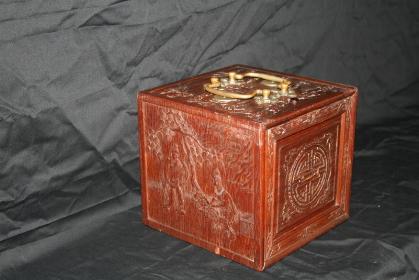
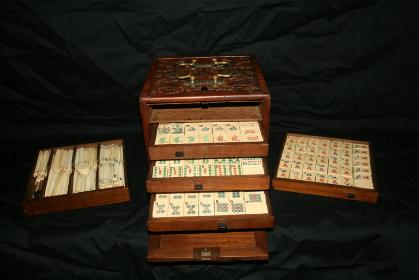
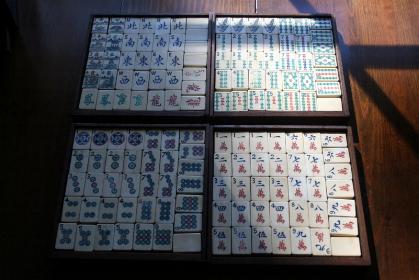
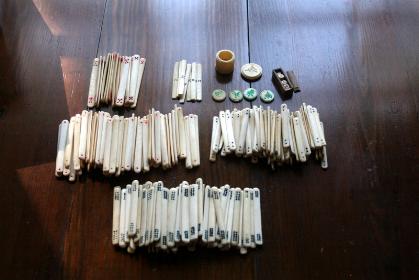
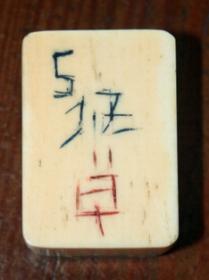
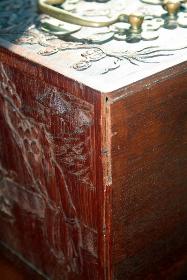
Hi Stephen,
You say the set is in Very Good condition (Item has a few defects that any normal person would notice upon close examination. All defects must be noted. ) But you don't mention any defects other than the one crudely-made Five Crak tile and the missing splinter from the case. I cannot tell from the photos how much Haversian system is present on your tiles, for instance. Other than those two defects, the absence of a manual, and a couple of missing sticks, it appears to be a reasonably nice made-for-export 1920s set. From the original photos (which are larger than the ones shown here), I discern that there's a fair amount of Haversian system, which detracts from its value. You didn't include a closeup of the flower tiles, which might be a factor in the set's value. I assume the flowers are attractive, and the dragons are of the feng and leung type, and you mention an operable spring-release mechanism, all of which adds to the value. So the defects and the pluses kind of cancel each other out. The box is ornately carved, but might be of modern origin, for all I know.
Still, the exact value is hard to determine, so I have to give you a range. A pennywise collector might not want to pay more than $100 for it, or then again, someone who doesn't have a set like that might be willing to spring for as much as $500 because of the ornately-carved box. Good luck.
Tom Sloper
Author of "The Red Dragon & The West Wind," the definitive book on Mah-Jongg East & West.
Los Angeles, California, USA
February 11, 2011
Questions about tournament rules
>From: Janet D
>Date: Thu, 10 Feb 2011 16:54:43 -0700
>Subject: NMJL Tournament Questions
>Hello Tom,
>Q. What is the procedure if East (without thinking) discards before the optional pass has taken place?
>Q. Where can I find rules governing NMJL tournament play?
>Many thanks,
>Janet D.
Hello Janet.
She should take the tile back until after the courtesy has occurred, then discard that same tile. If somebody at the table wants to question the validity of that (or get her called dead), then she can ask for a judge to rule on it. Maybe the judge will call her dead, maybe not.
You won't. No League tournament rules have been officially published anywhere. You can go to a tournament, and usually they'll hand you a Xeroxed sheet of their tournament rules (then you will have found one version). You can also read FAQ 21 -- link to the FAQs above left.
May the tiles be with you.
Tom Sloper
Author of "The Red Dragon & The West Wind," the definitive book on Mah-Jongg East & West.
Los Angeles, California, USA
February 10, 2011
I forgot to post this last week:

Tom Sloper
Author of "The Red Dragon & The West Wind," the definitive book on Mah-Jongg East & West.
Los Angeles, California, USA
February 3, 2011
Can you help me find a teacher? (Frequently Asked Question 4A)
>From: Ziporah Janowski
>Email: ziporahjanowski♥hotmail.com
>Subject: Teacher
>Date: Wed, 9 Feb 2011 17:35:40 -0500
>Hi,
>Live in Northern Westchester County and have a sudden hankering to learn to play American Mahjong with some friends. Can you help me find a teacher in our area? Thanks.
>I can be reached at this email.
Ziporah,
You have asked Frequently Asked Questions 15 & 4A.
Please scroll up and look for the blue and yellow flashing arrow (emblazoned "READ 1ST," like this ). I've already helped you by posting information about every mah-jongg teacher I know of, and more information about how you can look for teachers and players in your area. Please always check the FAQs first, before asking a question. Thanks!
You can also post on the Find Players/Teachers bulletin board. But before you do, you should search the page and see what you can find in your area. If you want to post your own announcement on that board, you should mention what state and/or country Westchester County is in.
May the tiles be with you.
Tom Sloper
Author of "The Red Dragon & The West Wind," the definitive book on Mah-Jongg East & West.
Los Angeles, California, USA
February 9, 2011
Can I claim a redeemable tile when it's discarded? (FAQ 19G)
>Date: Wed, 09 Feb 2011 16:25:32 -0500
>Subject: Mah-Jongg Q+A
>From: Joanne F
>My mah-jongg question or comment is:
>Situation:
>A player has exposed a group of tiles including a joker (example: three 5
>cracks and one joker to make a group of four 5 cracks).
>If another player discards the tile that the joker is replacing (a 5 crack),
>can the player with the exposed grouping of 5 cracks pick up the discarded
>tile and replace the joker in the exposed grouping (thereby putting the
>joker in the hidden hand)?
>This question came up at a game today and people disagreed on the answer...
>Thanks very much.
>Joanne F
>Thornhill, Ontario, Canada
You have asked
Frequently Asked Question #19G.
Please scroll up and look for the blue and yellow flashing arrow (emblazoned "READ 1ST," like this ). Find the link to FAQ #19 (it's marked with a red, white, and blue flashing arrow, emblazoned "AMERICAN," like this ) and click it.
After you've landed at the FAQ 19 page, please bookmark it so you can easily return to it anytime you have a mah-jongg question. Answers to all of the most frequently-asked questions about North American (NMJL) mah-jongg are found in FAQ 19. Please always check the FAQs first, before asking a question. Thanks!
May the tiles be with you.
Tom Sloper
Author of "The Red Dragon & The West Wind," the definitive book on Mah-Jongg East & West.
Los Angeles, California, USA
February 9, 2011
How much is mine worth, part 2
>From: "Woods, Craig - Hoboken"
>Date: Wed, 9 Feb 2011 15:56:51 -0500
>Subject: Mah-Jongg Q+A
>My mah-jongg question or comment is:
>Thanks, Tom, for taking the time to value my set. It is very much appreciated.
>AC Woods
Dear Readers: if you want a free assessment of your set, you MUST, PLEASE, provide the information I need! See FAQ 7H before asking for an assessment!
How much is mine worth?
>From: "Woods, Craig - Hoboken"
>Date: Wed, 9 Feb 2011 13:49:45 -0500
>Subject: How Much is my Set Worth?
>Dear Mr. Sloper,
>I am writing to inquire as to the value of my Mah-Jongg set. This set was purchased by my mom, I believe in Japan, back in either 1968, 1969 or 1970. The set has never been removed from the wooden case, which is a flat box with a sliding top, but I did take some of the pieces out so I could take pictures.
>There are 152 tiles in the set. I believe that they may be comprised of bamboo and bone, although I am not completely sure. The measurements of the tiles are as follows:
>Length – 15/16''
>Width – 10/ 16''
>Depth – 7/16''
>The set comes with 4 miniature die and 4 plastic chips. There is also an instruction booklet that accompanied this set. As with the tiles, these have never been used.
>I have enclosed pictures for your review. I must admit that my knowledge of Mah-Jongg is limited at best, so I really appreciate you taking the time out to review this for me.
>If you need further information, please do not hesitate to contact me.
>Sincerely,
>AC Woods
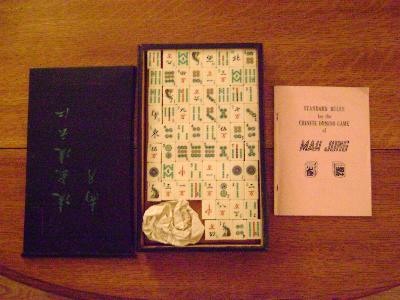
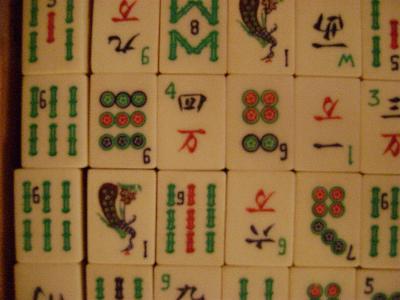
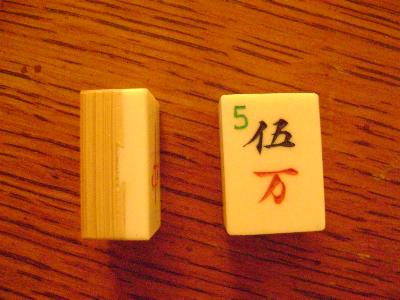
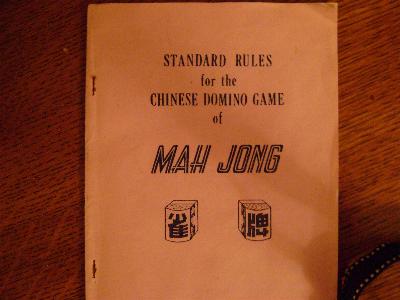
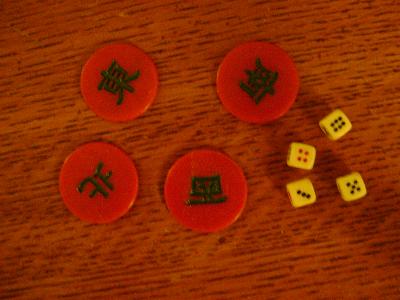
Hello, AC,
It's a common set with a common booklet. The value depends on the condition, like I clearly stated in FAQ 7H. Your statement that the tiles have never been removed from the box is questionable, since the tiles are disorganized.
You say the tiles are in Mint condition, but you didn't say what condition the box and manual are in. If the box and manual are also in Mint condition, then the set might be worth $90, give or take, in North America. Apparently they sell for more in the UK. But if the box and manual are in Good condition, then the set (regardless of the tiles' excellent condition) would go for maybe $60, give or take.
By the way, the plural of "die" is "dice." ("Die" is the singular of "dice.")
May the tiles be with you.
Tom Sloper
Author of "The Red Dragon & The West Wind," the definitive book on Mah-Jongg East & West.
Los Angeles, California, USA
February 9, 2011
Set value Q pt. 2
>Date: Tue, 8 Feb 2011 11:54:07 -0600
>Subject: Thanks
>From: Christopher P
>Thanks for taking a look, sorry about the skimpy info!
Set value Q
>Date: Tue, 8 Feb 2011 11:09:26 -0600
>Subject: Set Value Question
>From: Christopher P
>Hello Tom,
>I'd love your thoughts on value for this mah jong set please.
>The set has 152 tiles in fine condition as well as two dice.
>They are some kind of plastic, tri layer with an orange base layer, clear middle and ivory colored top layer.
>There are eight tiles with "mazeltov" written diagonally on each.
>The box is a faux alligator with no markings and no papers. Box shows significant signs of age.
>Four racks, three have brass colored ends and one has a silver end and is marked Crisloid. This name only appears on the odd silver rack and nowhere else.
>Enclosed are pics to help evaluate.
>I'm still working on my lingo and descriptions, please bear with me.
>Appreciate your help and great website.
>Regards,
>Chris
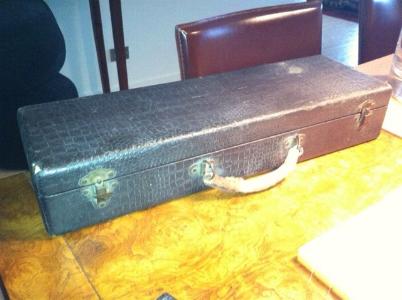
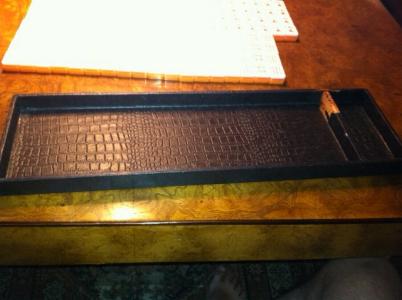
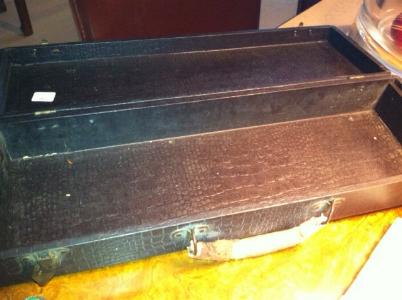
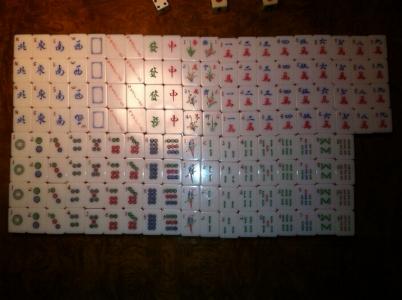
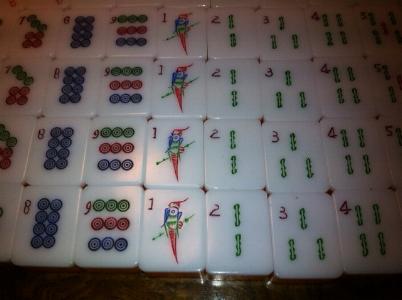
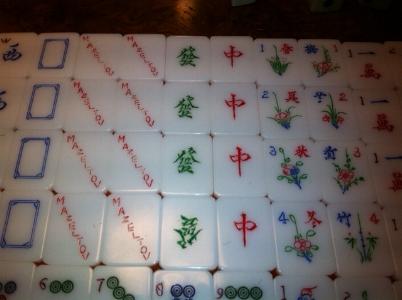
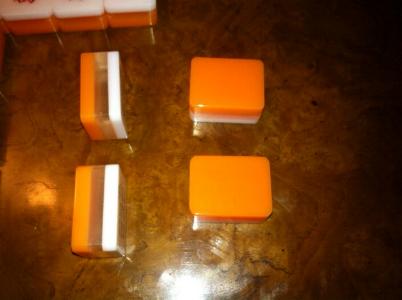
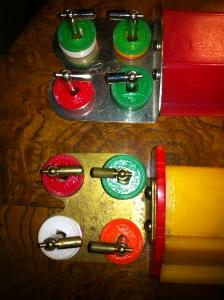
Chris,
Based on the skimpy information you gave me but mostly on the photos, it looks to me like the case actually is going to hurt you. I think you should buy a new case for the set. But make sure the racks and tiles will all fit! A new case would probably cost you $50 or $60. If this set was in a new case, it might sell for from $100 to $150. In the decrepit case you have, definitely under $100 (because the buyer would have to shell out the $50 or $60 for a decent case). Maybe around $50 to $70.
May the tiles be with you.
Tom Sloper
Author of "The Red Dragon & The West Wind," the definitive book on Mah-Jongg East & West.
Los Angeles, California, USA
February 8, 2011
Why a player should not touch another player's tiles
>From: jacqueline j
>Sent: Mon, February 7, 2011 4:35:44 PM
>Subject: Why a player should not touch another players tiles
>Dear Sir:
>I started a Mah Jongg Club at my community and the question came up why a player should not touch another players tiles.
>Example: Taking a joker off another players rack, or East dealing all the tiles to other players.
>I told the ladies some players in their exuberance in getting a Joker disturb the tiles in the rack and they end up everywhere but on and in the rack exposing tiles for all to see.
>When I teach Mah jongg I tell my students to put the tile in the palm of their hand and say to the player with the Joker, "May I have your Joker please." Let the player with the Joker do the exchange.
>Some of the ladies wanted to know if it is just superstition or is their some official rule in place on why you should not touch another players tiles.
>I could not find a rule in any of the books or websites I consulted on why players do not like other players touching their tiles.
>I would appreciate your expertise on this subject please.
>Jokers to you!
>Jackie J
Hi Jackie, you wrote:
the question came up why a player should not touch another players tiles.
>Example: Taking a joker off another players rack...
>I told the ladies some players in their exuberance in getting a Joker disturb the tiles in the rack and they end up everywhere but on and in the rack exposing tiles for all to see.
Yes. And another reason is "because the other player might get angry at you and warn you never to touch her tiles." I've encountered players like that in tournaments.
When I teach Mah jongg I tell my students to put the tile in the palm of their hand and say to the player with the Joker, "May I have your Joker please." Let the player with the Joker do the exchange.
Yep. I'm assuming you read my reply to Molly (below) and you're responding to it? Certainly that's the most polite (and harmonious) way to do it.
Some of the ladies wanted to know if it is just superstition
Tell them "no."
or is their some official rule in place on why you should not touch another players tiles.
Tell them "no." Actually, the official rulebook just gives the bare bones of the rules, and doesn't make a clear distinction between "rules" and "etiquette" or "table practices."
I could not find ... why players do not like other players touching their tiles.
It's possible to cheat, I suppose, if the tile-toucher has skilled hands like a magician or a con artist.
May the tiles be with you.
Tom Sloper
Author of "The Red Dragon & The West Wind," the definitive book on Mah-Jongg East & West.
Los Angeles, California, USA
February 7, 2011
Methods of redemption
>From: Molly A
>Sent: Sun, February 6, 2011 10:23:11 PM
>Subject: Mah-Jongg Q+A
>My mah-jongg question or comment is: I am so scared to ask the question but I have tried to find the answer on your website and have been unsuccessful, so here goes: When you redeem a joker with a natural tile, is there a specific way to do it? I understand that it has to be your turn and you have to have picked from the wall or called a discard first but what is the exact procedure for redeeming. I have friends who have suffered penalties at tournaments for putting the natural tile in front of the rack of the player with the exposure with the joker, because they are told that it is considered a discard as soon as the tile hits the table…..soooooo….are we supposed to stand up and put it on the rack of the player with the exposure or announce over the loud speaker that we are redeeming a joker? I am playing in a tournament tomorrow and would love some insight. If this is already explained somewhere in your formidable assemblage of information, I apologize. Molly
Hi Molly,
You wrote:
I have friends who have suffered penalties at tournaments for putting the natural tile in front of the rack of the player with the exposure with the joker, because they are told that it is considered a discard as soon as the tile hits the table
Perhaps your friends didn't bother announcing what they were doing, but rather just put the tile on the table. In which case, yes. The tile is "down" and discarded, as described in FAQ 19A.
If your friends said, "I'm redeeming that joker, here's the natural," and then put the tile on the table, then whoever called them dead was perhaps being a bit too eager to call them dead, but arguably in the right.
are we supposed to stand up and put it on the rack of the player with the exposure or announce over the loud speaker that we are redeeming a joker?
The table is not really so large that it's never possible to lay the tile upon the other player's rack, now is it?
is there a specific way to do it?
If it's too far to put the tile on the horizontal top surface of the exposed player's rack, then while saying "I'd like that joker, please," simply hold the natural in the hand, with arm extended towards the player. The other player then lifts her joker, puts it in your hand, takes your natural, and puts the natural in her exposure. You then say, "thank you."
Otherwise, if the exposure is within reach, it is not out of line to simply make the exchange yourself. Saying something is customary. Like for example, "I'll just have that pretty little joker, thank you."
May the tiles be with you.
Tom Sloper
Author of "The Red Dragon & The West Wind," the definitive book on Mah-Jongg East & West.
Los Angeles, California, USA
February 7, 2011
Value, part 2
>Date: Sun, 6 Feb 2011
>From: JasonW
>Subject: re: Mah-Jongg Q&A
>Thank you.
Value?
>Date: Sat, 5 Feb 2011 20:25:55 -0800 (PST)
>From: JasonW
>Subject: Mah-Jongg Q&A
>Dear Mr. Sloper,
>I am in possession of my late grandmothers 164 Ivory tile Mah-Jongg set. (Make that 165 with an orange tile that seems to me as "out of place". My mother told me that this set was purchased new by my grandfather in NYC sometime in the 1940's and the tiles are made of Ivory which is no longer used to make the tiles. I have attached some jpeg files for you to view. I have no instruction booklet and really dont know what I am looking at. There is also a plastic bag with small round colored chips and two keys to the burgandy case which has an odor that its been around for a while. I am curious what you think set this might be worth. Overall the case appears to be worn but everything else seems to be in good shape. I was considering listing it on ebay but am not sure what to expect. Thank you for your time.
>Sincerely,
>Jason W
>North Carolina
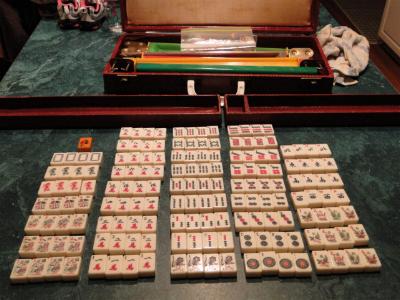
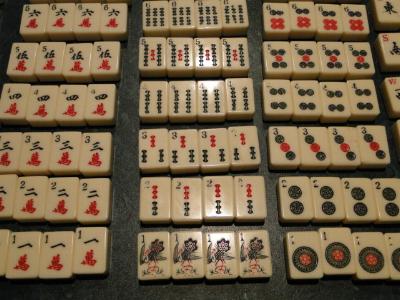
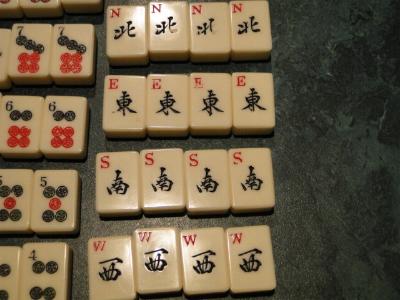
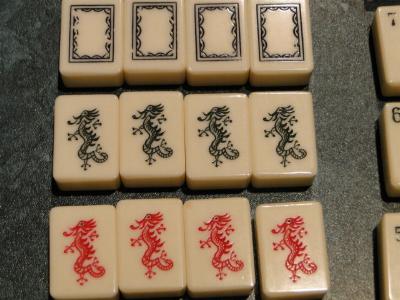
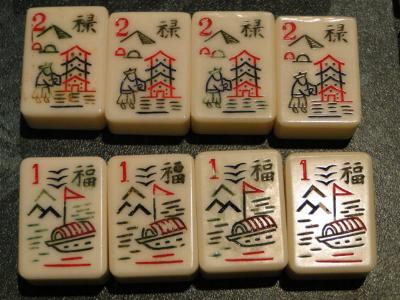
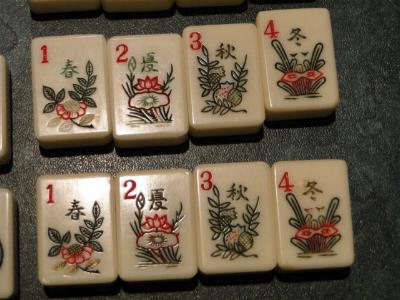
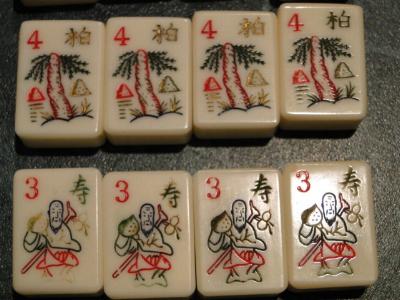
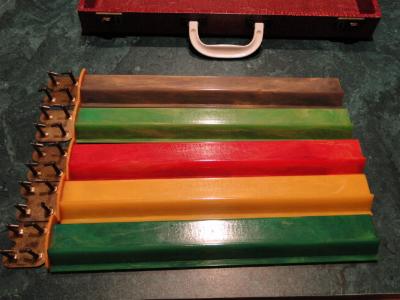
Mr. W.,
You didn't give me all the information requested in FAQ 7h, but I think I can make a stab at it anyway.
First off, the tiles are NOT made of ivory -- they're plastic. See FAQ 7c. Secondly, I think the set was made in the 1950s, not the 40s. Take a look at column #311. The set was made for playing American-style mah-jongg, and was probably made in America. You didn't indicate how many chips there are, but most people won't care about that. You say the case is smelly but everything else is "in good shape." If you look at FAQ 7h, you may want to revise that descriptor. But let's say the tiles and racks are in "Good" condition but the case is worn and smelly. With 28 flower tiles, it's got plenty enough tiles for any player of American-style mah-jongg, with a whole lotta extra tiles most players won't know what to do with. The set might be worth more to someone who buys and sells sets, since they can use the extra tiles.
You didn't show a tile back or mention what color the backs are, so I assume the backs are the same color as the fronts.
For someone who wants a set to play with, a regular modern set can be bought for $90-150. If your set isn't prettier or more exotic than a regular set, and in like-new condition, then it's going to go in the same range. Your dragons are a little prettier, but the other tiles show a lot of worn-off paint. So it belongs in the low end of the price range.
I sure don't know why you thought the tiles were made of ivory...!
May the tiles be with you.
Tom Sloper
Author of "The Red Dragon & The West Wind," the definitive book on Mah-Jongg East & West.
Los Angeles, California, USA
February 5, 2011
Question about generals
>Subject: General question
>From: nrk2378
>Date: Sat, 5 Feb 2011 18:13:45 -0500 (EST)
>I came across a "vintage" set that has black dragons and black bamboos instead of green. The tiles are ivory/white in color - not material. They are not bakelite either although the racks are bakelite - which leads me to think the set is pre 1970. Can you tell me anything about the black vs green dragons and bamboos?
>Thanks
Maybe, if you send me some photos and a question that does not contain the word "anything" in it.
In other words, I need clear focused questions -- what is it you want to know exactly?
I thought you were going to ask me something about generals? (^_^)
By the way, I don't know what the word "vintage" means to you. If you haven't read the FAQs yet, please do.
Please scroll up and look for the blue and yellow flashing arrow (emblazoned "READ 1ST," like this ).
Please always check the FAQs first, before asking a question. Thanks!
By the way, I also don't know what the phrase "came across" means -- somebody gave it to you, you saw it on eBay, you saw it in an antique store, a friend showed it to you...?
May the tiles be with you.
Tom Sloper
Author of "The Red Dragon & The West Wind," the definitive book on Mah-Jongg East & West.
Los Angeles, California, USA
February 5, 2011
What about "Heavenly Hand"? (part 3)
>From: Cathy D
>Sent: Fri, February 4, 2011 10:32:44 AM
>Subject: Earthly Hand
>Well, Tom, is it you or is it me? I wasn't asking about the Heavenly Hand. . . I get that, (as I stated in my last note); what I was asking about is what was phrased as "Earthly Hand" (so forget Heavenly Hand, no need to rehash that). And I did read everything you wrote (both in the Column #476 and the FAQ #19 B, multiple times). Your column mentioned the phrase "Earthly Hand". This is from your Column:
2. How about if the hand was complete after the first right pass of the Charleston? In other forms of mah jongg, a "second-chance Heavenly" hand is called "Earthly Hand." If the League doesn't recognize that, having to pass three tiles out of a complete hand would certainly be very frustrating!
>So when reading the FAQ #19 BJ (as the column directs you to do), it only referenced the "Heavenly Hand" again, no reference to Earthly Hand (that is where I lost the trail of the Earthly Hand), but I am now realizing that because you didn't mention it again, and only went through the process of Heavenly Hand, that by omission, Earthly Hand is apparently not recognized, and only Heavenly Hand is recognized.
>Wouldn't it have been more clear to readers to just write that the "Earthly Hand" is not recognized in American Mah Jongg (since it apparently is in other Ma Jongg games)? That was what I was trying to discover and what seemed to be missing for me when I went from your column directly to the FAQ.
>Cleared up now. Thanks.
>Cathy on Whidbey
Hi Cathy,
I mentioned 3 times in my reply of this morning that once a player had not achieved Heavenly Hand, the standard Charleston rules still apply. You say:
Wouldn't it have been more clear to readers to just write that the "Earthly Hand" is not recognized in American Mah Jongg (since it apparently is in other Ma Jongg games)?
You would think so, but if I said that in FAQ 19, then I'd get a ton of emails all asking me "What the heck is Earthly Hand?" I think I'll modify FAQ 19.BJ to note that Heavenly Hand is the only exception to the standard Charleston rules.
May the tiles be with you.
Tom Sloper
Author of "The Red Dragon & The West Wind," the definitive book on Mah-Jongg East & West.
Los Angeles, CA (USA)
February 4, 2011
What about "Heavenly Hand"? (part 2)
>From: Cathy D
>Subject: Re: Declaring Mah Jongg during the Charleston
>Date: Friday, February 4, 2011, 12:23 AM
>Thank you for the quick posting and response. I have now read your column #476, so thank you for clarifying the "Heavenly Hand" for me. It did however mention the phrase "Earthly Hand" (if I understood it correctly, it is a sort of 2nd chance for MJ after the 1st right of the Charleston), but it did not address if this was allowed, it only said it would be frustrating if it was not.
>So, is it allowed/legal to declare Mah Jongg if the 1st right gives you the tiles to complete Mah Jongg before you have to pass across? Sorry, but I just found it a bit confusing . . . if making an "Earthly Hand" and declaring Mah Jongg is allowed or not (or is it just frustrating)?
>Your column explanation was completely understandable regarding if the 1st across pass gave me Mah Jongg, on the first left of the Charleston I could blind pass all three tiles and I could stop the Charleston and then decline any optional passing, it is just whether this "Earthly Hand" (before making the first across) is allowed in American Mah Jongg rules?
>Thanks again,
>Cathy on Whidbey
Hello Cathy,
So you're saying that you didn't read my full reply here on the bulletin board before, where I said:
After I wrote the column, I sent a letter to the League asking for the official ruling, and I got a very nice reply confirming that indeed Heavenly Hand is recognized. But once the "first right" pass has occurred, all bets are off -- from then on, standard Charleston rules apply.
... the rare "Heavenly" circumstance has not occurred, and everyone is subject to the standard Charleston rules. "Mandatory" always means "mandatory." "Compulsory" always means "compulsory"...
And when you read column 476, you did not notice the note at the bottom:
FOLLOW-UP: After writing this column, I sent a letter to the League to request the official ruling. You can read about it in FAQ 19 -- it's Frequently Asked Question 19.BJ.
And you didn't click the FAQ 19 link and read FAQ 19.BJ, where it says:
Q: What if I'm dealer and I have a complete hand before the Charleston?
A: Ah, yes, "Heavenly Hand." I wrote about it in column 476, then wrote a letter to the League requesting an official ruling. The ruling: Heavenly Hand is indeed recognized. It's valued the same as a self-picked mah-jongg. But once the "first right" pass has occurred, all bets are off -- the standard Charleston rules apply. Mandatory (compulsory) passes are still mandatory; you can still blind pass when you're normally permitted to blind pass; you can still stop the Charleston after the first left. You can refuse to exchange tiles during the final Courtesy exchange as usual.
If you scroll down from here, you'll see the words that I said before that you apparently missed (just below).
May the tiles be with you.
Tom Sloper
Author of "The Red Dragon & The West Wind," the definitive book on Mah-Jongg East & West.
Los Angeles, California, USA
February 4, 2011
What about "Heavenly Hand"?
>Date: Thu, 3 Feb 2011 11:51:44 -0800 (PST)
>From: Cathy D
>Subject: Declaring Mah Jongg during the Charleston
>First, I love your site. Second, I did peruse your EXTENSIVE list of FAQs, and did not readily find this question posted or answered (if it has been asked and answered, then my apologies up front). My question is this:
>Although the odds of this occurring are probably astronomical, I came so close to this yesterday, that it raised the question, which none of us could answer definitively and I am hoping you can/will . . .
>Tiles have been dealt, we are on the first pass of the Charleston to the right. As a result of the first pass to the right, I have everything except 1 tile to make Mah Jongg (yes, lucky me). However, IF I had received the tiles I needed for MJ on that first (or even second, before completing the Charleston, or take it a wild step further and say you were dealt MJ), could I declare Mah Jongg (since the "compulsive" Charleston [right, across, left] was not completed), or would I have to tear up my hand and pass away my MJ tiles in order to complete the Charleston?
>I am afraid you will say that "compulsive Charleston, means you MUST COMPLETE the first Charleston", and to that I would say, how sad! What is your ruling oh Exhaulted MJ one?
>Never Too Old To Learn,
>Cathy on Whidbey
Hello Cathy,
I just recently wrote a column about "Heavenly Hand" (the rare event in which the dealer has a complete mah-jongg hand at the start of the Charleston). It's column 476.
Note that once the Charleston has begun, the rare "Heavenly" circumstance has not occurred, and everyone is subject to the standard Charleston rules. "Mandatory" always means "mandatory." "Compulsory" always means "compulsory" (and has nothing whatsoever to do with the word "compulsive" -- that's an entirely different word).
After I wrote the column, I sent a letter to the League asking for the official ruling, and I got a very nice reply confirming that indeed Heavenly Hand is recognized. But once the "first right" pass has occurred, all bets are off -- from then on, standard Charleston rules apply.
May the tiles be with you.
Tom Sloper
Author of "The Red Dragon & The West Wind," the definitive book on Mah-Jongg East & West.
Los Angeles, California, USA
February 3, 2011
Can you name a joker anything?
>From: kp
>Sender: "Lee P
>Subject: Mah-Jongg Q+A
>Date: Wed, 2 Feb 2011 17:19:08 -0700
>My mah-jongg question or comment is:
>When discarding a joker, can you name it anything? Or does it have to be joker or same?
>Karen P
Hello Karen, you asked:
When discarding a joker, can you name it anything?
No. If previous discard was eight dot, you cannot name the joker "west."
Or does it have to be joker or same?
Yes. If previous discard was two dot, you can say "same" or "two dot" or "joker."
May the tiles be with you.
Tom Sloper
Author of "The Red Dragon & The West Wind," the definitive book on Mah-Jongg East & West.
Los Angeles, California, USA
Groundhog Day, 2011
Why so many players of American mah-jongg are Jewish
>From: "H, Bill"
>Sent: Tue, February 1, 2011 2:17:58 PM
>Subject: FAQ T - mah-jongg
>I think a better answer to your FAQ [19]T may derive from the fact that in the lower east side of NYC a hundred years ago, many groups lived packed together, and several ethnic neighborhoods abutted each other. Little Italy, Chinatown, and the Jewish part of the lower east side are all adjacent in a small area. I heard that in the 1890-1920 period, the lower east side of NY had the most dense population on the planet.
>It would not be a stretch to think that Mrs. Chan could invite Mrs. Cohen and Mrs. Sorvino and Mrs Goldberg down to her apartment to drink tea and play mah-jongg.
>Bill H, Hamden, CT
Well, okay then. Glad that's settled! Thanks, Bill.
May the tiles be with you.
Tom Sloper
Author of "The Red Dragon & The West Wind," the definitive book on Mah-Jongg East & West.
Los Angeles, California, USA
February 1, 2011
[Edit: Added this thought to FAQ 19T.]
I need tiles
>From: Evie G
>Sent: Mon, January 31, 2011 7:58:06 PM
>Subject: Need tiles for my 70 year old Mah Jongg set
>Tom:
>I have a Mah Jong set from my grand mother that is wonderful, but two of the tiles need to be replaced. I have contacted Mah Jong headquarters in NY and they said they no longer replace tiles it is too difficult. Can you refer me to a company that can help me.
>Thank you very much.
>Evie G
Hi Evie,
Yes, you can check out Matthew Shim's MahjongTiles website. There are links to it on the Tiles Wanted bulletin board (above left), the Tiles For Sale bulletin board (above left), and in FAQ 7R (above left).
I was surprised to hear you say that the NMJL told you they don't do that any more, so I checked their website and their latest bulletin. On the website it says:
Rescuing Mah Jongg Sets
If you have lost tiles from your set or have an older set that needs additional tiles, the League will make an attempt to obtain a match for your set. If you need a tile or tiles, send it to us, in an insulated bag (jiffy bag). Request the specific tiles needed, be it a Joker, Flower or Symbol. The League will obtain the nearest match to your set and substitute the new tile, putting a Joker, Flower or Symbol decal on your tile. This gives the best "mix" of tiles, since all tiles age somewhat differently.
The League will do its utmost to provide symbol tiles exactly as requested. Price is $4.50 per tile ($5.50 for bamboo), including postage. Please include check or money order with your request.
© 2011 The National Mah Jongg League Inc.
And I noticed that their website is totally redesigned. And it has to be a very recent redesign, since there's a 2011 copyright notice, and it's still January (for another couple hours, anyway). Then I checked the latest bulletin (just got it this past month), and found this:
PLEASE SEND TILES AFTER APRIL 1st
This is how we try to rescue your set...
Carefully wrap and send us one of your tiles (in a jiffy bag) and request for a specific tile be it a joker, flower, or symbol tile. We try to get the nearest match to your set... and substitute our tile and use our joker decals or flower decals on your own tiles... we will try to give you symbol tiles as requested, if we can... tiles all oxidize and no two are exactly the same. Price: $4.50 per tile or $5.50 for a bamboo-backed tile.... which includes postage and handling.
So I have to conclude that they just don't want to replace tiles now, because this period of time (preparatory to sending out the new card) is a very busy time for them - and that after April 1st you can send them one of your tiles for them to match. And I'm also guessing that you phoned them rather than mail them a tile, and it's possible that there was a miscommunication between you and whoever you talked to.
Or they really have decided to cancel that service despite what they say on their brand new redesigned website and in their very latest and up-to-date bulletin. That is indeed possible.
But anyway, you can give Matthew a try.
May the tiles be with you.
Tom Sloper
Author of "The Red Dragon & The West Wind," the definitive book on Mah-Jongg East & West.
Los Angeles, California, USA
January 31, 2011
Special hand for the Year of the Rabbit?
>Date: Sun, 30 Jan 2011 11:42:57 -0800
>From: cwalker67
>Subject: Year of the Rabbit Hand
>Hi, our group has enjoyed the Year of the Tiger hand (SSS EEE 2010 2011) and are looking forward to your Rabbit creation. Thanks! Connie
Connie,
Good idea, and very timely. Check this week's column. (^_^)
May the tiles be with you.
Tom Sloper
Author of "The Red Dragon & The West Wind," the definitive book on Mah-Jongg East & West.
Los Angeles, California, USA
January 30, 2011
Are you going to make a YouTube video?
>From: "robert kalin"
>Subject: Youtube and Mahjong
>Date: Sun, 30 Jan 2011 13:17:39 -0500
>I love reading and seeing (photos) about your adventures in mahjong around the world. To me you are the foremost american english speaking expert on mahjong. Your pages are about the best in reguards to the rules of the game. Every time I mention mahjong I keep pointing folks to your page as the best starter refference.
>Unfortunately when it comes to a quick video overview I unfortunately keep reffering to youtube. One particular video in the ‘board games with scott' series goes over mahjong quite well.
>Recently thinking about the disconnect between the two refferences I keep wondering.
>Are you going to provide a youtube video presentation on mahjong for new western players?
>Bob Kalin.
I think about it sometimes.
May the tiles be with you.
Tom Sloper
Author of "The Red Dragon & The West Wind," the definitive book on Mah-Jongg East & West.
Los Angeles, California, USA
January 30, 2011
I do hope there is a CD out there somewhere that has American Mah Jongg, pt. 2
>Date: Sat, 29 Jan 2011
>From: Nancy B
>Subject: Re: Mah Jongg CD
>Thank you -- so very much -- for your prompt response to my query. I'm disappointed, of course, but I appreciate your suggestions.
>Sincerely,
>Nancy B
You're welcome, Nancy. Thanks for the thanks. (^_^)
May the tiles be with you.
Tom Sloper
Author of "The Red Dragon & The West Wind," the definitive book on Mah-Jongg East & West.
Los Angeles, California, USA
January 29, 2011
I do hope there is a CD out there somewhere that has American Mah Jongg
>Date: Sat, 29 Jan 2011 10:54:20 -0800 (PST)
>From: Nancy B
>Subject: Mah Jongg CD
>I'm a new Mah Jongg player and I enjoy the game very much; however, the players in this group play SO FAST! Is there a CD for American Mah Jongg to purchase and install in my computer? I would like to improve my game, but I don't want to play online. I would prefer to play 'against my computer'.
>I'm a bridge player and I have Bridge Baron which is a CD to install my computer. I can play bridge to my heart's content and I've improved my bridge game immensely.
>I do hope there is a CD out there somewhere that has American Mah Jongg to help me out.
>Looking forward to hearing from you soon. Thank you.
>Nan B
Sorry, Nancy.
There used to be, but there isn't any more. The only American-style software available now is only online (not on CD), and is listed in
Frequently Asked Question #5.
Please scroll up and look for the blue and yellow flashing arrow (emblazoned "READ 1ST," like this ).
Please always check the FAQs first, before asking a question here. Thanks!
May the tiles be with you.
Tom Sloper
Author of "The Red Dragon & The West Wind," the definitive book on Mah-Jongg East & West.
Los Angeles, California, USA
January 29, 2011
What does "racking" mean? (Frequently Asked Question 19AD)
>From: "Shirley"
>Subject: Mah-Jongg Q+A
>Date: Thu, 27 Jan 2011 15:49:45 -0500
>My mah-jongg question or comment is: If a player picks a tile, lays it behind her rack, the slow player on her right calls previous discard, Is the tile on the table behind the rack, not racked??
Hello Shirley,
You have asked
Frequently Asked Question #19AD.
Please scroll up and look for the blue and yellow flashing arrow (emblazoned "READ 1ST," like this ). Find the link to FAQ #19 (it's marked with a red, white, and blue flashing arrow, emblazoned "AMERICAN," like this ) and click it.
After you've landed at the FAQ 19 page, please bookmark it so you can easily return to it anytime you have a mah-jongg question. Answers to all of the most frequently-asked questions about American (NMJL) mah-jongg are found in FAQ 19. Please always check the FAQs first, before asking a question. Thanks!
May the tiles be with you.
Tom Sloper
Author of "The Red Dragon & The West Wind," the definitive book on Mah-Jongg East & West.
Los Angeles, California, USA
January 27, 2011
I need Flowers and Jokers.. please advice..
From: Cwestmanaol.com
Date: Wed, 26 Jan 2011 20:41:07 EST
Subject: RE Tiles
Material:
Color(s):
Dimensions:
Tile(s) wanted:
URL (internet address) of online photos:
I need Flowers and Jokers.. please advice..
Thanks Charlotte
Charlotte, you have asked
Frequently Asked Question #7R.
Please scroll up and look for the blue and yellow flashing arrow (emblazoned "READ 1ST," like this ).
Answers to all of the most frequently-asked questions about mah-jongg are found in the FAQs. Please always check the FAQs first, before asking a question. Thanks!
May the tiles be with you. Literally.
Tom Sloper
Author of "The Red Dragon & The West Wind," the definitive book on Mah-Jongg East & West.
Los Angeles, California, USA
January 26, 2011
Its origin and value?
>From: Mr clarence t
>Sent: Tue, January 25, 2011 11:17:12 PM
>Subject: I need some help my dad had this set get got in the 70s
>We were never alowed to touch them when we were kids but now the set is mine and
>I wold like to find where they were mad if I can where is the top site to
>identify origion and value. If you could help I would appriciate it verry much.
>Clarence T
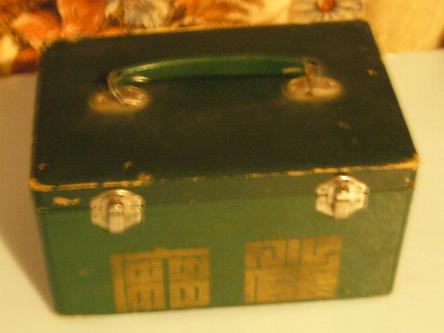
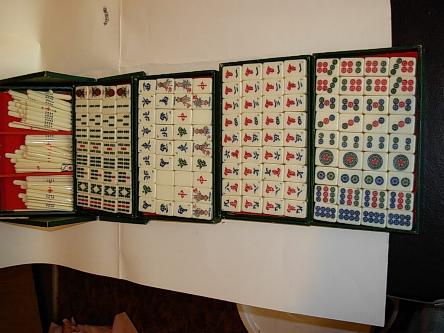
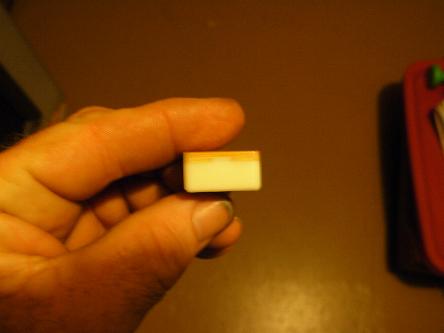
Hello Mr. T.,
Your box looked familiar, so I scrolled down and found that you asked me before about this set on December 10. As I told you then, I believe your set was made somewhere in Asia: probably China, or perhaps Korea. As for its worth, it's less than $100. Maybe around $50.
May the tiles be with you.
Tom Sloper
Author of "The Red Dragon & The West Wind," the definitive book on Mah-Jongg East & West.
Los Angeles, California, USA
January 2, 2011
Newbie Q's - part 2
>From: Lynn P
>Sent: Tue, January 25, 2011 6:44:36 PM
>Subject: Mah-Jongg Q+A
>My mah-jongg question or comment is: Re: Newbie Q's by Judy on 1/24: I would highly recommend that all new mah jongg players buy a copy of Tom Sloper's book "The Red Dragon & The West Wind" even if they have a copy of the NMJL Rule book. Every group should have at least one copy of "RD & WW" since it is an excellent reference book for American and Chinese mah jong. My American mah jong groups have referred to it many times. It is easy to read and many strategies are outlined in the book. I now carry my copy to all my games. "RD & WW" is worth its weight in gold. Don't play mah jongg without it!! Lynn P.
History of mahjong
>Date: Tue, 25 Jan 2011 23:03:08 +0800
>Subject: The History and Culture of Mahjong
>From: The Suffocated (aloneinthefart)
>Dear Mr Sloper,
>I am a Hong Kong blogger who is doing some hobby research on the history of Chinese card and dominoe games (e.g. see my series of articles on Tien Gow here and some blog entries on the Hakka card game Luk Fu here). Incidentally, I came across your website and found it very detailed and informative. I really appreciate that you went through the trouble to ask the Mahjong Museum in Chiba for a copy of Frederick Harvey's diary. I have a few questions, though, and I would be grateful if you could give me some pointers.
>1) In your Tianyi Pavilion travel notes, I spotted the phrase "Frederick (FEB) Harvey". What does this FEB stand for?
>2) In your "History of Mahjong (FAQ11)", you cited the following paragraph from the booklet "The History and Culture of Mahjong":
> "During the reign of Emperor Xianfeng of the Qing Dynasty, Madiao paper cards were modified by Mr. Chen Yumen of Ningbo to become the basic cards of Mahjong. Mr. Chen Yumen (1817-1878), also called Zhengyao and Yanglou... was very skillful at paper-card playing... For details on how Chen Yumen invented Mahjong, read here the "biography" of Chen Yumen."
>Following this paragraph is a photo that you took of a biography. Is this biography the one the above passage refers to?
>3) As the characters in your photo are too small, I downloaded a copy of the original biography (note: the speed of download is very slow) from a Chinese government website. However, I don't find any reference to Mahjong (or playing cards) in it. Actually, I have long suspected that the Chen Yumen story is a scam (but surely, the Tianyi Pavilion wasn't the first to cook up a story ---- J.B. Powell was perpahs the first), but I cannot refute it by looking at just one paragraph. Would you kindly give me a copy of the whole booklet? A "photocopy" (that is comprised of photos of the booklet's pages) would be fine if creating a scanned copy is too troublesome.
>4) On the website of Chiba Mahjong Museum, it is said that the Chiba Mahjong Museum will establish a branch in Ningpo. (Incidentally, it also advocates the Chen Yumen story.) Since I rely on Google's translation to read Japanese, I may have misread the passage. Do you know anything about the relation between the two mahjong museums in Chiba and Ningbo?
>By the way, in old times, those Chinese who were educated had two names, one ( ) called by his family and relatives, and one ( ) called by his family and relatives, and one ( ) called by the others. The "Zhengyao" ( ) called by the others. The "Zhengyao" ( ) you mentioned on your website is the former; Yumen ( ) you mentioned on your website is the former; Yumen ( ) is the latter. ) is the latter.
>Best regards,
>The suffocated
Hello, "The suffocated," you wrote:
"Frederick (FEB) Harvey". What does this FEB stand for?
I assume it's his initials. Many upperclass Brits had more than one middle name. The F stands for Frederick, of course. You could try Googling. I did just now, and found
http://books.google.com/books?id=NiW-uogYXQMC&pg=PA48&lpg=PA48&dq
=frederick+f.+e.+b.+harvey+consul+ningbo&source=bl&ots=UONPsQCKD3
&sig=jYFXKEDWErrD9CTmP86pPOx_Qqc&hl=en&ei=5Gc_Tf6aIoSisQODxMH9BA&
sa=X&oi=book_result&ct=result&resnum=2&ved=0CB0Q6AEwAQ#v=onepage&
q&f=false
(line breaks inserted to fix a problem caused by very long URLs)
read here the "biography" of Chen Yumen."
>Following this paragraph is a photo that you took of a biography. Is this biography the one the above passage refers to?
You mean Fig. 24 at http://sloperama.com/mjfaq/mjfaq11b.htm? It's a scan from the museum booklet.

the characters in your photo are too small
Did you click Fig. 24 to see the full-size scan?
I downloaded a copy of the original biography...from a Chinese government website.
Wonderful! I wish I was able to read Chinese so I could find documents (much less read them).
However, I don't find any reference to Mahjong (or playing cards) in it.
Is it the same "biography" shown in the booklet? Some kind person translated that for me, and yes, there's no particularly helpful mahjong info in it.
I have long suspected that the Chen Yumen story is a scam
Well, if you manage to find any evidence of that, the mahjong scholars of the world would dearly love to hear about it.
Would you kindly give me a copy of the whole booklet?
Since you can read and write Chinese, wouldn't it be fairly simple for you to contact the museum in Ningbo and order a copy by mail? I do not think it says much at all about Chen Yumen.
On the website of Chiba Mahjong Museum, it is said that the Chiba Mahjong Museum will establish a branch in Ningpo. (Incidentally, it also advocates the Chen Yumen story.) ... Do you know anything about the relation between the two mahjong museums in Chiba and Ningbo?
That may be old information -- perhaps it's a reference to some past collaboration with the Tianyi Pavilion (maybe Mr. Noguchi, who passed away recently, provided some funds to the Tianyi Pavilion so that the mahjong garden could be constructed. I wonder what will happen to the Chiba museum now that Mr. Noguchi is gone, actually.
in old times, those Chinese who were educated had two names, one () called by his family and relatives, and one () called by the others. The "Zhengyao" () you mentioned on your website is the former; Yumen () is the latter.
Thanks for the information.
May the tiles be with you.
Tom Sloper
Author of "The Red Dragon & The West Wind," the definitive book on Mah-Jongg East & West.
Los Angeles, California, USA
January 25, 2011
Korean set, part 4
>Date: Tue, 25 Jan 2011 13:33:27 -0800
>Subject: Re: Seoul Mahjong Tournament Set?
>From: James A
>Hi again Tom. What makes you think that the likelihood of the tile
>material is plastic and not compressed-fish bone? It looked to me like
>the fish bone pics you posted look exactly like mine and seem to meet
>all "your" criteria for being fish bone--maybe even the tactile
>criteria isn't mentioned. They don't feel like plastic. Or certainly
>any plastic I've felt. They feel more like stones if I had to compare
>it to anything. Anyway, I've read in the FAQs that American sets use a
>vinyl/plastic a lot, but since this set is probably Korean, what made
>you conclude plastic over fishbone? Are vinyl tiles typical to Korean
>sets? Thanks again for your help and education.
>-James
Hi James,
Because every set I've had that looks like that and that comes in a red/black vinyl case has been plastic on bamboo. Fishbone does not feel like "stone" but the type of plastic used in Japanese and Korean sets does. Read FAQ 7c3, if you haven't yet.
May the tiles be with you.
Tom Sloper
Author of "The Red Dragon & The West Wind," the definitive book on Mah-Jongg East & West.
Los Angeles, California, USA
January 25, 2011
Book about Korean mahjong
>Date: Tue, 25 Jan 2011 09:42:03 -0600
>From: Chris Schumann
>Organization: The Idle Lion
>Subject: MJFAQ 2b
>Hi Tom,
>In answering a question on BoardGameGeek, I was looking at your FAQ 2b.
>In the section on WMPA/WMF, you say there are no books. I'm sure that was true when you wrote that, but there is now a book: _World Mahjong Essence_ by Kim Kingstone.
>>From Amazon.com:
>Product Details
> * Paperback: 231 pages
> * Publisher: World Mahjong Federation (November 15, 2007)
> * Language: English
> * ISBN-10: 8974424401
> * ISBN-13: 978-8974424404
>Also, Alan Kwan has a book on Zung Jung available on his web site:
>http://home.netvigator.com/~tarot/Mahjong/ZungJung/book_hk/
>Unfortunately (for me, at least), it is in Chinese. I'm very much looking forward to having that available in English.
>Take care,
>Chris
Hi Chris,
You are right. Actually, I got a copy of that book, but hadn't really looked at it, and had forgotten it might apply to FAQ 2b. I'll fix that, and I'll also make sure to reference it in FAQ 23 as well (since the author discusses demographics). The author also makes absurd claims about the history of the game, but that's pretty much par for the course.
May the tiles be with you.
Tom Sloper
Author of "The Red Dragon & The West Wind," the definitive book on Mah-Jongg East & West.
Los Angeles, California, USA
January 25, 2011
Effect of cracked tiles on man-in-the-moon marigolds
>From: Sheila H
>Subject: crack in tile
>Date: Mon, 24 Jan 2011 21:31:16 -0800
>I hope I have not missed this question asked previously
>I did read the portion of your website that says read about Q&A here...but your site encompasses alot...so perhaps I have missed
>But will try.
>I am considering buying a set with 2 cracked tiles. Appears as bakelite or Catalin...cracks on back, one appears as larger (or dirtier) than
>the other.
>Will these cracked tile affect play in any way?
>In other words, will seeing a tile with a crack, which eventually all players will know what that tile is...if someone picks up and keeps,
>will that affect play in the long run?iI have not been playing long enough to really understand how
>giving away the value of one tile may affect play
>Can you help me understand this?
>Thank you in advance
>I love this game
>Look forward to finding any amount of time to play when I can get the 3 friends together
>And am considering investing in my own set...just dont want to make a mistake in purchase as some of my friends have
>Thanks again
>Sheila
Hello Sheila, you wrote:
Will these cracked tile affect play in any way?
>In other words, will seeing a tile with a crack, which eventually all players will know what that tile is...if someone picks up and keeps,
Yes. If there are two tiles with obvious flaws on their backs, players will quickly discern what those tiles are and will know their whereabouts.
just dont want to make a mistake in purchase as some of my friends have
Either don't buy that set, or make sure you know where to get replacement tiles.
May the tiles be with you.
Tom Sloper
Author of "The Red Dragon & The West Wind," the definitive book on Mah-Jongg East & West.
Los Angeles, California, USA
January 25, 2011
Korean set, part 3
>From: James A
>Sent: Tue, January 25, 2011 1:05:36 AM
>Subject: Re: Seoul Mahjong Tournament Set?
>Hi Tom. You asked for photos because you needed more information to
>evaluate it's datedness and value. Hope these file work. Thanks for
>your help.
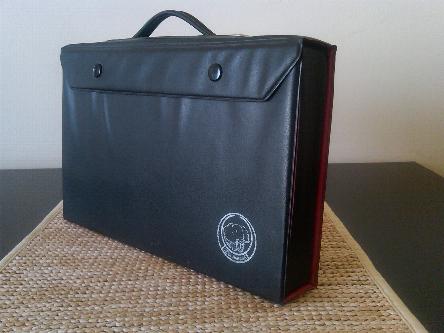
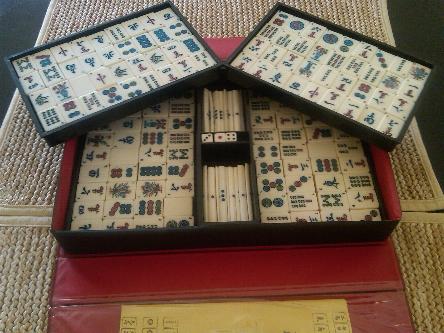
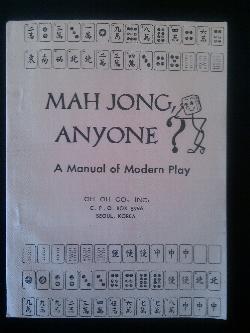
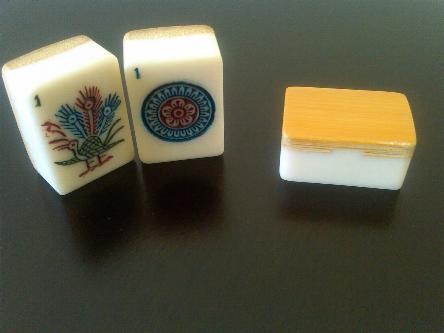

Hello James, you still didn't provide me all the necessary information specified in the FAQs. So this may be a little off. You asked:
it's datedness
Sometime after 1964. Likely before the 21st century. Somewhere in the 60's-90's.
and value.
Maybe somewhere around $60, if you can find a collector interested in it for the unusual manual (off-standard edition of common book).
By the way, the white portion of the tiles is likely plastic, not bone.
May the tiles be with you.
Tom Sloper
Author of "The Red Dragon & The West Wind," the definitive book on Mah-Jongg East & West.
Los Angeles, California, USA
January 25, 2011
I want to make a custom mahjon table
>From: [DELETED]
>Sent: Mon, January 24, 2011 11:34:28 AM
>Subject: Mahjon table top
>Hello,
>I don't play Mahjon but my wife does and I wantred to surprise her by building a Mahjon table playing serface.
>My idea is to make it the size of a standard bridge table out of clear plastice resin with designs and game-significant areas on the bottom. I would also add open areas to store tiles. She plays the American version.
>So my questions are:
>Is there a standard starting arrangement that I could outline as part of the design? (A space to put first tiles?)
>Are there symbols or tile designs that would make sense at certain areas?
>Are there generic symbols that I could use for decoration?
>How much tile storage makes sense?
>Any information you can provide would be appreciated.
>[DELETED]
Hi there, [name deleted since you're trying to surprise your wife] -- you wrote:
My idea is to make it the size of a standard bridge table out of clear plastice resin
Oh god no! Plastic tiles on plastic table? That would be horrible. For paper cards, a plastic table is fine. But not for plastic tiles. We like cloth-covered tables best, both to deaden the sound and to make for smooth shuffling/smooshing of the tiles before and after a hand.
with designs and game-significant areas
Don't bother. Players know what goes where, they don't need all that stuff. I have a custom mahjong tablecloth that was embroidered with places to put what where, but it's just a curiosity more than anything. Get out your sewing machine, get some nice cloth with little or no visible pattern and little or no texture, and custom fit it to the table.
I would also add open areas to store tiles.
I have no idea what you're thinking.
Is there a standard starting arrangement that I could outline as part of the design? (A space to put first tiles?)
>Are there symbols or tile designs that would make sense at certain areas?
>Are there generic symbols that I could use for decoration?
>How much tile storage makes sense?
Forget all that stuff. All she needs is a nice square table, two nice party tables for beverages and coin purses, and a pleasant cloth-covered playing surface. I don't suppose you've seen FAQ 7F? You can link to it above left. You can also scroll down (in FAQ 7F) and see photos that people have sent me of their own custom mahjong table setups. If you make a table for players of American mahjong, make sure there's enough room for the racks and walls (go more towards 36", rather than smaller).
May the tiles be with you.
Tom Sloper
Author of "The Red Dragon & The West Wind," the definitive book on Mah-Jongg East & West.
Los Angeles, CA (USA)
January 24, 2011
Newbie Q's
>From: Judy D
>Sent: Mon, January 24, 2011 8:17:17 AM
>Subject: NMJL Rule book
>Hi
>I have been trying to help some men learn to play Mah Jongg. Questions come up that I am not 100% about. Thus I would like to buy a copy of a League Rule book.
>Well I wrote the League, they sent me a copy of this years order form. Is there a helpful book?
>You mention: NMJL Rulebook Mah Jongg Made Easy in your site. Can I order this from you?
>Our current question, you pick a tile, click it on the table. Does that
>stop the opportunity to Call for the tile, must it be racked first, etc? If two people Call, neither for Mah....one it is their turn...who has claim to the tile first? (I tried to find
>this one on your site but with so much information must have missed the line).
>Anyway, what is your policy about asking a email question and getting a reply from you? Cost?
>Thank you, again I will be glad to pay for the rule book if you think it will help, also where it can be purchased.
Hello Judy,
Welcome to my website. You asked:
I would like to buy a copy of a League Rule book.
>Well I wrote the League, they sent me a copy of this years order form. Is there a helpful book?
>You mention: NMJL Rulebook Mah Jongg Made Easy in your site. Can I order this from you?
That is the official rulebook, and it is available from the League. It's listed on their order form. I highly recommend that you do buy the official rulebook -- it's important to have a copy when little gotchas occur during a game. You might also buy my book too -- it goes into more detail and includes rules that are not in the official rulebook. It's called "The Red Dragon & The West Wind," and if you click that link, you'll find more information about where it can be purchased. I don't sell it by mail order myself.
you pick a tile, click it on the table. Does that
>stop the opportunity to Call for the tile, must it be racked first, etc?
Please scroll up and find the links to the Frequently Asked Questions (look for the blue and yellow flashing arrow, emblazoned "READ 1ST," like this ). Find the link to FAQ #19 (it's marked with a red, white, and blue flashing arrow, emblazoned "AMERICAN," like this ) and click it.
After you've landed at the FAQ 19 page, please bookmark it so you can easily return to it anytime you have a mah-jongg question. Answers to all of the most frequently-asked questions about American (NMJL) mah-jongg are found in FAQ 19. Always check the FAQs first before asking a question.
In the case of what you've asked just now, read the first 3 FAQs: FAQs 19A, B, and C.
If two people Call, neither for Mah....one it is their turn...who has claim to the tile first?
Read FAQ 19H.
what is your policy about asking a email question and getting a reply from you? Cost?
This is how it works (what you see here). There is no cost, but the answers are given here on this bulletin board. And it's expected that you try hard to find the answer in the FAQs before asking.
May the tiles be with you.
Tom Sloper
Author of "The Red Dragon & The West Wind," the definitive book on Mah-Jongg East & West.
Los Angeles, CA (USA)
January 24, 2011
Misnamed discard, part 2
>Date: Sun, 23 Jan 2011 16:51:23 -0500
>Subject: Re: A hypothetical situation
>From: Linda F
>Well, after reading the FAQ and re-reading the rule book and reading the strategy column (whew) I would say we made the right call. The distinction to me is this:
>Erroneous discard: She said the correct name of the tile she intended to throw, but did not throw that tile (or any tile). There was no other tile involved at that point. But because she said the full name of the tile it is considered discarded. She might have tried to change her mind and thrown any tile other than a 7 bam, but the result would have been the same. She was obligated to discard the tile she named.
>Misnamed discard: If she had first put down the 2 dot (or any other tile) and called it a seven bam, then the two dot would have been misnamed and she would have had the opportunity to correct it. And if she had been merely dreaming of a seven bam and threw the two dot, she would still have had the opportunity to correct it, as long as no one called it.
Hi Linda,
I disagree with your finding. It still goes back to the hypothetical question you initially posted. What if she did not actually possess the tile whose name she'd said?
If someone says a tile name in full, but has not yet picked up a tile from the rack, then she has to discard a tile (assuming it's her turn, and she's holding 14 tiles in the hand). If the tile does not match the name she'd spoken, then she has to speak the correct name of the tile.
You are welcome (if not encouraged) to get a ruling from the NMJL on this. My strong recommendation is to get it in writing, which means sending them a self-addressed stamped envelope.
May the tiles be with you.
Tom Sloper
Author of "The Red Dragon & The West Wind," the definitive book on Mah-Jongg East & West.
Los Angeles, California, USA
1/23, 2011
Need someone to repaint my old tiles
>Date: Sun, 23 Jan 2011 13:06:50 -0800 (PST)
>From: Lauren B
>Subject: Mah Jongg tile question
>Hello,
>I have a set from my grandmother but the color in the front where the designs are has worn out--what do you recommend to use to put the color back in the grooves? Is there a certain type of ink pen or person that can do this?
>Lauren B
>
>----- Forwarded Message ----
>From: The Maven
>To: Lauren B
>Sent: Sun, January 23, 2011 3:35:23 PM
>Subject: RE: tile question
>Dear Lauren,
>Do you mean the ink? I know someone who used to re-paint them – it's pretty painstaking work, but they no longer do it. You may want to visit www.sloperama.com to try to find some information. Good luck!
>Julie
>"The Mah Jongg Maven"
>
>From: Lauren B
>Sent: Saturday, January 22, 2011 2:46 PM
>To: themaven
>Subject: tile question
>I have a set from my grandmother but the color in many of the tiles has worn out--what do you recommend to use to put the color back in the grooves? Is there a certain type of ink pen?
>Lauren B
Hi Lauren,
Check out Frequently Asked Questions 4a & 7o (that's seven-oh, not seventy). Please scroll up and look for the blue and yellow flashing arrow (emblazoned "READ 1ST," like this ). Please always check the FAQs first, before asking a question. Thanks!
May the tiles be with you.
Tom Sloper
Author of "The Red Dragon & The West Wind," the definitive book on Mah-Jongg East & West.
Los Angeles, California, USA
January 2, 2011
Korean set, part 2
Date: Sun, 23 Jan 2011 00:44:46 -0800
Subject: Re: Seoul Mahjong Tournament Set?
From: James A
>Hey Tom, you referenced FAQ7h to give some ideas on what makes a set
>valuable, but I was hoping you'd be more specific. Especially since
>you've got a set like this. Let's say it's from mid to late 60's,
>excellent condition, with complete Japanese-style tiling; what do you
>think it'd be worth (if you had to guess)? Does it being made in Korea
>while being a Japanese-style set affect the value? You've bought sets
>and you've got no reason to play dumb so knowing what you know--what
>would you pay for it? Thanks for your help. Btw, I was thinking that
>the "Seoul Mahjong" logo might be a "tournament set" possibly because
>of it's portability or maybe because it had been a set used in team
>competition, making the logo a "team logo" unrelated to the
>manufacturer. Just some more unfounded speculation to dig some more
>witty answers out of your Q and As. Mission accomplished.
>PS. Trying to get a hold of the manufacturer experts you mentioned (thanks)
>-James
Good morning James, you wrote:
you referenced FAQ7h to give some ideas on what makes a set
>valuable, but I was hoping you'd be more specific.
The FAQ specifically says what information I need, and what photos I need, in order to give a value.
Does it being made in Korea
>while being a Japanese-style set affect the value?
It's a common type of set. Korean-made sets look like Japanese sets, but without the red fives. Being a common type of set "affects the value," I suppose.
you've got no reason to play dumb
Yes, I do. I don't want to state an incorrect value. The FAQ specifically asks for more information than you've given me.
what
>would you pay for it?
Better question: what would you pay me for mine? I'll probably be offering it on eBay soon.
I was thinking that
>the "Seoul Mahjong" logo might be a "tournament set" possibly because
>of it's portability or maybe because it had been a set used in team
>competition, making the logo a "team logo" unrelated to the
>manufacturer. Just some more unfounded speculation to dig some more
>witty answers out of your Q and As.
I see. Well, I can't corroborate your thinking in that regard. BTW, my set does not have the same logo on it, doesn't have the same manual in it, and I don't know if it was made by Oh Oh.
May the tiles be with you.
Tom Sloper
Author of "The Red Dragon & The West Wind," the definitive book on Mah-Jongg East & West.
Los Angeles, California, USA
1.23.2011
Korean set
>Date: Sat, 22 Jan 2011 20:50:35 -0800
>Subject: Seoul Mahjong Tournament Set?
>From: James A
>Beautiful site. I was hoping to see some info on travelers sets to see
>if I could figure out what I'm dealing with. I have what was my
>grandmother's traveler's set which is a black plastic flap-box with
>red interior plastic (button clasp). It's definitely a bone
>bone/bamboo Japanese style set (Japanese-complete) but I think it's
>made in Seoul Korea. There is a logo on the front of the travel case
>in the right hand corner with an elephant and it says "Seoul Mahjong."
>Possibly a tournament set? There is also a very old looking manual
>inside called "Mahjong Anyone?" printed in Korea. I found a reprint of
>the manual on Amazon.com with the EXACT same cover EXCEPT it doesn't
>have the datedness or an address under the title like mine. The
>address on the manual is: Oh Oh Co., Inc. C.P.O Box 5996 Seoul Korea.
>I couldn't find anything online about Oh Oh Co. Heard anything about
>these or how old/valuable they are? I would certainly appreciate any
>help or pointing in the right direction. Thank you.
>Regards,
>James
Hello James, you wrote:
I was hoping to see some info on travelers sets
Sorry. I'm not sure what you mean by "travelers sets." Do you mean the tiles are small? Or do you mean the tiles are flat and light?
a black plastic flap-box with
>red interior plastic (button clasp). It's definitely a bone
>bone/bamboo Japanese style set (Japanese-complete) but I think it's
>made in Seoul Korea.
Yes, I have a set like that in my collection.
Possibly a tournament set?
I don't know what you mean. What would you see as the difference between a regular set and a tournament set and a travel set?
There is also a very old looking manual
>inside called "Mahjong Anyone?" printed in Korea.
I'm very familiar with the Strauser & Evans book. Interesting that you have one printed in Korea. I haven't seen that. FAQ 3.
I couldn't find anything online about Oh Oh Co.
Sorry. I do not know much about manufacturers, especially Korean manufacturers. Jim May and CHarli are the experts on manufacturers. FAQ 4a.
how old
The Strauser & Evans book first appeared in 1964. So the set was made sometime after that. FAQ 11H.
/valuable they are?
FAQ 7G.
May the tiles be with you.
Tom Sloper
Author of "The Red Dragon & The West Wind," the definitive book on Mah-Jongg East & West.
Los Angeles, California, USA
January 22, 2011
Misnamed discard
>Date: Sat, 22 Jan 2011 20:14:15 -0500
>Subject: A hypothetical situation
>From: Linda F
>Hi, Tom. A hypothetical situation came up in our game yesterday. The real situation was:
>It was E's turn to discard. She looked at her hand, said "7 bam" then looked again, pulled out a different tile and discarded a 2 dot.
>E doesn't play with us regularly and is unaware of what sticklers for the rules we are, but she was quickly informed that under the erroneous discard rule (page 97 of TRD&TWW), since she fully named the 7 bam, she had to throw it. She did, but asked, "What if I didn't have a 7 bam and was merely thinking of a 7 bam?" We weren't sure of the answer. My thought was it would be covered under misnamed discard (p. 61), and as long as no one called it she could correct herself and throw the 2 dot without penalty. We discussed the fine differences between erroneous discard and misnamed discard and the group decided we needed a professional opinion (yours).
>Thanks much. Your friend in mahj
>Linda
Hi Linda,
You should read page 97 again.
And read rule 95.a. on page 61.
And read FAQ 19AY.
And read column 472.
"What if I didn't have a 7 bam and was merely thinking of a 7 bam?" We weren't sure of the answer.
Yes, well. I asked and answered the same question in column 472.
We discussed the fine differences between erroneous discard and misnamed discard
Really. Tell me the difference, then. (^_^) Because to me, they're the same thing. The rules don't make any distinction. Once you've said the tile's name, it's down (even if you said the wrong name). And once it's down, if you said the wrong name, it's an erroneous/misnamed discard, regardless of what intentions you'd had before putting the tile down.
May the tiles be with you.
Tom Sloper
Author of "The Red Dragon & The West Wind," the definitive book on Mah-Jongg East & West.
Los Angeles, California, USA
January 22, 2011
Weird way of showing a concealed kong
>Date: Fri, 21 Jan 2011 20:26:00 -0800
>Subject: Mah-Jongg Q A
>From: Tony S - boardgamer55
>My mah-jongg question or comment is: When I draw a tile and it results in a kong I put the pieces up For exp :4 tiles of 8 dots to show that it was concealed I put the two outside tiles up to show what they are and the two inside tiles down to show that it was concealed for the purpose of counting points later. Have been playing with a group that puts all 4 tiles down which conceals what the tiles are. They say they put it down that way because it is " Concealed " Was not taaught that Cannot find that rule anywhere.
> Tony
Hi Tony,
Which kind of mahjong do you normally play?
Which kind of mahjong does this group play?
What book or website do you use as your mahjong "bible"? (Don't tell me the book title -- just the author's name.)
Do you know what book or website the group uses?
Both ways of displaying a concealed kong are normal, but for different varieties of mahjong.
May the tiles be with you.
Tom Sloper
Author of "The Red Dragon & The West Wind," the definitive book on Mah-Jongg East & West.
Los Angeles, California, USA
January 21, 2011
It's pricy -- too pricy? (part 4)
>From: Frederic D
>Sent: Thu, January 20, 2011 6:23:16 AM
>Subject: Re: Mahj Eval
>Thank you for the update and your help sir.
>-F-
It's pricy -- too pricy? (part 3)
>From: "Michael Stanwick"
>Subject: Re: It's pricy -- too pricy? (part 3)
>Date: Wed, 19 Jan 2011 21:07:26 -0000
>Hi Tom. I totally agree with your assessment regarding the origin of this set. I think it is most probably from 1920/30. It is nicely engraved but the iconography is nothing special IMO.
>It certainly appears to be bone judging from the quality of the engravings and the appearance of the tiles.
>It is a nice set with uniform engravings on the suits.
>But...as you said, £645!!! You are quite right to be aghast.
>I live in the UK and am aware of prices here, even the London ones (they vary from London out to the home counties).
>This would retail at £345 on average from antique dealers.
>Higher prices are recorded but they are usually for highly sought after sets that have unique and exceptional qualities.
>Where I live on the South coast I have observed similar sets going for £245 to £300.
>On the question of the other set we were talking about, I think the darker wind indicators were an addition and not original to the set.
>Regards
>Michael Stanwick
Hi Michael,
Wow, I had no idea mahjong sets could go for four times their eBay price at UK antique shops. "£345 on average" is almost as shocking as £645. (^_^)
May the tiles be with you.
Tom Sloper
Author of "The Red Dragon & The West Wind," the definitive book on Mah-Jongg East & West.
Los Angeles, California, USA
January 19, 2011
Where and when was it made, part 5
>From: "Michael Stanwick"
>Subject: Re: slide top boxes
>Date: Wed, 19 Jan 2011 21:49:40 -0000
>Hello Tom. On the question of slide top box types; the slide top boxes that are rectangular and flat with, generally, engraved Chinese script in columns on the lid are generally from the 1950's/60's. However, there are some from the 1930's so one has to be careful and appraise each box on its own merits.
>The early type of box I was referring to is square with a slide top lid. It is generally about 6 inches on each side and sometimes can come with a label on one side. This type of box is plain to look at and can be dated as far back as 1890.
>Regards
>Michael Stanwick
Ah. Thanks very much! Good to know.
May the tiles be with you.
Tom Sloper
Author of "The Red Dragon & The West Wind," the definitive book on Mah-Jongg East & West.
Los Angeles, California, USA
January 19, 2011
It's pricy -- too pricy? (part 2)
>From: Frederic D
>Subject: Re: Mahj Eval
>Date: Wed, 19 Jan 2011
>Hello Mr SLoper,
>Thank you !!!
>For the missing information, I have tried to provide as much as I could, I would have preferred not to release the price of the item to respect the seller and fully well knowing that these emails are posted to the site. However, since I do value your opinion I will comply, they are asking 645 British Pounds. Secondly, you are quite right, not roman ... arabic ... my mistake. And yes the measurements are in metric centimeters.
>Having said all this, the vendor has been quite pleasant to deal with an I do prefer this set. I am waiting on the significant other (the Chinese one in our family) to give me her opinion, but just as one always states to budding art collectors "buy what you like" is often more important than 10-20% differences in cost, however I do want to make sure I am not making a gross and evident error.?
>Thanks again sir,
>-F-
Hello Frederic,
Wow! That's definitely pricy! I don't see how the seller can possibly justify such a high price. Somewhere around 100 pounds maybe (maybe even a little more since the craks and flowers are unusual) but holy cow! For £645, the tiles would have to be solid ivory (just as thick and without the bamboo backs), otherwise: geez! Is the seller saying the white portion is ivory, is that it? They aren't -- they're bone.
Tom Sloper
Author of "The Red Dragon & The West Wind," the definitive book on Mah-Jongg East & West.
Los Angeles, California, USA
January 19, 2011
It's pricy -- too pricy?
>From: Frederic D
>Subject: Mahj Eval
>Date: Wed, 19 Jan 2011 16:08:00 +0000 (GMT)
>Hello Mr Sloper,
>First and foremost, great site, wonderful site. I landed here while trying to learn/read about 1920's sets to help in making a decision on a purchase. I have been looking at sets from www.mahjongmuseum.com, www.mahjongmahjong.com, and other vendors. The following set is one that has caught my eye and I would appreciate your help in making a final decision. I have a decent grasp of the value of sets at the other vendors but I cannot "place" this set very well. It is 30% pricier than others I am considering and I am therefore curious.
>Thank you for your help.
>The set has all tiles for chinese play including the 4 blanks.
>Bone to bamboo ratio seems to be as hi as 65% to 35%.
>Roman numerals are indicated placing it at post 1920's.
>1 bam and 1 dot pictures are included, white dragons are entirely white.
>Crack seem to have the more complex lower symbol, picture included.
>Case is leather with functioning lock, 23 x 13 x 15.5.
>Tiles are 3 x 2 x 1.5.
>Period, value, and maker are the specifics I am interested in if they immediately jump out at you. Value at this point being the most important as I wish to purchase the set.
>Thanks for your help and time,
>-F-
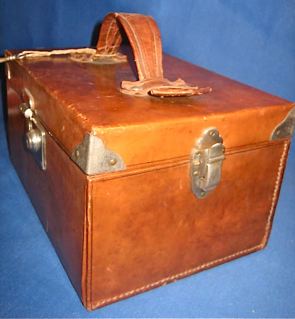
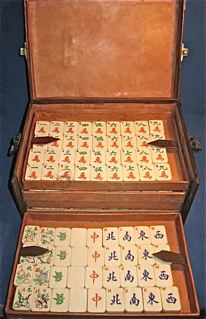
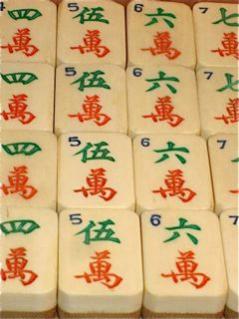
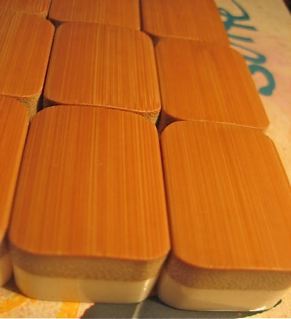
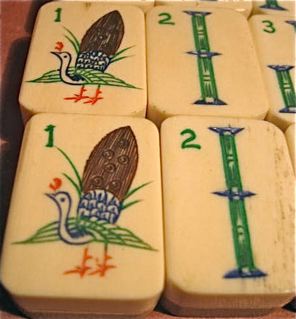
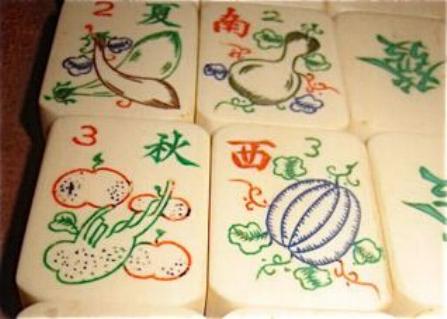
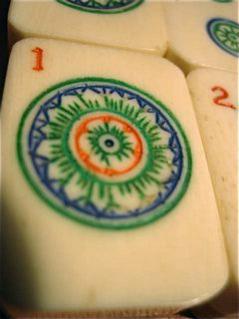
Hello Frederic, you asked for:
Value
Requests for valuations need to be accompanied by information about condition, as I said in FAQ 7H. But since you do not actually have the set in your possession, you can only tell me what you know -- and you have not even done that. You are considering buying this set rather than selling it, and you say it's "30% pricier than others." So, since you haven't given me enough information to valuate it for you, why don't you just tell me what the seller is asking for?
Period
The variation from standard coloration (the green craks) suggests 1920s. But the leather case and the higher-quality craftsmanship of the tile shaping and joining of bone and bamboo (with thicker bone) indicate a later date: 1930s to 1960s.
Maker
No idea. I'm not knowledgeable about manufacturers. Jim May and CHarli are the experts there. Possibly Japanese origin rather than Chinese, given the look of the tiles from the back and sides.
You also mentioned:
Roman numerals are indicated
Where? I don't see any Roman numerals. That would be rare indeed!
Case is leather with functioning lock, 23 x 13 x 15.5.
>Tiles are 3 x 2 x 1.5.
I assume those measurements are metric -- specifically, centimeters?
Tom Sloper
Author of "The Red Dragon & The West Wind," the definitive book on Mah-Jongg East & West.
Los Angeles, California, USA
January 19, 2011
Where and when was it made, part 4
>From: Michael Stanwick
>Sent: Tue, January 18, 2011 3:06:52 PM
>Subject: Re: Where and when was it made, part 3
>Hello Tom.
>I think Natalia has identified the correct time period (1930 - 1960). The only evidence I have regarding the 'marker' tiles (used for dating) of the rat and cat is that they appeared in the late 1930's in China but disappeared soon after. But that is only one source.
>The engraving is quite good quality and appears to be done by a hand held bladed tool rather than an electric one.
>Do you think the material might be our old friend casein? It certainly has that milky opaque appearance.
>The box is interesting and is one of the oldest box type to house MJ tiles. The very earliest box - from 1890 - was very similar to this one, right down to the label type on the side. Indeed, I own a similar box with label. The wood appears to be padauk but it is difficult to tell from just a couple of pics.
>As you say - pity about the missing tile.
>Regards
>Michael Stanwick
Hi Michael,
I hesitated to say it might be casein. The discs and disc container are darker yellow, so I was thinking those might be casein.
As for slide-top boxes, I'm fairly confused by a previous comment from you (Dec. 19), about slide-top sets dating from '55 to the 60's. Perhaps that was only a particular type of slide-top set...
May the tiles be with you.
Tom Sloper
Author of "The Red Dragon & The West Wind," the definitive book on Mah-Jongg East & West.
Los Angeles, CA (USA)
January 18, 2011
Joker redemption again (2nd time today)
>From: "Mggab
>Sent: Tue, January 18, 2011 3:00:51 PM
>Subject: A Question
>Hi Tom,
>I can't find the answer to this question anywhere.
>I know if a player calls Maj in error and exposes their hand with jokers, the jokers cannot be taken by anyone. But, if a hand is called "dead" by another player and there are remaining tiles that have not been exposed and there are jokers that have been used to call parts of the hand, can those jokers be taken by another player?
>Thank you,
>Michele
Hello Michele,
As I told Mary this morning (below), how to handle jokers in a dead player's hand is explained fully in FAQ 19P.
Please scroll up and find the links to the Frequently Asked Questions (look for the blue and yellow flashing arrow, emblazoned "READ 1ST," like this ). Find the link to FAQ #19 (it's marked with a red, white, and blue flashing arrow, emblazoned "AMERICAN," like this ) and click it.
After you've landed at the FAQ 19 page, please bookmark it so you can easily return to it anytime you have a mah-jongg question. Answers to all of the most frequently-asked questions about American (NMJL) mah-jongg are found in FAQ 19. Please always check the FAQs first before asking a question.
May the tiles be with you.
Tom Sloper
Author of "The Red Dragon & The West Wind," the definitive book on Mah-Jongg East & West.
Los Angeles, CA (USA)
January 18, 2011
Where and when was it made, part 3
>From: Natalia mixed-berries
>Subject: RE: Mahjong Questions
>Date: Tue, 18 Jan 2011 11:53:31 -0700
>Wow you're fast.
>Thank you so much for the info!
>On a side note, do you think this set is worth anything? Like I said, we originally got it for me to make jewelry but I'm nervous about doing so.
>Obviously with a missing tile and a missing wind disc it will never reach full value again... especially without knowing the plastic so I can replace it.
>The tiles and wind discs are made from different plastics. I know that for sure. I'm also going to try to take this set to someone in town so they can *hopefully*
>tell me the type of plastic.
>Thank you again!
>Natalia
Hi Natalia,
It has value for sure, and certainly for someone who's going to use it to make jewelry. If it was mine, I'd probably try to get a replacement tile at least. As an incomplete set the way it is, it's certainly worth less than $100 to a mah-jongg set collector.
If you want to know the type of plastic (not that I know why), you might try going to the local plastics store (look in the yellow pages under Plastic).
May the tiles be with you.
Tom Sloper
Author of "The Red Dragon & The West Wind," the definitive book on Mah-Jongg East & West.
Los Angeles, California, USA
January 18, 2011
Where and when was it made, part 2
>From: Natalia M
>Sent: Tue, January 18, 2011 9:09:43 AM
>Subject: RE: Mahjong Questions
>Tom,
>Thank you for being so quick. Here is what I can give you.
>1. All that came with my set: 147 tiles (missing 1), 4 mini bone dice, 3 wind discs (missing 1) in their holder, slide top box
>2. No paper material unless you count the stuff at the bottom of the box.
>3. Tiles are most likely celluloid or bakelite (again, has that camphor smell though)
>4. We purchased it at a thrift store but from what your site says it's probably from 1930's - 1960's
>5. The tiles are about 1" long, about 3/4" wide and a tiny bit more than 1/2" thick with the black back.
>6. 147 tiles (1 number 6 bamboo is missing), 4 flower tiles (seasons), also has the Man, Pot of Gold, Mouse and Cat tiles, has the red fives (??? I think that's what they are),
> has Red, Green and White dragons (whites are blank), has wind tiles (east, south, west, and north)
>7. The box is wooden, hand assembled, sort of a cherry wood color and has a label of some sort that is almost completely gone. The lid is a slide off lid
>8. Elaborate style crak I guess?
>9. Done
>10. Done
>11. Done
>12. No jokers.
>I'd like to know pretty much when and where this set is from. It seems to be the Japanese version with a little bit of a Singapore influence. But that would make more sense to you.
>Natalia
>attached are the pics. Thanks again.
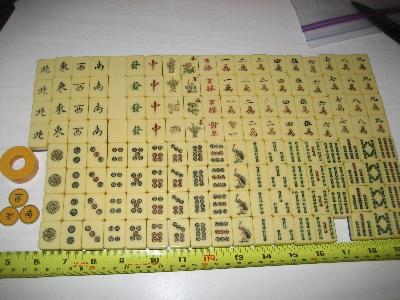
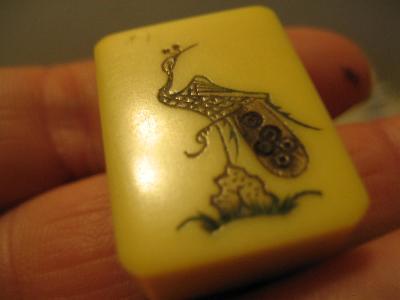
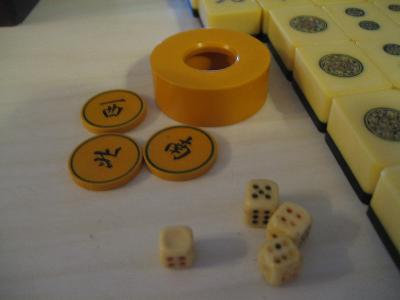
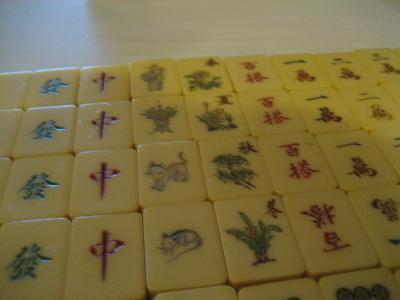
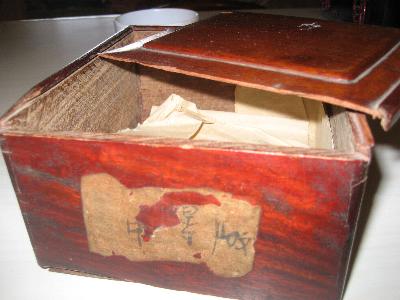
Hi Natalia,
It's a shame that a tile is missing and a wind disc is missing -- those would be extremely difficult to replace. The tiles are an uncommon two-tone plastic type (with thin back), with intricate designs.
The tiles are not Bakelite, and are probably not celluloid. I don't know exactly what kind of plastic they are, though.
Your "red fives" are jokers -- see FAQ 7E.
The set was surely made in China. And most likely in the sixties. The set was made for use in Asia, since it has no western indices. Slide-top boxed sets are discussed further below, see "Where and when was this set made, part 2" from December 19. It's very common for slide-top sets to have animal flowers and Chinese jokers. But it's more usual to see them made of bone and bamboo.
May the tiles be with you.
Tom Sloper
Author of "The Red Dragon & The West Wind," the definitive book on Mah-Jongg East & West.
Los Angeles, California, USA
January 18, 2011
Joker redemption
>From: Mary
>Sent: Tue, January 18, 2011 7:23:48 AM
>Subject: Mah-Jongg Q+A
>My mah-jongg question or comment is:
>I have read the FAQ concerning when jokers can be redeemed, but am still not clear on an Exposure that happened during a home game. A player exposed with 3 Flowers and 2 Jokers. No one challenged this and play continued. I was the next player in turn (right of the player that exposed). I picked and racked and handed a Flower to the player to take 1 of the Jokers. It was then that I and another player realized there was no such Hand. Was I allowed to take the Joker or was it Dead?
>Thanks
Hi Mary,
Two players had realized that the exposure was dead; there's no flower quint hand on the 2010 card. It says in FAQ 19P: "Jokers which were exposed improperly are not available for redemption." It also says in FAQ 19P: "All portions of the hand exposed erroneously are to be returned to the sloping front of the rack, including and especially the now-dead jokers." The player with the erroneous exposure must stop playing once it's publicly realized that she has erred and is dead.
May the tiles be with you. Just not those 2 jokers.
Tom Sloper
Author of "The Red Dragon & The West Wind," the definitive book on Mah-Jongg East & West.
Los Angeles, California, USA
January 18, 2011
Forgot the book, part 3
>From: Lynn P
>Sent: Mon, January 17, 2011 5:13:15 AM
>Subject: Mah-Jongg Q+A
>My mah-jongg question or comment is: Regarding my 1/15 "Forgot the Book" question: If I wasn't so 'harmonious and gracious' during the aforementioned game, I could have just kept 2 seven craks and my joker exposed and returned my 3rd 7 crak to my slanted rack. Then later in the game I could redeem my exposed joker with the 7 crak in my hand hopefully for a self picked mah jongg. Is this a chance worth taking since there may have been one more 7 crak in the wall. (I don't remember if it had already been discarded.) or since I had already exposed all 3 seven craks, did I have to leave the 3 of them exposed? As I understand p. 65 #113 in "RD & WW", I had to leave at least 3 tiles but it doesn't matter which ones. My "RD & WW" book is all packed and ready for some big games today and I have put a sticker on my card that says "Turn over & read". Have a great week and thanks again. I plan to go back to your weekly columns and try to figure them out using my card. Lynn P.
Hi Lynn, you wrote:
I could have just kept 2 seven craks and my joker exposed and returned my 3rd 7 crak to my slanted rack. Then later in the game I could redeem my exposed joker with the 7 crak in my hand hopefully for a self picked mah jongg. Is this a chance worth taking since there may have been one more 7 crak in the wall.
In this world, ya takes yer chances. I certainly wouldn't do it, if it meant somebody might take the joker, leaving me with a worthless tile in hand. I always try to get closer to mah jongg, I'm not always looking for sneaky (and risky) tricks that might increase the score.
May the tiles be with you.
Tom Sloper
Author of "The Red Dragon & The West Wind," the definitive book on Mah-Jongg East & West.
Los Angeles, California, USA
Martin Luther King Jr. Day, 2011
Where and when was it made?
>From: Natalia mixed-berries
>Subject: Mahjong Questions
>Date: Mon, 17 Jan 2011 09:18:34 -0700
>Hello!
>I have read your site, I promise. My head is just spinning with all the information I've picked up. So far your site seems to be the most informative!!!
>
>My husband recently picked up a Mahjong set from a thrift store for a dollar. Yay! We love thrift stores. We always seem to find at least one good find.
>
>I've recently resumed my hobby of jewelry making and when he saw the tiles (he had NO idea what mahjong is) he picked up the box and asked if I could use
>them. I instantly knew what it was but only because I used to play the computer version on my grandma's pc. I said I could definitely use them and when we got
>home I couldn't wait to start drilling into them and gluing on bails. Just as I was ready to do that though I thought I should look them up and learn more about them.
>
>And I'm glad I did. I don't think they're worth thousands of dollars like the ones on ebay but I think they're worth more than the dollar we spent. :)
>
>I'm just still a little confused as to their origins. They're old. I know that. And I don't think they're made from bone or ivory. And they're not Americanized. They don't
>have any roman or american numerals on them at all. I've done the "hot water" test and I would guess just from the smell that they're Celluloid because it has that
>camphor/menthol smell but it doesn't have those lines that the pics have. Instead they look like the bakelite or the catalin.
>
>I don't have pictures to send you just yet. I counted them and I know I'm missing 1 tile. I believe it's one of the bamboo... I was in a hurry to pick them up so I just
>did a very quick mental note. I think it was 147 tiles. From your pictures I'd guess it is the Japanese version because of the characters on the tiles. They're the closest I can find to my set right down to the flowered dots. Except the bird on my one bam is a stork on one leg... the flower tiles have different flowers and I have the tiles with the man, pot of gold, cat and mouse from the Singapore version... My white dragons are also completely blank like the Japanese version. The box they came in is severely damaged. It was hand
>assembled, dark rose colored with some sort of label with asian characters written on it that is almost completely faded away. The lid of the box is one of those that
>slide open and off. The tiles are black on the back and yellowed on the front (again they look like bakelite or catalin but smell like celluloid).
>Also, there was an orange disc with wind discs inside. There are only 3 so I know one of those is missing as well. The discs are made of plastic but definitely NOT
>the same as the tiles so I don't know if it was added in later. There are also 4 mini bone dice like the ones you have pictured. I know they're some sort of bone because
>of the etchings and characteristics I can see when I hold them at different angles in the light. Like yours, the "1" is only indented and blank and the 4 is red.
>
>I just want to know where this could possible come from and maybe an era... I can send you pictures but I'd like to know that you get this email before I do all that.
>
>Could you please email me back with any ideas you may have? It would be greatly appreciated.
>Thank you so much!
Hello Natalie,
My head is spinning from all those words you wrote. The only question I could find among them was:
where this could possible come from and maybe an era
I'd really need to see pictures. And since you're asking how old it is, you should please give me the information requested in Frequently Asked Question #7G.
Please scroll up and look for the blue and yellow flashing arrow (emblazoned "READ 1ST," like this ).
May the tiles be with you.
Tom Sloper
Author of "The Red Dragon & The West Wind," the definitive book on Mah-Jongg East & West.
Los Angeles, California, USA
Martin Luther King Jr. Day, 2011
Conflicting claims for exposure, part 3
>From: ENID
>Subject: RE: "Call" Question in American MJ etc.
>Date: Sun, 16 Jan 2011 21:08:57 -0800
>Tom - thx sooo much for clearing this up. I'm wrong then. Good to have clarification. Didn't think to look for a detailed 'call' explanation on card backing. I knew for MJ there's no problem. If you ever decide you want to sub one night.... I'll look for your 8/29 newsletter on your website to read abt Carol.
>Best, Enid
Conflicting claims for exposure, part 2
>From: "Lynn P
>Subject: Mah-Jongg Q+A
>Date: Sun, 16 Jan 2011 13:59:45 -0500
>My mah-jongg question or comment is: Concerning Enid's email titled "Conflicting claims for exposure": The answer is right on the back of this year's mah jongg card (2010) - left hand side on the bottom beginning with #1. "No picking ahead." It is #3: "When two players want the same tile for exposure, player next in turn to discarder has preference." The back of the mah jongg card should be the first place to check and then, of course, "The Red Dragon & The West Wind". I guess players just don't think to turn the card over and read what is on the back. Lynn P.
Good point. RTDC. Read The Darned Card.
May the tiles be with you.
Tom Sloper
Author of "The Red Dragon & The West Wind," the definitive book on Mah-Jongg East & West.
Los Angeles, California, USA
January 16, 2011
Conflicting claims for exposure
From: ENID
Subject: "Call" Question in American MJ etc.
Date: Sat, 15 Jan 2011 21:02:34 -0800
>Hi Tom ~ it's been awhile since we've spoken let alone played mah j together. You did hear of Carol Kaiserman's passing about 6 months ago?
>Anyway, I'm dropping this line to you because I played in a game last night (Friday) and two of us disagreed quite vocally on "Calling" rules; I can't find the answer on your site - let alone this particular question. Here's the table set up (note this isn't a 'call' to make MJ):
> 1. East throws a tile and West calls it to use in an exposure.
> 2. North decides she wants the tile after West had called the tile and says it's hers because of seat position and West hadn't racked the tile.
> 3. She says West had to expose her tiles prior to racking the 'called' tile in addition.
>Now, I learned from Carol and everyone I know who's taught MJ, that when a tile is called other than for MJ, the tile goes to the person who calls the tile! None of this seat rotation order (nearest the person in order of turn) and/or she had not racked the tile or exposed her tiles (that needed the called tile). This explanation sounds like something made up for their convenience. PLEASE CORRECT me if I'm in error!
>I'm going to send a fax to the NY National MJL ofc, but knowing you're a published authority on the rules, I thought I could get a faster response from you. The NMJL doesn't respond on-line to anything.
>Best,
>Enid
Hello Enid,
I went to a memorial service for Carol, and wrote about it in my column. Column 464, August 29. As for your question:
I learned from Carol and everyone I know who's taught MJ, that when a tile is called other than for MJ, the tile goes to the person who calls the tile! None of this seat rotation order
Sorry, that's wrong. See FAQ 19H. I assume you know you can get to the FAQs above left. It's not unusual for two people to claim a discard, so there are rules governing that.
I'm going to send a fax to the NY National MJL
A self-addressed stamped envelope is probably better, but whatever. You can also look at page 19 of the official NMJL rulebook, and see the 2007 bulletin.
May the tiles be with you.
Tom Sloper
Author of "The Red Dragon & The West Wind," the definitive book on Mah-Jongg East & West.
Los Angeles, California, USA
January 15, 2011
Forgot the book; what should I have done? (part 2)
>From: "Lynn P
>Subject: Mah-Jongg Q+A
>Date: Sat, 15 Jan 2011 22:30:53 -0500
>My mah-jongg question or comment is: RE: Forgot the book...Some of the other players are not willing to say if a questionable play is correct or not
> nor will they give their opinion or they actually don't know the answer. Re: your weekly column: So the tiles you are displaying in your column are tiles that a player has exposed on his/her rack and the "hot tiles" are the ones he/she needs to make mah jongg so other players should not discard them. I should have my mah jongg card in front of me when I check these columns then. I read up on "hot tiles" in your book ( RD & WW) and also read p. 65 rule 113 which I knew. So I just should have put my joker back in my hand and then discarded in spite of the objection from one player. I had already put a sticky tab on page 65 as well as many other pages but I just have to bring my book with me and take the time to reference the correct page. The tiles and jokers have been with me the last few times I have played! Now I will make sure your book is too. Thanks one more time. Lynn P.
So I just should have put my joker back in my hand and then discarded in spite of the objection from one player.
I didn't say that. In this case, it's a case of "she said, she said." The two of you are both convinced of the rightness of your positions, and neither of you has proof. Since you do not have a judge, and since you did not have your book, there's no easy or happy solution. Backing down is harmonious and gracious, if unsatisfying.
So the tiles you are displaying in your column are tiles that a player has exposed on his/her rack and the "hot tiles" are the ones he/she needs to make mah jongg
That is the idea, yes.
so other players should not discard them.
Well, the defensive play would be to not discard a hot tile. But if you're ready for mah jongg yourself, sometimes the risk is worth it. The point isn't "never discard a hot tile" -- it's "know what's hot before you discard it."
May the tiles be with you.
Tom Sloper
Author of "The Red Dragon & The West Wind," the definitive book on Mah-Jongg East & West.
Los Angeles, California, USA
January 15, 2011
Forgot the book; what should I have done?
>From: "Lynn P
>Subject: Mah-Jongg Q+A
>Date: Sat, 15 Jan 2011 20:26:17 -0500
>My mah-jongg question or comment is: Playing according to NMJL rules: Hi again, I called a 7 crak discard, put it and my two 7 craks plus a joker on my flat rack, realized I only needed three 7 craks so put the joker back on my slanting rack. Long time player said since I had exposed the joker I had to keep it exposed even though I said I hadn't discarded yet so I could change my exposure. She insisted so I did leave joker exposed. First time in a while I hadn't brought your book to a game and the other 2 players didn't say anything but I know I was correct. (Right?) We had a wall game anyway. What should I have done in this situation? Thanks for your sites especially your Q & A and the columns of the MJ words. I really don't get what you are doing when you display various hands except when you say no such hand exists. Have I missed any explanations regarding your weekly columns when you show the tiles? Lynn P.
Hi Lynn, you wrote:
She insisted so I did leave joker exposed. First time in a while I hadn't brought your book to a game and the other 2 players didn't say anything but I know I was correct. ... What should I have done in this situation?
You should have taken the book to the game so you could show them rule 113 on page 65. The other 2 players didn't say anything, you say -- you should have asked them. Then abide by the majority decision.
I really don't get what you are doing when you display various hands except when you say no such hand exists.
I don't get what you are saying. You mean when I say "she's making 13579 #2 and the hot tiles are 3C and 3D," you don't understand that?
Have I missed any explanations regarding your weekly columns when you show the tiles?
I don't know!
May the tiles be with you.
Tom Sloper
Author of "The Red Dragon & The West Wind," the definitive book on Mah-Jongg East & West.
Los Angeles, California, USA
January 15, 2011
Was this handled correctly? (Part 2)
>Subject: Fwd: MJ Question
>From: lfish195
>Date: Thu, 13 Jan 2011 23:31:25 -0500 (EST)
>Hi Tom,
>You answered my question but not completely.
>Is my Mah Jongg call the ultimate call in the end?
>Should I have been able to call the Mah Jongg even though someone called the tile that was just thrown?
>Thanks,
>Lisa
Lisa,
I DID tell you the answer. I can only tell you what the official rules are. But!! You are not playing by any official rules! You are playing by your group's made-up rules. If you want ME to tell you what those rules are, you would have to get your group to write their rules down, then send them to me, then I could see how your group's rules handle this. But if they wrote their rules down, you could read them for yourself, so what am I even needed for?
I also told you that you can read the official NMJL rule in FAQs 19H & I. Did you go to FAQ 19 and read FAQs H and I? The official rule is clearly stated there. But your group does not play by the official rules, so what does it matter what the official rule is, as long as you play with your present group? You should also read FAQ 14, all about how "table rules" work. You can link to the FAQs above left.
May the tiles be with you.
Tom Sloper
Author of "The Red Dragon & The West Wind," the definitive book on Mah-Jongg East & West.
Los Angeles, California, USA
January 13, 2011
Was this handled correctly?
>Subject: MJ Question
>From: lfish195
>Date: Thu, 13 Jan 2011 18:20:29 -0500 (EST)
>Mr. Webmaster,
>During our weekly Mah Jongg game, Gail, to my left, threw out a 3 Dot.
>I immediately looked at my future, (I do admit it was very quick but not done for any other reasont then we were playing quickly) it was a joker and I declared Mah Jongg. At exactly the same moment (to my ears, I called out Mah Jongg a second earlier)!, Kim, to my right, called the 3 Dot. The ruling of the table, which I respectfully adhered to, was Kim got to call the 3 Dot and make the exposure and I had to wait my turn and not get to declare Mah Jongg.
>Final Note: Kim eventually threw out the tile I needed for Mah Jongg and ended up having to pay double! All in good fun, but awaiting your decision if this was done correctly.
>Thank You!
>Lisa
Hi Lisa, you wrote:
I immediately looked at my future
So you're saying you do not play by the NMJL rules. I can't give you rulings about made-up rules. Your group made up your rules, so only your group can tell you how your rules are supposed to work. Read Frequently Asked Question #19R.
Please scroll up and look for the blue and yellow flashing arrow (emblazoned "READ 1ST," like this ). Find the link to FAQ #19 (it's marked with a red, white, and blue flashing arrow, emblazoned "AMERICAN," like this ) and click it.
I declared Mah Jongg. At exactly the same moment... Kim... called the 3 Dot. The ruling of the table, which I respectfully adhered to, was Kim got to call the 3 Dot and make the exposure and I had to wait my turn and not get to declare Mah Jongg... awaiting your decision if this was done correctly.
You say your group says this is the way they do it. So that's the way your group's made-up rules work! But in NMJL rules, a mah jongg call trumps an exposure call. Read Frequently Asked Questions 19H & I.
May the tiles be with you.
Tom Sloper
Author of "The Red Dragon & The West Wind," the definitive book on Mah-Jongg East & West.
Los Angeles, California, USA
January 13, 2011
Frequently Asked Question #19B
>From: carolyn f
>Subject:
>Date: Wed, 12 Jan 2011 09:22:34 -0500
>I have a question about a move I made. I was told I could not do it.
>A pattern of three dots and one joker were displayed. My turn, I called three dot to discard, but the tile was still in my hand, so I changed my mind and said, "Oh no, I'll take that joker." Was that a legal move, or did I have to put my tile down because I already named it?
>Thank you for taking time to answer this question. You do such a great job answering our crazy questions.
>Sincerely,
>Carolyn F
Carolyn,
You have asked Frequently Asked Question #19B.
Please scroll up and look for the blue and yellow flashing arrow (emblazoned "READ 1ST," like this ). Find the link to FAQ #19 (it's marked with a red, white, and blue flashing arrow, emblazoned "AMERICAN," like this ) and click it.
After you've landed at the FAQ 19 page, please bookmark it so you can easily return to it anytime you have a mah-jongg question. Answers to all of the most frequently-asked questions about American (NMJL) mah-jongg are found in FAQ 19. Please always check the FAQs first, before asking a question. Thanks!
P.S. In addition to FAQ 19B, you should read FAQ 19A, column
353, and column 477.
May the tiles be with you.
Tom Sloper
Author of "The Red Dragon & The West Wind," the definitive book on Mah-Jongg East & West.
Los Angeles, California, USA
January 12, 2011
Mah Jongg Marathon at the Museum of Jewish Heritage
>Subject: Sunday, February 6th--Mah Jongg Marathon on February 6 Puts the Fun Back in Fundraising at the Museum of Jewish Heritage-A Living Memorial to the Holocaust
>Date: Tue, 11 Jan 2011 15:21:02 -0500
>From: Sarah Laufer @Rubenstein.com>
>Edmond J. Safra Plaza
>36 Battery Place, New York, NY 10280
>(646) 437-4202 www.mjhnyc.org
>FOR IMMEDIATE RELEASE
>January 11, 2011
>Contacts:
>Betsy Aldredge / (646) 437-4337 / baldredge@mjhnyc.org
>Abby R. Spilka / (646) 437-4333 / aspilka@mjhnyc.org
>
>New York, NY—On Sunday, February 6, from noon to 6 p.m. the Museum of Jewish Heritage – A Living Memorial to the Holocaust will be hosting a Mah Jongg Marathon in conjunction with the wildly popular exhibit, Project Mah Jongg, extended through February 27.
>
>Participants will pay a $25 registration fee and will get sponsors to support them in their efforts. The structure of the event will resemble that of a walk-a-thon — no carb-loading required. The suggested minimum donation per sponsor is $18. All proceeds will benefit the Museum.
>
>Melissa Martens, the exhibition's curator, said, "Since the 1920s, mah jongg has been used by Americans for both entertainment and philanthropic purposes. Mah jongg is still the perfect way to have a great time while supporting a cause you believe in."
>
>The event will include special theme hours, prizes, and the chance to chat or play a hand or two
>with some very special guests including illustrator and author Maira whose work is featured in Project Mah Jongg. Snacks will be available for purchase.
>
>Participants are encouraged to register online (www.projectmahjongg.com) and set up a personal fundraising page. Participants may also register by phone. Players may register alone or with a team. Single players will be matched with other players of their own level. All levels are welcome. Participants can play for as little or as long a time as they wish.
>
>Ivy Barsky, Deputy Director of the Museum, said, "We encourage all mah jongg enthusiasts to put the chili in the crock pot in the morning and celebrate Super Bowl Sunday with us. It is better the longer it simmers, and we have a fantastic day planned that will end in time for kick off."
>
>For more information, please contact mahjongg@mjhnyc.org.
>
>About the Exhibition
>Project Mah Jongg is now extended through February 27. The exhibition, a favorite of visitors and critics alike, explores how the game of mah jongg has ignited the imagination with its beautiful tiles, mythical origins, and communal spirit since the 1920s. Come learn the history and meaning of the beloved game that became a Jewish-American tradition. Visit www.projectmahjongg.com for more information.
>
>This exhibition is made possible through the generosity of the National Mah Jongg League. Additional support provided by Sylvia Kay Hassenfeld and the 2wice Arts Foundation. Exhibit design by Abbott Miller, Pentagram. New York magazine is the media partner.
>
>About the Museum of Jewish Heritage
>The Museum's three-floor Core Exhibition educates people of all ages and backgrounds about the rich tapestry of Jewish life over the past century—before, during, and after the Holocaust. Special exhibitions include Project Mah Jongg, on view through February 27, 2011; Fire in My Heart: The Story of Hannah Senesh, on view through August 7, 2011; and The Morgenthaus: A Legacy of Service, on view through September 5, 2011. It is also home to the award-winning Keeping History Center, an interactive visitor experience, and Andy Goldsworthy's memorial Garden of Stones. The Museum offers visitors a vibrant public program schedule in its Edmond J. Safra Hall and receives general operating support from the New York City Department of Cultural Affairs.
>
>###
Pie, 3rd helping
>From: "Swanson222
>Sent: Mon, January 10, 2011 7:25:50 AM
>Subject: Re: Mahjong Question
>Dear Tom, Thank you for your thoughtful responses. Happy Tiles to You!
>Linda S
>San Carlos, Mexico
You're welcome, Linda.
May the tiles be with you.
Tom Sloper
Author of "The Red Dragon & The West Wind," the definitive book on Mah-Jongg East & West.
Los Angeles, CA (USA)
01/10/11
Pie, 2nd helping
>From: Swanson222
>Date: Sun, 9 Jan 2011 15:13:26 EST
>Subject: Re: Mahjong Question
>Thank you for your response, Tom. I guess I have issue with part of the "Pie" rule, itself. I have no problem with everyone agreeing to a monetary limit, but once a person has lost more than her limit, it makes no sense for others to pay her on future wins until she pays the others back. Even if she paid the winners back, she still would never have to lose more than her limit. Let me illustrate:
>[for simplification and illustration purposes only, assume two players, a three dollar pie limit for each person and that each winning hand pays a dollar]
>Player one wins the first 10 hands. At that point, she is up three because that is all the other person can lose. She now has six in her pocket (the three she came with and three from player two). She loses the next six hands to player two and leaves with zero, down three dollars for the day.
>Player two loses the first 10 hands. She is down only three because that is all she can lose. She then wins the next six hands from player one and leaves with her three dollars back and an extra three dollars.
>In other words, player one has won almost twice as many hands that day as player two, but leaves with nothing, while player two, who lost the most hands, leaves with a 100 percent net gain. It turns the game into a "lose first, win later" contest and changes the game strategy dramatically.
>I completely agree with your advice on the other issues involved, and I have no problem if everyone agrees to a monetary limit, but the portion of the rule that mandates paying a player who has lost more than her limit makes no logical sense to me.
>Thank you for your time and advice,
>Linda S
>San Carlos, Mexico
Hi Linda, you wrote:
it makes no sense for others to pay her on future wins
I think you must be misunderstanding something. A player only wins money now when she won a hand just now. There's nothing about "future wins" in the Pie concept.
she still would never have to lose more than her limit.
That is the whole purpose of the pie. It limits one's possible losses. My group uses a $5 pie. Nobody in my group can ever lose more than $5 in an evening's play session.
In other words, player one has won almost twice as many hands that day as player two, but leaves with nothing, while player two, who lost the most hands, leaves with a 100 percent net gain... the portion of the rule that mandates paying a player who has lost more than her limit makes no logical sense to me.
If you see that as inequitable, you don't have to use the system. You can make a system that you think is more equitable, as long as the other people in your group agree to use it. Read FAQ 14 -- your group can do whatever you want, as long as you all agree and are going to resolve problems that may arise from your custom rule. I didn't create the pie concept, and I've never encountered a problem with it. Yes, when an opponent has gone pie, she isn't paying you anymore. Oh well, at least you know that when it's your turn to lose, you won't lose more than the pie amount.
May the tiles be with you.
Tom Sloper
Author of "The Red Dragon & The West Wind," the definitive book on Mah-Jongg East & West.
Los Angeles, California, USA
January 9, 2011
Pie
>From: "Swanson222
>Sent: Sun, January 9, 2011 8:47:36 AM
>Subject: Mahjong Question
>Dear Webmaster,
>I have a question and comment about your analysis of the "Pie" (WQ1). I understand that when a person loses her limit, she can continue playing, but it makes no sense that she should continue to be paid if she wins and not pay back with her future winnings. One of the women we play with announced that she is going to limit her losses to thirty pesos per day (about $3 US), while all the others play no limit. When she loses her 30 pesos, she delights in not having to pay, but she continues to take other's money even if they are playing no limit. She said that anyone can declare their limit and play that way and that is the "rule". If everyone cannot agree on whether to play with a pie limit, or what the limit should be, how do you think this should be handled?
>This situation reached a boiling point yesterday, when one of the players won a singles and pairs hand with a tile that the "pie" lady had thrown, thus making her responsible to pay double. The "pie" lady gleefully announced that she already had lost her money and did not have to pay the winner. On the next hand, the "pie" lady mahjonged, and demanded that everyone pay her. That just does not seem fair and violates every gambling rule I every have come across. Shouldn't she at least have to pay back the money she did not pay the hand before? She still would not ever have to lose more than her pie limit, and it would be much more fair to all.
>Thank you,
>Linda S
>San Carlos, Mexico
Hello Linda, you wrote:
Dear Webmaster,
Mi nombre es "Tom."
I have a question and comment about your analysis of the "Pie" (WQ1).
¿WQ1? Oh, you mean FAQ 19W.2.
it makes no sense that she should continue to be paid if she wins and not pay back with her future winnings.
No, it doesn't. With her winnings, she starts to pay whenever she loses. Not retroactively, mind you. She plays for free only while her pie purse is empty.
One of the women we play with announced that she is going to limit her losses to thirty pesos per day (about $3 US), while all the others play no limit.
¿And the rest of you are just going to go along with that?? Either everybody goes on a 30-peso pie or she's out.
She said that anyone can declare their limit and play that way and that is the "rule".
No way. I don't know where people get these ideas and then insist "that's the rule." Ask her to show everybody this alleged "rule!" In print.
If everyone cannot agree on whether to play with a pie limit, or what the limit should be, how do you think this should be handled?
The group will have to break up. I don't see how else it could be handled, if the players can't agree on whether they're playing for money or not. The only compromise I can see would be for all to play for only a little money ("pie"), but if they can't agree on that, then they can't play together.
one of the players won a singles and pairs hand with a tile that the "pie" lady had thrown, thus making her responsible to pay double. The "pie" lady gleefully announced that she already had lost her money and did not have to pay the winner. On the next hand, the "pie" lady mahjonged, and demanded that everyone pay her. That just does not seem fair and violates every gambling rule I every have come across.
Well, that is how "pie" works. If you don't like it, don't use it. But it certainly can't apply solely to one individual and not everybody else (that definitely would be unfair). Everybody absolutely has to play on the same paying basis.
May the tiles be with you.
Tom Sloper
Author of "The Red Dragon & The West Wind," the definitive book on Mah-Jongg East & West.
Los Angeles, California, USA
January 9, 2011
Tournament in Las Vegas - March 13-16
>Date: Wed, 5 Jan 2011 21:11:46 -0500 (EST)
>from: mah jongg madness
>reply-to: gladiola@mahjongg.org
>subject: las vegas mah jongg madness tournament march 2011
> Mah Jongg Madness returns to
>Las vegas winter tile
> sunday march 13 thru wed mar 16,harrah's sign 2011
>We love embassy suites for ....and we cordially invite you to join us ....
>We know you've been waiting for this event
>Join us for the best vegas mah jongg tournament yet
>Am I good enough to play in a tournament?
>If you have enough experience that you are comfortable playing at least 4 games in an hour, and play according to the NMJL rules - you are ready to join us.
>www.mahjongg.org
>Mar 13-16, 2011
>Harrah's Hotel & Casino
>$299.95 pp Double Occupancy
>Triple Occupancy $279.95
>Single Occupancy $399.95
>Local Resident-Commuters $109.95 We invite commuters who reside in Clark County to join us as a commuter. For those of you who live outside this area, we will gladly fill your requests for rooms at this exciting centrally located hotel.
>total rewards and harrah's comped reservations - call for special pricing
>Additional nights available - call for information
>toll free:
> 866-624-5664
>fax: 941-351-2323
>mah jongg madness
>5750 carriage drive
>sarasota, fl 34243
>email: gladiola@mahjongg.org
>we welcome you to contact us with your comments and questions.
>looking forward to having you join us.
>mah jongg madness tournaments & cruises
[All all-caps "shouts" were converted to lower-case in the foregoing - Webmaster]
A goof in the latest column
>From: "Lynn H
>Subject: ?error on Column 478?
>Date: Thu, 6 Jan 2011 12:35:56 -0500
>Hey, Tom,
>Don't know if this is correct, but I think there's an error on your weekly Column 478, answer for #8 – shouldn't it be 9D and soap?
>Best,
>Lynn
You are quite right, Lynn. It was a test to see if anybody was paying attention. (^_~) Just kidding, I goofed. It's fixed now, and I tip my hat to you.
 May the tiles be with you.
Tom Sloper
Author of "The Red Dragon & The West Wind," the definitive book on Mah-Jongg East & West.
Los Angeles, California, USA
January 6, 2011
Found this old set, part 8
>From: Michael Stanwick
>Sent: Thu, January 6, 2011 3:12:10 AM
>Subject: Re: Fwd: Follow up
>Hi Tom.
>[you said]
>I gather that the reason you find the staining suspicious is that it may be an effort on some previous owner's part to make the set look older? Could well just be accidental.
>Sorry, no Tom. I think it is possible that the staining was a result of someone ageing the bamboo bases at the time or just before the bone tops were inserted into them, that is, at the time of the faking procedure. I don't think it was an attempt by a previous owner. I have seen a couple of sources mention that soaking them in tea and burying in dirt for some time are a couple of ways of artificially aging the tiles. However, I have no personal experience of this.
>My suspicion is the result of an inference I drew from a comparison between my set (which I bought directly from a seller in China) and Chris's set.
>Maybe one of your readers has a take on this possible fakery?
>Cheers
>Michael
Hi Michael,
Right, the maker/faker (not someone who owned the set before Chris) - makes sense.
May the tiles be with you.
Tom Sloper
Author of "The Red Dragon & The West Wind," the definitive book on Mah-Jongg East & West.
Los Angeles, California, USA
January 6, 2011
I was taught that a redeemable tile had to settle in a while
>Date: Tue, 04 Jan 2011 16:45:59 -0500
>From: "khiori
>Subject: Redeeming Jokers Question
>Tom,
>I have a question that deals with how you state the rule for redeeming jokers. It appears to contradict what I was taught.
>Your Rule: M Q: 1. When can I redeem a joker? .....
>A: 1, 2. When it is your turn, you must first bring a 14th tile into the hand. There are two ways to bring a 14th tile into the hand - by picking from the wall OR by taking a discard for exposure. THEN, after picking (or after taking and exposing a COMPLETE* exposure), you may redeem jokers from atop anyone's rack (including your own).
>>From how that is written above, one can pick a tile from the wall, place it on ones rack, then use THAT tile to INSTANTLY redeem an exposed joker. Your rule does not state that the recently picked tile cannot be used. I was taught it had to sit on ones rack for a round and be redeemed on ones next turn. Which way is correct? Can a picked tile be instantly used in that turn to redeem a joker?
>Thank you for clarifying this.
>Khiori
>Date: Tue, 04 Jan 2011 17:22:30 -0500
>From: "khiori
>Subject: Please Disregard Joker question
>Tom,
>Reading further through your column I have found other discussions which also seem to indicate that players are instantly redeeming jokers they pick from the wall. For instance to achieve Mah Jongg. We have been playing that a joker cannot be used instantly for the last year, but will now change that. What good news! Everyone will be happy to hear this.
>The women who taught me to play (a group of 4 older ladies who have played together for 30 years) insist that a picked tile has to be placed in the hand, and only tiles already residing there can redeem jokers. I wonder where they got that idea?!
>Oh well, nice to find out it's easier than that.
>Khiori
Hi Khiori,
Yeah, who knows where they came up with that rule. Doesn't matter, though. I'm glad you've learned the truth, and especially I'm glad you're happy with the truth! (^_^)
May the tiles be with you.
Tom Sloper
Author of "The Red Dragon & The West Wind," the definitive book on Mah-Jongg East & West.
Los Angeles, California, USA
January 4, 2011
Frequently Asked Question #14 / 19Y
>From: "Marie B
>Subject: Mah-Jongg Q+A
>Date: Mon, 3 Jan 2011 18:57:15 -0500
>My mah-jongg question or comment is:
>If we play with our last wall being a cold wall, can you still call for the 14th tile for Mah Jongg
I don't know, Marie. You're playing by your own made-up rules, so how on earth can I presume to tell you how your rules work? Read
Frequently Asked Question #14 and also FAQ 19Y
(FAQ 19 is marked with a red, white, and blue flashing arrow, emblazoned "AMERICAN," like this ). To access the FAQs, please scroll up and look for the blue and yellow flashing arrow (emblazoned "READ 1ST," like this ).
Answers to all of the most frequently-asked questions about mah-jongg are found in the FAQs. Please always check the FAQs first, before asking a question. Thanks!
May the tiles be with you.
Tom Sloper
Author of "The Red Dragon & The West Wind," the definitive book on Mah-Jongg East & West.
Los Angeles, California, USA
January 3, 2011
Found this old set, part 7
>From: Michael Stanwick
>Sent: Mon, January 3, 2011 2:28:36 AM
>Subject: Re: Fwd: Follow up
>Hi Tom. Happy new Year. I checked that set of Chris's in the Japanese MJ Museum book. Sure enough, they have representations of Chris's set in their collections. Their sets have 8 Flowers/Seasons however.
>Most of the material in the book does not provide any additional useful info.
>One thing I did not mention – the staining on the sides of some of Chris's tiles is suspicious.
>It is a pity about these type of sets. I don't know why they are in such a poor state – mine included.
>I think they were pretty nice sets in their day, maybe from the 50's – 70's.
>All I can say is ‘caveat emptor'.
>Regards
>Michael Stanwick
Happy new year, Michael. I gather that the reason you find the staining suspicious is that it may be an effort on some previous owner's part to make the set look older? Could well just be accidental.
Your estimate of the set's age is interesting as well. Guess the set isn't as old as it looks! I thought the carving style of the dots looked rather old, but that was countered by the style of the craks, 1B, and fa and chung tiles. The absence of the flowers is a small mystery too. Anyway, my estimation of the set's value is lower now.
May the tiles be with you.
Tom Sloper
Author of "The Red Dragon & The West Wind," the definitive book on Mah-Jongg East & West.
Los Angeles, California, USA
January 3, 2011
Tournament - Feb 27 - Sarasota FL
>From: Hkknyc AT aol.com
>Date: Sat, 1 Jan 2011 11:19:29 -0500 (EST)
>Subject: Tournament Announcement
>Sarasota, FL 34232
>Sunday, Febaruary 27th, 2011
>Mini Tournament and Silent Auction
>To Benefit the Kobernick House, Housing Council
>Sponsored by The Teahouse at Asian Arts
>Tournament to Be Held at Kobernick House
>in Sarasota.
>For more info go to www.AsianArtsTeahouse.com
>Click on Mah Jongg Tournaments
>Yours truly,
>Hannah
New Mahjong book - Singapore style
>From: "Edwin Phua"
>Subject: Book on Singapore Style mahjong
>Date: Sat, 1 Jan 2011 13:38:19 +0800
>Dear Tom,
>A Happy New Year to you!
>I write to inform you about a new book on Singapore Style mahjong, for addition to your FAQ. Amazing Mahjong by Celia Ching has just been published by a Singapore company Rank Books (http://www.rankbooks.com/), and is available for order online (http://www.rankbooks.com/play-mahjong.html). This book covers modern Singapore Style rules, as well as general basics, strategy and techniques, and also comparisons with other Asian variants (including MCR).
>Best regards,
>Edwin Phua
>Singapore
Edwin, that's great news! Thank you for sharing.
Happy new year, and may the tiles be with you.
Tom Sloper
Author of "The Red Dragon & The West Wind," the definitive book on Mah-Jongg East & West.
Los Angeles, California, USA
December 31, 2010
Color key
Blue = an FAQ, a question that's been asked frequently.
Purple = an unhappy email from a dissatisfied reader.
Green = a happy email from a grateful reader.
Red = a technical support question about a computer game.
Orange = a weird or off-topic email.
Black = none of the above. Regular question or comment.
MORE Q&A!!
 CLICK HERE to go back in time and read older Mah-Jongg Q&A postings! CLICK HERE to go back in time and read older Mah-Jongg Q&A postings!
 CLICK HERE to return to the present and see the latest Mah-Jongg Q&A postings! CLICK HERE to return to the present and see the latest Mah-Jongg Q&A postings!
|


 SITE LINKS


