Erroneous maj
>From: rhs007
>Sent: Monday, June 16, 2008 6:39 PM
>Subject: incorrect mahjongg
>Dear Sir:
>A player has picked a tile from the wall or discard pile and declares mahjongg. When she exposes her hand we find she has an incorrect mahjongg. What happens to that 14th tile she has picked. Does she return it to the discard pile or the wall for the next player to pick up?Some seem to think it goes back to her rack , now having 14 tiles. She is already disqualified. Thanks, Rosalind
 Dear Rosalind, Dear Rosalind,
Once a player has taken a tile into her hand, it stays there.
May the tiles be with you.
Tom Sloper
Author of "The Red Dragon & The West Wind," the definitive book on mah-jongg East & West.
トム·スローパー
/
湯姆 斯洛珀 / 탐 슬로퍼
Los Angeles, CA (USA)
June 16, 2008
Here's some public-use colored Mah-Jongg Tiles - part 2
This is a folowup to yesterday's post by Lana looky.lou.
I've learned several things that need to be corrected from yesterday's misunderstandings.
The tile graphics are not owned by PsyPets.
PsyPets is not the site to go to to get the original tile graphics.
The graphics made by Jerry Crimson Mann are larger than the small images I saw yesterday at PsyPets.


The larger images are more attractive and detailed, but the issues I pointed out yesterday still apply:
To use them in my columns (especially those intended for players of American mah-jongg) I'd still need to add corner indices to the craks and winds, and I'd still need to add a joker and perhaps a back.
Each graphic still has that oblique depiction of a side and top, which artificially adds unwanted horizontal space between each tile.
In addition, each graphic has actual white space around it, which further exacerbates the undesirable horizontal spacing.
If I want my column to be picked up for use in newspapers, I still need to use a black and white depiction of the tiles.
So as attractive as these tiles are, I'm still staying with my font solution for my column for the time being. At some point, I may create my own 3D-looking tile solution. But it's nice to have my eyes opened to these other possibilities, and I do appreciate the tip.
May the tiles be with you.
Tom Sloper
Author of "The Red Dragon & The West Wind," the definitive book on mah-jongg East & West.
トム·スローパー
/
湯姆 斯洛珀 / 탐 슬로퍼
Los Angeles, CA (USA)
June 16, 2008
Here's some public-use colored Mah-Jongg Tiles (Would look great in your columns.)
>From: (Lana) looky.lou
>Sent: Sunday, June 15, 2008 12:56 PM
>Subject: Here's some public-use colored Mah-Jongg Tiles (Would look great in your columns.)
>PsyPets.net
>Log In
>Reset Password
>Create Account
>Activate Account
>Help
>Help Desk
>Encyclopedia
>Administrators
>Statistics
> Help > Copyright Information > Mahjong Graphics
>General Copyright Information Item, Pet and Avatar Graphics Mahjong Graphics NPC and Event Graphics Code Libraries
>The following graphics were created by Jerry Crimson Mann, and released for public use under the GFDL, version 1.2, with no Invariant Sections, no Front-Cover Texts, and no Back-Cover Texts.
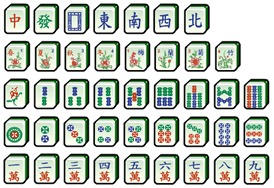
>PsyPets © 2004-2008 telkoth (copyright information, privacy policy, terms of service)
>This page updated 96 days 21 hours 33 minutes ago.
Hi Lana,
Thanks for the suggestion, but I'm actually quite satisfied with the font I currently use.
It's intentional that it not be in color, actually. I have this whimsical daydream of someday being picked up for a newspaper column - which means it needs to be in black and white.
The tile graphics you pointed me to are very small, a little hard to read. As far as I can tell, that's the actual size you get from PsyPets? (I didn't explore the site to learn more about what exactly you get, or how you use it.)
Those tiles don't have corner indices, which means players of American mah-jongg won't know which crak is which or which wind is which.
Those tiles also don't include jokers or backs, which I need to use sometimes.
Those tiles are viewed, not straight-on, but with an isometric or orthogonal view (meaning, the top and an edge are also visible), which means those tiles always have extra blank space between them - which I think makes them a little hard to read.
Lastly, the PsyPets graphics may be free, but they do come with restrictions, called a license ("the GFDL"). The site says:
>The following graphics were created by Jerry Crimson Mann, and released for public use under the GFDL, version 1.2, with no Invariant Sections, no Front-Cover Texts, and no Back-Cover Texts.
>This License applies to any manual or other work, in any medium, that contains a notice placed by the copyright holder saying it can be distributed under the terms of this License.
I didn't dig very deeply into the matter, but it seems to mean that I'd have to place a license notice on each column, and for all I know my columns might even constitute "front covers" or "invariant sections" (whatever those are).
I'm not positive, but I think those PsyPet tiles are the ones used by YakitoriOnline. (I went to check, but YakitoriOnline was down today - guess the webmaster forgot to pay his webhost bill or his domain renewal.)
If it becomes apparent to me that color tiles would be better than the font I'm currently using, I don't think it would be difficult for me to make some graphics more suitable to my needs. For now, though, I'll stay with the graphics I currently use. They're a font that I modified (adding corner indices and a Joker tile) from a font created by Yoshiki Kita and available for free download at http://www.asahi-net.or.jp/~mn8y-kt/font/font.html.
Thanks for the thought, anyway. May the tiles be with you.
Tom Sloper
Author of "The Red Dragon & The West Wind," the definitive book on mah-jongg East & West.
トム·スローパー
/
湯姆 斯洛珀 / 탐 슬로퍼
Los Angeles, CA (USA)
Father's Day, 2008
Wow! Chinese MahJongg is so much fun!
>From: (Lana) looky.lou
>Sent: Saturday, June 14, 2008 4:07 PM
>Subject: Wow...Chinese MahJongg is so much fun...
>Tom:
>Thanks for helping us in our attempt to learn the CHINESE MAH-JONGG SIMPLIFIED, available on sloperama.com. Your rules are an easy way to teach regular mah-jongg players (NMJL -- or that other one...lol) how to break into another mah-jongg dimension.
>
>We started playing for Chows (3 in-a-sequence) and Pungs (3 of-a-kind) and later added Kongs (4 of-a-kind). Our teacher said we were ready to put the 8 Flowers back in, and we did. We learned how manage our Flowers and how to pick replacement tiles from the Garden Gate. For ease, we pushed each working wall out at an angle.
>
>After about two hours we had even mastered the double-dice toss (to initially break the walls). We tried to learn how to keep score. Who would have "thunk" that a revered mah-jongg doesn't always earn the player the higher score?
>
>Our teacher explained..."that above all else one must always maintain harmony in play." And we'll certainly remember that saying when we're trying to out-play, out-scheme, out-mahj, and out-score other players...lol.
>
>We are anxiously looking forward to choosing our Chinese nicknames. What is your Chinese nickname, and, if you have one...what does it mean?
>
>Happily we were all able to mahj at least once...phew!
>Lana
>--------------------------------------------------------------------------------
>Tom: Since I had recently written to you on June 7th (and my email was published on your Q&A BB) you don't need to publish this one -- your choice. I really just wanted you to know how much fun we had. I hope I didn't mis-quote any of the above-mentioned rules.
Hi Lana,
I'm so delighted that you're enjoying Chinese Classical mah-jongg. So many players of American mah-jongg don't know what they're missing.
You also wrote:
 Our teacher explained..."that above all else one must always maintain harmony in play." Our teacher explained..."that above all else one must always maintain harmony in play."
 Which is what I've been saying all along in FAQ 9. Glad to hear the word is getting out. Which is what I've been saying all along in FAQ 9. Glad to hear the word is getting out.
looking forward to choosing our Chinese nicknames. What is your Chinese nickname
In all the times I've been to China, nobody ever said word one to me about having a Chinese nickname. I don't have one, and I don't know if any of the other non-Chinese players on the international mah-jongg scene have one either. I know nothing about how one goes about choosing one.
Oh wait, a guy I met there last time offered me 时同梦, which he said was a more poetic way of writing my last name. But I wasn't sure (its meaning is "it's time to have a common dream," which didn't sound special to me), and a Chinese friend didn't think it was so great, so I haven't been using it - and I don't know if it qualifies as a "Chinese nickname" as you suggest. I just write my name the way it was written in Chinese player lists - 湯姆 斯洛珀. It means "Tom Sloper."
you don't need to publish this one
Of all the emails I've gotten in the past month, this one above all needs to be shouted to the world. A player of American mah-jongg who's discovered the joys of one of the Chinese variants? Wild pandas couldn't stop me from posting it! Well, okay, I guess they could, but you get the point. (^_^)
May the tiles be with you.
Tom Sloper
Author of "The Red Dragon & The West Wind," the definitive book on mah-jongg East & West.
トム·スローパー
/
湯姆 斯洛珀 / 탐 슬로퍼
Los Angeles, CA (USA)
Father's Day, 2008
Is this a "missing link" or "hybrid" variant? (followup to May 7 post)
>From: arnold
>Cc: ArnoldA100
>Sent: Sunday, June 15, 2008 8:43 AM
>Subject: Mah-Jongg Q+A
>My mah-jongg question or comment is:
>Thank you very much for the information on the laaks from P&C. From the little I had been able to find—Rep's book and mahjongtime.com—both of which showed a 10 fan, 3 laak system—I had figured that a laak of 3 fan (before the final limit) was pretty much an ironclad rule.
>
>I am still a little leary about how a home-crafted Hong Kong game could warp these laak and the fan ranking of hands. In the only game I played, I later got the feeling that the fan and laak design had been designed toward a particular playing goal of its designer, i.e., to give a higher than "normal" payout to the more difficult hands that could or had to include chows, because of the high relative payments given to all players during the game to their declared kongs. She gave 8 fan to both Pure Hand and Pico Pico. This is compared to the "normal" 10 Fan she gave to 13 Wonders, 3 Fan to Clean Hand, 3 Fan to All Pungs, & 1 Fan to All Chows.
>
>Yes, there was a typo. Sorry. Pico Pico had to consist entirely of Terminal Chows (123s, 789s), with an Eye of 11's or 99's. No suit limitations. No requirement of a "pairing" of a 123 with a 789. Later, I thought that this Pico Pico should have been built up from different defined combinations like 1 Fan for Paired Terminals, and 3 Fan for the hand Rep called 5 Corners (or 2 Fan for the OC Outside Hand). Or if just defined as an isolated hand, then ranked as 5 or 6 fan maximum.
>
>This laak system automatically had both Pure Hand and Pico Pico skipping the long 1st laak of (4,5,6,7), placing them on the 2nd (short) laak (8,9), giving them a good opportunity to jump to the 3rd laak (10, 11), right up there with 13 Wonders.
>
>Maybe this was all okay. I just would have liked to have been "let in" on this design feature. Later, for a long time, I just felt so crushed when the game I had loved and played so long was not the "real" mahjong shown on the computer and in the one book I could find.
>
>Well, such is mahjong. I still feel privileged to have been able to play, with real live players, any modern Chinese game, particularly a Hong Kong game with laaks. It was a unique cultural opportunity and I have found out so much about the history and context of mahjong.
>Again, thank you very much. (And I do hope I have no typos this time!)
>Marlene
Hi Marlene,
Took me a moment to realize that you were writing in regards to a post from five weeks ago (far, far below) -
>Is this a "missing link" or "hybrid" variant?
>>From: MKAswWA
>>Cc: MKAswWA; ArnoldA100
>>Sent: Wednesday, May 07, 2008 3:03 PM
Now you write:
Maybe this was all okay. I just would have liked to have been "let in" on this design feature. Later, for a long time, I just felt so crushed when the game I had loved and played so long was not the "real" mahjong shown on the computer and in the one book I could find.
Mah-jongg players have to be flexible. Because every time you go to someone else's house to play a game, you'll discover that they use some house rules, some special interpretation of how the game is played. And invariably, they're convinced that their way is "the only right way" to play. See FAQ 14 and FAQ 9. Just be flexible, and bend graciously to others' cherished rules.
Anytime you have questions about the game, I'm always here!
May the tiles be with you.
Tom Sloper
Author of "The Red Dragon & The West Wind," the definitive book on mah-jongg East & West.
トム·スローパー
/
湯姆 斯洛珀 / 탐 슬로퍼
Los Angeles, CA (USA)
Father's Day, 2008
From the FIND PLAYERS board:
From: Scana5溌aol.com
Sent: Sunday, June 15, 2008 6:23 AM
Subject: Find Players/Teachers
Location (city and zip code): Manhattan 10025
I would like to learn to play Mah Jongg and am interested in joining a friendly group that meets in the evening. Thanks, Susan
email - scana5溌aol.com
Susan, also see FAQ 15 for tips on finding players or teachers. And you should probably use FAQ 2a to help you decide which kind of mah-jongg you want to learn, then look for websites (FAQ 4b) or books (FAQ 3) that teach that kind of mah-jongg. See FAQs above left.
May the game be with you.
Tom Sloper
Author of "The Red Dragon & The West Wind," the definitive book on mah-jongg East & West.
トム·スローパー
/
湯姆 斯洛珀 / 탐 슬로퍼
Los Angeles, CA (USA)
Father's Day, 2008
Kudos from NY
>From: Robert
>Sent: Friday, June 13, 2008 4:24 PM
>Subject: Hi Tom
>Hi Tom,
>Just wanted to send you a quick email thanking you for such a kick ass site. I've been playing one or another variant of "Chinese" Mah Jong for a while now and thought American MJ would be a boring, useless pursuit. How wrong I was! I enjoy it just as much as CMJ and have joined a group of women (once again the only man) who play weekly at the local coffee house. Keep up the good work, your site is invaluable for reference. You truly are Mr. Mah Jong!!!
>Cheers!,
>Robert
>Mahopac, NY
Cool! Thanks for writing, Robert.
May the tiles be with you.
Tom Sloper
Author of "The Red Dragon & The West Wind," the definitive book on mah-jongg East & West.
トム·スローパー
/
湯姆 斯洛珀 / 탐 슬로퍼
Los Angeles, CA (USA)
Friday the 13th, June 2008
Where can I get tiles like those?
>From: Sheryl
>Sent: Friday, June 13, 2008 12:59 PM
>Subject: mah jongg tiles
>Dear Tom, I viewed your site and really loved your journey. I was wondering if you knew of any websites for this stores or anyplace to get tiles like the ones shown on your site. Thank you, Sheryl
Hi Sheryl,
Well thanks, but I don't know which journey you mean. I also don't know which tiles you are referring to. To find out about buying mah-jongg sets, please scroll up and find the links to the FAQs, above left. Read FAQs 7j & 7k.
May the tiles be with you.
Tom Sloper
Author of "The Red Dragon & The West Wind," the definitive book on mah-jongg East & West.
トム·スローパー
/
湯姆 斯洛珀 / 탐 슬로퍼
Los Angeles, CA (USA)
Friday the 13th, June 2008
Kudos from Down Under
From: nickandclaire
Sent: Wednesday, June 11, 2008 10:38 PM
Subject: simple mah-jongg rules
Hello Tom,
I would like to say thank-you very much for your simplified rules for mah-jongg. I used your simplified rules to firstly learn, and then to teach, some friends mah-jongg for a weekend getaway last weekend. Your version of the rules made playing as a beginner really easy and fun. We scored using the ‘oooh aaah' method and had a great time playing the whole weekend!
Thanks very much.
Nick
Melbourne
Australia
Nice! Thanks for writing, Nick.
May the tiles be with you.
Tom Sloper
Author of "The Red Dragon & The West Wind," the definitive book on mah-jongg East & West.
トム·スローパー
/
湯姆 斯洛珀 / 탐 슬로퍼
Los Angeles, CA (USA)
June 11, 2008
Erroneous exposure
>From: Ruth Schnake
>Sent: Wednesday, June 11, 2008 6:00 PM
>Subject: Mah-Jongg Q+A
>My mah-jongg question or comment is:
>Re: American Mah Jongg
>When west discarded a 3 bam, east claimed it and displayed 2 bams and a joker. When looking for a discard she found that she had the wrong number of tiles and her hand was declared dead. When play moved back to west again, she wanted to claim the joker with another 3 bam. Two of us said "No, this is a dead hand.which was discovered during the play when she displayed the joker." Two of us said "Yes. She did not find the error until she had displayed the tile."
>Who is correct?
>Thank you. RMS
Hi Ruth,
You lost me with your first sentence. I don't know what East did wrong exactly. But I think I don't need to, to answer the question. East was declared dead, you said. But you didn't mention her putting that erroneous exposure back on the sloping front of her rack, which is what she's supposed to do when she goes dead on an exposure. If she'd done that, you never would have asked me a question at all. Read FAQ 19P - the FAQs are above left. I recommend you bookmark FAQ 19 for future reference.
May the tiles be with you.
Tom Sloper
Author of "The Red Dragon & The West Wind," the definitive book on mah-jongg East & West.
トム·スローパー
/
湯姆 斯洛珀 / 탐 슬로퍼
Los Angeles, CA (USA)
June 11, 2008
Couple tricky situations
>From: Bernice Vitcov
>To: Questions Sloper
>Sent: Wednesday, June 11, 2008 5:16 PM
>Subject: After I called and exposed
>Hi dear Tom: 2 questions: 1)After I called a tile and exposed 2 jokers with the other 2 I needed for my kong I noticed that I had another tile in my rack and really only had to put up one joker. Is there a time I can exchange the tile from my rack to the kong I exposed?
>2) If a person throws a tile and miss states the correct name of the tile. The next player picks, racks the tile she picked and throws and the one who misnamed the tile says: "I made a mistake I threw this instead of that and player number 3 says: "I want that tile that was named incorrectly." Of course they can say that but is there a remedy? The person who racked a tile wants the tile she racked and doesn't want to put it back. What can be done, if anything. How would you resolve it?? Bernice Vitcov
Hi Bernice, you asked:
 Is there a time I can exchange the tile from my rack to the kong I exposed? Is there a time I can exchange the tile from my rack to the kong I exposed?
Read FAQ 19AF and FAQ 19M. You know where the FAQs are.
 If a person throws a tile and miss states the correct name of the tile. The next player picks, racks the tile she picked and throws and the one who misnamed the tile says: "I made a mistake I threw this instead of that and player number 3 says: "I want that tile that was named incorrectly." Of course they can say that but is there a remedy? If a person throws a tile and miss states the correct name of the tile. The next player picks, racks the tile she picked and throws and the one who misnamed the tile says: "I made a mistake I threw this instead of that and player number 3 says: "I want that tile that was named incorrectly." Of course they can say that but is there a remedy?
There's no remedy for something that happened in the past and cannot be undone.
Once the next player picked and racked, the error was in the past. Player 3 is out of luck, and it's her own fault for not keeping her eyes open. In this case, four people erred - first, the player who misnamed the tile - secondly, the three players who didn't bother looking at the discard.
From what you told me that player 3 said, she didn't say she wanted the tile for mah-jongg - if she did, the game should be thrown in entirely, and rule 95c from my book (page 61) should be invoked. Player 1 pays player 3 four times the value of the hand completed by the misnamed discard (she "pays for the party"). This is also rule 6 on page 17 of the NMJL rulebook. But since player 3 just wanted it for an exposure, there's no penalty and no disruption to the game - everybody just continue playing (player 3 gritting her teeth and kvetching if that's her wont). FAQ 9 might offer some useful tips too - I recommend giving it a re-read.
May the tiles be with you.
Tom Sloper
Author of "The Red Dragon & The West Wind," the definitive book on mah-jongg East & West.
トム·スローパー
/
湯姆 斯洛珀 / 탐 슬로퍼
Los Angeles, CA (USA)
June 11, 2008
Metal racks, part 2
>From: Sharon McClure
>Sent: Tuesday, June 10, 2008 12:06 PM
>Subject: Metal Racks
>My mah-jongg question or comment is: Thank you for your prompt reply regarding my rather unusual metal racks. I would be interested to learn anything you are able to discern from the information/photos included here. Per your request, here is detailed information on the set:
>
>I would classify it as being in fair condition, since there are missing tiles, as well as some problems created by someone's boxing up the set before glue repairs were completely dry on the tiles. (The fragile & somewhat brittle paper faces have stuck together and several are chipped or torn.)
>
>The exterior of the sturdy wooden box is painted black, the lid being decorated with a hand-painted gold picture of pig-tailed Chinese players (who look somewhat "witch-like" with their pointed hats). The lid does not slide; it merely lifts up. There is no brass or other metal trim. The lid is also decorated with strips of paper repeating the words "Mah jongg" which appear to have once surrounded the gold painted figures. The interior of the box is painted red and has compartments for racks, tiles, counters, etc.
>
>There are 134 dark wooden tiles with paper faces, consisting of 32 craks, 29 dots, 36 bams, 14 winds, 11 dragons, 7 flowers, & 5 tiles with the paper faces missing. (10 tiles appear to be missing.) There are no jokers. The tile dimensions are 13/16 x 1 1/16 x 6/16. The craks appear in 3 colors - red, green, & yellow. The one bams (2 red birds/2 yellow birds) & the one dots have reverse red & yellow coloring.
>
>There are 72 painted wooden counting sticks, consisting of 10 gold, 15 red, 18 yellow, & 29 green. (Some of the "greens" may be faded blues.)
>
>There are 2 ivory-colored dice, one of which is accented with a large red dot on the 1,3, & 5.
>
>There are 4 metal racks, previously mentioned.
>
>No paper manuals or other paper materials are included, except for the tile faces & decor on the lid.
>
>I will probably not keep an incomplete set, since I use my sets for playing, so I would appreciate an opinion of its value, in addition to its story - if it has one - so I can pass it along to anyone who might have an interest in it.
>Thank you.
>Mah jongg Mama
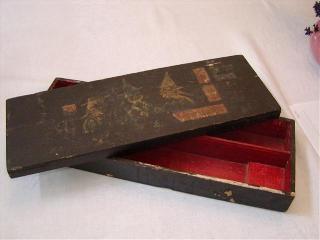
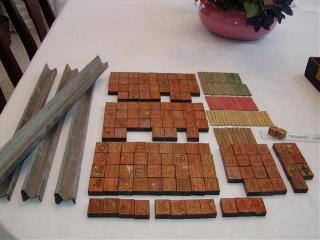
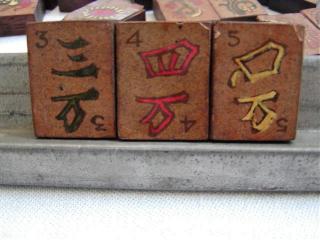

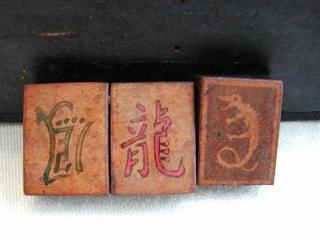
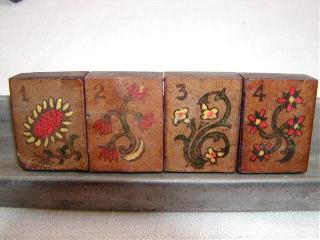
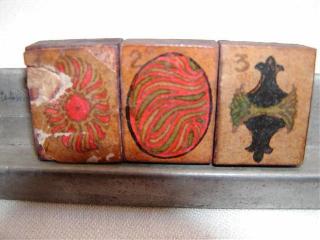
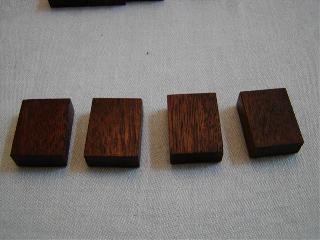
Hi Sharon, you asked about:
its value
That's a hard one, because I've never seen one of these before - meaning it's probably rare. But it's badly flawed, in that numerous pieces are missing, and one of the flower tiles is badly damaged, and there's no instruction manual, and the box top looks to be in bad shape too. It would only have value to a collector, especially one who has another set like it. A collector who doesn't have another set like it (thus doesn't have a crying need for its parts) would probably not pay more than $60 for it, but I could be off by $20 either way.
its story
Since I've never seen one before, I can't tell much. It looks like it was made cheaply, to be sold for a cheap price. The use of the name "mah jongg" on the box top is unusual and confusing, because it might mean any of 3 things - that it was made under Babcock's auspices, that it was made ignorant of Babcock's trademark, or that it was made after the trademark died of disuse. The set was definitely made for sale outside of China, probably North America, and probably was made IN North America. Could have been made anytime between 1924 and 1941 (possibly after WWII but probably not).
May the tiles be with you.
Tom Sloper
Author of "The Red Dragon & The West Wind," the definitive book on mah-jongg East & West.
トム·スローパー
/
湯姆 斯洛珀 / 탐 슬로퍼
Los Angeles, CA (USA)
June 10, 2008
Sandberg must be wrong! Right?
>From: Amcxyz
>Sent: Monday, June 09, 2008 8:57 PM
>Subject: Mah-Jongg Q+A
>My mah-jongg question or comment is: Regarding this book
>A BEGINNER'S GUIDE TO AMERICAN MAH JONGG, by Elaine Sandberg (Foreword by Tom Sloper), Tuttle Publishing, 2007. ISBN: 0-8048-3878-X
>Sandberg on page 94 states if dead and challenger is correct:" ...you must pay challenger the amount your hand is worth listed in Values..."
>Our weekly group was surprised by this, as far as we know this is not part of NMJL rules. What is your read on this?
>A M Conboy
>Forest Hills NY
>amcxyz
Hello AMC,
Didn't you see the 2005 bulletin from the NMJL? (^_^) See Frequently Asked Question #19AB ("Called me dead but I'm not. What now?"). Please scroll up and find the links to the FAQs, above left. Click FAQ 19. Bookmark the page for your future reference. Scroll down and find your answer. If the wording of the answer is unclear, please let me know how I can improve the wording for future askers of this same question.
May the tiles be with you.
Tom Sloper
Author of "The Red Dragon & The West Wind," the definitive book on mah-jongg East & West.
トム·スローパー
/
湯姆 斯洛珀 / 탐 슬로퍼
Los Angeles, CA (USA)
June 9, 2008
From the FIND PLAYERS board:
From: Jayne Owens
Email: jayneowens♥gmail.com
Sent: Monday, June 09, 2008 9:19 PM
Subject: Find Players/Teachers
Location (city and zip code): Reno, NV 89523
My kind of mah jongg is: unknown
I would very much like to LEARN mah johgg. I am in northwest Reno and am open to learning any form of the game. If you have a game that needs a player, or if I can just sit in and learn while you play, I would really appreciate it.
Jayne, also see FAQ 15 for tips on finding players or teachers. And you should probably use FAQ 2a to help you decide which kind of mah-jongg you want to learn, then look for websites (FAQ 4b) or books (FAQ 3) that teach that kind of mah-jongg. See FAQs above left.
May the game be with you.
Tom Sloper
Author of "The Red Dragon & The West Wind," the definitive book on mah-jongg East & West.
トム·スローパー
/
湯姆 斯洛珀 / 탐 슬로퍼
Los Angeles, CA (USA)
June 9, 2008
Metal racks
>From: sharonmcclure
>Sent: Monday, June 09, 2008 6:26 PM
>Subject: Mah-Jongg Q+A
>My mah-jongg question or comment is: I have just received an old American MJ set with racks made of what appears to be galvanized metal. Most of the racks I have seen and used have been wooden or plastic. Are metal racks unusual? (The tiles are wooden with paper faces, and the entire set is contained in a painted wooden box). I would appreciate any history you can share regarding this type of set.
>Mah jongg mama
Hi Sharon, you asked:
Are metal racks unusual?
Yep.
I would appreciate any history you can share regarding this type of set.
See Frequently Asked Question #7h. Please scroll up and find the links to the FAQs, above left. Give me more information after reading the FAQ, and maybe I can add something.
May the tiles be with you.
Tom Sloper
Author of "The Red Dragon & The West Wind," the definitive book on mah-jongg East & West.
トム·スローパー
/
湯姆 斯洛珀 / 탐 슬로퍼
Los Angeles, CA (USA)
June 9, 2008
Questions about Chinese mahjong
>From: (Lana) looky.lou
>Sent: Saturday, June 07, 2008 4:18 PM
>Subject: Just a half dozen MahJongg clarifications would help...
>Good day to you, Tom.
>Finally getting some gals together to start learning Chinese Mahj and then I discovered that there's the "official" and there's the "classical" and now I don't know which one to go with.
>
>In your book "The Red Dragon and The West Wind" you devoted pages 127 through 249 to the Chinese Official Mahjong. You devoted pages 2 through 126 to the American version, along with some history of Mahjongg. By the way, your book is a "keeper!" I decided to go with your book's instructions for Chinese Mah-Jongg.
>
>So I went online and copied your instructions for CHINESE MAH-JONGG SIMPLIFIED, which uses 136 tiles, but, but, but...I'm unsure about tackling this easier version. Until I compared both sets of rules I didn't realize that they were two different versions.
>
>Would the simplified version be best for current American MahJongg players who just want to experiment with some Chinese version?
>
>Should we jump right into the version that uses no jokers or flowers, or is that too big of a jump?
>
>Tom, we're anxiously waiting at the edge of the cliff and we're ready to jump...but how far? (Bite your tongue.)
>
>Just curious: What's the story behind the artistic sketch you use with your emails?
>
>A lesson learned: The other day I was playing for money and tossed away a 4 Bamboo which was really a Flower. I threw away a Mahj hand and didn't even know it until it was too late. The lesson learned is to carefully preview the tiles of any set you're not used to playing with before the game starts. The hand ended up as a wall game and cost me money. Strange, but no one caught the error at the time. Double duh...
>Lana
Hi Lana,
I'm so glad you like my book. You asked:
I discovered that there's the "official" and there's the "classical"
Look in FAQ 2b - there are a lot more Chinese variants than that!
and now I don't know which one to go with.
That's what FAQ 2a is for.
I went online and copied your instructions for CHINESE MAH-JONGG SIMPLIFIED, which uses 136 tiles, but, but, but...I'm unsure about tackling this easier version.
The simplified rules are intended to be a way to break in gently into any Asian variant. Actually, all it is is Asian mahjong, without any flowers, and without any scoring. You can accomplish the same thing by playing the rules in my book but ignoring flowers and scoring. FAQ 10 simply shows you the basics of Asian mahjong, is all. To get you started.
Until I compared both sets of rules I didn't realize that they were two different versions.
You haven't looked at Chinese Classical yet, if all you've printed is FAQ 10. FAQ 4b lists lots of websites where the CC rules are given. And as I said above, FAQ 2b lists all known variants - there aren't just two Chinese and one American. Take a look at Appendix 5 in my book. Personally, I think the CC scoring is too complicated, since every player pays every other player. But some folks think CO is too complicated because there are so many patterns to either memorize or look up. If playing CO, photocopy Appendix 7 as a tableside guide. After breaking in gently via FAQ 10, of course.
Would the simplified version be best for current American MahJongg players who just want to experiment with some Chinese version?
Sure.
Should we jump right into the version that uses no jokers or flowers, or is that too big of a jump?
As opposed to what?
What's the story behind the artistic sketch you use with your emails?
You mean the little drawing of me that I use to precede my answers here on the BB, and atop each of my weekly strategy columns? That's a caricature of me, from the Japanese manga "Kindai Majan" (2007年10月1日 issue, in the comic strip "愉快な人々," by artist 有元美保. Jenn Barr, an American who lives in Japan, is a professional mahjong player. She came to the Open European Mahjong Championship in Copenhagen last summer, and we first met there. She went back to Japan and was interviewed by 有元美保. In that interview she told him about meeting me, so I was part of the story. I'm chuffed to be a Japanese manga character! (^_^) Even if it was only the one frame.
The lesson learned is to carefully preview the tiles of any set you're not used to playing with before the game starts.
Yes, which is why I said that on page 30. And which is why I always use a different mahjong set in each class when I'm teaching.
May the tiles be with you.
Tom Sloper
Author of "The Red Dragon & The West Wind," the definitive book on mah-jongg East & West.
トム·スローパー
/
湯姆 斯洛珀 / 탐 슬로퍼
Los Angeles, CA (USA)
June 7, 2008
Where can one buy Hatsune Mai's book?
>From: Joe Ng
>Sent: Saturday, June 07, 2008 10:46 AM
>Subject: Hatsune Mai's book
>Tom,
>Where can one buy Hatsune Mai's book? My local Japanese booksotre (Kikokuniya) does not carry it. I had a friend inquire about the book when she was in Japan, apparently it is still in print.
>Do you have any links to book stores here or in Japan that still sell this?
>Thanks.
>Joe
Hi Joe,
No, I have no idea about specific bookstores that have particular books in stock. I couldn't even give you the exact location of a bookstore that has my own book in stock right now.
I recommend the Internet. I see that in FAQ 3 I'd neglected to show the kanji for the authors' names - an integral part of doing an Internet search. I fixed that, and here's the part you need to search on (you can copy and paste this into Japanese Google, at google.co.jp):
初音舞の世界に勝Ӗ
初音 舞 • 梶本 琢理
竹書房 ISBN 4-8124-2190-X.
That's the title (line 1), the authors' names (line 2), publisher and ISBN (line 3)
Of course, since the book is in Japanese, the book is most likely carried on Japanese sites, so you might have to order it in Japanese. If you don't read Japanese, maybe a friend can help you figure out how to input the order.
By the way, you do know (from FAQ 3) that the important strategy chapters of the book have been translated into English, at http://museum.takeshobo.co.jp/kokusai/index.html, right?
May the tiles be with you.
Tom Sloper
Author of "The Red Dragon & The West Wind," the definitive book on mah-jongg East & West.
トム·スローパー
/
湯姆 斯洛珀 / 탐 슬로퍼
Los Angeles, CA (USA)
June 7, 2008
Would it be better to break it up or sell it as a set, part 2
>From: Neva Wheeler
>Sent: Friday, June 06, 2008 2:16 PM
>Subject: Mah-Jongg Q+A
>My mah-jongg question or comment is:
>No, don't have the box. Not sure what wind tiles look like
>thanks for your help
>neva
Hi Neva, you said:
Not sure what wind tiles look like
You need to find out, then. You don't want to go on eBay and sell stuff without being informed. Prospective buyers are sure to ask questions, and you need to be able to answer them.
Look in the Frequently Asked Questions ("FAQs"), specifically Frequently Asked Question #7N. Please scroll up and find the links to the FAQs, above left. Click FAQ 7N. Bookmark the page for your future reference.
May the sale be with you.
Tom Sloper
Author of "The Red Dragon & The West Wind," the definitive book on mah-jongg East & West.
トム·スローパー
/
湯姆 斯洛珀 / 탐 슬로퍼
Los Angeles, CA (USA)
June 6, 2008
How much would this type of set sell for?
>From: LFHSC
>Sent: Friday, June 06, 2008 1:33 PM
>Subject: Mah-Jongg Q+A
>My mah-jongg question or comment is: How much would the set #079 on the museum website sell for? My friends Mother has one like it. All drawers have all the items like the one shown on the website.
>Thanks,
>Melinda
>Alabama
Hi Melinda, you asked:
How much would the set #079 on the museum website sell for? My friends Mother has one like it.
You're asking me to go to a website and look for a picture and give you an appraisal for a hypothetical identical set. Sorry, I do not offer a service like that. What I offer is to appraise your friend's mother's set for you, provided that you give me all the information requested in FAQ 7h, above left. An appraisal has to be based on a particular set - not a hypothetical set identical to a photo somewhere.
Standing by...
Tom Sloper
Author of "The Red Dragon & The West Wind," the definitive book on mah-jongg East & West.
トム·スローパー
/
湯姆 斯洛珀 / 탐 슬로퍼
Los Angeles, CA (USA)
June 6, 2008
Would it be better to break it up or sell it as a set?
>From: Neva Wheeler
>Sent: Friday, June 06, 2008 1:13 PM
>Subject: Mah-Jongg Q+A
>My mah-jongg question or comment is:
>Your site is so informative. I have learned so much and thank you.
>I bought a collection (set?) of tiles, some of which are bakelite (tested) and the rest I think are bone and bamboo. Also counting sticks dice, etc.
>I can send you pictures.
>The elderly lady said she had played with this set for over 50 years.
>I plan to list this on EBay
>Would it be better to break it up or sell it as a set?
>Thanks a lot
>neva
Hi Neva, you asked:
Would it be better to break it up or sell it as a set?
That depends. It's not clear from the photos you sent me whether you have a complete set or not. I didn't see any wind tiles, and the only catalin (Bakelite) tiles I saw in your photos were flowers and jokers (not enough jokers for a modern American set). It's also not clear from your description whether you have a box for the tiles or not.
If you don't have a complete set with box, then it's probably best to break it up.
May the sale be with you.
Tom Sloper
Author of "The Red Dragon & The West Wind," the definitive book on mah-jongg East & West.
トム·スローパー
/
湯姆 斯洛珀 / 탐 슬로퍼
Los Angeles, CA (USA)
June 6, 2008
Slow player
>From: jackie.berman
>Sent: Friday, June 06, 2008 9:58 AM
>Subject: Mah-Jongg Q+A
>My mah-jongg question or comment is:
>I play in a weekly game with 4 other women NMJL rules for approx 2
>years. One of the players is so painfully slow
>It is really becoming a problem it's so not fun. All she is interested
>in is winning. She does not have a clue what is going on at the table.
>All she cares about is her hand. She is a really good neighbor and I
>don't want to piss her off.
>We have said things like we have to play faster, we have even resorted
>to using a timer, 15 min per game.
>She is still looking on the back of the card to match dragons. She never
>knows when to push her wall out, any suggestions
>Other that ending this game and playing a night when she is busy? Love
>Love Love this site. Wish I could play in your game!!!!!!!
Hi Jackie,
Sorry, but I don't have any magic for you. If after 2 years of all of you urging her to speed up and pay attention, she still can't see anything beyond her card and she still plays slowly, there's nothing more I can offer you. She is what she is, take her or leave her.
May the tiles be with you.
Tom Sloper
Author of "The Red Dragon & The West Wind," the definitive book on mah-jongg East & West.
トム·スローパー
/
湯姆 斯洛珀 / 탐 슬로퍼
Los Angeles, CA (USA)
June 6, 2008
About stopping the Charleston too much, part 2
>From: Chak12
>Sent: Friday, June 06, 2008 5:12 AM
>Subject: Mah-Jongg Q+A
>My mah-jongg question or comment is:
>Hi Tom
>Thank you so much for your really astute answer to my question AND dilemma about my group and their Charleston habits. I will definitely try your suggestions, and for now, not say anything, and keep track of winners and when they stop the Charleston. My frustration is that I do feel they are trying to keep ME from getting a better hand. As we say: OY Vey!
>I'll keep you posted on my travails.
>Helaine
Hi Helaine, as for what you said:
I do feel they are trying to keep ME from getting a better hand.
Yes, well, that is part of the battle, after all.
May the tiles be with you.
Tom Sloper
Author of "The Red Dragon & The West Wind," the definitive book on mah-jongg East & West.
トム·スローパー
/
湯姆 斯洛珀 / 탐 슬로퍼
Los Angeles, CA (USA)
June 6, 2008
About stopping the Charleston too much
>From: Chak12
>Sent: Thursday, June 05, 2008 4:22 PM
>Subject: Mah-Jongg Q+A
>My mah-jongg question or comment is:
>Hi Tom
>Charleston question - I have been playing with the same group of 5 players for about 2 years. During the past 6 months, the trend has been that someone, more often than not, stops the second Charleston. We could play 10 games, and maybe 5 of those games have the Charleston stopped after the first left. I have gently said that it is not really fair to everyone, but the others continue to do it. I now get the feeling that this trend is done to: 1. possibly prevent the "stronger" players from gaining a better hand, or 2. people don't want to "think" anymore so they just stop it. I have even suggested that we NOT REMIND players about stopping after the first left, because as soon as someone says "does anyone want to stop," inevitably someone says YES. Last time we played, we had more Wall Games, than wins. NEVER does the person who stopped the Charleston, win the hand! How can I bring the group back to stopping the Charleston only when necessary?
>Thanks for your time.
>Helaine
Hi Helaine,
I imagine you're going to find this really annoying... but I don't think this is really a Charleston question. I think this is really a question of how to manage a ménage à trios - an evil triangle. Your question involves three disparate needs ([1] the rules, [2] harmony, and [3] "what I want"), and how to find the optimum solution between the three.
 The rules say that any player may stop the Charleston at any time, for any reason.
The most harmonious thing would be that all players use the right to invoke the stop-the-Charleston rule only infrequently, in a manner that doesn't frustrate anybody else.
What I want is that nobody ever stop the Charleston frivolously.. that nobody abuse the rule! Is that too much to ask??
The rules say that any player may stop the Charleston at any time, for any reason.
The most harmonious thing would be that all players use the right to invoke the stop-the-Charleston rule only infrequently, in a manner that doesn't frustrate anybody else.
What I want is that nobody ever stop the Charleston frivolously.. that nobody abuse the rule! Is that too much to ask??
This is a moral dilemma for you, Helaine! And I fully understand that.
The most harmonious thing would be for the other players to recognize that their frivolous invoking of the stop-the-Charleston rule is impacting harmony.
The quandary for you is that telling them that their acts are adversely affecting harmony could in and of itself be a disharmonious act! This is truly a delicate walk for you, Helaine.
You have told me that "NEVER does the person who stopped the Charleston, win the hand!" But you have not backed up that assertion with hard facts. As I see it, you have the following limited options:
1. Announce to the group: "I think we stop the Charleston an awful lot, and I also believe that the person who stops the Charleston NEVER actually wins the hand. So what I'm going to do is keep track of who stops the Charleston, and then see if that person actually wins that hand. After I've recorded 50 such events, I'll present you with the statistics I've recorded, and then we can discuss whether we've been stopping the Charleston too much, or not, and decide what to do going forward."
2. Keep your mouth shut for the time being. Keep track of who stops the Charleston and then see if that person actually wins that hand. After you've recorded 50 such events, present the group with the statistics you've recorded, and force a discussion as to whether they've been stopping the Charleston too much, or not, and what to do going forward.
3. Stop fretting about it. Frets are for guitar players (oh all right, banjo players and mandolin players and ukulele players too)! Just go with the flow, and enjoy the group - they're nice folks after all, right? Everything can't be perfect. That's life.
4. Quit that group and go find another.
May the tiles be with you.
Tom Sloper
Author of "The Red Dragon & The West Wind," the definitive book on mah-jongg East & West.
トム·スローパー
/
湯姆 斯洛珀 / 탐 슬로퍼
Los Angeles, CA (USA)
June 5, 2008
Tile spacing - and joker locating
>From: Chickering50273
>Sent: Thursday, June 05, 2008 2:10 PM
>Subject: Mah-Jongg Q+A
>My mah-jongg question or comment is:
>Display of tiles on the rack:
>1. Does it make any difference where a joker is placed? dot-joker-dot or
> joker-dot-dot joker-dot-dot-dot or dot-joker-dot-dot
>2. Can all tiles be pushed together or should they be separated as each is called:
>3-dot,3-dot,3-dot (space) 4-dot,4-dot,4-dot or 3-dot,3-dot,3-dot,4-dot,4-dot,4-dot
> ^
> (NO space)
>Thanks!
Hello "Chick," you asked:
Does it make any difference where a joker is placed?
It depends - are you talking about placement within exposures, or within the hand (on the sloping front of the rack as opposed to the horizontal top of the rack). This isn't a rules question - it's a question of strategy or etiquette.
- In the case of exposures (on the horizontal top of the rack), it's a matter of etiquette to put the jokers embedded within the exposure, so all other players can easily see which exposure a joker belongs to. The goal is to maximize harmony.
- Within the hand (on the sloping front of the rack), it's a matter of strategy. You should place the jokers in a place where you can most easily imagine them used in any of the possible places in the hand. Other players couldn't care less where you place them, since they can't see them anyway.
Can all tiles be pushed together or should they be separated
It depends - are you talking about spacing between exposures, or spacing within the hand (on the sloping front of the rack as opposed to the horizontal top of the rack). This isn't a rules question - it's a question of strategy or etiquette.
- In the case of exposures (on the horizontal top of the rack), it's a matter of etiquette to put spaces between your exposures, so all other players can easily see what your exposures are. The goal is to maximize harmony.
- Within the hand (on the sloping front of the rack), it's a matter of strategy to keep your tiles all together, without any spaces. If you put spaces between your groupings, other players can deduce clues as to what you're doing and how close you might be to making mah-jongg.
May the tiles be with you.
Tom Sloper
Author of "The Red Dragon & The West Wind," the definitive book on mah-jongg East & West.
トム·スローパー
/
湯姆 斯洛珀 / 탐 슬로퍼
Los Angeles, CA (USA)
June 5, 2008
Somebody who can touch up my tiles?
>From: hannah young
>Email: heygirl at sbcglobal.net
>Sent: Wednesday, June 04, 2008 6:24 PM
>Subject: Mah-Jongg Q+A
>My mah-jongg question or comment is: Do you know any one in the bay area in northern California that can touch up and paint mahjong tiles. I have a beautiful vintage set and some of the tiles are getting worn Thank you
Hey Hannah,
What I got is FAQ 7o (that's seven oh, not seventy). You can find the answer to this, and many other often-asked questions, in the Frequently Asked Questions ("FAQs"). You have asked Frequently Asked Question #7o. Please scroll up and find the links to the FAQs, above left. Click FAQ 7o. I think you'll find some ideas there.
May the tiles be with you.
Tom Sloper
Author of "The Red Dragon & The West Wind," the definitive book on mah-jongg East & West.
トム·スローパー
/
湯姆 斯洛珀 / 탐 슬로퍼
Los Angeles, CA (USA)
June 4, 2008
Those confusing joker rules yet again (FAQ 19P)
>From: Dolores70000
>Sent: Tuesday, June 03, 2008 8:11 PM
>Subject: Mah-Jongg Q+A DEAD HAND IN NMJL
>My mah-jongg question or comment is:
>Thank you for all the great information on your site.
>A declared dead hand that has jokers.
>Can the jokers be TRADED by the other players?
>Thank you, new player, Dolores
Hello Dolores,
This question has been asked many times before, and recently.
It was asked by Barbara Suden within the past week (below). You can find the answer to this, and many other often-asked questions, in the Frequently Asked Questions ("FAQs"). You have asked Frequently Asked Question #19P. Please scroll up and find the links to the FAQs, above left. Click FAQ 19. Bookmark the page for your future reference. Scroll down and find your answer. If the wording of the answer is unclear, please let me know how I can improve the wording for future askers of this same question.
May the tiles be with you.
Tom Sloper
Author of "The Red Dragon & The West Wind," the definitive book on mah-jongg East & West.
トム·スローパー
/
湯姆 斯洛珀 / 탐 슬로퍼
Los Angeles, CA (USA)
June 3, 2008
Those joker rules are so confusing! - part 3
>From: Philjack06
>Sent: Sunday, June 01, 2008 10:15 AM
>Subject: Mah-Jongg Q+A
>My mah-jongg question or comment is:
>Thanks for your help. I guess it's clear now.
May the tiles be with you, Phil. Or Jack. As the case may be.
Tom Sloper
Author of "The Red Dragon & The West Wind," the definitive book on mah-jongg East & West.
トム·スローパー
/
湯姆 斯洛珀 / 탐 슬로퍼
Los Angeles, CA (USA)
June 1, 2008
How much is my set worth, part 3
>From: Hazel Richards
>To: Mike MahJongg
>Sent: Sunday, June 01, 2008 1:50 AM
>Subject: Is there anything else you can tell us
>Hi there
>Thanks for your reply to this email on your site. I do think the box and the set belong together because everything fits so well. However, apart from the fact that it's not worth much, is there anything else you can tell us about it. Like, how old is it, where was it made etc?
>Also, isn't it normal for bone pieces to show variations in colour or has this set just been well-loved?
>Thanking you in advance.
>Regards
>Haze
Hola Haze, you asked:
how old is it, where was it made
It was made in China in the 1920s.
etc?
Read FAQ 7P.
isn't it normal for bone pieces to show variations in colour
It's normal for bone pieces to mellow to a pleasing cream color, with only very slight variations of tone from piece to piece.
has this set just been well-loved?
It has been stored unkindly. There may have been mold or mildew or something, causing those unsightly blotches.
By the way, if you email me again, please delete the very large photos instead of keeping them still attached.
May the tiles be with you.
Tom Sloper
Author of "The Red Dragon & The West Wind," the definitive book on mah-jongg East & West.
トム·スローパー
/
湯姆 斯洛珀 / 탐 슬로퍼
Los Angeles, CA (USA)
June 1, 2008
Those joker rules are so confusing! - asked a 2nd time
>From: Philjack06
>Sent: Sunday, June 01, 2008 8:13 AM
>Subject: Mah-Jongg Q+A
>My mah-jongg question or comment is:
>Can I use two jokers and call the pair two 2's? I am using NMJL card. I am teaching some friends the game and want to get it right.
>Thanks
Phil or Jack,
I answered you yesterday (below). I told you the answer is on the back of your card. I do not know if you found yesterday's reply or not, and I do not know if you read the back of your card or not.
To save time, here's what it says on the back of your card:
Joker or Jokers can NEVER be used for single tile, or for a pair.
If the wording of that answer is unclear, please let me know how I can clarify it for you...?
Tom Sloper
Author of "The Red Dragon & The West Wind," the definitive book on mah-jongg East & West.
トム·スローパー
/
湯姆 斯洛珀 / 탐 슬로퍼
Los Angeles, CA (USA)
June 1, 2008
Those joker rules are so confusing!
>From: Philjack06
>Sent: Saturday, May 31, 2008 1:20 PM
>Subject: Mah-Jongg Q+A
>My mah-jongg question or comment is:
>Hello,
>Can I use two jokers for a pair ?
>Thanks
Hello Phil and/or Jack, you asked:
Can I use two jokers for a pair ?
It depends on what rules you're playing. If you play NMJL rules, using the NMJL card, the answer is on the back of your card.
If you don't play NMJL rules and use the NMJL card, tell me what rules you use and I can help you.
May the tiles be with you.
Tom Sloper
Author of "The Red Dragon & The West Wind," the definitive book on mah-jongg East & West.
トム·スローパー
/
湯姆 斯洛珀 / 탐 슬로퍼
Los Angeles, CA (USA)
May 31, 2008
How much is my set worth, cont'd.
>From: Hazel Richards
>Sent: Saturday, May 31, 2008 12:43 PM
>Subject: Re: Need some help identifying a Mah-Jongg set
>Tom you are a star !! Pity it isn't worth a fortune though :-))
>Many thanks
>Regards
>Haze
How much is my set worth?
>From: Hazel Richards
>Sent: Saturday, May 31, 2008 11:21 AM
>Subject: Need some help identifying a Mah-Jongg set
>Hi there
>I have gone through your questionnaire and hope I've supplied all the information you need to identify our Mah-Jongg set. It's attached and I've made the photos as small as possible.
>If I've missed anything, it's out of ignorance so please ask for other stuff if it's required. If you can supply an approximate value, that would be stupendous !
>If there's a charge or you'd like a contribution to the maintenance of your site, please let me know - it would be worth it.
>Many thanks and warm regards (well, they would be if it wasn't raining) from Spain.
>Haze
>
>1 Write a factual detailed list of all the contents of your set. Describe all the contents, listing all dice, chips, racks, etc.
>- Container is a mid-brown thick leather carrying case with red felt lined drawers and lockable catches plus 2 keys
>- 148 Tiles comprising
>• 36 Bams
>• 36 Craks (older type)
>• 32 Winds
>• 36 Dots
>• 8 Blanks
>- No Jokers
>- No racks
>- 3 Small dice
>- 2 round double-sided disks (green symbol on one side, red on the other – all 4 symbols are different
>- Round "doughnut" thing but I'm not sure it's part of the set
>- Instruction booklet in Spanish
>- 113 Sticks with the following characteristics:
>• 35 each 6cm long by 0.6cm wide 2 dots each end and on both sides
>• 35 each 7.5cm long by 0.6cm wide 2 red dots each end and on both sides
>• 35 each 7.5cm long by 0.6cm wide 10 black dots each end and on both sides
>• 8 each 7.5cm long by 0.6cm wide 5 red dots each end and on both sides
>-
>2 IMPORTANT: Describe the condition of all the components of the set. Describe the condition of the case, the paper materials, and of course the tiles. Are they clean and attractive, like new, or are they dirty, mildewed, smelly? Appraisers use specific language to grade or describe the condition of collectibles.
>CONDITION IS AS FOLLOWS:
>- CASE: outer leather is thick, stiff and in good order and case still locks. The 2 brass keys are there. Carrying handle is missing and some of the stitching has come undone from one corner. Metalwork on the locks is silver coloured, very worn and about 50% rusty. Internally there are 4 lift-out drawers covered with red felt with black leather lifting strips. The internal felt in all 4 drawers is only in poor to fair condition but the external felt is in good condition.
>- BAMS: 36 present but the bone on one number 2 is chipped on the top right-hand corner but bone and bamboo on all others are in perfect order. Printing is rubbed on 5 and there is some colour variation
>- CRAKS: 36 present but there is some colour variation. Condition of all tiles is very good
>- WINDS: 32 present all in good condition
>- DOTS: 36 with some colour variation. Condition of all tiles is very good
>- BLANKS: 8 all in very good condition
>- DICE: 3 small, unboxed and dots rubbed. In fair to good condition
>- STICKS:113 in total – 2 chipped but all others in good condition, slight colour loss on the dots on about 20 of them (not sure whether they should be black or red)
>- DISKS: 2 double-sided disks about 1.5cms in diameter. Disks in very good condition but writing slight rubbed on all 4 sides
>- INSTRUCTION BOOKLET: No cover and in very poor condition. Written in Spanish – no date anywhere but typeface looks early 20th century (picture attached)
>3 What are the tiles made of ?
>• I'm pretty sure the tiles are made of bone (certainly not plastic nor bakelite) with bamboo backs
>4 Describe what you know about when the set was made or purchased, if you know. Describe the history of the set to the best of your knowledge.
>• Set was purchased about 4 years ago but no previous history known
>5 What are the dimensions of the tiles? Use either inches or metric (one or the other, not both - doesn't matter which; just be precise). Height, width, depth. If the tiles are bone & bamboo, give thickness of the bone portion. (Same goes for ivory & bamboo tiles.)
>• Each tile has a bone part, which measures 3cm x 2.1cm x 0.5cm (1.7cm including the depth of the bamboo)
>6 How many tiles are there in the set?
>• Please see 1 and 2 above attached photographs
>7 What other pieces (besides tiles) are included with the set? Give descriptions and exact counts.
>• Please see 1 and 2 above attached photographs
>8 What kind of container does the set come in? If it's wood, is it one of those flat boxes with a sliding top, or is it one of those squarish boxes with drawers, and if so how many drawers?
>• Please see 1 and 2 above attached photographs
>9 What condition is the container in? If it has brass doodads, is the brass all there and in good condition?
>• Please see 1 and 2 above attached photographs
>10 Does the set have any paper materials -- a manual, a label, anything at all? What's the condition?
>• Please see 1 and 2 above attached photographs
>11 Which kind of craks are in this set -- the older kind or the later kind? Take a picture to provide to the appraiser.
>• Older type – photograph sent
>12 Provide a picture of the One Bams . These tiles can sometimes tell a lot about which part of China the set came from
>• Photograph sent
>13 Provide a picture of the dragons too. These tiles can sometimes tell a lot about which era of mah-jongg history the set came from
>• Not sure which are dragons but please see photographs
>14 And provide a picture of the flowers /seasons. These tiles are sometimes exotic and can enhance the set's value
>• Photograph sent
>15 How many jokers (if any) does the set have?
>• None but there are 8 blanks
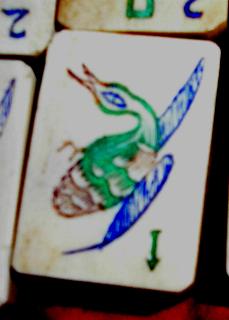
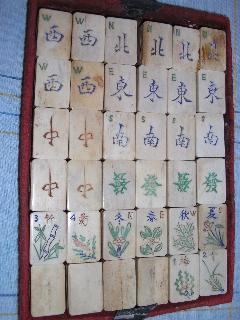
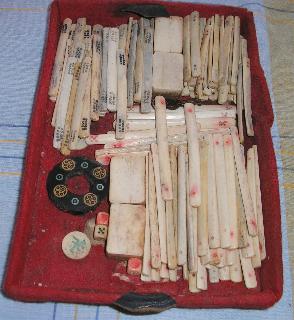
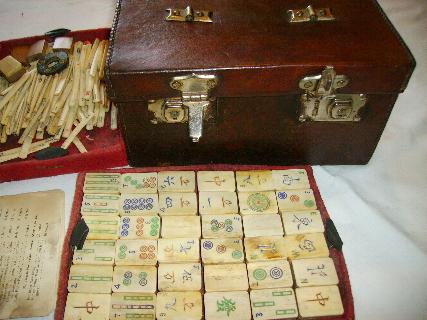
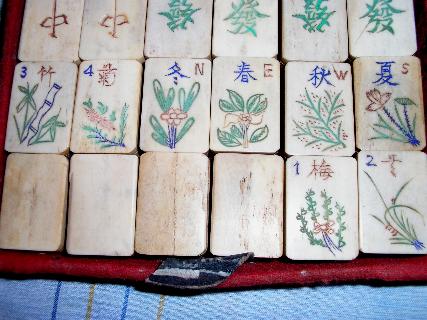
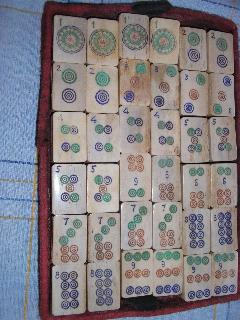
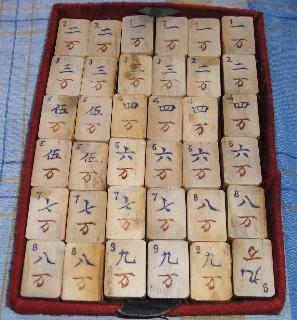
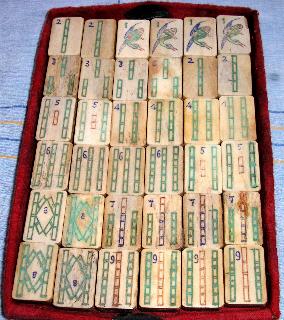
Hola Hazel, you asked:
If you can supply an approximate value
Maybe $40 or $50 US. It's not a very good set. Details:
Heavy staining and miscoloration on many of the tiles and sticks and dice;
Unsightly Haversian system on some tiles;
Box condition could be better, per your description;
Box may not even be original to this set;
Instruction manual in very poor condition;
Some sticks are missing (they should all be in multiples of 4).
BTW, FYI - you don't have 32 wind tiles and 8 blanks. You have the proper 16 wind tiles, 12 dragon tiles, and 4 extra blanks (read FAQ 7e). The nicest thing about your set is the unusual wind indicator (the 2 discs and the torus, the doughnut-shaped thingy) - assuming the discs rest nicely into the torus.
May the tiles be with you.
Tom Sloper
Author of "The Red Dragon & The West Wind," the definitive book on mah-jongg East & West.
トム·スローパー
/
湯姆 斯洛珀 / 탐 슬로퍼
Los Angeles, CA (USA)
May 31, 2008
Tables and tile size
>From: Jonathan Cho
>Sent: Saturday, May 31, 2008 11:13 AM
>Subject: MahJong Tables, and Their Relation to Tile Sizes
>Greetings, Mr. Sloper!
>I'm not sure if you remember, but I posted a question a while back on the subject of building my own Mahjong Table. I did a little more research, and double-checked your FAQ on Tables to see if I had missed anything.
>
>Now, for the moment, I will pass up on "building" my own table until I have a little more spare cash, but am considering purchasing a JUNK Mat from Japan. I'm sure you've heard about the little wonders - a Mahjong mat that comes with four plastic sidings to hold the mat in place, provide a place to straighten tiles, AND even holds bones/counters! It costs a little over $80 USD, all told (around 40-50 for the mat itself, then 30-40 for shipping straight from Japan), but it seems like it'd be worth the investment.
>
>Now, as for my actual question... You recommended on your FAQ7f that a good Mahjong playing area should be about 33" - 36" square. What kind of Mahjong playing is that SIZED to? For instance, American Mahjong sets use more tiles, so the squares made by the walls would be much larger than the squares made by an Asian set. In addition to that, Asian sets come in multiple sizes, ranging anywhere from the miniscule "Travel" sets to the larger "Professional" tiles. I myself carry a larger, Chinese acrylic set, and have noticed that in comparison to my friends' antique set, my tiles are enormous, and thus take up more space during play. Should I thus attempt to obtain a larger playing area as result? Or have you already compensated for that when you recommended the 36" square?
>Still as Mahjong Obssessed as ever,
>JonJon C.
HiHi JonJon,
33" square is the standard size for all mah-jongg tables. The playing area of Asian "lipped" tables is actually too small for American mah-jongg, regardless of tile size - due to the need for racks and cards on the American table. That's why a lipless card table is the perfect thing for American mah-jongg (better than an Asian lipped table).
A 36" square table borders on being almost too large for comfort - and it has nothing to do with tile size. Rather, the governing factor is arm length. The human arm can only reach so far. But when you go to a round table, 36" is just right.
May the tiles be with you.
Tom Sloper
Author of "The Red Dragon & The West Wind," the definitive book on mah-jongg East & West.
トム·スローパー
/
湯姆 斯洛珀 / 탐 슬로퍼
Los Angeles, CA (USA)
May 31, 2008
Frequently Asked Question #19P
From: "Barbara Suden"
Sent: Friday, May 30, 2008 4:30 AM
Subject: Mah-Jongg Q+A
> My mah-jongg question or comment is: when someone exposes their hand
> for mah jongg, but is incorrect and therefore dead and play continues
> for the other players, can the other players take any of the jokers
> that the "dead" person has in their exposed hand
Hi Barbara,
This question has been asked many times before. You can find the answer to this, and many other often-asked questions, in the Frequently Asked Questions ("FAQs"). Please scroll up and find the links to the FAQs, at the left. Click FAQ 19. Please bookmark the FAQs page for your future reference. Then scroll down and find your answer (FAQ 19P). If the wording of the answer is unclear, please let me know how I can improve the wording for future askers of this same question.
May the tiles be with you.
Tom Sloper
Author of "The Red Dragon & The West Wind," the definitive book on mah-jongg East & West.
トム·スローパー
/
湯姆 斯洛珀 / 탐 슬로퍼
Los Angeles, CA (USA)
May 30, 2008
Questions about my set (Frequently Asked Question #7)
>Subject: Mah Jongg question
>From: Richard Douglass
>Date: Wednesday, May 28, 2008 11:43:48 PM
>Please help. I have read all your web sites so here are the facts: Have inherrrited a set of 148 tiles, 7 of which are blank. There appears to be no jokers. There are 118 popsicle like (but smaller) sticks with dots. There are 4 scoring tile holders ( like in scrabble ) with doubling scales. There are 2 small dice with a red dot for the "one". The set is in a wooden box with "Made in China" on the bottom. The box opens upwards and there are 5 drawers pulling outward that contain the tiles. There appears to be the Haversian system straight grain with streaks down the faces but there is obviously bamboo dovetailed and there is cross - hatching on the sides. Could this set be Ivory??? How much ( in a ballpark figure is it worth ) and what are the popsicle stick like figures used for,. Thank you for your time Richard Douglass
Hello Richard, you asked:
I have read all your web sites
Apparently you missed some of the pertinent pages, like FAQs 7a, 7d, 7c2, & 7h. You can get to Frequently Asked Question #7 by scrolling up and looking in the links to the FAQs, above left. Click FAQ 7. Bookmark the page for your future reference. FAQ 7 is broken down into
the most frequently asked questions about mah-jongg sets. Scroll down and click the question to find your answer. If the wording of the answer is unclear, please let me know how I can improve the wording for future askers of this same question.
There appears to be the Haversian system ... Could this set be Ivory???
I don't see how you can ask that question after making that statement. It's great that you know the term "Haversian system," but you missed the part of the FAQ where it explains the significance of Haversian system in a mah-jongg tile. Please read FAQ 7c2 again.
How much ( in a ballpark figure is it worth )
Please read FAQ 7h again. You haven't given me enough information.
what are the popsicle stick like figures used for,.
Please read FAQ 7d again.
Standing by to be of assistance with any questions you have after reading the FAQs. May the tiles be with you.
Tom Sloper
Author of "The Red Dragon & The West Wind," the definitive book on mah-jongg East & West.
トム·スローパー
/
湯姆 斯洛珀 / 탐 슬로퍼
Los Angeles, CA (USA)
May 29, 2008
National? American? Not confused any more.
From: Karen Lloyd
Sent: Saturday, May 24, 2008 6:01 PM
Subject: Re: Mah-Jongg
Tom,
Thanks for the prompt reply. I love your web site and will continue to use it.
Karen
National? American? I'm confused.
From: "Karen Lloyd"
Sent: Saturday, May 24, 2008 1:46 PM
Subject: Mah-Jongg
> What is actually the difference between National Mah Jongg and
> American Mah Jongg? I learned using the National League card. I like
> learning from things from your we site but someone told me your style
> is America. That I should be going to The National league with
> questions. True?
> Thanks Karen
Hi Karen,
If you read FAQs 2B & 7i, I think you'll see that "American" is just the name I use to distinguish NMJL rules from the other 30+ kinds of mah-jongg. People who play using the AMJA card use the NMJL rules. The AMJA (which issues an alternative card) does not really have a separate set of rules.
And yes, if you want authoritative answers to "American" rule questions, the NMJL is the ultimate arbiter. Mail a self-addressed stamped envelope to the address on your NMJL card whenever you have a question. I'm just a guy who wrote a book, writes a weekly strategy column, and answers emailed questions (usually within 24 hours) here on this website. Pay no attention to the man behind the curtain... (^_^)
May the tiles be with you.
Tom Sloper
Author of "The Red Dragon & The West Wind," the definitive book on mah-jongg East & West.
トム·スローパー
/
湯姆 斯洛珀 / 탐 슬로퍼
Los Angeles, CA (USA)
May 24, 2008
About my Chinese calendar
>From: lmw
>Sent: Saturday, May 24, 2008 11:09 AM
>Subject: vintage MahJongg calendar
>Hi Tom, I have a calendar I would like to know the age of it and the value. Could you help me? L. Wood
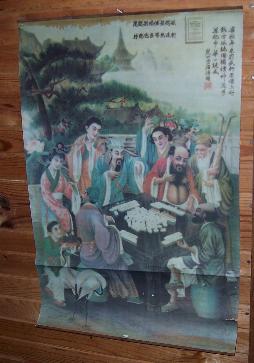
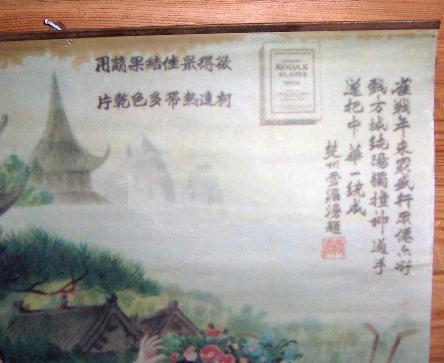
Hello L,
Sorry, but I haven't a clue. I'll give you $10 for it...
Tom Sloper
Author of "The Red Dragon & The West Wind," the definitive book on mah-jongg East & West.
トム·スローパー
/
湯姆 斯洛珀 / 탐 슬로퍼
Los Angeles, CA (USA)
May 24, 2008
Frequently Asked Question #19G (those confusing joker rules!)
>From: jimalgine
>Sent: Friday, May 23, 2008 11:41 AM
>Subject: Mah-Jongg Q+A
>My mah-jongg question or comment is: If I have 3 2 Bams and a joker showing, and a 2 Bam is discarded, the person to my left, and I need that 2 Bam to replace my joker to make mah-jongg, can I pick it up and declare mah-jongg? I have been playing mah-jongg for a about a year and haven't seen this before. The players gave me the mah-jongg, but later said that I couldn't make that move. Thank you, Allie
Hello Allie,
You have asked Frequently Asked Question #19G. Please scroll up and find the links to the FAQs, above left. Click FAQ 19. Bookmark the page for your future reference. Scroll down and find your answer. If the wording of the answer is unclear, please let me know how I can improve the wording for future askers of this same question.
May the tiles be with you.
Tom Sloper
Author of "The Red Dragon & The West Wind," the definitive book on mah-jongg East & West.
トム·スローパー
/
湯姆 斯洛珀 / 탐 슬로퍼
Los Angeles, CA (USA)
May 23, 2008
Why may the Charleston be stopped? - Parts 2 and 3
>From: TacTac20
>Sent: Thursday, May 22, 2008 11:00 AM
>Subject: Mah-Jongg Q+A
>My mah-jongg question or comment is:
>This is a repeat question but I cannot find my answer on your site: Please give me practical reasons for stopping the Charleston after the first round. I have played with players that will stop just because they don't like the Charleston. I was taught that the Charleston is to be stopped when only two tiles can be exchanged from a pat hand.
>
>From: TacTac20
>Sent: Thursday, May 22, 2008 11:05 AM
>Subject: Mah-Jongg Q+A
>My mah-jongg question or comment is: Please disregard my repeat question to you Re: the stopping of the Charleston. I did find your response......Yes, people have blatantly admitted to me during games that the only reason they stop the play is because of their dislike of the process.
Hello hello TacTac,
Whew! Your first email made me sad that you hadn't found your answer that I posted a week ago. (I guess you just do email on Thursdays, huh?)
If you still have a question you're welcome to ask it anytime.
May the tiles be with you.
Tom Sloper
Author of "The Red Dragon & The West Wind," the definitive book on mah-jongg East & West.
トム·スローパー
/
湯姆 斯洛珀 / 탐 슬로퍼
Los Angeles, CA (USA)
May 22, 2008
My Godori/GoStop's scoring table is in Korean. Help!
>From: "Ray"
>Sent: Monday, May 19, 2008 2:44 AM
>Subject: Hanafuda Pocket PC Game questions
>Hi Tom,
>I download a Godori/GoStop (PocketMong.zip) game from the internet. I play
>it a lot with lot's off fun. Only the scoring table on the end off each hand
>puzzles me. Every thing is in Korean and abracadabra for me. Can you help
>me? Thanx in advance,...
>Grtz, Ray.
>=============================
>There are 10 kinds of people.
>Those who understand binary,
>and those who don't.
>=============================
 Goedemorgen Ray, Goedemorgen Ray,
I don't read Korean either (just my name), but I can help by offering you two ideas for how you can sort out your game's scoring table. I'm sure there are other ideas as well - these are just the two I have for you this morning.
1. The Korean alphabet is called "hangul." You can get a good description of the alphabet, and just go through your table character by character. I've given the Korean names of many of the GoStop combinations in my GoStop page (there's a handy link above left (under "Other parts of Sloperama" you see "Hanafuda (Go-Stop)"). Make a printout of the table (I gather by your binary joke that you're a programmer? You can figure out how to print the table). Then print a hangul pronunciation guide. You can find those easily on the Internet. I found these in seconds:
* http://thinkzone.wlonk.com/Language/Korean.htm
* http://www.indiana.edu/~koreanrs/hangul.html
* http://en.wikipedia.org/wiki/Hangul
Then identify a character, write its pronunciation on your printout of the table, and you've got a start on figuring out what all the combinations are.
2. Or you could go search the Internet for a bilingual scoring table. I'm sure you should be able to find one since there are so many online GoStop games, and correlate that with your PDA's scoring table. You might need to use the Korean Google (www.google.co.kr), using the Korean names GoStop and GoDori as search terms. You should be able to find those names, in hangul, on a site - and copy and paste them into the Google search box.
Good luck! And greetz.
Tom Sloper
Author of "The Red Dragon & The West Wind," the definitive book on mah-jongg East & West.
トム·スローパー
/
湯姆 斯洛珀 / 탐 슬로퍼
Los Angeles, CA (USA)
May 19, 2008
Frequently Asked Question 19I
>From: Linda Kaufman
>Sent: Sunday, May 18, 2008 1:40 PM
>Subject: [none]
>Hi Tom
> I have a Mah Jongg question.
>Player 4 discards a tile. Player 1 and 2 both call it for Mah Jongg. Player 1 takes the tile and exposes, but Mah Jongg was called in error.
>Can Player 2 take the tile for Mah Jongg?
>Thanx. Linda
Hi Linda,
Please read Frequently Asked Question #19I. Please scroll up and find the links to the FAQs, above left. Click FAQ 19. Bookmark the page for your future reference. Scroll down and find your answer. If the wording of the answer is unclear, please let me know how I can improve the wording for future askers of this same question.
May the tiles be with you.
Tom Sloper
Author of "The Red Dragon & The West Wind," the definitive book on mah-jongg East & West.
トム·スローパー
/
湯姆 斯洛珀 / 탐 슬로퍼
Los Angeles, CA (USA)
May 18, 2008
How to resolve this conflicting claim situation? (Part 3)
From: gailbsmith
Sent: Sunday, May 18, 2008 12:42 PM
Subject: another view
> The player who called mahj with the disgarded flower and THEN redeamed the joker...didn't have mahj when she called for the flower....she still needed to make another move...so the person who really had Mahj with the flower should have gotten the tile and won and that should have been the end of the discussion.
>
> The person who needed another joker to make her mahj took the flower out of turn, she only picked up the disgard for an exposure, it didn't give her mahj.
>
> if she had picked the flower from the wall and then redeamed the 2 d for a joker I would agree that she had a self pick mahj...but not the way it was played...
>
> a joker can be redeamed after picking...either from the wall or from a disgard, but it is AFTER...
> I don't understand why the NMJL doesn't get this point?
> Gail Smith
> plays by the rules.
> --
> we cannot change the wind
> but we can readjust our sails
Thanks for your view, Gail. (^_^)
I thought it was such an interesting question that I made it the topic of this week's column.
May the tiles be with you.
Tom Sloper
Author of "The Red Dragon & The West Wind," the definitive book on mah-jongg East & West.
トム·スローパー
/
湯姆 斯洛珀 / 탐 슬로퍼
Los Angeles, CA (USA)
May 18, 2008
I usually play with 14 tiles, no future, but could easily adapt to 13 tiles, Part 2
>From: sindler
>Sent: Sunday, May 18, 2008 6:32 AM
>Subject: Re: Find Players/Teachers
>Hi Tom,
>When I learned how to play mah jongg, the tile we picked was not considered ours until our we had to throw another tile because, in that game we were forced to pass the tile when someone called a thrown tile. I think that picked tile was known as your future because it was not really yours. I hadn't played for many years and when I started again several years ago, tiles were not required to be passed away when another was called. I included the term "future" in my description in case there were people out there still playing that way.
>I hope this description helps.
>Toby Sindler
Hi Toby,
Thanks for the explanation, but there's something I still don't quite get. But I won't ask you to explain further. I'm probably making too big a deal out of nothing. Seriously - don't even bother reading any of the rest of this. Just me raving. Molehill into a mountain.
I've never played "future tile" myself. None of the folks in my circle play that way, but I have encountered future players at tournaments occasionally. Since it's a way of playing that is outside the official way of playing, I imagine that there are numerous different practices for when someone claims a discard. Had only heard of putting it back on the wall (in reverse chronological order) but handing it to another player in sort of a partial Charleston is logical, I suppose. But regardless...
You still always have either 13 or 14 tiles in your hand. If the future tile is present face-down atop your rack, you don't really have 14 tiles - you have 13 and the not-yet-seen future (it isn't "your" tile yet - it isn't in your hand until it's your turn).
Those of us who don't use futures likewise always have either 13 or 14 tiles in the hand. We have 13 tiles while others are playing, and we have 14 tiles during our own turn. 75% of the time we hold 13; 25% of the time we hold 14.
Accordingly, I don't know what it means to play with 13 tiles as opposed to 14 tiles. I have heard some folks refer to this, and I've never wrapped my mind around the distinction (and I'm not talking about the Chinese "12-tile" variant described by Amy Lo in her book; I'm talking about players of American mah-jongg).
And to play with "13 tiles" as opposed to "14 tiles, no future" is even more mysterious to me...
- I can understand "14 tiles with future" as opposed to "14 tiles, no future"
- I get "13 tiles with future" as opposed to "13 tiles, no future" (it's exactly the same thing as 14 tiles with or without future. Isn't it?)
- But "13 tiles, no future" versus "14 tiles, no future"?
- Or "13 tiles, no future" versus "14 tiles, with future"?
- Or "13 tiles, with future" versus "14 tiles, no future"?
- Or "13 tiles, with future" versus "14 tiles, with future"?
- Or "13 tiles, with future" versus "14 tiles"?
- Or "13 tiles, no future" versus "14 tiles"?
- Or "13 tiles" versus "14 tiles with future"?
- Or "13 tiles" versus "14 tiles without future"??
I have no idea what any of those things are! Thus I asked. So now I've explained my confusion. But I don't expect further clarification (unless you want to try again, of course). I'm just such a nitpicker in regards to words (as I wrote in column #353 - http://www.sloperama.com/mahjongg/column353a.htm). Still, I wish I could reliably know for sure what people mean when they talk about a "13 tiles" game as opposed to a "14 tiles" game - if it's even possible that everybody always has the same meaning when they use the terms.
May the tiles be with you.
Tom Sloper
Author of "The Red Dragon & The West Wind," the definitive book on mah-jongg East & West.
トム·スローパー
/
湯姆 斯洛珀 / 탐 슬로퍼
Los Angeles, CA (USA)
May 18, 2008
Is it ivory? Part 2
>From: KIM GRAHAM
>Sent: Friday, May 16, 2008 7:56 PM
>Subject: Re: Mah Jong tiles
>My bad! Since I inherited 4000 individual pieces of stuff, I didn't read over your website, only the page that came up when I did a specific search. Good to know I have Ivory.
>Thanks.
Hi Kim,
So you're saying that your test results found:
1. No Haversian System;
2. Pearlescent wavy grain (aka Schreger lines);
3. Cross-hatch effect on the ends or edges of the tiles (a pattern in the material itself, not simply saw marks).
I have to say, I'm surprised that this is what you found. Because:
1. The carving on the tiles looks very ordinary to me;
2. The photos show perhaps not Haversian system, but flaws in the surface of the South and the Green;
3. The craftsmanship of the dovetails isn't up to the quality one would expect to be taken when making tiles out of a more valuable material than the usual;
4. The craftsmanship of the sticks isn't, either. One usually sees highly increased attention to craftsmanship and detail in sets made of ivory.
But if you say your 3-step test results indicate that it's ivory, well... congrats.
Tom Sloper
Author of "The Red Dragon & The West Wind," the definitive book on mah-jongg East & West.
トム·スローパー
/
湯姆 斯洛珀 / 탐 슬로퍼
Los Angeles, CA (USA)
May 16, 2008
Is it ivory?
>From: "KIM GRAHAM" (luluk6469)
>Subject: Mah Jong tiles
>Date: Fri, 16 May 2008 18:31:08 -0700
>msn Photo E-mail Play slideshow | Download images
>I have been reading and re-reading your descriptions. These look more =
>like Ivory to me but I am torn between the bone and the Ivory. Is there =
>anything else I can look for without taking a chance of ruining a tile? =
>When I hold up a lens to them under the light I see fine lines but none =
>of what you describe for the bone.

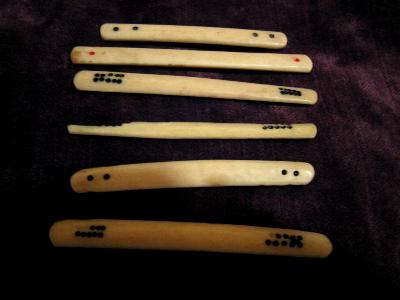
Hi Kim,
You say you've read my "descriptions." But you haven't told me the results of your 3-step "is it ivory" test. Nowhere on my site do I say "if you look through a lens under light and see fine lines, they're ivory." So the only thing I can do is point you to the "is it ivory" test and ask you to do all 3 steps of the test.
Scroll up and look at the left side, under SITE LINKS, you'll see where it says:
The Mah-Jongg FAQs
(Frequently Asked Questions) <-READ 1ST
Farther down under that you'll see where it says:
7c2. Is It Ivory?
Click that, and perform the test (it's beneath the words:
DISTINGUISHING BONE FROM IVORY - THE "IS IT IVORY" CHECKLIST)
My apologies if you've already done the test. But you're asking me to tell you if your tiles are ivory or not, and you haven't given me the full 3-step results.
Standing by to help farther, after you give me those results...
Tom Sloper
Author of "The Red Dragon & The West Wind," the definitive book on mah-jongg East & West.
トム·スローパー
/
湯姆 斯洛珀 / 탐 슬로퍼
Los Angeles, CA (USA)
May 16, 2008
I usually play with 14 tiles, no future, but could easily adapt to 13 tiles.
>From: sindler
>Sent: Friday, May 16, 2008 2:49 PM
>Subject: Find Players/Teachers
>Location (city and zip code): Northern Westchester County, NY Millwood 10546
>My kind of mah jongg is: American Mahjongg I usually play with 14 tiles, no future, but could easily adapt to 13 tiles. I'll be in Millwood, NY until October and would love to find a game one afternoon or evening each week.
>My name is Toby. E-mail sindler中optonline.net
Hi Toby,
I'm puzzled by what you wrote on the Find Players/Teachers bulletin board:
I usually play with 14 tiles, no future, but could easily adapt to 13 tiles.
Whether or not one plays with a "future," one always has either 13 or 14 tiles in the hand. So I'm puzzled by what you mean. I'd greatly appreciate it if you'd tell me the difference between "14 tiles, no future" and "13 tiles," for my future edification and so that when people come to me with questions, there are fewer gaps in my ability to give them the best answer.
May the (13 or 14) tiles be with you. (^_^)
Tom Sloper
Author of "The Red Dragon & The West Wind," the definitive book on mah-jongg East & West.
トム·スローパー
/
湯姆 斯洛珀 / 탐 슬로퍼
Los Angeles, CA (USA)
May 16, 2008
Misnamed discard, not noticed until later
>From: weeziejen
>Sent: Friday, May 16, 2008 10:24 AM
>Subject: Mah Jongg Q+A
>My mah-jongg question or comment is:
>If a player needs a tile for exposure or Mah Jongg and someone throws it out but MISNAMES it and nobody notices until after the next player picks up and RACKS their tile, can it still be called for?
>Louise Dufault
Hi Louise,
Of course not. The "window of opportunity" (see FAQ 19, above left) is closed. The player who wants the misnamed discard screwed up badly by not looking in time, so she pays the price (she loses out on the lost opportunity to call that tile). If the one who wanted it wanted it for mah-jongg, in my opinion the player who misnamed the discard should be declared dead. See FAQ 9 for a discussion of how to handle errors.
May the paying-attention be with you all.
Tom Sloper
Author of "The Red Dragon & The West Wind," the definitive book on mah-jongg East & West.
トム·スローパー
/
湯姆 斯洛珀 / 탐 슬로퍼
Los Angeles, CA (USA)
May 16, 2008
Why may the Charleston be stopped?
>From: TacTac20
>Sent: Thursday, May 15, 2008 8:55 PM
>Subject: Mah-Jongg Q+A
>My mah-jongg question or comment is: Can you give me some practical reasons why the Charleston may be stopped after the first three exchanges. I am finding with some players that they are stopping the action just because they don't like to Charleston. Please be specific. Thanks.
Hi! You tactfully asked:
Can you give me some practical reasons why the Charleston may be stopped after the first three exchanges.
Are you asking me why this is the rule? I don't justify rules, if that's what you're asking. Only the creators of a rule are able to explain the reasoning behind the existence of a rule.
I am finding with some players that they are stopping the action just because
Or are you asking me what justification a player needs for stopping the Charleston? None. Read Frequently Asked Question #19AG. Please scroll up and find the links to the FAQs, above left. Click FAQ 19. Bookmark the page for your future reference. Scroll down and find your answer. If the wording of the answer is unclear, please let me know how I can improve the wording for future askers of this same question.
just because they don't like to Charleston.
As bizarre as that sounds, why do you know this? You don't ask people to justify their stopping the Charleston, do you? That's tacky, and I wouldn't do that. Unless somebody did it every single time or something... That would be really irritating!
If you have a player who's constantly stopping the Charleston every time, I recommend you print FAQ 19AG and take it to your next game. Bring up the topic before play begins, and have the group take a vote. See FAQ 14 and learn how "table rules" work (print that too). Stopping the Charleston is every player's right, but there are reasonable limits, and the group should discuss what's acceptable at your table.
May the tiles be with you.
Tom Sloper
Author of "The Red Dragon & The West Wind," the definitive book on mah-jongg East & West.
トム·スローパー
/
湯姆 斯洛珀 / 탐 슬로퍼
Los Angeles, CA (USA)
The Ides of May, 2008
How to resolve this conflicting claim situation? (Part 2)
From: "bweiser"
Sent: Thursday, May 15, 2008 8:04 PM
Subject: Re: Mah-Jongg Q+A
> Yes, I assumed that North sits to the right of East, and West across from
> East, as they do in tournaments. I asked you the question after having
> already gotten a response from the NMJL. They agreed with you that North, in
> my example, was entitled to the Mah Jongg. I was surprised by their answer
> because of the issue you pointed out. How can you simultaneously call a tile
> for Mah Jongg while picking it yourself by redeeming a joker?? Thanks so
> much for your response. At least I know I wasn't off
> base in questioning their answer.
Hi Barbara,
Ah. Yes, more weight on the argument that calling that play self-pick is inconsistent. In my opinion, redeeming the joker to win should be treated as self-pick only when you pick a tile that can be redeemed for instant mah-jongg.
I have to add - it's so cool that you checked with me to back up the NMJL's ruling, rather than the other way around! (^_^) As the Brits say, "I'm chuffed."
May the tiles be with you.
Tom Sloper
Author of "The Red Dragon & The West Wind," the definitive book on mah-jongg East & West.
トム·スローパー
/
湯姆 斯洛珀 / 탐 슬로퍼
Los Angeles, CA (USA)
May 15, 2008
The Chengdu Earthquake
Chengdu, in Sichuan province in south central China, was the site of the 2007 World Mahjong Championship (http://www.sloperama.com/Chengdu/chengdu1.htm). If you want to help the victims of the May 12 earthquake (http://en.wikipedia.org/wiki/2008_Sichuan_earthquake), the best way is through Red Cross Society of China. The American Red Cross is working with its partners in the International Red Cross and Red Crescent Movement, including the Red Cross Society of China. Click this link to learn more: http://www.redcross.org/news/in/profiles/Intl_profile_ChinaEarthquake.html - or use Google to find such sites yourself. Be advised that in times of crisis, bogus aid organizations and websites often appear. Only deal with reputable aid organizations - and if you ask me, the International Red Cross and its partner organizations are among the most reputable in the world.
May the aid be with our friends in Chengdu.
Tom Sloper
Author of "The Red Dragon & The West Wind," the definitive book on mah-jongg East & West.
トム·スローパー
/
湯姆 斯洛珀 / 탐 슬로퍼
Los Angeles, CA (USA)
May 15, 2008
How to resolve this conflicting claim situation?
From: "bweiser"
Sent: Thursday, May 15, 2008 4:16 PM
Subject: Mah-Jongg Q+A
> My mah-jongg question or comment is:
> East throws a flower. North wants to call the flower and during the same
> turn exchange a tile in her hand for a joker on someone's rack, which then
> gives North Mah Jongg. West wants to call the flower for Mah Jongg. Who's
> entitled to the flower and the Mah Jongg?
> Thanks,
> Barbara
Hi Barbara,
Let's see if I can simplify the situation:
North and West both call "maj" on East's discard.
The snag (if it is a snag) is that one player's claim is slightly roundabout (i.e., she will be redeeming a joker along the way), while the other one's claim is more straightforward. We'll come back to this.
If we ignore the roundaboutness, there's no question. Right? Well, actually, there is, but it's not where you think it is. The NMJL rules do not specify exactly where North and West sit at the table. I suppose everybody who plays American mah-jongg assumes that the table is laid out like a map viewed from above (i.e. North sits to East's right, West sits opposite East, and South sits to East's left). And that may be the practice in tournaments. But since nowhere in the official NMJL rulebook does it specifically say so (and since it's actually not like that in any other form of mah-jongg), I need to verify this with you (since you, Barbara, are the one who used the term "North" in your statement of the question). Are you saying that North sits to East's right? If so, North gets the tile - because North's claim has priority over a player farther in turn from the discarder.
Now then, to come back to what you probably saw as a snag. I hinted that it's questionable whether or not it's a snag. Because in my opinion, the discarded flower does give North the right to say "maj," regardless of the fact that she has to redeem a joker during the process. But there's a disputable NMJL rule that might give West grounds to object - but not for the reason most readers are probably thinking.
For a moment, let's imagine this without West's conflicting claim (only North, let's imagine, wants the tile). In the January 2006 bulletin, the NMJL stated that North's situation (having to redeem a joker during the turn to win) is a self-picked win - not a win on a discard. When I stated this rule in my book (rule 88 on page 66, and then restated on page 116), I flagged it as one of the two objections I have with the official NMJL rules. My original reason for objecting is that I think it's a dirty trick to keep a redeemable tile in the hand, so that you can pounce on a discard and still collect double from everyone. In my book I called this a loophole in the rules.
Since this rule exists, though (and as far as I know, it exists only in the January 2006 bulletin), it's arguable that this rule implies that North's call for the discard is not a maj call. If the loophole didn't exist, the North player could do what I said initially - call "maj," not just "I want that." But since the loophole does exist, the North player should rightly not say "maj." But it's arguable.
Personally, I believe this loophole should not exist. When a player is sitting with a redeemable tile, waiting for one tile to win (to occur simultaneously with redeeming the joker to win), the redeemable tile isn't her winning tile - the wait tile is.
In my opinion, both players should say "maj," and North should get the tile.
That's my opinion, though. The existence of the January 2006 rule implies that North should say "call," not "maj," so West's claim for maj takes precedence - but this is not explicitly stated in the official rules.
In the end, I wasn't able to simplify the matter (far from it!). And since I actually disagree with the rightness of this particular rule, only the NMJL can determine the right answer. One would need to send them the question in writing, along with a self-addressed stamped envelope.
Interesting and meaty question, Barbara! (^_^) May the tiles be with you.
Tom Sloper
Author of "The Red Dragon & The West Wind," the definitive book on mah-jongg East & West.
トム·スローパー
/
湯姆 斯洛珀 / 탐 슬로퍼
Los Angeles, CA (USA)
May 15, 2008
About FAQ 22
From: "Oscar Lindberg"
Sent: Thursday, May 15, 2008 4:07 AM
Subject: Comments on FAQ#22 of the Mahjong FAQ - Chinese Official Scoring Explained
> Hi Tom,
> I just read your "FAQ #22. Chinese Official Scoring Explained" on
> http://www.sloperama.com/mjfaq/mjfaq22.html.
> The text is really useful and clear on how scoring is performed.
> I think the explanations of the "Prohibition against identical
> patterns" examples is a little bit misguiding though. They are not as
> clear as they could be.
>
> Your explanation is this for Probibition against identical patterns:
> 10.1.5.3. Prohibition against identical patterns
> Once you've used a set to form a particular 2- or 3-set pattern, you
> can't use the same set to form an identical pattern with another set.
> Sometimes referred to as the "non-identical principle."
>
> But then in 10.1.5.3. you write: "The winner might wish to claim that
> the remaining chow, 567B, should be combined with the 345C 456D to
> make a second Mixed Shifted Chows scoring pattern, but the
> non-identical rule prohibits doing this because it uses more than one
> of the sets in the first Mixed Shifted to make a second Mixed Shifted.
> " The problem is not that it uses "more than one" of the sets of the
> first Mixed Shifted, is it? Isn't the problem that the player would
> use the same set in two identical patterns? As you describe it, it
> sounds like that it would have been ok if only one set would be used
> twice for the same pattern.
>
> Then: "However, the 567B can be combined with the 234B to make a Short
> Straight, because that combination only uses one set from the Mixed
> Shifted pattern." Does it really matter, regarding "Prohibition
> against identical patterns" that it uses only one set? Shouldn't it
> say that it is ok, since none of the sets have already been used in a
> Mixed Shifted before?
>
> Then, even later, "To use two sets from the first combination would
> violate the non-identical rule. " I think this would be clearer if it
> said "To use any set from the first combination to create a
> combination of the same type would violate the non-identical rule. "
>
> Simply put: The explanations in examples give the impression that the
> "Prohibition against identical patterns" has something to do with
> using more than one set from a previously counted pattern.
>
> I'm also a bit confused by the "main scoring element" concept. I might
> have missed something, but I do not see why any element would have to
> be special in the hand. This is my understanding of counting the
> score:
>
> 1. Group the hand into sets. These can not be changed later on,
> otherwise the non-separation principle will be broken.
> 2. Start by counting the elements using all sets in the hand, and be
> sure not to count implied elements. I would think that this can be
> performed in decreasing value of the element without ever risking
> getting a lower score that the highest possible.
> 3. Count the elements using two or more sets in turn. Make sure not to
> count implied elements. Keep track of which sets have been used for
> which element types, to prevent breaking the non-identical principle.
> Also keep track of which sets have been used in the elements counted
> in step 3, to prevent breaking the combine-just-once principle. Care
> should be taken in this step, depending on the order of counting
> elements the score might change.
> 4. Count the waits and elements only involving one set. Make sure not
> to count implied elements.
>
> I don't really see why any set would need to stand out as the "main
> scoring element". If there is a point to call one element the main
> scoring element, maybe an explanation would fit in your FAQ#22?
> / Oscar Lindberg
Hi Oscar,
Excellent suggestions all, so I've made those adjustments to the FAQ. Please have a look.
In regards to the "main scoring element," you are correct. I had actually questioned the WMO on that, and didn't get a satisfying answer. Clearly it isn't really a required step, for one thing, and it hardly even matters whether you choose the highest-scoring element as the main element. So I've made that adjustment in the FAQ, too.
May the tiles be with you.
Tom Sloper
Author of "The Red Dragon & The West Wind," the definitive book on mah-jongg East & West.
トム·スローパー
/
湯姆 斯洛珀 / 탐 슬로퍼
Los Angeles, CA (USA)
May 15, 2008
Now I'm wondering what kind of varnish to use
>From: DAMONTT
>Sent: Tuesday, May 13, 2008 2:41 PM
>Subject: Mah-Jongg Q+A
>My mah-jongg question or comment is:
>I have a bone/bamboo mah-jong set and I keep it in an antique box that was stained the typical China Red color. When I wipe the inside of the box with a damp cloth, the red comes off on the cloth. I am afraid that the red might also come off on the tiles and would like to seal or varnish the inside (not the outside) of the box only to protect the tiles. What kind of a finish would you recommend that won't interact with the bone or the bamboo?
>Suzanne
Hi Suzanne,
I think the inside of your box is unlikely to transfer any red color onto your tiles. ...Unless you store the box in, like, a steam sauna or something? I have at least 3 of those old red antique boxed sets, and none of my tiles have turned red (but I live in Los Angeles, a sort of seaside desert area).
If you varnish the inside of the box, you'll have substantially altered an antique - which could possibly substantially alter its inherent value. (Although the glue-eating pests you think might be inhabiting your tiles could already have done that for you.) This might partially explain why nobody, in the 8 or so years I've maintained this website, has ever posted any information about the best varnish to use on those boxes.
But if you want to investigate the matter further, I'd recommend looking in your local yellow pages for antique shops and antique restorers. If you're nice when you call or visit them, they might well offer you some helpful tips. Good luck! (^_^)
Tom Sloper
Author of "The Red Dragon & The West Wind," the definitive book on mah-jongg East & West.
トム·スローパー
/
湯姆 斯洛珀 / 탐 슬로퍼
Los Angeles, CA (USA)
May 13, 2008
Custom engraved joker tiles?
>From: Maxine
>Sent: Tuesday, May 13, 2008 5:54 AM
>Subject: custom mahjongg sets
>Are you able to get custom sets of tiles, where a "name" is imprinted in the jokers, rather than the word joker? I purchased a set from Kwong Fat Cheung like this many years ago but am unable to find them again
>Please let me know
>Thank you
>Maxine Derby
>QPL, Inc & The Image Group
>### Billerica Road
>Chelmsford, MA 01824
>###-###-####
>###-###-#### fax
>qplimage.com
Hi Maxine,
You can find one or two sources for engraving blank joker tiles in
Frequently Asked Question #4A, and you'll find the contact information for KFC in FAQ 7Q. Several of the vendors listed in FAQ 4A get their sets from KFC and offer custom jokers, as well. Please scroll up and find the links to the FAQs, above left. Bookmark the page for your future reference.
May the custom tiles be with you.
Tom Sloper
Author of "The Red Dragon & The West Wind," the definitive book on mah-jongg East & West.
トム·スローパー
/
湯姆 斯洛珀 / 탐 슬로퍼
Los Angeles, CA (USA)
May 13, 2008
Conflicting simultaneous claim - what should we have done?
>From: D. BABASHAK
>Sent: Monday, May 12, 2008 2:41 PM
>Subject: Mah-Jongg Q+A
>My mah-jongg question or comment is:
>Player one discarded a tile, the second player picked up a tile from the wall and called mah jong just as the third player called for the discarded tile. When is a turn deemed to be over? Should player #2 have won the hand? Player #4 then picked up the tile that #2 had to put back and, of course, at that time, knew it was the mah jong tile and then had to break up her hand.
>In the past, we have played that you can go back one turn if you decide to pick up a discarded tile but we never had the wall tile be one that was needed for the next player's mah jong.
>Thanks for your imput.
Hello, D, you wrote:
Player one discarded a tile, the second player picked up a tile from the wall and called mah jong just as the third player called for the discarded tile.
The third player is out of luck! The second player declared mah-jongg. That's it.
When is a turn deemed to be over?
This is an unrelated question. But FYI, the answer is "when the player has either said mah-jongg or discarded (said the tile's name and put it on the table)."
Should player #2 have won the hand?
Yes. Mah-jongg trumps everything. I realize FAQ 19I doesn't specifically mention this case, but the principle still applies. Mah-jongg always trumps everything. Everything. Always.
Player
#4 then picked up the tile that #2 had to put back and, of course, at that time,
knew it was the mah jong tile and then had to break up her
hand.
It's too bad that's what happened!
In the past, we have played that you can go back one turn if you decide to pick up a discarded tile
I don't follow you. Sounds like you made up a rule. I really recommend that everybody play by the official rules, and not make rules up. See FAQ 3.
but we never had the wall tile be one that was needed for the next player's mah jong.
Yes, that's a rare circumstance.
May the tiles be with you.
Tom Sloper
Author of "The Red Dragon & The West Wind," the definitive book on mah-jongg East & West.
トム·スローパー
/
湯姆 斯洛珀 / 탐 슬로퍼
Los Angeles, CA (USA)
May 12, 2008
My antique set might have glue-eating pests in it - what to do?
>From: DAMONTT
>Sent: Sunday, May 11, 2008 8:44 AM
>Subject: Mah-Jongg Q+A
>My mah-jongg question or comment is:
>I just purchased an old bone/bamboo Mah Jongg set (circa 1920) originally from China. The bone face of the tiles is in very good condition but the bamboo has small pin holes around the area where it joins the bone and when I tap it, a small amount of saw dust comes out. It seems like some pest has gotten into the bamboo and is eating it. My question is: 1.) how can I tell if the pests are still there, and 2.) if the pests are still there, how can I get rid of them? Someone told me to put the tiles in the freezer for a few days but I am afraid that this might damage them.
>From: DAMONTT
>Sent: Sunday, May 11, 2008 8:48 AM
>Subject: Mah-Jongg Q+A
>My mah-jongg question or comment is:
>whoops! I forgot to sign my name on the questions about possible pests eating the bamboo on my mah jongg tiles.
>Thanks,
>Suzanne M
Hi Suzanne, you wrote:
the bamboo has small pin holes around the area where it joins the bone and when I tap it, a small amount of saw dust comes out. It seems like some pest has gotten into the bamboo and is eating it.
If the pinholes are only at the joint, it sounds to me like the glue (rather than the bamboo) is what's been eaten (either by time or possibly by pests, although I've never heard of glue-eating bugs in mah-jongg tiles before).
how can I tell if the pests are still there
This is a question for an exterminator. I have no idea.
if the pests are still there, how can I get rid of them? Someone told me to put the tiles in the freezer for a few days but I am afraid that this might damage them.
I share your concern. Some old sets did suffer glue problems, but this is a new glue problem on me! If you really think there are living critters inside your tiles, only an exterminator could give you peace of mind.
May the [pest-free] tiles be with you.
Tom Sloper
Author of "The Red Dragon & The West Wind," the definitive book on mah-jongg East & West.
トム·スローパー
/
湯姆 斯洛珀 / 탐 슬로퍼
Los Angeles, CA (USA)
May 11, 2008
The advice you gave in your book
>From: vze3cq4g
>Sent: Saturday, May 10, 2008 12:50 PM
>Subject: etiquette for novices
>Dear Mr. Sloper,
>A new player, I sent for your book The Red Dragon and the West Wind. It's very good; I doubt the official NMJL rulebook will add much to my understanding, but I'll send for it since you say so.
>
>My comment refers to page 110 of your book, where you imply that a newbie who struggles too long "with a jumble of disassociated tiles and an inscrutable card" is putting, as you uncharitably put it, winning over "just keeping up." And that when the experienced players at the table begin rolling their eyes and drumming their fingers, she has violated etiquette and should remember it isn't all about her, and just get on with things or she won't be invited back. If the new player pushed herself on them, naturally they will be irked when they find out she doesn't know how to play. But if they knew she was a newbie and invited her anyway, there is no excuse for their feelings. In either case, there is no excuse for their behavior. I wouldn't want to be invited back anyway.
>
>It would have been better if you advised the novice to find a real Mah Jongg class (senior and community centers are likely). Then round up other novices to play with every week so they can learn and progress together at their own pace, and not feel rushed and harassed to pass tiles before they understand what they're doing. That's no way to learn. Experienced players needing a fourth body at their table will just have to wait.
>LHF, in New Jersey
Hello L,
It's a good thought, and I thank you. I only wish it was that easy. And I fear that I've not stated my reasoning clearly enough.
In my experience (although each person's case is different and could vary considerably from my experience), it's easier to find experienced players than it is to find a mah-jongg class. And it's easier to find three experienced players than it is to gather three willing novices at one's own level.
It's also my experience that very few experienced players have the ability to teach, or the patience to deal with a slow novice player for more than one evening.
The people I play with, for example, are very nice - but they like the game to progress at a reasonable pace. If a new player joins even my nice group and she's so intent on winning that she can't maintain a reasonable pace, my nice friends won't want to play with her a second time. They might not say anything, and they certainly wouldn't drum their fingers. Okay, so they might roll their eyes after a few hours of slow playing.
I guess what I'm saying is that a reasonable pace is normal to the game, regardless of the niceness of the players. To clarify, I have played with some fastfastfast players, and I don't enjoy such games. A reasonable pace is one that gives a player enough time to call a discard.
A player who starts off by taking her sweet time to think, in the company of other novices, will learn how to play slowly.
Reasonably speedy play will take a long time to achieve in such a setting, in my opinion. And I fear that the novice group might lose interest in the game before the group reaches the level of reasonably-paced fun that most players find enjoyable.
So it's not my advice to suck it up and play with impatient and unkind experienced players, for the purpose of giving those other players a nice person to win coins from. The reason I advise novice players to sacrifice winning for harmony is not that she's violating the experienced players' etiquette - that's not my intent at all. I've seen many new players lose the chance for repeat play with nice people, and then to lose all interest in the game, due to their trying too hard to win, that's all.
My advice is to learn the game in a way that enables one to think "on her feet," an important ability in mah-jongg. Once the player has come up to speed, she'll enjoy the game and can then have the luxury of finding nice play companions.
I'm making a note, though, to add your suggestions to the book, assuming I get a chance to revise it for a second publishing run. And I'll try to state my point more charitably. (^_^) Mind you, I was that novice "with a jumble of disassociated tiles and an inscrutable card," struggling to win over "just keeping up" myself, once. I found that the game went more harmoniously if I just went along. And in fact, a player at the World Championship last autumn found herself intimidated by sitting at an actual table with live people. She'd been well accustomed to playing online, but found the experience of dealing with real tiles and real people discouraging. Another player and I gave her the same advice I did in my book - "don't worry about winning, just get comfortable at the table. The winning will come." And it did. She adapted and had a wonderful time. But now I'm rambling on far too long.
May the tiles be with you.
Tom Sloper
Author of "The Red Dragon & The West Wind," the definitive book on mah-jongg East & West.
トム·スローパー
/
湯姆 斯洛珀 / 탐 슬로퍼
Los Angeles, CA (USA)
May 10, 2008
Those confusing joker rules! (A question of timing)
>From: Bob and Laurie
>Sent: Saturday, May 10, 2008 9:17 AM
>Subject: Mah-Jongg Q+A
>My mah-jongg question or comment is:
>This seems to fall in a gray area regarding redeeming jokers from dead hand.
>North makes a second exposure with a joker.
>East (slow to play) attempts to redeem the joker with the natural tile but has not actually pick it up and rack before
>South calls North hand dead and says East cannot claim the joker since no actual exchange was made.
>East felt the joker was hers since she made the intention before hand was called dead.
>Thanks for your help,
>Laurie
Hi Laurie, let's dissect the play:
North makes a second exposure with a joker.
East (slow to play) attempts to redeem the joker
I see a problem already. North hasn't discarded yet, and East hasn't picked a tile from the wall yet. But let's overlook that (maybe you just omitted describing these steps) and continue:
 South calls North hand dead and says East cannot claim the joker South calls North hand dead and says East cannot claim the joker
She's right, of course. As stated in FAQ 19P.
 East felt the joker was hers since she made the intention before hand was called dead. East felt the joker was hers since she made the intention before hand was called dead.
Oh! So the rules need to take "feelings" into account? I don't think so! (^_^) Besides, simply stating an intention to perform an erroneous or illegal action, either in ignorance that it's illegal, or before it's stated that it's illegal, doesn't make it a rightful or legal action. I don't see any gray area here.
If East had made the redemption, then discarded, and then South declared North dead, at that point it would have been too late to undo East's action. Read FAQ 9 for a discussion on my philosophy of the handling of errors depending on the timing. Whenever an erroneous action can be undone easily, it should be undone, so long as there isn't a rule that prohibits it. (Feelings notwithstanding.)
May the tiles be with you.
Tom Sloper
Author of "The Red Dragon & The West Wind," the definitive book on mah-jongg East & West.
トム·スローパー
/
湯姆 斯洛珀 / 탐 슬로퍼
Los Angeles, CA (USA)
May 10, 2008
FAQ 19E (Those confusing joker rules! What is a kong?)
>From: Sandra Fruitman
>Sent: Saturday, May 10, 2008 7:03 AM
>Subject: Mah-Jongg Q+A
>My mah-jongg question or comment is:
>When playing 2008, can a joker be used as part of the number ? Is it considered a Kong and can you call it like any other kong?
You have asked Frequently Asked Question #19E. Please scroll up and find the links to the FAQs, above left. Click FAQ 19. Bookmark the page for your future reference. Scroll down and find your answer. If the wording of the answer is unclear, please let me know how I can improve the wording for future askers of this same question.
May the tiles be with you.
Tom Sloper
Author of "The Red Dragon & The West Wind," the definitive book on mah-jongg East & West.
トム·スローパー
/
湯姆 斯洛珀 / 탐 슬로퍼
Los Angeles, CA (USA)
May 10, 2008
Frequently Asked Question #19L (Those confusing joker rules)
>From: Ellen and Dean Sanders
>Sent: Friday, May 09, 2008 7:30 PM
>Subject: Mah-Jongg Q+A
>My mah-jongg question or comment is:
>In 2008, line 2, FFFF 2222 0000 08, can more than 1 joker be used in the Kong 0000?
>Thank you,
>E. Sanders
Hello E.,
You have asked Frequently Asked Question #19L. Please scroll up and find the links to the FAQs, above left. Click FAQ 19. Bookmark the page for your future reference. Scroll down and find your answer. If the wording of the answer is unclear, please let me know how I can improve the wording for future askers of this same question.
May the tiles be with you.
Tom Sloper
Author of "The Red Dragon & The West Wind," the definitive book on mah-jongg East & West.
トム·スローパー
/
湯姆 斯洛珀 / 탐 슬로퍼
Los Angeles, CA (USA)
May 9, 2008
When to throw caution to the wind and go for it?
>From: Linda Goodman
>Sent: Friday, May 09, 2008 7:06 AM
>Subject: Mah-Jongg Q+A
>My mah-jongg question or comment is:
>This is really a strategy question. You indicated in a recent column to NOT throw a hot tile (in that case it was a flower) even if it would kill your own hand. There are many times I am not sure whether to throw a tile that an opponent probably needs but might not be his mahjong tile if in fact I am only one tile away so that it is my only choice of what to throw if I want to keep the chance of winning myself. Do you have advice how to evaluate whether to be offensive or defensive in this situation?
Hi Linda,
It's called "taking a gamble" or "taking a risk." The advice I gave, not to discard the hot tile, is general advice, assuming that:
You're playing by the official rules (you don't use a "cold wall" table rule, or any table rule that prohibits throwing a hot tile);
You're more than one tile away from mah-jongg yourself.
Clearly, if you're waiting for mah-jongg, and the only tile you have to discard is hot, you've got a decision to make. You don't have to kill your hand just because that's what I advised in a column. You can throw caution to the wind and go for it. I've done it lots of times. Sometimes I've won, and sometimes I've paid the penalty. And sometimes another player has gotten mad at me because it was clearly a hot tile, and American rules say that all players must pay the winner.
I don't really have any advice for you. It's like Clint Eastwood said in that movie: "Do you feel lucky?"*
Whether or not you feel lucky is something only you can determine for yourself. It's called "taking a gamble," and that's the name of the game.
May the tiles be with you.
Tom Sloper
Author of "The Red Dragon & The West Wind," the definitive book on mah-jongg East & West.
トム·スローパー
/
湯姆 斯洛珀 / 탐 슬로퍼
Los Angeles, CA (USA)
May 9, 2008
* Okay, so I changed the line a little. The exact line just didn't quite seem appropriate somehow.
Where can I get money-suited cards?
>From: Colin Bisasky
>Sent: Friday, May 09, 2008 6:13 AM
>Subject: matiao cards
>Tom,
>Dunno if this is in your area of expertise, but where can you find a deck of Ma Tiao cards, or money-suited cards or whatever, as well as directions on how to play them?
>---Colin
Hi Colin,
As I said in FAQ 11b, you can download a print-it-yourself deck right here.
http://www.sloperama.com/mahjongg/printit.htm
...Or you could enlarge a photo in FAQ 11b and print that...
The only place where I've found pre-printed money-suited cards is Tianjin, among the tourist shops in the old part of town. I've never found them for sale anywhere else.

And as I said in FAQ 11b, I don't have a source of rules in English.
There's one remote possibility. Last year there was a lot of historical discussion on the rec.games.mahjong newsgroup, but it died out after the level of discourse degenerated into silly apophenia (as I declared in the thread "Mahjong Cash : Real or Mistaken Translation?" on Tues, Nov. 6, 2007). Along with the nonsense, real information and sources flew so fast one could barely keep up. I'm fairly certain that nobody revealed any source of rules for money-suited cards, either in English or in Chinese. I mention this only because it's possible that I might have missed it, in which eventuality it might be worth your while to dig through it all (skipping past all the spam that's sprung up like weeds in the interim) to find out - or to pop your head up there to see if anybody has found anything.
May the tiles be with you.
Tom Sloper
Author of "The Red Dragon & The West Wind," the definitive book on mah-jongg East & West.
トム·スローパー
/
湯姆 斯洛珀 / 탐 슬로퍼
Los Angeles, CA (USA)
May 9, 2008
Is this a "missing link" or "hybrid" variant?
>From: MKAswWA
>Cc: MKAswWA; ArnoldA100
>Sent: Wednesday, May 07, 2008 3:03 PM
>Subject: Mah Jong Question - Odd Hong Kong Game from Macau Home Game
>My mah-jongg question or comment is:
>I played a 13-Tile Mah Jong game, called "Chinese Mah Jong," on its lengthy typed instructions. A friend, middle aged white American, who introduced it, said she had learned it in Puerto Rico, and it had been designed by her friend, based on a game her friend's family had played in Macau. The instructions bore this lady's (married?) name (not Asian-sounding or Portuguese) and date -- 1997.
>I am very interested in finding out if this was some kind of well known hybrid game that was partly old Classical Chinese and partly modern Hong Kong.
>We used a Fan/Payments Scale sort of like the one on Page 137 of Jelte Rep's Book, except it grouped 4,5,6 & 7 on the first Laak (shelf?) and then put 8 & 9 on the next higher one, and then 10 & 11 on the next, and 12 & more on the highest.
>Discarder, however, did Not pay double, but rather East Wind paid and got double.
>Winner only was paid, as per Hong Kong rules, except for Kong Payments of 50 Cents for Open and $1.00 for Closed to any played who exposed or declared them during the game.
>1 "Table" was 20 Cents, 2 - 40 Cents, Etc.
>The Combinations looked mostly like HK Old Style or Cantenese, except for a Hand called Pico Pico, which was an All Chows Hand Having All Terminal Pungs, no suit limitations & No Paired Terminal Requirements, which was probably greatly over-ranked at 8.
>Pure Hand was 8 and 13 Wonders was 10.
>Other Fan looked "normal". Ex: All Chows 1; All Pungs 3; "Mixed Colors" (All One Suite + Honors) 3, etc.
>Also, which perturbed another lady greatly, there was no procedure or points given for Stealing the Kong.
>So the real question is: Should I report this to some society as some great "missing link" game? Or is it very common to find many hybrid or mutant games with partly Classical and Partly Hong Kong characteristics?
>Also, is it a very well-observed rule that the "Laak" levels that Rep talks about in The Great Mahjong Book, be clustered in 3's, as in 456, and 789? After having read his book (which is terrific) I sort of felt uncomfortable that this lady had not so clustered her "Tables". Plus, I now feel a little "short changed" that when I hit 7, I was still stuck down on the first Laak.
>I have learned much from your site and I do enjoy it. Sorry for the great length of this message. Hope it doesn't overwhelm you and that you can help me. Thank You.
>Marlene
Hi Marlene,
Welcome. You wrote:
A friend... said... it had been designed by her friend, based on a game her friend's family had played in Macau.
Got it. A game designed by a friend of a friend, based on another friend's home rules.
I am very interested in finding out if this was some kind of well known hybrid game
You just said it was designed by a friend of a friend. Or was that a typo...? Maybe you meant it was your friend's friend's very best effort to thoroughly document her friend's home rules?
... Pico Pico, which was an All Chows Hand Having All Terminal Pungs...
I assume that was a typo. How could you have a pung in an all chow hand?
which was probably greatly over-ranked at 8.
8 tables? 8 fan? 8 laaks?
Should I report this to some society as some great "missing link" game?
Well, if this is a game that was designed by a friend of a friend, the chances of its being anything other than a made-up rule set aren't too great. Even if your friend's friend made her very best effort to document her friend's home rules from Macau, it's quite possible that that's just the way it was played in that one Macau household. I imagine that at the time your friend's friend's friend lived in Macau, the game was played in 100 different ways in 200 households.
That said, all I have to go on is what you've told me. There's no "society" to report this discovery to, per se. If someone else contacts me with a report of an identical or nearly identical set of rules, also with roots in Macau, then I would probably list it in FAQ 2b, if it was significantly different from HKOS. And to me it doesn't sound significantly different from HKOS.
But if you want to spread the word and get more feedback, you could post the description on news:rec.games.mahjong ( http://groups.google.com/group/rec.games.mahjong/topics). Just make sure not to put too much stock in the responses - there are some serious scholars there, but also some... um, noisemakers, shall we say.
Or is it very common to find many hybrid or mutant games with partly Classical and Partly Hong Kong characteristics?
Yes, it is. If you have a lot of patience, you could dig through the old posts on the newsgroup (Google has a record of them all the way back) to learn about some. One thing you're sure to be asked is for a solid timeframe. During what decade did your friend's friend's friend live and play in Macau - things like that. Without a certainty that these rules can be definitively traced to around or before the 1920s, it's probably not going to generate a lot of interest from the scholarly community.
is it a very well-observed rule that the "Laak" levels that Rep talks about in The Great Mahjong Book, be clustered in 3's, as in 456, and 789?
Perlmen and Chan's laak system is 6-7-8 fan (1 laak), 9-10-11 (2 laaks), 12-13-14 (3 laaks), 15-16-17-18-19 (4 laaks), 20+ fan (5 laaks).
Amy Lo describes a different naming system. 4-5 fan is "moon woo," 6-7 fan is "seung lart," 8-9 fan is "sam lart," 10-11 fan is "sei lart," and 12+ fan is "ung lart."
That should tell you that the answer to your question, in short, is "no." There's no universal standard.
May the tiles be with you.
Tom Sloper
Author of "The Red Dragon & The West Wind," the definitive book on mah-jongg East & West.
トム·スローパー
/
湯姆 斯洛珀 / 탐 슬로퍼
Los Angeles, CA (USA)
May 7, 2008
Frequently Asked Question #19E (what is a kong?)
>from: "edward & lisa guerin" (lag8848)
>sent: wednesday, may 07, 2008 11:51 am
>subject: [no subject]
>> the new 2008 american mah jongg card has a quints 1123 11111 11111 (any 3 suits, and 3 consec. nos. pr. any no. pr. & quits match). this is very confusing, can the 1123 be picked up and exposed. thank you
Hello Edward & Lisa,
A "1123" is the same thing as a "2008" or a "NEWS." Read Frequently Asked Question #19E to find out how this sort of grouping is handled.
You can link to the FAQs above left. Click FAQ 19. Bookmark the page for your future reference, then scroll down and find your answer.
May the tiles be with you.
Tom Sloper
Author of "The Red Dragon & The West Wind," the definitive book on mah-jongg East & West.
トム·スローパー
/
湯姆 斯洛珀 / 탐 슬로퍼
Los Angeles, CA (USA)
May 2, 2008
NO SHOUTING, PLEASE! TYPING IN ALL CAPS IS CONSIDERED "SHOUTING." THE ONLY PERSON ALLOWED TO SHOUT HERE IS ME, CONSARNIT! ANY SHOUTED EMAILS WILL BE CONVERTED TO ALL LOWER CASE.
How to deal with a slow player?
>From: Tomer, Arlene E
>Sent: Wednesday, May 07, 2008 7:01 AM
>Subject: Mah-Jongg Q+A
>My mah-jongg question or comment is: In my group of players, we have a few that are especially slow. How can I get them to play faster. They hem and haw on discarding a tile because of the exposures other players have.
>Thank you
>Arlene
>This e-mail, including attachments, may include confidential and/or
>proprietary information, and may be used only by the person or entity to
>which it is addressed. If the reader of this e-mail is not the intended
>recipient or his or her authorized agent, the reader is hereby notified
>that any dissemination, distribution or copying of this e-mail is
>prohibited. If you have received this e-mail in error, please notify the
>sender by replying to this message and delete this e-mail immediately.
Hi Arlene,
I wrote about this in Column 350, but this is such a frequently asked question that I'm going to append this email to FAQ 9. But be advised that you probably won't like my answer.
The only way to deal with a slow player is to talk to her about it, openly, in the group setting. It isn't possible to get her to speed up without letting her know that you want her to. I have given this answer to a number of people before, and invariably they've responded "oh dear, I can't do that." That reaction doesn't make any sense to me, but that's usually been the reaction I've gotten.
First you have to bring up the subject of playing speed to the entire group. I recommend this be done at the beginning of a session, before play has begun. It's possible that you'll get a clear majority supporting your position - if so, then the slow player will see clearly that she must speed up her play else she'll be the odd man out.
It's also possible that you'll discover that you're in the minority - that the majority supports a relaxed atmosphere, one without pressure for speedy play. If that happens, then you know that you have to adapt to their mode of play if you want to stay with the group.
The third possibility is that two of you want a speedier game and two of you want time to think. Your possible courses of action in such a case are limited. You can (a) quit the group and seek players who play at your speed, (b) adopt a more patient attitude, or (c) you can nag the slow players and thereby eventually cause the group to break up from all the discord, meaning, in effect, you're going with option (a).
No matter what you do - speak up or hold your peace, it's vital that you be patient. Even if you get a slow player to agree to speed up, you need to find a way to be gentle when urging her to make her play. I like Marge Simpson's phrase: "This can be fixed with some gentle nagging."
May the tiles be with you.
Tom Sloper
Author of "The Red Dragon & The West Wind," the definitive book on mah-jongg East & West.
トム·スローパー
/
湯姆 斯洛珀 / 탐 슬로퍼
Los Angeles, CA (USA)
May 7, 2008
"When you email me, I own it." Answers I give are given only in this public forum. Emailing me a question constitutes implied consent for the question and answer to be given on this bulletin board. If you do not want your email disseminated, distributed or copied, then I cannot answer your question for you, and you will have to get your question answered somewhere else.
Nihon no riichi dora majan shitsumon, part 2
>From: Marissa Vincenti
>Sent: Wednesday, May 07, 2008 4:26 AM
>Subject: Oya? O-Yeah!
>>I assume you already knew all the above.
>Yes, that I did know...thank God!
>I just didn't realize that the oya always stayed "east" regardless of which round was current. Somewhere we had made the mistake that the oya's wind had to match the round, and thus he/she "became south" when that round began. Whoops.
>Thanks! :-) And I'm checking with Yakitori Online about the north wind rules!
>Best,
>Marissa
Hi Marissa,
So when you're the dealer in the East round, you're "double east." Which means that if you pung the East wind, you'll earn not just 1 fan but 2.
You can be "double south" during the south round (meaning that if you pung the South wind, you earn 2 fan) - but you're not the dealer when you're "double south."
May the tiles be with you.
Tom Sloper
Author of "The Red Dragon & The West Wind," the definitive book on mah-jongg East & West.
トム·スローパー
/
湯姆 斯洛珀 / 탐 슬로퍼
Los Angeles, CA (USA)
May 7, 2008
Why Dragon and Phoenix?
>From: Colin Bisasky
>Sent: Wednesday, May 07, 2008 2:41 AM
>Subject: "dragon" tiles
>Dear Tom,
>I noticed--judging by the Mah Jong Museum's pictures--that the usual red/green dragons mean center/prosperity. But it says that some sets use dragon/phoenix characters. What is the reason/significance of this?
>---Colin
Hi Colin,
In FAQ 7e, there's a discussion about what the C and F on dragon tiles stand for (I prever "Center" and "Fortune" since that corresponds with C and F). And if you watch closely the following illustrations from FAQ 7e, you'll see the Dragon and Phoenix:
 
And in FAQ 11e you'll find a discussion of early mah-jongg sets that included dragon/phoenix dragon tiles.
Beyond that, I have little to say as to the whys or wherefores for the archaic use of the dragon and phoenix.
May the tiles be with you.
Tom Sloper
Author of "The Red Dragon & The West Wind," the definitive book on mah-jongg East & West.
トム·スローパー
/
湯姆 斯洛珀 / 탐 슬로퍼
Los Angeles, CA (USA)
May 7, 2008
Nihon no riichi dora majan shitsumon ga futatsu arimasu
>From: Marissa Vincenti
>To: Tom Sloper
>Sent: Tuesday, May 06, 2008 6:32 AM
>Subject: South round Oya and 3-player North wind question
>Hi, Tom!
>Our group is coming along with learning Japanese mahjong, so thank you very much for your help!
>Two questions:
>1. In the East round, I know that the Oya is the player who is East, but when the South round begins, is the Oya position given to the person who is South? I saw on tenhou.net that even in the South round, the Oya is East wind-- is this correct?
>2. In 3-player, I thought the North wind was only a "flower" tile, and could only be used in a 13 Impossible hand. However, twice now on tenhou.net I've seen a player win on another player's declared North wind. In one case, the tile completed a pon of Norths and, in the other a pair for 7 Pairs. Could you explain more about this? Can the Norths be used in the hand like any other wind in 3-player, or are there certain conditions for their use in a hand? And do the North winds count as dora if they are used in the hand and not declared?
>Thanks, Tom! :-)
>Marissa
Konnichiwa, Marissa m(-_-)m
Dealer rotation and round rotation are two separate things that go on concurrently. Imagine that you are the player sitting near the East wall of a janso in Tokyo. Imagine that you are (coincidentally) the oya (East/Dealer) when the first round (coincidentally called "East") begins. Follow? You (Marissa) are in Tokyo, sitting at the eastmost seat, and your role is East, and it's the East round.
After you've finished playing that hand, IF you (Marissa) were NOT the winner, then the deal passes to the player to your right. This player, who is seated in the northernmost seat at the table (let's call him "Kita-san"), was South when you dealt. But NOW, since the deal has passed to him, HE is East ("oya").
He's sitting in the northernmost chair (as anyone looking down on the seat from orbit could easily tell, if it wasn't for the inconvenient imposition of a roof and ceiling), but you all now regard him as "East." YOU (Marissa) are not East anymore. Yes, I know you're sitting in the easternmost chair, and you were "East" ("oya") five minutes ago, but the times have changed. NOW you are "North." But the ROUND... IS STILL "EAST."
I assume you already knew all the above. If you did not, well, it's time again for you and all your playing group to forget everything you thought you knew and start over again. Ryan Morris' page explains the Japanese rules - and now there's also a nice description on ... I think it's the Danish mahjong association's website. See FAQ 4b or look in any column about the Japanese game.
Anyway... The round stays "east" until all four players have finished dealing. Just before the end of the east round, the player at your left is dealing (s/he is "east"), and you are "south."
But as soon as that dealer loses the deal, the east round ends. Now YOU (Marissa) are EAST again, but now it's the SOUTH round. The dealer (oya) is always "east." So I think now you have a complete picture that answers your question? Sorry for the longwinded explanation - I wasn't sure how longwinded it needed to be.
No, I cannot explain tenhou's 3-player rules. Sorry! You could probably get an answer if you post your question on yakitorionline, though. www.yakitorionline.com
May the tiles be with you.
Tom Sloper
Author of "The Red Dragon & The West Wind," the definitive book on mah-jongg East & West.
トム·スローパー
/
湯姆 斯洛珀 / 탐 슬로퍼
Los Angeles, CA (USA)
May 6, 2008
How do we score Heavenly Hand, won by the dealer, in American mah-jongg?
>From: "Lonnie Divack" (ldivack)
>Sent: Tuesday, May 06, 2008 4:11 AM
>Subject: Mah-Jongg Q+A
>> My mah-jongg question or comment is: When someone wins mah jongg
>> after all of the charlestons and is east how is one payed and how is
>> the better paid? Thank you
Hi Lonnie,
There is no special "heavenly hand" award in American mah-jongg. East won on plain old everyday self-pick.
There is no extra payment to East (dealer) in American mah-jongg.
See the back of your card for how self-pick is paid.
See FAQ 19W (above left) for how bettors are paid.
May the tiles be with you.
Tom Sloper
Author of "The Red Dragon & The West Wind," the definitive book on mah-jongg East & West.
トム·スローパー
/
湯姆 斯洛珀 / 탐 슬로퍼
Los Angeles, CA (USA)
May 6, 2008
I want an instructional video!
>From: DOWISLAND
>Sent: Tuesday, May 06, 2008 2:32 PM
>Subject: Mah-Jongg Q+A
>My mah-jongg question or comment is:
>Where could I buy or rent an instructional video demonstrating Mah Jongg play.
Nowhere, until I can raise the capital to create one.
(Caveat: or are you saying you want to learn the Chinese Classical rules? The variant that very few people play today - as discussed yesterday with Colin (below)? If so, there's a very basic video on YouTube - see FAQ 4b, above left. But until I can raise the funding, there is no American MJ video.)
May the tiles be with you.
Tom Sloper
Author of "The Red Dragon & The West Wind," the definitive book on mah-jongg East & West.
トム·スローパー
/
湯姆 斯洛珀 / 탐 슬로퍼
Los Angeles, CA (USA)
May 6, 2008
Where do I find the prerequisite information to understand the Window of Opportunity rule?
>From: Karen Pitner
>Sent: Tuesday, May 06, 2008 2:17 AM
>Subject: Window of Opportunity question
>You stated that the Window of Opportunity closes when a tile is discarded (when the tile touches the discard floor or has been named in full). Some of our players, when discarding, call out an abbreviated name for the tile (i.e. red, for red dragon). If this is done before the tile touches the discarded floor, is the Window of Opportunity closed?
>Karen Pitner
>(███) ███-████ home
>(███) ███-████ cell
>"Believe that your life is worth living and your beliefs will help create the fact."
Hi Karen,
You're supposed to use the abbreviated names in American mah-jongg.
I'm glad you found the Window of Opportunity rule (FAQ 19C). Now all you need to do is read FAQ 19A to get the answer to your question.
May the tiles be with you.
Tom Sloper
Author of "The Red Dragon & The West Wind," the definitive book on mah-jongg East & West.
トム·スローパー
/
湯姆 斯洛珀 / 탐 슬로퍼
Los Angeles, CA (USA)
May 6, 2008
Which variant? (FAQ 2a - was: The dead wall in HKOS)
>From: Colin Bisasky
>Sent: Monday, May 05, 2008 12:28 AM
>Subject: Chinese Classical: Anybody...?
>Hello again, Tom,
>Thanks for answering my question about the HKOS dead wall.
>I wanted to teach a couple of friends Chinese Classical and a thought occured to me: do people really still play classical these days? I see that Millington's book's most recent printing is 2003, so somebody must be playing it! If hardly anybody plays Classical these days, I might as well teach my friends HKOS or something...I am assuming HKOS is still played, since it was featured first in Amy Lo's book (good book! thank you for including it on your website!) So yeah, who really plays Classical anymore?
>Best regards,
>Colin Bisasky
Hi Colin,
Sure, there are folks who play CC. But not in any large organized way. There aren't any CC tournaments, and although there are a few online CC games, those aren't the most-used programs. And yes, HKOS is very widely played, especially in Hong Kong and by Hong Kong expats.
I wrote FAQ 2a expressly for the purpose of helping people choose which variant to play. I think you ought to give it a try.
May the tiles be with you.
Tom Sloper
Author of "The Red Dragon & The West Wind," the definitive book on mah-jongg East & West.
トム·スローパー
/
湯姆 斯洛珀 / 탐 슬로퍼
Los Angeles, CA (USA)
Cinco de Mayo, 2008
Mishaps while konging (follow-up)
Hi Chico,
On re-reading your Q (below) this morning, I realized another way your question might be interpreted:
What is the rule if the tile is lacking?
I think you mean "what's the penalty for having too few tiles in the hand," is that right? As with yesterday's answer, I need to know what mahjong rules you're playing by. I assume you do not play American-style mahjong, but which rules do you play? If you don't know what to call your ruleset, you could tell me the name of the author of the book you use as your mahjong bible, or the website you learned from. Standing by to answer your questions, once you've given me enough information about the game you play...
May the tiles be with you.
Tom Sloper
Author of "The Red Dragon & The West Wind," the definitive book on mah-jongg East & West.
トム·スローパー
/
湯姆 斯洛珀 / 탐 슬로퍼
Los Angeles, CA (USA)
May 4, 2008
From: JOMOMMANOW
Sent: Sunday, May 04, 2008 8:02 AM
Subject: Re: mah jongg question
Thank you Tom for your quick response...I'm a beginner and your site has helped me immensely...keep up the good work.
Jo ann
Mishaps while konging
>From: chico empleo
>Sent: Saturday, May 03, 2008 5:34 PM
>Subject: Mah-Jongg Q A
>My mah-jongg question or comment is:
>what is the rule if the player forget to get a replace tile after declaring a kong?
>What is the rule if the tile is lacking?
>Thank you.
Hi Chico, you asked:
what is the rule if the player forget to get a replace tile after declaring a kong?
Well, Chico, it depends on a number of variables. First, which kind of mahjong are you playing? Second, how much time has elapsed since you forgot to take the replacement (what further events have occurred since then)? Third, are you in a tournament or high-stakes situation? Fourth, are your opponents highly competitive rule-sticklers?
What is the rule if the tile is lacking?
I'm not sure what you mean. You mean the player made a kong with the last tile from the wall, so there is no available replacement? Is that your question?
May the tiles be with you.
Tom Sloper
Author of "The Red Dragon & The West Wind," the definitive book on mah-jongg East & West.
トム·スローパー
/
湯姆 斯洛珀 / 탐 슬로퍼
Los Angeles, CA (USA)
May 3, 2008
From the Tiles Wanted bulletin board (FAQs 7Q & 7R)
>From: Merrey Lynn Luke
>Email: merreylynn中cox.net
>Sent: Saturday, May 03, 2008 11:05 AM
>Subject: Tiles Wanted
>Material: Bamboo top
>Color(s): white
>Dimensions: 4/8"h/7/8"L/6/8w
>Tile(s) wanted: 8 blank (jokers or any blank
>URL (internet address) of online photos:
>Merrey Lynn
>[Street address omitted for security reasons - Webmaster]
>Scottsdale, AZ 85255
>480.473.1014
Hi Merrey Lynn,
Please read FAQs 7Q & 7R. I recommend you just get any tiles you can that match your bone/bam tiles, and sticker them.
Good luck getting the tiles you want - if a seller wants to contact you, s/he can do that by email or phone (you can provide your street address once you've made contact with a seller).
May the tiles be with you.
Tom Sloper
Author of "The Red Dragon & The West Wind," the definitive book on mah-jongg East & West.
トム·スローパー
/
湯姆 斯洛珀 / 탐 슬로퍼
Los Angeles, CA (USA)
May 3, 2008
Frequently Asked Question #19L (those confusing joker rules)
>From: JOMOMMANOW
>Sent: Saturday, May 03, 2008 8:11 AM
>Subject: mah jongg question
>Tom...
>can I use 3 jokers for a pung or 4 jokers for a kong???
>thank you,
>jo ann
> Live simply. Love generously. Care deeply. Speak kindly. Leave the rest to God.
>Wondering what's for Dinner Tonight? Get new twists on family favorites at AOL Food.
Hello Jo Ann,
You are the second person to have asked Frequently Asked Question #19L in the past week (it was also asked by Penny on Wednesday, below). Please scroll up and find the links to the FAQs, above left. Click FAQ 19. Bookmark the page for your future reference. Scroll down and find your answer. If the wording of the answer is unclear, please let me know how I can improve the wording for future askers of this same question.
May the tiles be with you.
Tom Sloper
Author of "The Red Dragon & The West Wind," the definitive book on mah-jongg East & West.
トム·スローパー
/
湯姆 斯洛珀 / 탐 슬로퍼
Los Angeles, CA (USA)
May 3, 2008
The blind pass
>From: letstawk
>Sent: Wednesday, April 30, 2008 3:48 PM
>Subject: mah jongg question
>Hi Tom, Thank you for answering me so promptly. I have another question that I did not find on the faq page. When you steal on the first left or last right of the charleston can you look at the tile you are passing away? I believe you cannot, isn't that why it is called a blind pass. One of my players always looks at the tile she is stealing to pass to me. She claims it is allowed. Can you clear this up please? Thanks again, Yvonne (*.*)
Hi Yvonne,
I wrote about this in my book, but it looks like I never got around to adding it to FAQ 19 yet.
You wrote:
>I believe you cannot, isn't that why it is called a blind pass.
You believe correctly. The problem is how to deal with it in your game. I recommend you read FAQ 14. Your group needs to take a vote - go with the official rules (in which case your group needs to have a copy of ... you know... the official rules), or go with your friend's "peek pass" table rule.
Please don't try to force your friend or correct her. See FAQ 9 - harmony is important. A vote is one good way to achieve it. A lot of groups use unofficial table rules quite harmoniously. It only becomes a problem when a new player joins the game and is not informed of the group's table rules.
By the way, I also recommend you read my column 353.
May the tiles be with you.
Tom Sloper
Author of "The Red Dragon & The West Wind," the definitive book on mah-jongg East & West.
トム·スローパー
/
湯姆 斯洛珀 / 탐 슬로퍼
Los Angeles, CA (USA)
April 30, 2008
The dead wall in HKOS
>From: Colin Bisasky
>Sent: Wednesday, April 30, 2008 2:43 PM
>Subject: HKOS: dead wall
>Hi Tom,
>I was wondering, out of the various sources for Hong Kong/Old Style, what is supposed to happen when the "dead wall" of 14 tiles has been used up, through everybody replacing flowers and drawing supplement tiles for kongs? Certainly I'm sure that's mathematically possible...I guess if all 8 flowers were replaced and 6 kongs were "konged" it would be used up, right?
Hi Colin,
You assume that the 14-tile dead wall is set aside at the beginning of the game, and then never replenished while people replace flowers and kongs from it.
That would defeat the entire purpose of the 14-tile dead wall!
The HKOS books don't discuss this particular detail, but there are only two ways replacement tiles can be taken without negating the concept of a 14-tile dead wall:
a. Replenish it. That is to say, if nobody goes mahjong, then the game ends when there are exactly 14 tiles remaining unpicked in the wall. (The usual way to do this is to not bother making a break between the dead and live walls until the wall is getting short.)
b. Set the 14-tile wall aside, and draw replacement tiles from the back end of the live wall.
I imagine there are people who do option B, but most people go with option A... If they use flowers at all (many Hong Kong players don't).
May the tiles be with you.
Tom Sloper
Author of "The Red Dragon & The West Wind," the definitive book on mah-jongg East & West.
トム·スローパー
/
湯姆 斯洛珀 / 탐 슬로퍼
Los Angeles, CA (USA)
April 30, 2008
Followup to Penny's post, below
Penny,
I just had an afterthought about your question (below).
You said you "picked" the 1D. Does that mean you took it from the wall? Because you never have to make an exposure if you make a complete set all by yourself. See FAQ 20A (maybe I need to add this to FAQ 19). Maybe that's what your friend was saying you couldn't do.
May the tiles be with you.
Tom Sloper
Author of "The Red Dragon & The West Wind," the definitive book on mah-jongg East & West.
トム·スローパー
/
湯姆 斯洛珀 / 탐 슬로퍼
Los Angeles, CA (USA)
April 30, 2008
Those confusing joker rules!
>From: Penny Montifinese
>Sent: Wednesday, April 30, 2008 5:53 AM
>Subject: Mah-Jongg Q+A
>My mah-jongg question or comment is: if I have 2 jokers in my hand, can I pick a single discarded tile to make a pong? When playing, I picked 1 dot & used the 2 jokers in my hand & exposed as a pong (all 1 dots). Someone at table called me on this & told me it was not legal. We could not find the rule on back of card. Thank you.
Hi Penny,
I wish I had a penny for every time somebody asked me this question. (^_^) You asked:
if I have 2 jokers in my hand, can I pick a single discarded tile to make a pong?
This is Frequently Asked Question #19L: "Do I have to have a natural tile to expose?" Please scroll up and find the links to the FAQs, above left. Click FAQ 19. Scroll down and find your answer. If the wording of the answer is unclear, please let me know how I can improve the wording for future askers of this same question.
Someone at table called me on this & told me it was not legal.
Someone was making up rules on the spot. She should buy a copy of the official rulebook. Even better, someone should buy her my book! (^_~)
We could not find the rule on back of card.
Of course not. There isn't enough space on the back of the card to list rebuttals to frequently made up rules. That's what FAQ 19 is for. I recommend you bookmark the web page for the next time she makes up a rule. Assuming you still don't have a rulebook.
May the tiles be with you, Penny.
Tom Sloper
Author of "The Red Dragon & The West Wind," the definitive book on mah-jongg East & West.
トム·スローパー
/
湯姆 斯洛珀 / 탐 슬로퍼
Los Angeles, CA (USA)
April 30, 2008
The notation system in the weekly column
From: "Dee Dee Quinn" (deedeeq)
Sent: Tuesday, April 29, 2008 6:11 PM
Subject: Mah-Jongg Q+A
> My mah-jongg question or comment is:
>
> I am new to this website. I am reading your column #359 from April
> 13, 2008, and I just don't understand how to read the diagram to find
> out what happened. Is there some way I can know what you passed and
> what you received at each pass? If so, how? (In the second row
> [labeled Received], there are 13 arrows pointing down and 8 tiles
> shown. I just don't understand how to read it.)
> Thank you,
> Dee Dee Quinn
Hi Dee Dee,
Take another look at Column #359. The first sentence says, "Anatomy of a random 2008 hand, using the notation system described in column #356." And the words "column #356" are underlined. That underline is a subtle internet hint called a "clickable link." That means that if you CLICK the underlined "column #356," you'll go directly to the column that described the notation system in detail. If, after you read column #356, you still don't understand something about the notation system, I'll gladly explain it using different phraseology. All I ask is that you try reading column #356 first, and quote me the part of the column that's unclear, so I know exactly where I went wrong explaining it the first time. Standing by...
Tom Sloper
Author of "The Red Dragon & The West Wind," the definitive book on mah-jongg East & West.
トム·スローパー
/
湯姆 斯洛珀 / 탐 슬로퍼
Los Angeles, CA (USA)
April 29, 2008
The etymology of "pie" (Frequently Asked Question #19W)
>From: letstawk
>Sent: Tuesday, April 29, 2008 6:18 PM
>Subject: Mj question
>
>Hi, I have been Mah Jongg for over thirty years and was curious about something that perhaps you can tell me. Why is it called pi/pie when you lose all of your money in playing. I know mathematically pi is 3.14 but what is the connection to mah jongg? My whole group would like to know. I emailed someone else and they suggested that I ask you, so please help if you can. Thank You, Yvonne
Hi Yvonne,
You can find my guess as to the answer by clicking the FAQ 19 link, above left. (I recommend you bookmark the page for future questions.) When you get to FAQ 19, look for Q&A "W." (Hint: it has nothing to do with the mathematical constant π=3.14159...)
May the tiles be with you.
Tom Sloper
Author of "The Red Dragon & The West Wind," the definitive book on mah-jongg East & West.
トム·スローパー
/
湯姆 斯洛珀 / 탐 슬로퍼
Los Angeles, CA (USA)
April 29, 2008
What's the difference between an American set and an American Western set?
>From: Karen
>Sent: Monday, April 28, 2008 4:44 PM
>Subject: Mah-Jongg Q A
>My mah-jongg question or comment is:
>Hi there.
>I'm about start meeting a group for Mah Jong next week and wanted to buy a set. I just did an exhaustive search on the internet to try and find the answer. My question is: is there a difference between buying a Mah Jong set that is American vs. American Western? The two terms seem to be used interchangeably but don't want to buy the wrong set.
>Thanks.
>Karen
Hi there.
Since there is no mah-jongg terminology police enforcing what words all mah-jongg sellers should use, my answer to your question is "I don't know - why don't you ask the seller?"
I assume you've already read FAQs 7a & 7b (above left). What you really need to know before buying a set is whether it...
...Has enough flowers and jokers for your kind of mah-jongg. How many flowers and jokers do you need for your kind of mah-jongg? (If you don't know, see FAQ 2b.) Make sure the set has all those before you buy it.
...Is marked with Western indices in the upper left corners. I assume your players don't all read Chinese? Make sure the set has Arabic numerals (1, 2, 3, 4...) in the corners of all the craks, and that there are Roman letters (E, S, W, N) in the corners of all the wind tiles, at the very least.
...Comes with racks (if your players expect racks).
And that's pretty much all you probably need to know before clicking the "Buy now" button. Pretty sure these tips are in FAQ 7j too...
May the tiles be with you.
Tom Sloper
Author of "The Red Dragon & The West Wind," the definitive book on mah-jongg East & West.
トム·スローパー
/
湯姆 斯洛珀 / 탐 슬로퍼
Los Angeles, CA (USA)
April 28, 2008
Please explain "robbing a kong"
From: "Christine Eddy Taylor"
Sent: Saturday, April 26, 2008 10:44 AM
Subject: robbing a kong
> Please explain the plays in "robbing a kong" to woo.
> Thank you...
> cet©asis,com
Hi Christine, it goes like this:
Player A has an exposed pung. Let's say it's 1B.
Player B is waiting to make mah-jongg, and 1B would do the trick. S/he knows there's only one more 1B, but doesn't know if it's in someone's hand or in the wall.
Player A picks a tile from the wall - it's 1B. S/he uses it to promote the pung to a kong. "Kong," s/he says, putting the fourth 1B with the 1B pung.
Player B says, "Hu!" S/he exposes the hand and takes the 1B to complete it.
You didn't mention which kind of mah-jongg you play, so I can't get any more specific than that.
May the tiles be with you.
Tom Sloper
Author of "The Red Dragon & The West Wind," the definitive book on mah-jongg East & West.
トム·スローパー
/
湯姆 斯洛珀 / 탐 슬로퍼
Los Angeles, CA (USA)
April 26, 2008
Multiple repeat "Find Players" post
>From: Bubbigal溌aol.com
>Sent: Wednesday, April 23, 2008 1:00 PM
>Subject: Find Players/Teachers
>Location (city and zip code): Monroe, NJ
>M y kind of mah jongg is: American
>We are looking for a weekday afternoon game (once a week) vicinity of Cranbury, East Windsor, Hightstown or Monroe. Experienced or beginner players Teacher available - no charge.
>Contact Bubbigal溌aol.com
Hi Bubbigal,
Look, this is the third time in the past four months you've tried to multiple-post on my Find Players bulletin board. If you go to http://www.sloperama.com/majexchange/findplayer.htm and search the page for "bubbigal" or "Monroe" or "New Jersey," you'll find your post:
From: Bubbigal中aol.com
Sent: Wednesday, July 25, 2007 11:12 AM
Subject: Find Players/Teachers
Location:
My kind of mah jongg is: American Mah Jongg - I am looking for players in Monroe Township, Cranbury, Hightstown, or vicinity New Jersey. I am also qualified to teach
Thank you for any help in this matter.
It's not like your email address is so common I'd forget that I'd ever seen it before! (^_^) So when you tried to post another announcement on December 31, I emailed you back and told you that you already had a post on that bulletin board, and that there is a limit of one post to a person.
Then you tried again on January 10, with a little typo in your location. Giving you the benefit of the doubt (maybe you'd moved from Monroe Township to "Mpnoe"), I again reminded you that there's a limit of one announcement per person, and you replied:
From: Bubbigal溌aol.com
Sent: Friday, January 11, 2008 4:09 PM
Subject: Re: Find Players/Teachers
Sorry - I didn't know I had an advertisement already. Monroe and Monroe Township is the same.
Awaiting some replies.
Thanks for your help.
In fact, after that exchange, I decided maybe I was letting the board get too long, so I deleted all posts more than 12 months old. 12 months seems reasonable.
So here's the thing. The no multiple posts rule is clearly stated on that board. And your old post is clearly visible on that board. Your old post is dated July 25, 2007. It'll be one year old just 3 months from now. If you can just wait three months, I'll permit you to post again, then I'll delete all posts older than 12 months again. Okay?
May some players be with you, Bubbigal.
Tom Sloper
Author of "The Red Dragon & The West Wind," the definitive book on mah-jongg East & West.
トム·スローパー
/
湯姆 斯洛珀 / 탐 슬로퍼
Los Angeles, CA (USA)
April 23, 2008
Any readers here think the "Find Players" list should be shorter? Should it run for only 6 months - 12 months too long? I could simply let it go back to the way it used to work (people could post anything there without having to go through me) - but then that would open the floodgates to spam too, and I think that would make it less valuable for those seeking players. Would welcome the feedback...
Should we buy a video?
>From: (Lana) looky.lou
>Sent: Tuesday, April 22, 2008 10:57 AM
>Subject: Mah-Jongg Q+A
>My mah-jongg question or comment is:
>Several of the ladies who play regular NMJL mahjongg are now wanting to learn how to play Chinese-style mahjongg. What's the smartest way to learn how to play? Should we just use the instructions in the second half of your book "The Red Dragon and the West Wind" or should we buy a video? I've watched a couple of UTube-type videos but I can't understand exactly what they're saying. Any help would be greatly appreciated. And, after learning the Chinese style rules does that make it more difficult to play the regular NMJL mahjongg?
Hi Lana,
I love your adventurous spirit! (^_^) Let me take your questions a bit at a time...
wanting to learn how to play Chinese-style mahjongg.
As much as I'd love to sell you my book, the first thing I recommend is that you choose which Chinese game you want to learn. Because there are at least 20 different Chinese variants. FAQ 2a is designed to help you choose. If you have someone in your circle of friends with ties in Taiwan, and you learn Chinese Official (Mahjong Competition Rules, AKA MCR), then you wouldn't be able to play with that friend. But if what you want is the simplest possible rules, and your choice wouldn't be excluding any friends you know of, then the Hong Kong style is the simplest. But once you've learned any Asian variant, it'll be real easy to upgrade to MCR.
What's the smartest way to learn how to play? Should we just use the instructions in the second half of your book "The Red Dragon and the West Wind"
You can start more cheaply than that, by using my FAQs 10 & 20 to get started. Then when you're ready to actually keep score, you definitely need to choose one variant. My book describes the rules used in the vast majority of international competitions - and I often write about that international variant in my strategy column.
or should we buy a video?
Since I haven't made that video yet, you can't buy it! (^_^) I mean, what video would you buy? (Unless you can speak Japanese, that is, and then of course you'd be learning Japanese mah-jongg.) Sorry, I guess I was ranting. If you know of an English-language instructional video for sale, please tell me its title.
I've watched a couple of UTube-type videos
I'm only aware of one, the one by the bearded guy. I'd love to add a link to the other one, if anybody wants to tell me its address...
but I can't understand exactly what they're saying.
If the video is in English, you'll probably understand it better after trying to play using my FAQs 10 and 20. (If it's not in English, can't help, sorry!)
after learning the Chinese style rules does that make it more difficult to play the regular NMJL mahjongg?
Pshaw! (As my grandmother used to say.) Absolutely not! You'll become a better player.
May the tiles be with you.
Tom Sloper
Author of "The Red Dragon & The West Wind," the definitive book on mah-jongg East & West.
トム·スローパー
/
湯姆 斯洛珀 / 탐 슬로퍼
Los Angeles, CA (USA)
April 22, 2008
Aging a set by the F&J count (was: Why five racks?)
>Subject: RE: Mah-Jongg Q+A
>From: stefan [eriamel@
>Date: Tuesday, April 22, 2008 8:00:18 AM
>Hi Tom,
>No, thank You!! :)
>That is a brilliant answer, and it makes perfect sense of course. (I'm somewhat ashamed now that I didn't see that one myself)
>I must confess I'm so used to playing with the stick money and racks that change hands all the time (3 black, 1 red),
>that I hadn't really looked on the racks as 'personal' items yet :)
>
>Btw, thumbs up for this site; I really learned a LOT here already!!
>
>There's one more thing that confuses me slightly;
>in your weekly from march 25, 2007 you wrote something on dating your set with aid of the amount of flowers and jokers in it:
>http://www.sloperama.com/mahjongg/column311.htm
>So mine is catalin and has (besides the usual tiles):
>6 jokers, 20 flowers, 2 blanks (spare, nor dragons)
>So I figured, since it has 6 real imprinted jokers that this would date it somewhere between 1966-1968
>(even though it has way too many flowers for that period :))
>
>So that's fine and all, and then I go browse some pictures of sets at the mahjongmuseum.com and I come across this one:
>http://www.mahjongmuseum.com/mj206.htm
>Now this set doesn't have anything to do with my set whatsoever, but it does say on top "Made in China Circa 1930"
>..but I can see two jokers in there!? that would date it 30 years younger right?
>
>For the record, I'm fine with my set coming from the 60's, I'm just wondering how he 'knows' that that set is from the 30's?
>and since you wrote: "As far as I know (I'd be delighted to learn differently, if a reader knows my present knowledge to be incorrect), no mah-jongg sets came with jokers until the NMJL first started requiring them in 1960-61." I thought I might as well ask you for your opinion :)
>Thanks again for the answer on the 5th rack :)
>cheers, stefan
Hi Stefan, you wrote:
[per column #311] So mine is catalin and has (besides the usual tiles):
>6 jokers, 20 flowers, 2 blanks (spare, nor dragons)
>So I figured, since it has 6 real imprinted jokers that this would date it somewhere between 1966-1968
>(even though it has way too many flowers for that period :))
The manufacturers seem to have gotten hyper-cautious on flower counts early on. "Always better to give'em more flowers," they appear to have said to themselves. "Nothing worse than letters from all those angry ladies looking for extra flowers." Just guessing.
http://www.mahjongmuseum.com/mj206.htm
>Now this set doesn't have anything to do with my set whatsoever, but it does say on top "Made in China Circa 1930"
>..but I can see two jokers in there!? that would date it 30 years younger right?
It is possible that Chinese sets were made with jokers long before the American manufacturers had to add jokers. The rule of thumb stated in column 311 applies strictly to sets made for American mah-jongg. One thing you'll usually see in Chinese sets with jokers - they usually have 8 flowers. Not talking about sets made for playing Vietnamese or Malaysian mah-jongg, mind you.
I'm just wondering how he 'knows' that that set is from the 30's?
You would have to ask him. (And lots of luck with that!) Personally, I might want to age that one a little younger.
you wrote: "As far as I know (I'd be delighted to learn differently, if a reader knows my present knowledge to be incorrect), no mah-jongg sets came with jokers until the NMJL first started requiring them in 1960-61."
I guess I'd better add a footnote to that. I have a couple of Chinese-made bone-and-bamboo sets with joker tiles, possibly from the 1930s. I guess them to be from the 1930s because of the carving style, the material, and for other reasons. That said, the 1930s is a dark period in mah-jongg history, since the craze had died down and few writings have been found from that decade.
May the tiles be with you.
Tom Sloper
Author of "The Red Dragon & The West Wind," the definitive book on mah-jongg East & West.
トム·スローパー
/
湯姆 斯洛珀 / 탐 슬로퍼
Los Angeles, CA (USA)
April 22, 2008
Why five racks?
>Subject: Mah-Jongg Q+A
>From: stefan (eriamel>
>Date: Tuesday, April 22, 2008 5:08:19 AM
>My mah-jongg question or comment is:
>My apologies in advance if my question was/is already answered somewhere on the site and I overlooked it
>I've recently bought an older US mah-jongg set on eBay (catalin) that came in a long case together with 5 colored racks.
>I've unsuccessfully searched your site and others for the significance of that fifth rack.
>All I've found so far was under 7a "Types of sets" where you wrote "American sets come with four or five racks"
>I have see many pictures of US sets that come with 5 racks so there must have been sold a lot of those at one time.
>Were they sold with that fifth rack just as a spare or do they serve a specific purpose that I might be overlooking perhaps?
>regards,
>stefan
Hi Stefan,
Nice job searching the FAQs - thank you! The reason for the 5th rack is simple - so 5 people could play.
Now I suppose you're saying to yourself, "why would 5 racks be needed for 5 players?" And the answer to that is, "they aren't. Any more."
So I can hear your next question, so I'll answer that too. "Because Americans used to use the chips."

Folks used to keep score with the chips, which were stored on the end of the rack. So when you got up from the table temporarily to let another person sit in your seat, naturally you'd have needed to take your chips (thus your rack) with you.
Now that most people have dispensed with the chips (and just exchange coins), people ask why five racks.
And now you know.
May the tiles be with you.
Tom Sloper
Author of "The Red Dragon & The West Wind," the definitive book on mah-jongg East & West.
トム·スローパー
/
湯姆 斯洛珀 / 탐 슬로퍼
Los Angeles, CA (USA)
April 22, 2008
Chinese Bakelite: what kind of glue?
From: "Jay Davis" (jmd5)
Sent: Monday, April 21, 2008 11:48 AM
Subject: Mah-Jongg Q+A
> My mah-jongg question or comment is: Hi, I have a set of chinese
> bakelite tiles with thin translucent green backs. Quite a few of the
> backs have come off and I would like to know what kind of glue I
> should use to reattach them (I was hoping to use something that would
> not show through). Thanks! Kim
Hi Jay,
I'm not sure what your tiles are made of. The term "Chinese Bakelite" is apparently one that was coined recently by sellers of older mah-jongg sets, and since it's a made-up term, there's no dictionary where anyone can look up the term and see which kind of plastic that really is. And even if everyone agreed that "Chinese Bakelite" is the same thing as "yellow casein," there's no way I could be positive that you knew for certain that your tiles were yellow casein.
So, since I'm not sure what kind of plastic your tiles are made of, I have to give a generic answer. Modern plastics like acrylic and polyurethane are best glued together with solvent (which you could get at the plastic store, where they could furthermore look at your tiles and confirm which solvent is right for your plastic). But it's likely that your tiles are made of a formaldehyde-based plastic, and I don't know about the backs (those might be an acrylic, or another formaldehyde-based plastic).
So I think you probably want to use "superglue." It's clear. But like Peter Gallagher wrote in FAQ 7o, use it sparingly for best results. Also, unless you buy a slow-drying variety, act quickly after applying it to align the pieces, otherwise they could get stuck together improperly aligned.
May the tiles be with you.
Tom Sloper
Author of "The Red Dragon & The West Wind," the definitive book on mah-jongg East & West.
トム·スローパー
/
湯姆 斯洛珀 / 탐 슬로퍼
Los Angeles, CA (USA)
April 21, 2008
Those confusing joker rules! (FAQ 19AR)
Subject: american maj-jongg
From: EDWARD & LISA GUERIN = lag8848
Date: Thursday, April 17, 2008 9:27:38 AM
>Can a joker be used with a concealed hand.
Hello Edward & Lisa,
You have asked Frequently Asked Question #19AR. Please scroll up and find the links to the FAQs, above left. Click FAQ 19. Bookmark the page for your future reference. Scroll down and find your answer (AR). If the wording of the answer is unclear, please let me know how I can improve the wording for future askers of this same question.
May the tiles be with you.
Tom Sloper
Author of "The Red Dragon & The West Wind," the definitive book on mah-jongg East & West.
トム·スローパー
/
湯姆 斯洛珀 / 탐 슬로퍼
Los Angeles, CA (USA)
April 17, 2008
Exposure order (FAQ 19G)
From: "Mary Drake"
Sent: Wednesday, April 16, 2008 8:10 AM
Subject: order of exposed tiles
> Dear Tom,
> I am a beginning player and I am using your book "The
> Red Dragon & The West Wind" as my bible. A player in
> my community gives me a very difficult time because I
> quote from your book and she disagrees because this is
> not the way she has played for thirty years.
> I have two questions.
>
> 1. Do you follow the National Mah Jongg Leagues
> rules/guidelines?
>
> 2. When you are exposing a hand do the segments of the
> hand have to be placed in the order shown on the card
> or can they be placed in any order?
> Example:
> Hand: FFFF 1111 9999 DD
> Exposure: 9999 1111 FFFF DD
>
> Thanks for your response.
> Mary Drake
Hi Mary,
That's very cool that you're a reader of my book! As the Brits say, "I'm chuffed." (^_^)
A player in my community [says] this is not the way she has played for thirty years... Do you follow the National Mah Jongg Leagues rules/guidelines?
Absolutely. The book is based on a very careful combination of the rules as stated in the League's official rulebook and the updated rules the League states in their yearly bulletins each January. I talked with Ruth Unger, the League president, after my book came out, and she was highly complimentary. In my not-so-humble opinion, my book is the "definitive" book on the NMJL rules - nowhere else can you find so accurate and complete a statement of the rules.
That said, there are bound to be those who play differently, who don't use the exact rules, and are convinced of the rightness of their way of playing. I don't recommend trying to correct such players. When a question arises as to the correctness of a particular rule, the only way to get an authoritative ruling is to mail the question, along with a stamped self-addressed envelope, directly to the NMJL (the address is on the card). The League has made changes in the past 30 years, although many players don't know about them. But of course, even if you got a ruling in writing from the League, your friend could still choose to ignore it. When there's disagreement about how a rule should work, even though the actual rule is known, your play group has to discuss and come to an agreement as to how the rule shall be handled - see FAQ 14 above left (page 118 of my book).
When you are exposing a hand do the segments of the
> hand have to be placed in the order shown on the card
> or can they be placed in any order?
This is answered on page 107 of my book, and the answer is also here on my website - see FAQ 19G (above left).
May the tiles be with you.
Tom Sloper
Author of "The Red Dragon & The West Wind," the definitive book on mah-jongg East & West.
トム·スローパー
/
湯姆 斯洛珀 / 탐 슬로퍼
Los Angeles, CA (USA)
April 16, 2008
A great resource for those wanting to read the flower tiles
>From: Bruce Bacher
>Sent: Tuesday, April 15, 2008 5:48 AM
>Subject: great chinese dictionary
>You and/or your readers may be interested in a great Chinese dictionary I've been reading: "What Character is That?", by Ping-gam Go.
>
>Paraphrasing the blurb on the back of the book: "Most Chinese dictionaries sort by the complexity of the character, IE the number of strokes in the character. The unique feature of this dictionary is its arrangement: first by the English word of the character's root, and then by the number of strokes. This simple arrangement dramatically narrows your field of search for any given character. This dictionary teaches you how to identify the radicals and also provides etymology to help you memorize it."
>
>I've been reading the book just a few days and already I've been able to identify the characters on many of the old MJ tiles I have. Using this book I'm really surprised how easy it is to read the characters. Of course, reading the characters and understanding the meaning of a sentence are NOT the same thing - but it's a start.
>
>Here's a link to the book: [click here]
>--
>Bruce
Great, Bruce!
I'm adding that to FAQs 3 and 18 right now.
May the tiles be with you.
Tom Sloper
Author of "The Red Dragon & The West Wind," the definitive book on mah-jongg East & West.
トム·スローパー
/
湯姆 斯洛珀 / 탐 슬로퍼
Los Angeles, CA (USA)
The Ides of April, 2008
How does the blind pass work?
>From: Lynn Peters
>Sent: Monday, April 14, 2008 4:34 PM
>Subject: Mah-Jongg Q+A
>My mah-jongg question or comment is:
>During the Charleston if you are satisfied with your tiles, can you blind pass at any time or are you only limited to the last pass of either Charleston? Sometimes I don't want to give up a tile but am told I must pass one of my tiles rather than pass on a tile that was passed to me even though I didn't look at it. thanks for your help. L. Peters
Hi Lynn,
You're asking how the blind pass works. I'm glad you don't call it "stealing," anyway (as I wrote in Column #353 (click here to read that column))! (^_^)
The blind pass rule is described very specifically and clearly on the back of your NMJL card, and also in    here on this website (the Frequently Asked Question links are above left - I recommend you bookmark the page for your future reference). here on this website (the Frequently Asked Question links are above left - I recommend you bookmark the page for your future reference).
After you re-read the back of the card and that FAQ, if you still have a question, I'm always here to give clarifications anytime.
May the tiles be with you.
Tom Sloper
Author of "The Red Dragon & The West Wind," the definitive book on mah-jongg East & West.
トム·スローパー
/
湯姆 斯洛珀 / 탐 슬로퍼
Los Angeles, CA (USA)
April 14, 2008
Qs about the AMJA card - Followup
A followup to Betty's two questions. I just got off the phone with Lois Madow, the president of the AMJA. Turns out it's one answer for the two questions.
There is a very narrow circumstance (actually a pair of circumstances) that permits calling a discarded joker using the AMJA rule:
The joker must be the first discard of the game;
the caller must be waiting for a joker to complete an "AMJA joker pair" for mah-jongg, right after the Charleston.
The logic: a discarded joker is not a joker, except when it's the first discard of the game. (After the first discard of the game, a discarded joker is "same as previous," but is not callable, per the current NMJL rule - see FAQ 19G.)
Very interesting question, Betty!
May the tiles be with you.
Tom Sloper
Author of "The Red Dragon & The West Wind," the definitive book on mah-jongg East & West.
トム·スローパー
/
湯姆 斯洛珀 / 탐 슬로퍼
Los Angeles, CA (USA)
April 14, 2008
A 2nd Q about the AMJA card
>From: Robert Betty Ward
>Sent: Monday, April 14, 2008 8:57 AM
>Subject: Mah-Jongg Q A
>My mah-jongg question or comment is:
>On the 2008 Year of the Rat American MJ Card there are combinations with a pair of jokers. Since the jokers are required as part of the combination and not being used as wild cards, can a discarded joker be claimed for Mah Jongg if that is the last tile needed to mah jongg? Betty Ward
Hi Betty,
Wow, I just got finished replying to your first question, and now we have a second. (^_^)
And what a great question! You're a thinker, you are.
Since this card does actually require a joker pair in some hands, it does seem only right that one should be permitted to call a discarded joker to make the pair, but if that was permitted, then how should a situation like this one be handled:

News Worthy #1 requires a pung of each wind and a joker pair. In the above case, jokers are used to fill out each wind pung. So in effect, this hand is waiting for 5 possible different tiles - E S W N J. I think in this case, the player should not be permitted to win on a discarded joker. Would you agree? So the only time the taking of a discarded joker to win on that hand should be allowed (if at all) would be:

Would you agree? (Of course, we still have to ask the AMJA for how they want to rule on this question. It might be that the rule is "no, you can never take a discarded joker under any circumstances.")
May the tiles be with you.
Tom Sloper
Author of "The Red Dragon & The West Wind," the definitive book on mah-jongg East & West.
トム·スローパー
/
湯姆 斯洛珀 / 탐 슬로퍼
Los Angeles, CA (USA)
April 14, 2008
Q about the AMJA card
>From: Robert Betty Ward
>Sent: Monday, April 14, 2008 8:53 AM
>Subject: Mah-Jongg Q A
>My mah-jongg question or comment is: On the American Mah-Jongg Assoc. 2008 - Year of the Rat Card- what does the last sentence of the Joker paragraph on the back of the card mean? It reads:" Joker may not be called for exposure except if first tile thrwn is a joker." Betty Ward Lagrange Ga.
Hi Betty,
Two possibilities:
The AMJA might be introducing a rule that differs from the NMJL rule,
or it might be nothing more than a misstatement of an NMJL rule.
The AMJA's intent historically has been to provide an alternate card for players to use, not to create rules that differ from the NMJL rules. In fact, AMJA tournaments use the NMJL card. So it seems unlikely that the intent is to introduce a new rule.
It's probably just a misstatement of the NMJL rule regarding how to handle a first throw, when the first throw is a joker. Under NMJL rules, the practice is to say (some people say "call" but in my opinion it's confusing to use the word "call" for two very different acts, as I wrote in my February 17 column, Column #353) "same," or to say the name of the previously discarded tile. Obviously, if the first discard is a joker, you can't "call" it (name the tile) "same." You have to say "joker" instead. On page 19 of the official NMJL rulebook, joker rule #3 says, "Jokers may be discarded at any time during the game and called the same as previous discard." I think that it's unfortunate that the word "called" is used in that sentence. But the NMJL used the word "named" in the January 2003 bulletin when they wrote:
If East chooses to make her first discard a Joker, what does she name it?
She may only name it "JOKER."
It's probable that this is the rule that was in the mind of the writer of that line of the AMJA card. It got muddled in the writing, is all. That's my guess.
I realize that my name is on the front of the card as its editor, but my editing duties have been pretty much limited to the hands. I'll let the AMJA know about this matter, and you just might see this sentence change in next year's card.
May the tiles be with you.
Tom Sloper
Author of "The Red Dragon & The West Wind," the definitive book on mah-jongg East & West.
トム·スローパー
/
湯姆 斯洛珀 / 탐 슬로퍼
Los Angeles, CA (USA)
April 14, 2008
Are we looking at the same card? - part 2 (PS: yes, we are)
>From: kate black
>To: tom slope
>Sent: Sunday, April 13, 2008 4:52 PM
>Subject: question
>Regarding column 358:
>With a pung of 2D and 2B exposed you say to think of these two possibilities for a hand your opponent might have.
>"2. Two possibilities. 2468 #6 or Winds-Dragons #5. Look for clues among the melds and discards. If E or W is dead, and she doesn't look unhappy, then soaps and Greens are hot. Otherwise, don't throw E, W, or 2C. "
>Why not #6 under consecutive run as a third possibility?
>Kate
Hi Kate,
For a simple reason. Because if she is working on Consec. #6, she's dead. See the little C over there at the right. It's perfectly OK to throw R, 1B, 3B, 1D, 3D - if she calls any one of those, you know for a fact she's dead.
Tom Sloper
Author of "The Red Dragon & The West Wind," the definitive book on mah-jongg East & West.
トム·スローパー
/
湯姆 斯洛珀 / 탐 슬로퍼
Los Angeles, CA (USA)
April 13, 2008
Are we looking at the same card?
>From: kate black
>Sent: Sunday, April 13, 2008 11:09 AM
>Subject: Quick question
>Tom
>As a newcomer to Mah Jongg I was delighted to find your web page but the explanations for the exercises do not agree with my NMJL card for 2008...... even though you indicate that the exercises are for the new 2008 card.
>Please advise.
>Lynn
Hi Kate,
When you say "the exercises," does that mean you're talking about Column #358? Last week's column? I just looked again, and I'm definitely seeing that these examples are in line with the 2008 NMJL card. If you're seeing something else, please give me a specific example (just pick any one). For example, "exercise one talks about the bottom Winds-Dragons hand but the bottom Winds-Dragons hand on my card doesn't have two dragon pungs." Or "your exercise one shows pungs of soaps and red, but the bottom Winds-Dragons hand on the 2008 NMJL card shows pungs of soaps and green" (which it doesn't, but a new player might possibly think it does). Or otherwise explain exactly what problem you are seeing between any one example in my column and its corresponding hand on the 2008 NMJL card.
And of course, if you're not talking about Column #358, which one are you talking about?
And of course, I presume you are using the NMJL card, not the AMJA card - the NMJL card has a red cover, and the AMJA card has a green cover. Column #348 is about the 2008 AMJA card - that's not the one you were talking about, is it?
Standing by to resolve this mysterious misunderstanding...
Tom Sloper
Author of "The Red Dragon & The West Wind," the definitive book on mah-jongg East & West.
トム·スローパー
/
湯姆 斯洛珀 / 탐 슬로퍼
Los Angeles, CA (USA)
April 13, 2008
Kudos (OK, so that's not a Chinese word)
>From: Christine Tan
>Sent: Friday, April 11, 2008 9:02 PM
>Subject: Shanghai
>Dear Tom,
>I just read all the emails posted on your website asking for tech support on Shanghai. Seriously, this is ROFL hilarious ^___^ (better than some jokes I tell)
>But this should also be a great testament to how wildly popular and addictive your game is!
>Wanted to write in to thank you for this game (I played it when I was a kid, very nostalgic now, also suffering from insatiable cravings). As well as maybe play a 'prank' on you (make you think I'm writing in to ask for tech support hehe).
>You have a nice website, that is also humourous (very important element!), and a fat cool cat~
>Interesting enough for me to want to pick up Hanafuda when I have time (i.e. not doing research in lab), with my fellow grad students. We play mahjong together when we're outside lab, 1/2 of our group are japanese culture enthusiasts!
>All the best in your endeavours!
>Christine
Hi Christine,
Thanks so much. I'm very glad you enjoy my site and the games I made. Just to set the record straight, though, I wasn't the original creator of Shanghai. Brodie Lockard created the original - I just inherited the Shanghai mantle around 1991 or so. So the only Shanghai games I can claim responsibility for are the versions released after that date. If you wish to play the old tile-matcher, the original may have gone bye-bye, but you can find lots of imitators via FAQ 12 (above left). Hope you do get to play hanafuda (either Koi-Koi or Go-Stop), and I hope you find it as enjoyable as I do!
May the tiles (or cards) be with you.
Tom Sloper
Author of "The Red Dragon & The West Wind," the definitive book on mah-jongg East & West.
トム·スローパー
/
湯姆 斯洛珀 / 탐 슬로퍼
Los Angeles, CA (USA)
April 11, 2008
Need to make sure my set is good to sell on eBay
>From: Joan Krengel
>Sent: Friday, April 11, 2008 6:10 AM
>Subject: Mah-Jongg Q A
>My mah-jongg question or comment is:
>How many flowers and jokers are required in a set?. I have an old set with bakelite tiles and would like to 'update' it.
Hi Joan,
Welcome, eBay seller! (Obviously you're not a player of American mah-jongg, because if you were, you'd already know the answer because it's right there on your NMJL card.) You need to read FAQ 7, which gives the answers to every Frequently Asked Question about mah-jongg sets. The FAQs are above left. You should bookmark FAQ 7 for future reference! Specifically, re your Bakelite/Catalin set, you should read the following FAQs:
FAQ 7B - Is it complete?
FAQ 7Q - I need extra blank tiles!
FAQ 7R - I need jokers!
FAQ 7D - What are the extra bits and pieces in a mah-jongg set?
 FAQ 7C - What's it made of? FAQ 7C - What's it made of?
 FAQ 7N - Tips for sellers FAQ 7N - Tips for sellers
 FAQ 7G - How old is it? FAQ 7G - How old is it?
 FAQ 7H - How much can I sell it for? FAQ 7H - How much can I sell it for?
May the sale be with you.
Tom Sloper
Author of "The Red Dragon & The West Wind," the definitive book on mah-jongg East & West.
トム·スローパー
/
湯姆 斯洛珀 / 탐 슬로퍼
Los Angeles, CA (USA)
April 11, 2008
Racking and doubling, continued
>From: Elaine Klone
>Sent: Wednesday, April 09, 2008 10:47 AM
>Subject: Mah-Jongg Q A
>My mah-jongg question or comment is:
>Yesterday, I asked if a tile was considered "racked" if someone places it on the front section of their rack while deciding what to do with it (please refer to my question). I don't believe that was answered. I went to the 19AD.2, but it just refers to "racked", not what constitutes "racked". Is it "racked" if it is placed on the front of the rack? Thank you. Elaine
Hi Elaine,
I'm not sure which part of the rack a particular reader might consider the "front," so in FAQ 19AD.2 I referred to "the top of the rack" AND "the sloping front of the rack" so nobody would be confused.
I'm guessing you didn't actually find where I wrote, in that FAQ:
That's what it says in FAQ 19AD.2 - but after checking it I saw that that Q&A was laid out confusingly. My bad! So I've touched it up a bit for clarity this morning. Please have another look.
May the tiles be with you.
Tom Sloper
Author of "The Red Dragon & The West Wind," the definitive book on mah-jongg East & West.
トム·スローパー
/
湯姆 斯洛珀 / 탐 슬로퍼
Los Angeles, CA (USA)
April 9, 2008
Racking and doubling
>Subject: Mah-Jongg Q A
>From: Elaine Klone (kloneelaine)
>Date: Tuesday, April 8, 2008 10:38:01 PM
>My mah-jongg question or comment is:
>When is a tile considered "racked"? Our new player picks and immediately "racks" the tile on the front portion of her rack where you expose your tiles. She lets it sit there until she decides what to do with it (keep or throw), claiming that since she has "racked" her tile, the previous tile may not be picked. What is your opinion on this?
>Also, if East calls Mah Jongg, does she receive double the money? Isn't this a table rule? Or is it an official Mah Jongg rule?
>Thank you for your help. Elaine
Hi Elaine, you wrote:
When is a tile considered "racked"?
See FAQ 19AD.2. The FAQs are above left.
What is your opinion on this?
I think your new player needs a copy of my book! (^_^)
if East calls Mah Jongg, does she receive double the money?
If she's playing Chinese Classical mahjong, or Japanese majan, yes. But I'm guessing (just going out on a limb here) that you play American mah-jongg (National Mah Jongg League rules). If I've guessed correctly, then you can read the back of your 2008 card - you won't see any "East receives double" rule on there! I think you need a copy of my book!
Isn't this a table rule?
If someone's using an "East receives double" table rule, in American mah-jongg, then yes, it would have to be an unofficial "table" rule. I recommend you read FAQ 14. One new player doesn't get to decree that everybody abide by her table rules - unless you're playing at her home.
May the tiles be with you.
Tom Sloper
Author of "The Red Dragon & The West Wind," the definitive book on mah-jongg East & West.
トム·スローパー
/
湯姆 斯洛珀 / 탐 슬로퍼
Los Angeles, CA (USA)
April 8, 2008
Frequently Asked Question #19P
>From: Carol Berdan
>Sent: Tuesday, April 08, 2008 10:43 AM
>Subject: MAH JONGG QUESTION
>Dear Sir:
>Could you please give us the rule regarding a person whose hand is dead; however, they have a Joker
>that is exposed on the rack. If the hand is dead, can the Joker be taken and replace it with the same
>tile as shown?
>Also, if a hand goes dead because the number of tiles that were exposed with a Joker was incorrect,
>can the Joker also be taken?
>We were playing yesterday and this question came up. Thank you in advance.
>Sincerely,
>Carol
Dear Madam:
You have asked Frequently Asked Question #19P. Please scroll up and find the links to the FAQs, above left. Click FAQ 19. Bookmark the page for your future reference. You'll find your answer, entry P, right there on that page!
May the tiles be with you.
Tom Sloper
Author of "The Red Dragon & The West Wind," the definitive book on mah-jongg East & West.
トム·スローパー
/
湯姆 斯洛珀 / 탐 슬로퍼
Los Angeles, CA (USA)
April 8, 2008
Can I call the 2nd same discard? - continued
>Re: Mah-Jongg Q+A
>From: "wshuang%ucsd,edu"
>Date: Monday, April 7, 2008 10:36:31 PM
>What if I am playing hong kong style mah jong? Will I be able to pung that
>card? Thanks:)
Nei hou ma W,
According to Perlmen & Chan (page 50), yes. You may. Usually. ...Depending on the house rule. Meaning, you should expect to get an argument from the second discarder.
But not so fast! According to Amy Lo (page 28), the answer is no. You may not. Note: Lo's book is more recent.
But in any case, this is one of those rules you can ask the other players about before starting your next game.
May the tiles be with you.
Tom Sloper
Author of "The Red Dragon & The West Wind," the definitive book on mah-jongg East & West.
トム·スローパー
/
湯姆 斯洛珀 / 탐 슬로퍼
Los Angeles, CA (USA)
April 8, 2008
Frequently Asked Question #13A, continued
>From: Kathy Breezee
>Sent: Monday, April 07, 2008 2:56 PM
>Subject: Re: Mah-Jongg Q+A
>Thanks for the answer----next time I will look more carefully at the questions that have already been asked and answered!!
Thanks, Kathy, it's always best when folks look before asking. Appreciate your understanding.
May the tiles be with you! (^_^)
Tom Sloper
Author of "The Red Dragon & The West Wind," the definitive book on mah-jongg East & West.
トム·スローパー
/
湯姆 斯洛珀 / 탐 슬로퍼
Los Angeles, CA (USA)
April 7, 2008
Frequently Asked Question #13A
>From: Kathy (Breezee)
>Sent: Monday, April 07, 2008 2:04 PM
>Subject: Mah-Jongg Q+A
>My mah-jongg question or comment is:%0A If you only have three players I was told that you omit the Charleston step completely and East discards the 14th tile and then you proceed in rotation. Is this true?
Hi Kathy,
Click the FAQ 13A link, above left, to find your answer.
May the tiles be with you.
Tom Sloper
Author of "The Red Dragon & The West Wind," the definitive book on mah-jongg East & West.
トム·スローパー
/
湯姆 斯洛珀 / 탐 슬로퍼
Los Angeles, CA (USA)
April 7, 2008
Can I call the 2nd same discard?
From: wshuang©ucsd:edu>
Sent: Monday, April 07, 2008 10:59 AM
Subject: Mah-Jongg Q+A
> my question is that if player 1 discarded a card but player 3 did not see
> that card(she has a set of that card in her hand) until player 2 discards
> the same card, can player 3 pung with the card that player 2 discarded?
It depends, W. Which kind of mahjong do you play?
May the tiles be with you.
Tom Sloper
Author of "The Red Dragon & The West Wind," the definitive book on mah-jongg East & West.
トム·スローパー
/
湯姆 斯洛珀 / 탐 슬로퍼
Los Angeles, CA (USA)
April 7, 2008
"Reverse redemption" (Frequently Asked Question #19AL)
>From: Susan Genovese
>Sent: Monday, April 07, 2008 8:58 AM
>Subject: question
>Can I use a joker in my hand to substitute in another player's exposure. IE, if I need a specific tile to make a double or a single, and have extra jokers, can I use one of my jokers to substitute in an exposure in order to get my "natural" doubleton or singleton.
>Thanks.
>Susan
Hi Susan,
Debra Zucker started to ask about "reverse redemption" 5 days ago on April 2 (below), but withdrew the question. So since she withdrew the question, I never mentioned FAQ 19AL on that occasion. To get your answer, go to the FAQ links above left. Click FAQ 19. Bookmark the page for your future reference. Scroll down and find your answer, entry AL.
May the tiles be with you.
Tom Sloper
Author of "The Red Dragon & The West Wind," the definitive book on mah-jongg East & West.
トム·スローパー
/
湯姆 斯洛珀 / 탐 슬로퍼
Los Angeles, CA (USA)
April 7, 2008
Frequently Asked Question #19.E.1, part 2
>From: mary walker
>Sent: Sunday, April 06, 2008 6:29 PM
>Subject: Re: Mah-Jongg Q+A
>Thanks so much!!
You're so welcome!! (^_^)
Tom Sloper
Author of "The Red Dragon & The West Wind," the definitive book on mah-jongg East & West.
トム·スローパー
/
湯姆 斯洛珀 / 탐 슬로퍼
Los Angeles, CA (USA)
April 6, 2008
Frequently Asked Question #19.E.1
>From: mary walker
>Sent: Sunday, April 06, 2008 5:04 PM
>Subject: Mah-Jongg Q+A
>My mah-jongg question or comment is:
>If the Hand I am trying to complete is one with "2008", is there any of these tiles that I can "call" from another's discard, or must I draw the 2, the 8 and the 2 white dragons? Also, please confirm that if trying for the "2008", a joker may not be used for any of the 4 tiles.
>Thank you.
Hi Mary,
The Frequently Asked Question links are above left. Click FAQ 19. Bookmark the page for future reference. Scroll down to entry  and you'll find your answer. If you ever run into questions about the 2008 card, use FAQ 16. If your questions aren't answered in either FAQ 19 or FAQ 16, I'm always here to answer questions anytime. and you'll find your answer. If you ever run into questions about the 2008 card, use FAQ 16. If your questions aren't answered in either FAQ 19 or FAQ 16, I'm always here to answer questions anytime.
May the tiles be with you.
Tom Sloper
トム·スローパー
/
湯姆 斯洛珀 / 탐 슬로퍼
Author of "The Red Dragon & The West Wind," the definitive book on mah-jongg East & West.
Los Angeles, CA (USA)
April 6, 2008
Frequently Asked Question #22
From: "Josephine
Sent: Sunday, April 06, 2008 4:07 PM
Subject: pure shifted chows 2x
> Hi Tom
> Which rule prohibits counting pure shifted chows twice
> in the following hand even though it is achieved 2
> different ways?
>
> 345 456 567 789 99
>
> So:
>
> 345 456 567
> 345 567 789
>
> Thanks.
> Josephine
Hi Josephine,
It's rule 10.1.5.3., Prohibition against identical patterns. (In my book, see page 139, rule 64.c. On page 194, it's the 3rd principle.)
May the tiles be with you.
Tom Sloper
Author of "The Red Dragon & The West Wind," the definitive book on mah-jongg East & West.
トム·スローパー
/
湯姆 斯洛珀 / 탐 슬로퍼
Los Angeles, CA (USA)
April 6, 2008
Can't find Matthew Shim's email or website
>From: Eklectk
>Sent: Saturday, April 05, 2008 10:53 AM
>Subject: I need MJ help!
>Hi...
>I can't for the life of me find Matt Shim's email or website...
>Do you have either, and would you be willing to share with me?
>Thanks-
>Michelle
Hi Michelle,
The main reason I can think of for someone to come to me and ask me for that particular website would be because she needed some replacement tiles for her mah-jongg set. So a couple of logical places to look for that information would be:
My "Tiles Wanted" bulletin board;
My "Tiles For Sale" bulletin board (links to both are above left).
And another way to have found it would have been to try:
My "selected links" page (FAQ 4a, above left);
my "tons o' links" page (FAQ 4b);
or even Google, using search string "matt shim mahjong."
May the tiles literally be with you.
Tom Sloper
トム·スローパー
/
湯姆 斯洛珀 / 탐 슬로퍼
Author of "The Red Dragon & The West Wind," the definitive book on mah-jongg East & West.
Los Angeles, CA (USA)
April 5, 2008
Frequently Asked Question #16
>From: Potchkee1@aol
>Sent: Friday, April 04, 2008 8:55 AM
>Subject: Mah-Jongg Q+A
>My mah-jongg question or comment is:
>2008
>3 down under QUINTS
>NNNNN DDDD 11111 (Quint Any Wind & Any No. in Any Suit,...)
>so could it be...
>SSSSS DDDD 22222
Hello Mr. or Ms. Kee (may I call you Potch?),
I just now added this Q&A to FAQ 16. Click the FAQ 16 link above left to find your answer.
May the tiles be with you.
Tom Sloper / トム·スローパー
/
湯姆 斯洛珀 / 탐 슬로퍼
Los Angeles, CA (USA)
4/4, 2008
Author of "The Red Dragon & The West Wind," the definitive book on mah-jongg East & West.
Why?
>From: Hodel, Kathy (Kathy.Hodel, khodel)
>Sent: Friday, April 04, 2008 7:32 AM
>Subject: Mah-Jongg Q+A
>My mah-jongg question or comment is: Why is the rotation in MAH JONG counter clockwise ?
Hi, Kathy.
To me, "rotation" refers to the changing of players' seats that occurs every hour or two to mix up the order of play. In Asian forms of mah-jongg, this greatly influences the game because players "feed" the neighbor to the right (counterclockwise). Mixing up the order of play has somewhat less of an impact in the American variant.
But I assume you are asking about the order of play (the "picking order," if you will). Several points:
As I've said to two other posters in the last couple of days, it may be that nobody can tell you "why" a particular rule exists. Some rules' rationales are knowable, and some are not. Sometimes the only way anybody could know the rationale behind the existence of a particular rule would be to have been present when the rule was created.
Several other Chinese games are also played counterclockwise (cho dai di, paigow, for instance). Why? I could make up some story about the coriolis force, but that joke would break down as soon as someone points out that China is in the same (northern) hemisphere as we are. Trying to make up an analogous force that affects the western hemisphere differently from the eastern hemisphere would quickly degenerate into silliness. (^_^)
I can't help but wonder: "why" do you ask? Do you think it's strange and unusual that the play order is counterclockwise? Should all games be played clockwise, in your view?
May the tiles be with you.
Tom Sloper / トム·スローパー
/
湯姆 斯洛珀 / 탐 슬로퍼
Los Angeles, CA (USA)
April 4, 2008
Author of "The Red Dragon & The West Wind," the definitive book on mah-jongg East & West.
Why are they saying all these things about flowers?
>From: BERNARD KIRBY
>Sent: Thursday, April 03, 2008 3:38 PM
>Subject: 2008 card
>On The back of the 2008 card, under miscalled tiles. The lat three items all refer to flowers rather than just tiles, Why are they specifing flowers, are these rules not relevant to all the tiles? Sheelagh M Kirby
>This e-mail is from the desk of sheelagh m kirby
Hi Sheelagh,
That's a very good question! (^_^) It has to do with the history of American mah-jongg. As you can see by FAQ 11, FAQ 19S, and Column #311 (links above left), the flowers used to be treated as jokers. And most players of American mah-jongg don't know this, but using flowers in the hand (as if they were regular tiles) is a peculiarity of the American game (insofar as the whole world of mah-jongg is concerned).
Accordingly, the NMJL found it necessary to spell out these particular rules as they applied to the use of flower tiles in the hand.
I don't know why the language still exists on the card. It would probably be a better use of the available space to instead spell out the special rules that apply only to jokers.
May the tiles be with you.
Tom Sloper / トム·スローパー
/
湯姆 斯洛珀 / 탐 슬로퍼
Los Angeles, CA (USA)
April 3, 2008
Author of "The Red Dragon & The West Wind," the definitive book on mah-jongg East & West.
Some hanafuda questions
>From: "Biiruramen@aol.
>To: mj@sloperama.com
>Sent: Thursday, April 3, 2008 12:55:37 PM
>Subject: Mah-Jongg Q+A
>
>My mah-jongg question or comment is:
>I've read the rules at your hanafuda koi-koi/go-stop sites, and I realize I could make house rules for the following questions, but I'd like to know the typical arcade rules (even though it sounds like there are no "typical" arcade game rules) :
>
>1. What is the usual minimum yaku amount to have before you can declare koi-koi? Only one? Same question for the Hachi-hachi version.
>2. I'm not sure how to handle 2 cards of the same suit on the board after the deal. If the dealer has one of those suit cards, and he plays that card on the board, can he capture one and leave the other, or is he obligated (as in the Korean go-stop version) to combine all 3 cards and then wait for the final card? Instead of capturing one, or combining all 3 and waiting, could the dealer just lay the card on the table, in which case there would now be 3 cards of the same suit all separated on the table? And if he or his opponent draws the final card, would there be only one card to capture? Or all 3?
>3. Was that a true statement about the Korean version in question 2? If I play a card matching the suit of 2 cards that are already on the "desk", am I then "forced" to combine all 3 and then wait for the 4th card of that suit? Or could I capture one and leave the other? Or not capture any and just leave the one I put down with the rest of the cards from the desk (typical arcade rules again please).
>4. Many thanks in advance, best wishes, biiru.
Hi Beer & Ramen,
Under Japanese koi-koi rules, as stated in the Rules page, you must have "a yaku." The various yaku are defined in my hanafuda pages. Any yaku is sufficient.
 I have not made a study of hachi-hachi. I have not made a study of hachi-hachi.
Korean machines typically handle this as a "sa-tta" as described in the Go-Stop rules page. I cannot speak for "typical arcade" ways of handling this in Japan, though. I imagine the player is allowed to pair whichever one he chooses. Just guessing. If you still have an unanswered question, feel free to ask again. Separately numbered questions would be best (see how it makes it easier for me to respond by number).
Yes. You correctly understood the Korean "sa-tta" rule.
De nada. Ja, mata.
Tomu
Tom Sloper / トム·スローパー
/
湯姆 斯洛珀 / 탐 슬로퍼
Los Angeles, CA (USA)
April 3, 2008
Author of "The Red Dragon & The West Wind," the definitive book on mah-jongg East & West. Available at bookstores, BN.com, and Amazon.com.
Frequently Asked Question #7R (2nd time in less than an hour!)(7R being essentially the same thing as 7Q)
>From: SLE1102©aol.com
>Sent: Thursday, April 03, 2008 10:13 AM
>Subject: Tiles For Sale
>Tiles For Sale:
>Dimensions:
>Color:
>Material the tiles are made of:
>URL where you can see pictures:
>I NEED JOKERS TO MATCH MY GRANDMOTHERS IVORY SET - THEY ARE ALL QUITE YELLOW - WHERE CAN I FIND THEM?
Hi Sle,
You don't need to shout! I can hear you just fine. (^_^)
Firstly, you've asked Frequently Asked Question #7R.
You can find answers to the frequently asked questions ("FAQs") above left. Click the one for FAQ 7R to find your answer.
Secondly, I sincerely doubt that your set is really ivory. Most people confuse cow bone with ivory - see FAQ 7C2. But since you say your tiles are "quite yellow," it's more likely that they're plastic, probably catalin - see FAQ 7C and FAQ 7C3.
May the tiles be with you.
Tom Sloper / トム·スローパー
/
湯姆 斯洛珀 / 탐 슬로퍼
Los Angeles, CA (USA)
April 3, 2008
Author of "The Red Dragon & The West Wind," the definitive book on mah-jongg East & West. Available at bookstores, BN.com, and Amazon.com.
Frequently Asked Question #7Q
>From: Sue Kaufman
>Email: suekaufmanathome©sbcglobal.net
>To: Tomster@ sloperama
>Sent: Thursday, April 03, 2008 9:26 AM
>Subject: Finders fee
>We have two Chinese sets that need 8 jokers each (stickers will do)---we offer a finders fee to get a match---or if you could email to me the business card of Ying Fat Cheung or any best company---to send him tiles for match---I live in Encino---have been searching ---National Mah Jongg League could not match the tile---you're my last hope!!!!
Hi Sue,
There are addresses of Ying Fat Cheung and other mah-jongg manufacturing companies in FAQ 7Q. The FAQ links are above left.
May the tiles be with you.
Tom Sloper / トム·スローパー
/
湯姆 斯洛珀 / 탐 슬로퍼
Los Angeles, CA (USA)
April 3, 2008
Author of "The Red Dragon & The West Wind," the definitive book on mah-jongg East & West. Available at bookstores, BN.com, and Amazon.com.
3 Qs 4 U
>From: barbaraalbert2@███.com
>Sent: Thursday, April 03, 2008 6:47 AM
>Subject: green and red kongs
>
> 1 When playing the 2008 card with green and red kongs can the kongs all be jokers
> 2 is it a rule one plays that years card for the year
> 3 when one has layed a tile down for discard - can that person pick it back up and lay anothr down instead
> Thank you for your
> Barb
Hi Barb, you asked:
When playing the 2008 card with green and red kongs [2008 #3] can the kongs all be jokers
Yes. It is possible, because that hand has just two kongs. Two kongs = eight tiles. And there are eight jokers in the mah-jongg set. So yes, the kongs can both be jokers. Also read FAQ 19L. See the links to the Frequently Asked Questions, above left. Click #19, then bookmark the page for your easy future reference. Scroll down to find question "L" and click it. You'll see the detailed answer to this question.
is it a rule one plays that years card for the year
I'm not sure what you're thinking one could do as an alternative...? (In other words, "as opposed to doing what, exactly?")
when one has layed a tile down for discard - can that person pick it back up and lay anothr down instead
Read FAQ 19B.
May the tiles be with you.
Tom Sloper / トム·スローパー
/
湯姆 斯洛珀 / 탐 슬로퍼
Los Angeles, CA (USA)
April 3, 2008
Author of "The Red Dragon & The West Wind," the definitive book on mah-jongg East & West. Available at bookstores, BN.com, and Amazon.com.
Why is "reverse redemption" prohibited? Don't answer that.
>From: Debra Zucker
>Sent: April 2, 2008 9:34 PM
>Subject: Mah-Jongg Q+A
>My mah-jongg question or comment is: Thanks for your very informative site. I'm one of the 50's something people taking up my mother's game (American) with her old set. My question is about FAQ 19, AL: Why can't I use a joker to get a tile I need for a single or pair from another player's exposure? I thought that was one of the advantages of having a joker. Thanks in advance for the clarification.
>From: Debra Zucker
>Sent: Wednesday, April 02, 2008 6:35 PM
>Subject: FW: Mah-Jongg Q+A
>Ignore my question! I got confused with a question somebody posted in February on the same subject.
None of the February posts were about reverse redemption, though - and I generally can't tell you the reason for a rule.
May the tiles be with you, Debra.
Tom Sloper / トム·スローパー
/
湯姆 斯洛珀 / 탐 슬로퍼
Los Angeles, CA (USA)
April 2, 2008
Author of "The Red Dragon & The West Wind," the definitive book on mah-jongg East & West. Available at bookstores, BN.com, and Amazon.com.
MCR scoring with multiple pungs/kongs, part 6
From: "Antonio E. M. Ramos"
Sent: Wednesday, April 02, 2008 4:33 PM
Subject: Mah-Jongg Q+A
> My mah-jongg question or comment is:
> MCR scoring with multiple pungs/kongs
> Hello, Tom.
> I'm glad that new posts about MCR scoring are being added to the bulletin.
> Mr. Feist is right when he says that both hands need 14 tiles from the wall
> (not counting the pair).
> However, I'm not sure that it makes them the same difficulty.
> There are several hands that require 13 tiles from the wall, and some of
> them are easier than others:
> "Seven Pairs", "Four Concelead Pungs", "Nine Gates", etc.
> "Seven Pair" is easier than "Four Concelead Pungs" because making pairs is
> easier than making pungs.
> "Nine Gates" is more difficult than "Four Concelead Pungs" because the
> player has only one option of suit to draw from the wall.
>
> Now, let's analyse the hands I mentioned:
> "CK CK CK MP Pair" (54 pts) vs. "CK CK MK CP Pair" (62 pts)
> Since both hands have two Concelead Kongs, let's concentrate in the other
> sets.
> "CK MP Pair" vs. "MK CP Pair"
>
> To make a Concelead Kong, or a Melded Kong, first the player must get, from
> the wall, three tiles of the same kind.
> He'll make a Concelead Kong if the forth tile comes from the wall.
> He'll make a Melded Kong if the forth tile comes from the other players.
> Thus, making a Melded Kong is three times easier than making a Concelead
> One.
> From this point of view, the first hand is more difficult than the second.
>
> In the second hand, making a Concelead Pung does not seem that difficult.
> Suppose the player holds the following tiles (he has already made the three
> kongs):
> 4b, 4b, 5d, 5d
> He has two pairs in his hand, and needs to draw a 4b or a 5d to call
> Mahjong.
> He has two options of tile to make the Concelead Pung, and since there are
> 4 tiles of each kind, it is not very unlikely.
> It's different from the first hand, when he needed to get from the wall the
> forth (and also the last remaining) tile of an exact kind to make the
> concelead kong.
>
> I know that the melded pung in first hand is very easy to make... but I
> still think that "CK + MP" is more difficult than "MK + CP". At least, both
> hands should score the same.
> But, since I've started playing Mahjong last year, maybe I'm wrong in my
> reasoning.
> This discussion wouldn't exist if there were a "Three concelead kongs" rule
> in Chinese Official Scoring System.
> Maybe there is a reason I don't know for not making such rule.
> Antonio
Hello Antonio, you wrote:
Mr. Feist is right when he says that both hands need 14 tiles from the wall
> (not counting the pair).
> However, I'm not sure that it makes them the same difficulty.
Perhaps not. I thought it was an interesting way, though, of thinking about a hand - it's more a tool to add to the toolbox, than a mathematical certainty.
This discussion wouldn't exist if there were a "Three concelead kongs" rule
> in Chinese Official Scoring System.
> Maybe there is a reason I don't know for not making such rule.
I don't know the reasons for many rules. In the case of this one, perhaps they thought 16 points was enough. I don't know. I try not to worry too much about the reason for rules.
May the tiles be with you.
Tom Sloper / トム·スローパー
/
湯姆 斯洛珀 / 탐 슬로퍼
Los Angeles, CA (USA)
April 2, 2008
Author of "The Red Dragon & The West Wind," the definitive book on mah-jongg East & West. Available at bookstores, BN.com, and Amazon.com.
That tricky quints hand, part 3
>From: Gordie Hall
>Sent: Wednesday, April 02, 2008 8:26 AM
>Subject: Re: Mah-Jongg Q+A
>Thanks Tom,
>I haven't used your expertise before and was directed to you buy a friend. In the future I will go straight to the board which I have since found. I'm not too computer savy but I managed to get around your site OK.
>Thanks again for the assistance.
>Lorraine
Hi Lorraine,
Welcome to the site, newcomer. By all means, bookmark this board, and FAQ 16, and FAQ 19, and my column. Anytime you can't find your answer written on any of those, just ask and ye shall be answered. (^_^)
May the tiles be with you.
Tom Sloper / トム·スローパー
/
湯姆 斯洛珀 / 탐 슬로퍼
Los Angeles, CA (USA)
April 2, 2008
Author of "The Red Dragon & The West Wind," the definitive book on mah-jongg East & West. Available at bookstores, BN.com, and Amazon.com.
That tricky quints hand (2nd time today)
>From: Gordie Hall
>Sent: Tuesday, April 01, 2008 10:02 PM
>Subject: Mah-Jongg Q+A
>My mah-jongg question or comment is:
>On the 2008 card under 'Quints', the first line says, 'Pair any Number'. Does this mean that any of the nmbers 1, 2 or 3 (in the sequence) can be the pair ??
>Thanks,
>Lorraine ID# 0116████ email: gahall©t████.net
Hi Lorraine,
On the 2008 card under 'Quints', the first line ...
I just answered that question this afternoon. You can scroll down and read "That tricky quints hand," posted by Millerjl @ 2:55 PM today. In addition to last Sunday's column (column #357 -- click the purple banner atop this page), you can also find the answer in FAQ 16 - I just put it up about an hour ago. The FAQs are above left.
>Lorraine ID# 0116████
Is that your NMJL member ID? (^_^) I'm not the NMJL! The NMJL doesn't have email (they don't want to get all the emails I get!). If you want to get questions answered by the NMJL, you need to send them a stamped, self-addressed envelope. And they have FAQs on their website, too.
May the tiles be with you.
Tom Sloper / トム·スローパー
/
湯姆 斯洛珀 / 탐 슬로퍼
Los Angeles, CA (USA)
April Fool's Day, 2008
Author of "The Red Dragon & The West Wind," the definitive book on mah-jongg East & West. Available at bookstores, BN.com, and Amazon.com.
 CLICK HERE to read older Q&A postings!
|


 SITE LINKS


