By the way, I don't even know what this special event would be called. Established mah-jongg terminology (FAQ 6) includes a word for having a complete mah-jongg hand after the initial deal (before the Charleston) -- as discussed with Paula on June 13 (below), that's called "Heavenly Hand" (or sometimes "Hand of Heaven"). In other ("un-American") variants, it's also possible to win on the first discard, "Earthly Hand" or "Hand of Earth," or to win within the first go-round, "Hand of Man" (hmm... since American mah-jongg is played by mostly women, if this event was recognized in American mah-jongg, it would probably have to be changed to "Hand of Woman"*).
But since only American mah-jongg starts every hand with a Charleston (in British Empire variants, there's only a Charleston when there's a "goulash"), there doesn't seem to be a name for the dealer having a complete hand after the Charleston. Maybe it should be called a "Dancely Hand," or, better, simply a "Charleston Hand."
For the sake of any readers who had difficulty following all that, again (in bullet form):
Any player win within first go-round: Hand of Woman (unless winning tile was discarded or picked by a male player, then Hand of Man*)
Of course, my applying established un-American mah-jongg terminology to American mah-jongg doesn't make these terms officially part of the American mah-jongg lexicon. Only accepted widespread usage can do that. And the Man/Woman thing marked with an asterisk* above is all tongue-in-cheek, of course, but then everybody knows how cheeky I can get.
May the tiles be with you.
Tom Sloper

Author of "The Red Dragon & The West Wind," the definitive book on Mah-Jongg East & West.
Creator of the Mah-Jongg FAQs -- donations welcome.
Los Angeles, California, USA
June 22, 2011
Is your description of the Charleston incomplete?
>From: Rebecca R. N
>Sent: Tue, June 21, 2011 6:56:18 AM
>Subject: Stopping the Charleston in NMJL
>Hi Tom,
>I have been reading and enjoying the information you provide.
>Question: Any player can stop the Charleston after the first series of passes. Can a player stop the Charleston before the first series (before any tiles have been passed)?
>Thanks for your help.
>Becky
 Hi Becky,
There is just one extremely rare circumstance in which the first three passes don't occur. Nobody I know has ever actually experienced that very rare circumstance. You say you know where FAQ 19 is; please read (or re-read, as the case may be) FAQ 19BK, FAQ 19BJ, column 476, and FAQ 19AG (in that order).
May the tiles be with you.
Tom Sloper
Author of "The Red Dragon & The West Wind," the definitive book on Mah-Jongg East & West.
Creator of the Mah-Jongg FAQs -- donations welcome.
Los Angeles, California, USA
Summer Solstice, 2011
I need an automatic table repairman
>From: "Richard V
>Subject: Auto Mah Jongg Table
>Date: Mon, 20 Jun 2011 10:54:29 -0700
>Do you know of any repair people in Southern California Area. I have an old auto table that needs a tune-up
Yes, Richard. One is listed at http://www.sloperama.com/majexchange/otherpieces2.htm
(the "Mah-Jongg Accessories For Sale" bulletin board). You can either click the link above left, or copy and paste the URL I gave you in this reply. He's the only person I know -- his real business is auto repair.
May the tiles be with you.
Tom Sloper
Author of "The Red Dragon & The West Wind," the definitive book on Mah-Jongg East & West.
Creator of the Mah-Jongg FAQs -- donations welcome.
Los Angeles, California, USA
June 20, 2011
What's the explanation for why dice have to be rolled to break the wall?
>From: "Mary B
>Subject: Question
>Date: Sun, 19 Jun 2011 11:48:01 -0500
>What is the reason for breaking the wall?
>I like to play a "hot wall" which we think means that you can only call for a tile for Maj when that wall is being used. But all directions I've read say "break the wall" but do not give an explanation as to why.
>Thank you.
Hello Mary,
Not all rules need to have a reason, a justification for their existence. But this one is an exception. There's a very good reason why dice should be rolled to determine where the dealer's wall is to be broken. And I explained it in column #403 (you can either scroll up and click the column banner above, then scroll down to #403, or click this underlined link). I also explained it in FAQ 19AP (you can scroll up look for the FAQs, which are marked by a blue and yellow flashing arrow (emblazoned "READ 1ST," like this  ).
).
So, once you've read column 403 and/or FAQ 19AP, you'll understand the justification for rolling dice to break the wall. But I don't understand the justification for your "hot wall" rule -- sounds unfair to me that if my hand is complete before we get to the last wall, I can't declare mah-jongg. How's that a good rule? I don't get it. As long as you're reading stuff on my site, you can read FAQ 19Y and FAQ 14.
May the tiles be with you.
Tom Sloper
Author of "The Red Dragon & The West Wind," the definitive book on Mah-Jongg East & West.
Creator of the Mah-Jongg FAQs -- donations welcome.
Los Angeles, California, USA
June 19, 2011
What are the rules when using blanks?
>From: Jim And Jackie
>Sent: Sat, June 18, 2011 7:43:35 PM
>Subject: American League Mah Jong
>What are the rules when using blanks?
>Thank you,
>Jackie
It depends, Jackie.
It depends on how many tiles you have in your set, and what tiles you have in your set. Did you know that some manufacturers put extra tiles in the set? A new set might have extra jokers, extra flowers, and/or blank tiles. What you have to do is lay out your tiles in a Big Square like this:

If you don't know which of your tiles are which, the Big Square will help you identify them, in conjunction with some reading in my FAQs (Frequently Asked Questions). You can find my FAQs if you just scroll up and look at the left -- the FAQs are
marked by a blue and yellow flashing arrow (emblazoned "READ 1ST," like this ). Read FAQs 7a, 7b, and 7e.
Once you've made your Big Square, if you have any tiles left over, those tiles are not used in American play. American mah-jongg uses only 8 flowers and 8 jokers, and only 4 (not 8) white dragons (total: 152 tiles). Any extra tiles can be placed in a baggie so you don't accidentally put them on the table when starting to play.
May the tiles be with you.
Tom Sloper
Author of "The Red Dragon & The West Wind," the definitive book on Mah-Jongg East & West.
Creator of the Mah-Jongg FAQs -- donations welcome.
Los Angeles, California, USA
June 19, 2011
Frequently Asked Question 19AC
>From: "Chickering50273
>Sent: Sat, June 18, 2011 8:10:50 AM
>Subject: Mah-Jongg Q+A
>My mah-jongg question or comment is:
>During the play of the game, a player notices she has 14 tiles on her rack (after she has discarded). Does she call herself dead? Or does she keep on playing and wait to see if one of the other players notices she has one too many tiles and call her dead?Thank you. Weezie
Weezie,
Please always check the FAQs first, before asking a question. Thanks!
Answers to all of the most frequently-asked questions about
American (NMJL)
mah-jongg are found in FAQ 19.
This time, you have asked Frequently Asked Question 19AC.
As always, the FAQs are above left.
FAQ #19 is marked with a red, white, and blue flashing arrow, emblazoned "AMERICAN," like this  .
Please bookmark FAQ 19 so you can easily get to it anytime you have a mah-jongg question.
.
Please bookmark FAQ 19 so you can easily get to it anytime you have a mah-jongg question.
May the tiles be with you.
Tom Sloper
Author of "The Red Dragon & The West Wind," the definitive book on Mah-Jongg East & West.
Creator of the Mah-Jongg FAQs -- donations welcome.
Los Angeles, California, USA
June 18, 2011
Calling a discarded joker (AMJA, not NMJL)
>Subject: question
>From: frascoe
>Date: Thu, 16 Jun 2011 10:54:54 -0400 (EDT)
>when using the american mah jongg association card if you are playing a hand which requires 2 jokers can you pick up a discarded joker to mah jongg?

Left to right: AMJA card, NMJL card
Hello "frascoe,"
In the NMJL rules, one can never pick up a discarded joker, ever, under any circumstances -- but in the AMJA rules (when playing with the green AMJA card), there is just one circumstance in which one can pick up a discarded joker. It's written on the back of the card, under "Jokers" (last sentence). If that one exceptional circumstance does not apply, then the usual rule "you cannot claim a discarded joker" still applies. Even if the bluebird of happiness flies across the full moon, even if it's the fifth Tuesday of the month, even if a black cat does a backflip in front of you as you walk under a ladder carrying pieces of a broken mirror.
Please always check the back of the card first, before asking a question. Thanks!
May the tiles be with you.
Tom Sloper
Author of "The Red Dragon & The West Wind," the definitive book on Mah-Jongg East & West.
Creator of the Mah-Jongg FAQs -- donations welcome.
Los Angeles, California, USA
June 16, 2011
Frequently Asked Question 19P
>Date: Wed, 15 Jun 2011 20:35:51 -0400
>From: Marsha
>Subject: Dead hand
>Once your hand is declared dead and your tiles are exposed, can other players use the jokers that are from the exposed hand? Thanks, Marsha
Hi Marsha,
Please read Frequently Asked Question 19P.
Scroll up and look for the FAQs, which are marked by a blue and yellow flashing arrow (emblazoned "READ 1ST," like this ).
Find the link to FAQ #19 (it's marked with a red, white, and blue flashing arrow, emblazoned "AMERICAN," like this ) and click it.
After you've landed at the FAQ 19 page, please bookmark it so you can easily return to it anytime you have a mah-jongg question. Answers to all of the most frequently-asked questions about
American (NMJL)
mah-jongg are found in FAQ 19. Please always check the FAQs first, before asking a question. Thanks!
May the tiles be with you.
Tom Sloper
Author of "The Red Dragon & The West Wind," the definitive book on Mah-Jongg East & West.
Creator of the Mah-Jongg FAQs -- donations welcome.
Los Angeles, California, USA
June 15, 2011
I cannot find anything about Heavenly Hand in FAQ 19
>From: Paula A
>Subject: Heavenly Hand
>Date: Mon, 13 Jun 2011 11:37:28 -0500
>I believe you wrote that the Mah Jongg League’s answer about Heavenly Hand is at FAQ 19. I cannot find anything about HH on this page and would like to present it to my group. Please help.
>Thanks. Paula
Hi Paula,
I just now went to FAQ 19 and typed Control-F, then typed "heavenly" and I went to it right away. It's FAQ 19BJ. Tell you what, I'll add that word to the top of the page.
May the tiles be with you.
Tom Sloper
Author of "The Red Dragon & The West Wind," the definitive book on Mah-Jongg East & West.
Creator of the Mah-Jongg FAQs -- donations welcome.
Los Angeles, California, USA
June 13, 2011
Where can I take these to find out more about them?
>From: "Norma G
>Subject:
>Date: Sun, 12 Jun 2011 21:09:24 -0400
>Hello, I have a set of Mah Jong tiles that my uncle brought home when he was in the service during World War 11. The book of instructions is from “YUE CHONG ZANG IVORY CO”. 141 Shanse Road ( Near Naning Road ) TEL. 97175 Shanghai printed in China. The tiles are like light wood on the bottom and yellowish in color on the top. I live in Birmingham, Michigan. Do you know where I can take these to find out more about them?
>Thank You, Norma G
Hello Norma,
Please read Frequently Asked Questions 7A, 7B, 7C, 7D, 7E, 7G, 7H, and 7P (the FAQs are above left, marked by a blue and yellow flashing arrow (emblazoned "READ 1ST," like this ).
After you've read the FAQs, if you still have questions I can help you with, send me the information I need, and photos, and I can answer them. Read those FAQs, especially 7G, 7H, and 7P, before you write me again. The FAQs are above left.
Tom Sloper
Author of "The Red Dragon & The West Wind," the definitive book on Mah-Jongg East & West.
Creator of the Mah-Jongg FAQs -- donations welcome.
Los Angeles, California, USA
June 12, 2011
Frequently Asked Question #19BL: Must I rack?
>From: Bernice V
>Subject: Do you have to rack a tile prior to discarding it?
>Date: Sat, 11 Jun 2011 13:18:14 -0700
>There's so many questions about this rule....if there is a rule. Some say just pick your tile and bring it over your rack and then discard. Some people just pick it up, hold in the air a second or two and then discard and some people say you pick the tile and whether or not you need it you must put into the rack and if not needed, discard. What do you say?
>Bernice
Hi Bernice, welcome to the Mah-Jongg info website.
Please read Frequently Asked Question 19BL.
Scroll up and look for the FAQs, which are marked by a blue and yellow flashing arrow (emblazoned "READ 1ST," like this ).
Find the link to FAQ #19 (it's marked with a red, white, and blue flashing arrow, emblazoned "AMERICAN," like this ) and click it.
After you've landed at the FAQ 19 page, please bookmark it so you can easily return to it anytime you have a mah-jongg question. Answers to all of the most frequently-asked questions about
American (NMJL)
mah-jongg are found in FAQ 19. Please always check the FAQs first, before asking a question. Thanks!
May the tiles be with you.
Tom Sloper
Author of "The Red Dragon & The West Wind," the definitive book on Mah-Jongg East & West.
Creator of the Mah-Jongg FAQs -- donations welcome.
Los Angeles, California, USA
June 11, 2011
Mr. Schumann's scoring system, part 2
>Date: Fri, 10 Jun 2011 20:23:01 -0500
>From: Chris Schumann
>Organization: The Idle Lion
>Subject: My Scoring
>Hi Tom,
>Joseph Smith suggested a change in my trivial scoring system. I want players to graduate quickly into a more popular form, and give links to several in the document, so my system was not given a lot of thought, as it isn't meant to be played very much before graduating to a "real" style.
>However, I did want to emphasize the dragon sets, the seat wind, and most importantly the concealed triplet. As it turns out, a concealed pung is usually 2 points, as is an exposed kong. However, Mr. Smith correctly points out that in the case of a set of dragons, an exposed kong is worth one point less than a concealed triplet. Just pass on that fourth tile: You get more points, and you keep your opponents guessing. Those lessons will serve you well whether you move on to the modern competitive styles, Zung Jung, Mahjong Competition Rules, or Riichi.
>Chris
Kind of what I figured you'd say. I considered saying "he probably just meant it to be a very simple system to get people started; once they figure out its minor imperfections, they're ready to move on to a real variant." But I figured you'd come back. (^_^)
May the tiles be with you.
Tom Sloper
Author of "The Red Dragon & The West Wind," the definitive book on Mah-Jongg East & West.
Creator of the Mah-Jongg FAQs -- donations welcome.
Los Angeles, California, USA
June 10, 2011
Links of possible interest
>From: King & Faris
>Sent: Fri, June 10, 2011 4:49:03 AM
>Subject: Mahjong links of possible interest
>A Story Involving Mahjong
>http://www.youthareawesome.com/a-story-involving-mahjong/
>How to play Mahjong
>http://www.gamedesign.jp/flash/mahjong/mahjong_e.html
Thanks, King. I've seen the 2nd link before, and it's listed in FAQ 5 rather than FAQ 4b because it doesn't tell how to play. It doesn't explain rules. It just lets you play Japanese mahjong (you have to figure out the rules by other means). The 1st link is of some interest, so I'll add it to FAQ 4b.
May the tiles be with you.
Tom Sloper
Author of "The Red Dragon & The West Wind," the definitive book on Mah-Jongg East & West.
Creator of the Mah-Jongg FAQs -- donations welcome.
Los Angeles, California, USA
June 10, 2011
FAQ 13
>From: karen k-two
>Sent: Thu, June 9, 2011 10:59:38 AM
>Subject: Mah-Jongg Q+A
>My mah-jongg question or comment is:
>What are the rules for American Mah jongg for three players??
>Karen
Hello Karen,
You have asked Frequently Asked Question 13a.
Scroll up and look for the FAQs, which are marked by a blue and yellow flashing arrow (emblazoned "READ 1ST," like this ).
Answers to all of the most frequently-asked questions about
mah-jongg are found in the FAQs. Please always check the FAQs first, before asking a question. Thanks!
May the tiles be with you.
Tom Sloper
Author of "The Red Dragon & The West Wind," the definitive book on Mah-Jongg East & West.
Creator of the Mah-Jongg FAQs -- donations welcome.
Los Angeles, California, USA
June 9, 2011
Mr. Schumann's scoring system
>Date: Wed, 8 Jun 2011 15:58:16 -0400
>Subject: Mr. Schumann's mahjong rules
>From: Joseph Smith
>Mr. Sloper,
>I like Mr. Schumann's scoring system a lot, it is quite easy for beginners. One observation though is that an exposed dragon kong is worth three points, but a concealed dragon pung, doubled according to his instructions, could be considered to be four points, which is more than a kong. If the order goes concealed double, then points for dragon, it would be three, and equal to a dragon kong, which makes more sense. So according to this a concealed dragon kong would be one for pung, one for kong, doubled is four, plus dragon point is five, so the best hand would be 21 points. So I propose the order or operations to be pung, point for kong, concealed, then an extra point if a dragon or own wind. Alternatively, you can ignore the suggested scoring altogether and have the non-dragons and dragons work in separate systems to avoid the concealed pung being worth more than the kong:
>(listed in order of exposed pung, concealed pung/exposed kong, concealed kong)
>non-dragons: 1,2,3
>dragons: 2,3,6
Hi Mr. Smith,
OK, we'll see what Mr. Schumann thinks of that suggestion...
May the tiles be with you.
Tom Sloper
Author of "The Red Dragon & The West Wind," the definitive book on Mah-Jongg East & West.
Creator of the Mah-Jongg FAQs -- donations welcome.
Los Angeles, California, USA
June 2, 2011
Is this book in the public domain, part 3
>Date: Mon, 06 Jun 2011 17:02:10 -0500
>From: Chris Schumann
>Subject: Copyright
>Hi Tom,
>To you and Colin who asked about expired copyrights - It is my understanding that a game's method of play cannot be copyrighted (see http://www.copyright.gov/fls/fl108.html
). That is to say, anyone could make a book about how to play mahjong, Monopoly, Trivial Pursuit, Uno, or any other game without penalty.
>However, the particular words used can be copyrighted (so you can't just copy their words), and the game names are likely to be trademarked (so you can't call your book "The Rules of Scrabble").
>Colin may wish to find a book (or two) in his local library, and describe how to play mahjong in his own words, and distribute that as he sees fit. Mahjong in particular is a game that is firmly in the public domain.
>Also, I made a very short document on how to play basic mahjong in my own words that anyone can print. I tried to make it both complete and short, so it's very terse and may not have enough detail or explanation for beginners. I put a Creative Commons license on it, and you can download it here:
>https://sites.google.com/site/minnesotamahjongclub/general-files/RulesforBasicChineseMahjong.pdf
>The Green Book is also available for download (see Tom's excellent links for that) directly from the authoring organization, and there are probably some web sites one could find with a search engine that have rules for mahjong of just about any variety nowadays.
>Chris
Hi Chris, you wrote:
 It is my understanding that a game's method of play cannot be copyrighted
 Yes, that's correct. As I explain in some detail to those who aspire to obtain careers in making video games, on another part of my website, FAQ 39:
http://www.sloperama.com/advice/lesson39.htm and FAQ 61:
http://www.sloperama.com/advice/faq61.htm
Yes, that's correct. As I explain in some detail to those who aspire to obtain careers in making video games, on another part of my website, FAQ 39:
http://www.sloperama.com/advice/lesson39.htm and FAQ 61:
http://www.sloperama.com/advice/faq61.htm
Colin may wish to find a book (or two) in his local library, and describe how to play mahjong in his own words, and distribute that as he sees fit.
I did briefly consider suggesting some alternative ideas (such as that one) to Colin, but I decided to merely limit my response to answering the narrow question that was asked. I figured if he wanted my ideas, he would come back and ask for them.
I made a very short document on how to play basic mahjong in my own words that anyone can print. I tried to make it both complete and short, so it's very terse and may not have enough detail or explanation for beginners. I put a Creative Commons license on it, and you can download it here:
>https://sites.google.com/site/minnesotamahjongclub/general-files/RulesforBasicChineseMahjong.pdf
Great! I'll add it to mah-jongg FAQ 4b, if it's not already listed there. Thanks!
The Green Book is also available for download (see Tom's excellent links for that) directly from the authoring organization
I had to think a moment to figure out what you were referring to. I have a mah-jongg book in my collection whose title is, in fact, "The Green Book," but I think you're actually referring to "Mahjong Competition Rules," the official rulebook of the World Mahjong Organization. Since Colin was asking about Hartman, I assumed what Colin wanted was Chinese Classical rules, instead. (I briefly considered questioning why one would want to teach CC rather than a simpler and more popular modern variant, but decided to merely limit my response to answering the narrow question that was asked.)
and there are probably some web sites one could find with a search engine that have rules for mahjong of just about any variety nowadays.
Yes, sure. Or one could go to FAQ 4b and find links there, too, to rules for a great many varieties. Googling the rules, one would often run into that old problem of identification -- since many if not most authors do not bother to identify the variant described.
Thanks for the kind thoughts behind your email, Chris. May the tiles be with you.
Tom Sloper
Author of "The Red Dragon & The West Wind," the definitive book on Mah-Jongg East & West.
Creator of the Mah-Jongg FAQs -- donations welcome.
Los Angeles, California, USA
June 6, 2011
How to play MJ with regular playing cards?
>Date: Sun, 5 Jun 2011 15:45:57 -0400
>Subject: Playing Mahjong with cards
>From: Joseph Smith
>Mr. Sloper,
>I believe I read on your site once that someone made a way to play mahjong with playing cards by taking the necessary cards out of four standard decks. Do you remember any of this, and if you do, can you direct me to where it is on the site?
>Also, I learned filipino mahjong from my Filipino neighbors (haha) and never was able to find online rules describing what exactly was going on...until yesterday.
>http://mahjongarchives.tripod.com/post/1998/9809-03.htm
>Thanks for all your mahjong work!!
>Joseph Smith
Mr. Smith,
I don't remember such a thing, but if I had it, it would be in either FAQ 7i or FAQ 4b. Thanks for the link, I'll add it to FAQ 2b and FAQ 4b.
May the cards be with you.
Tom Sloper
Author of "The Red Dragon & The West Wind," the definitive book on Mah-Jongg East & West.
Creator of the Mah-Jongg FAQs -- donations welcome.
Los Angeles, California, USA
June 5, 2011
Pre-1941 NMJL cards?
>Date: Sun, 5 Jun 2011 11:02:36 -0700 (PDT)
>From: SHEPARD M
>Subject: old NMJL cards
>Tom, have you ever seen a NMJL card from 1937-1940? I have seen from 1941 on, but nothing earlier than that except for paper from Kriendler dated 1939. Thanks, Cheryl M
Hello Cheryl,
To the best of my knowledge, the NMJL hands from before 1941 were not printed on a card. Instead, they were printed in the form of small booklets.
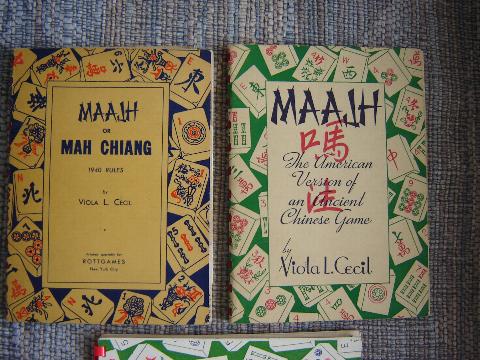
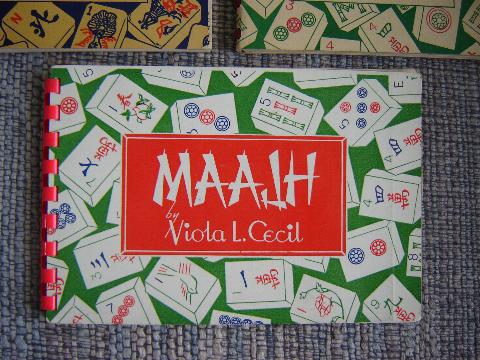
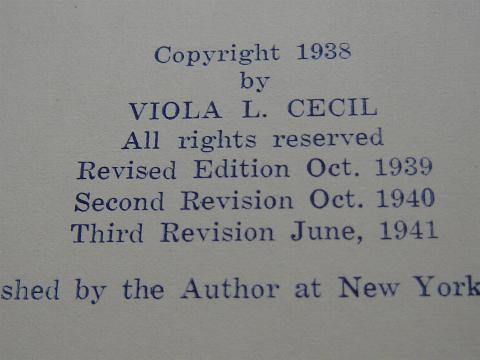
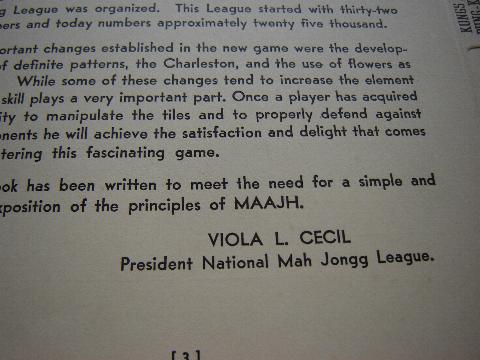
And as far as I can tell from a quick look through these three booklets just now, they all pretty much describe the same hands. It would require some patient analysis, since they're organized differently.
May the tiles be with you.
Tom Sloper
Author of "The Red Dragon & The West Wind," the definitive book on Mah-Jongg East & West.
Creator of the Mah-Jongg FAQs -- donations welcome.
Los Angeles, California, USA
June 5, 2011
Is this book in the public domain, part 2
>Date: Sat, 4 Jun 2011 17:39:18 -0400
>Subject: Re: out of print 20's books
>From: Colin B
>I understand, Tom, thank you as always for your help.
>C.
Could you be mistaken, Tom?
>From: Peter F. L
>Sent: Sat, June 4, 2011 12:13:50 AM
>Subject: Window of opportunity closing
>Tom,
>I'm just learning the rules of Mah Jongg. Please settle this question: My understanding is that the window of opportunity for a call closes if the next player picks and declares Mah Jongg without racking. This is one of the three conditions for closing the window in FAQ 19.
>My friend says not so! According to the 2011 card, back panel, item 5 says: "A tile may not be claimed for Exposure or Mah Jongg after player next in turn has picked and racked or discarded a tile" There is no mention of the case when the picker declares Mah Jongg without racking. Are we reading the card incorrectly?
>Thanks,
>Peter
Hi Peter,
The back of the card is very small, so it could never possibly be the end-all and be-all of the rules. If it could, then the League would not have had to write a rulebook, and the League would not have to issue updates in the yearly bulletin. You should check the rulebook and see what it says about different situations when someone declares "mah jongg."
Sometimes you have to extrapolate from there, since in fact the NMJL rules do have a few loose ends and loopholes. I have done a lot of that extrapolation in creating my FAQs and my book. But in this case, no extrapolation is necessary.
Tell your Doubting Thomasina to open her National Mah Jongg League rulebook and read rule 15 on page 19. The rule isn't on the back of the card. But it is in the rulebook. Declaring mah jongg closes the window of opportunity.
Even if there was no rule, doesn't it only make simple common logical sense that everybody should stop playing the instant someone declares "mah jongg!"? Like I said in my FAQ 9, "mah jongg trumps everything."
May the tiles be with you.
Tom Sloper
Author of "The Red Dragon & The West Wind," the definitive book on Mah-Jongg East & West.
Creator of the Mah-Jongg FAQs -- donations welcome.
Los Angeles, California, USA
June 4, 2011
Is this book in the public domain?
>From: Colin B
>Sent: Sat, June 4, 2011 2:01:26 AM
>Subject: out of print 20's books
>Hi Tom,
>This is kind of a legal question (and I know you're not a lawyer) but you have a lot of 1920s books on Mahjong, so I thought there would be a remote possibility you'd know the answer to this question:.can any of these books (specifically Lee Foster Hartman's Standardized Mah Jong) get photocopied or scanned? Are these out of print books considered to be "public domain" or something? I wanted to teach a few other people the game and figured it would be easier just to scan a few pages from Hartman's book, rather than type up a rules summary myself. Sorry if that's kind of an oddball question....
>Sincerely,
>Colin B
Hi Colin,
In general, the safest copyright guideline is "75 years after death of the author." I just Googled Hartman and found that he died in 1941. So after 2016, it might be reasonably safe to assume that the work is in the public domain. But it's possible that his offspring would still be alive and protecting the work. And I should remind you that I am not a lawyer, and I am not giving you legal advice here.
May the tiles be with you.
Tom Sloper
Author of "The Red Dragon & The West Wind," the definitive book on Mah-Jongg East & West.
Creator of the Mah-Jongg FAQs -- donations welcome.
Los Angeles, California, USA
June 4, 2011
Frequently Asked Question 19M
>From: Teresa W
>Sent: Fri, June 3, 2011 4:24:07 AM
>Subject: Mah-Jongg Q+A
>My mah-jongg question or comment is:
>_Is it necessary to pick up first_ when you want to exchange for a joker in an exposure?
>Here is the scenario: player B throws a tile that player C needs for an exposure, but player C needs to exchange B's joker in her exposure so that she
>can make the exposure with the thrown tile. Hence, the question can C exchange first?
>will appreciate your response. Thanks. Teresa
Hello Teresa,
Please read Frequently Asked Question 19M.
Scroll up and look for the FAQs, which are marked by a blue and yellow flashing arrow (emblazoned "READ 1ST," like this ).
Find the link to FAQ #19 (it's marked with a red, white, and blue flashing arrow, emblazoned "AMERICAN," like this ) and click it.
After you've landed at the FAQ 19 page, please bookmark it so you can easily return to it anytime you have a mah-jongg question. Answers to all of the most frequently-asked questions about
American (NMJL)
mah-jongg are found in FAQ 19. Please always check the FAQs first, before asking a question. Thanks!
May the tiles be with you.
Tom Sloper
Author of "The Red Dragon & The West Wind," the definitive book on Mah-Jongg East & West.
Creator of the Mah-Jongg FAQs -- donations welcome.
Los Angeles, California, USA
June 3, 2011
How about these two situations, part 2
>From: Lynn P
>Sent: Fri, June 3, 2011 8:51:41 AM
>Subject: Mah-Jongg Q+A
>My mah-jongg question or comment is: Re: How About These Situations email of 6/2 specifically #2: The winning hand that was self picked was under singles and pairs, last one, which is $.75 doubled-a whopping $1.50=1/2 of the pie of $3.00!!! I think that if someone has to leave before the established ending time, she should leave before a new game begins and not during a game especially when she is called dead and should know she owes the winner at the end of the game. This should come under mah jongg etiquette the same as arriving a little early or on time and not 10 minutes late. Re #1: Can one person play by herself when the others are dead? "Live" player picks and discards until she either calls mah jongg or runs out of tiles. This also happened in a game a few months ago. She called mah jongg and everyone had to pay her double. I will write to NMJL about the "dead" situation. It makes sense for another player to just call her "dead" and get on with the game. Thanks, Lynn P.
Hi Lynn, you wrote:
 The winning hand that was self picked was under singles and pairs, last one, which is $.75 doubled-a whopping $1.50
 Big whoop. Half a dollar or a dollar and a half. Either way, she isn't going to have to give up having her morning Starbucks the next day.
1/2 of the pie of $3.00
If it was 1/2 of her weekly food budget, I would clap my hands on my cheeks and make an O with my mouth, like that famous Munch painting. But a $3 pie is still small change in the overall scheme of things.
Can one person play by herself when the others are dead?
No, of course not. Read the rules. In the official rulebook, that's on pages 16 and 18. In my book, see pages 60 and 62. Please always check the rulebooks or the FAQs before asking a question.
May the tiles be with you.
Tom Sloper
Author of "The Red Dragon & The West Wind," the definitive book on Mah-Jongg East & West.
Creator of the Mah-Jongg FAQs -- donations welcome.
Los Angeles, California, USA
June 3, 2011
How about these two situations?
>From: "Lynn P
>Subject: Mah-Jongg Q+A
>Date: Thu, 2 Jun 2011 20:04:04 -0400
>My mah-jongg question or comment is: Playing American mah jongg with 2 tables of 3 players each and one table of four. 1. At one of the tables with 3 players after a few rounds dealer discovers she has 15 tiles and stops playing. After the next round with the 2 players another player only has 12 tiles so she also is dead. No one called them dead, they just said they can't play anymore. What should happen: last player picks and discards until she gets mah jongg (she only needed 2 tiles) or all players throw in tiles and start over? No one mentioned the word "dead" and I know you should not call yourself dead.
>2. At the other table with 3 players one player is called dead because she displayed a concealed hand. She needs to leave early anyway so she does. The other 2 players continue playing until a player wins and since winning tile was self-picked, losing player pays her double. Should player who left pay double too next time they play? I checked "RD&WW" but didn't find anything close to either of these situations. Thanks for your continued help. Lynn P.
Hi Lynn,
 This is indeed a major gap in the NMJL rules. You can either: a) WRITE to (never call) the NMJL and ask for a ruling IN WRITING -- then the gap will be closed; OR b) Make up a common-sense rule that solves the gap as far as your group is concerned.
Since it's not allowed to call yourself dead, you could do what I did last night. A player at my group said she was dead (too few tiles). Another player said "you have to keep playing -- you're not allowed to call yourself dead." I said, "I'm calling her dead." I had seen that she did indeed have too few tiles, and I figured it was to my advantage for her to stop picking tiles. What I'm saying is this: when a player sees that it should be obvious to any observant opponent that her hand is dead, there's no rule that says she can't request that someone please look at her obviously illegal hand and call her dead. However, since the NMJL says you can't call yourself dead, no other player is obligated to do her the favor of calling her dead. If nobody obliges, she must play until called dead by someone else.
It's an unenforceable rule, as it stands, since the NMJL does not specify a penalty for calling yourself dead. There's none for asking to be called dead, either. What can the others do, call you dead?? If the NMJL wants to, they can specify a penalty (maybe a player who calls herself dead has to pay 25¢ to each other player or something). But until the NMJL issues a rule in writing, it's a major loophole, and we can all jump on in -- the water's fine.
In fact, without any sort of penalty for calling oneself dead, it might even seem to some that there's implicit carte blanche to cheat -- to surreptitiously grab tiles from the wall or the discard floor to bring the hand up to the right number of tiles, or to surreptitiously discard that extra unwanted tile. Of course, common sense says that none of those maneuvers would be okay. But the rules are silent on this, as well.
 Sheesh! I couldn't anticipate every weird situation in my book. This is an instance where, since no rule exists, common sense has to be used. Of course she shouldn't have left without paying. Of course she owes that payment. Surely she's not arguing about 50¢, is she? Your mah-jongg players are all surely much richer than I am, and I would never argue about 50¢!
May the tiles be with you.
Tom Sloper
Author of "The Red Dragon & The West Wind," the definitive book on Mah-Jongg East & West.
Creator of the Mah-Jongg FAQs -- donations welcome.
Los Angeles, California, USA
June 2, 2011
The old Seven Oh
>Date: Tue, 31 May 2011 19:59:50 -0700 (PDT)
>From: Susan B
>Subject: Cleaning Tiles
>Tom,
>I just purchased a Bakelite mahjong set. How would you suggest I clean the tiles and racks. Is there a way to get the musty smell out of the case?
>Thanks for your help.
> Susan B
Hi Susan,
I suggest you begin by reading Frequently Asked Question 7o (that's seven and the letter oh, not seventy).
Scroll up and look for the FAQs, which are marked by a blue and yellow flashing arrow (emblazoned "READ 1ST," like this ).
Answers to all of the most frequently-asked questions about mah-jongg are found in the FAQs. Please always check the FAQs first, before asking a question. Thanks!
(Of course, after you've read Seven Oh, you're always welcome to come back with follow-up questions).
May the tiles be with you.
Tom Sloper
Author of "The Red Dragon & The West Wind," the definitive book on Mah-Jongg East & West.
Creator of the Mah-Jongg FAQs -- donations welcome.
Los Angeles, California, USA
May 31, 2011
Looking for a mah-jongg teacher
>From: John M
>Sent: Mon, May 30, 2011 11:11:12 PM
>Subject: Mah Jong instuctor Orange County
>Hi, I found your name on a list of Mah Jong instructors. Unfortunately I am in Orange County, CA. Do you know of any instructors near the Orange, Anaheim, Brea, Fullerton, Tustin area? Any help would be appreciated. Thanks, Jane
Hello Jane,
1. Browse and search my Find Players/Teachers Bulletin Board;
2. Check my List of Mah-Jongg Teachers (that's probably where you found me listed);
3. Read my FAQ 15, How to Find Players/Teachers.
Everything I know is an open book. Good luck!
Tom Sloper
Author of "The Red Dragon & The West Wind," the definitive book on Mah-Jongg East & West.
Creator of the Mah-Jongg FAQs -- donations welcome.
Los Angeles, California, USA
May 31, 2011
Help. please
>Date: Mon, 30 May 2011 10:05:58 -0700 (PDT)
>From: Harriett S (hattitnow)
>Subject: Mah-Jongg Q A
>My mah-jongg question or comment is: I cannot get the program to remember the scores after I close mahjong forever. Help. please
Hello, Harriett,
Please read Frequently Asked Question 24.
Scroll up and look for the blue and yellow flashing arrow (emblazoned "READ 1ST," like this ). FAQ 24 explains how to describe a technical problem clearly (so that you can get the help you need). And FAQ 24 explains that you have to contact the game's publisher in order to request technical support in regards to your computer game. FAQ 24 also explains how to find out who the publisher is and how to contact them. And please: never ask me any technical support questions again. I can't help you.
May the tech support be with you.
Tom Sloper
Author of "The Red Dragon & The West Wind," the definitive book on Mah-Jongg East & West.
Los Angeles, California, USA
May 30, 2011
My game is done, part 2
>Date: Mon, 30 May 2011 11:53:54 +0900
>Subject: Re: Japanese Mahjong Game JOYJAN
>From: Richard P
>Hi Tom,
>It is good to hear from you again. Yes, it has been quite a long time!
>As you pointed out, English players can play against the Japanese version Players (the language is separate on the user end only).
>Thank you for posting some links on your site. I really appreciate it.
>Yoroshiku Onegaishimasu!
>Richard
My game is done and online!
>Date: Sun, 29 May 2011 14:31:10 +0900
>Subject: Japanese Mahjong Game JOYJAN
>From: Richard P
>Hi Tom,
>I hope all is going well. We met a few years ago in Los Angeles (with Yoko) and discussed mahjong over dinner.
>Since then, we were finally able to able to get the project going and now we have the game online. The game is Japanese riichi mahjong only and can be played in live, multiplayer mode or you can practice by yourself against computer players. Players can play unlimited for free.
>There is an English version and Japanese version with separate sites for each language version. Although most players will be Japanese, we took the time and effort to make the English version for the community.
>Japanese version: www.joyjan.jp
>English version: www.joyjan.net
>Also, there is already some introduction at Reachmahjong.com regarding our game:
>http://reachmahjong.com/en/2011/05/joyjan-beta-testing-begins/
>Please take a look at your convenience, and we hope you can introduce both versions on your site as well.
>Thank you and best regards,
>Richard
Hi Richard,
Wow, that was a while back! I remember the delicious steak I had that night. And I later heard that restaurant's name in the context of Phil Spector's murder trial.
That's great that your game is up and running. I'll check it out. I approve of the ability to play against A.I. opponents, and for free. The only thing I wonder is if players of the English version can play against players who logged in on the Japanese domain -- seems to me that ought to be possible (just that each player sees his own language). And yes, I did see the post on Reachmahjong, but I didn't connect with our dinner so many years ago. Congratulations. I'll watch Reachmahjong with interest to see what that forum's users think of your game. I'll add links to your game in FAQ 5 on my site.
Dewa mata,
Tom Sloper
Author of "The Red Dragon & The West Wind," the definitive book on Mah-Jongg East & West.
Los Angeles, California, USA
May 28, 2011
Honors
>From: "Chuck & Marsha S
>Subject: Honors
>Date: Sun, 29 May 2011 00:30:47 -0400
>I enjoy your Weekly Mah Jongg column. I did not know that HONORS refers to the winds and dragons tiles until I read your column and you referenced it. This term is not on the NMJL card and I have never heard it used before. When using the card, is it more appropriate to use the word HONORS instead of WINDS-DRAGONS when referring to that section on the card?
>Marsha S
Hi Marsha,
I like to shock players of American mah jongg sometimes by making references to the much wider world of mah jongg than just the American game. The term "honors" is used by many authors of books about other forms of mah jongg (I haven't heard it used in reference to the American game). You don't have to use the term at all; I'm just being ecumenical. See FAQ 6 for this and other terms used in the wide wide world of mah jongg.
May the tiles be with you.
Tom Sloper
Author of "The Red Dragon & The West Wind," the definitive book on Mah-Jongg East & West.
Los Angeles, California, USA
May 28, 2011
Maybe I should sand them, part 2
>From: MMKROWS
>Date: Sat, 28 May 2011 12:39:07 EDT
>Subject: Mah-Jongg Q+A
>My mah-jongg question or comment is:
>Thank-you for such a prompt reply. No, I did not try to telephone you, but hope your answer helps the person who did.
>My set has 121 betting sticks and eight blank tiles instead of white dragons. I understand that the blanks are used for the dragons. When I find matching blank tiles (I haven't tried yet) I want to use them for the dragons and my originals for jokers in order to have a playable set. Depending on how well the replacement tiles match I probably should mix them with the old ones so it won't be obvious which ones are jokers and which are dragons. Agree?
>Your web site is extremely helpful to those of us who are beginners. Thanks.
>Margaret K
I understand that the blanks are used for the dragons.
Good, you have read FAQ 7E.
When I find matching blank tiles (I haven't tried yet)
Please read FAQ 7Q.
Depending on how well the replacement tiles match I probably should mix them with the old ones so it won't be obvious which ones are jokers and which are dragons. Agree?
I can only repeat what I said before: you are free to do whatever you want with your set. I can't tell you what I would do if it was mine, since I have not touched or seen your set, and since I do not know what you plan to do with it afterwards.
Tom Sloper
Author of "The Red Dragon & The West Wind," the definitive book on Mah-Jongg East & West.
Los Angeles, California, USA
May 28, 2011
Maybe I should sand them?
>From: Margaret K
>Subject: Mah-Jongg Q+A
>Date: Sat, 28 May 2011 08:46:18 -0700
>My mah-jongg question or comment is:
>I recently received my mother's 1920's era bone and bamboo set in a dark brown wood case. The stain from the drawers has come off onto many of the tiles. I am having success getting it off the bone side, but the bamboo side is more difficult. Once the "gluey" part of the stain is removed, the bamboo is still discolored. Many of the tiles are not damaged. Can I lightly sand the bamboo to remove more of the satin and then try to lightly oil them again to get the patina? I appreciate any hints. This will be a very tedious cleaning job and I don't want to make any serious mistakes.
>Thank-you.
>Margaret K
>Kenmore, WA
Hello Margaret, you wrote:
Can I lightly sand the bamboo to remove more of the satin and then try to lightly oil them again to get the patina?
You can do whatever you want. I guess it depends on what you intend to do with the set afterwards. If your intent is to keep it and display it, then anything is fine. But if your intent is to maximize its value for sale purposes, then tread carefully. Before you do anything, I think you should read FAQ 7o (seven oh, not seventy - the FAQs are above left), then maybe call a local furniture restorer (from the yellow pages) and see what he or she suggests.
By the way, if you're the person who left a message the other day and hung up before I could pick up yesterday, I'm glad you emailed. Because I do not do this sort of thing by telephone, and I might have become a bit brusque if you'd caught me on the phone.
Tom Sloper
Author of "The Red Dragon & The West Wind," the definitive book on Mah-Jongg East & West.
Los Angeles, California, USA
May 28, 2011
The glue that binds tiles together
>Subject: Glue for repair of MJ tiles?
>From: sara1.hirsch1
>Date: Fri, 27 May 2011 20:41:35 -0400 (EDT)
>What do you use to remove old glue from Bakelite tiles? What glue to you suggest for gluing the backs on to the fronts?
>Thank you for any help you may provide, I am a fan.
Hello Sara1,
It depends on the glue. Different solvents for different glues.
It depends on the plastic. Different solvents for different plastics. Read FAQs 7c3 & 7o (that latter is seven oh, not seventy -- click the FAQ links above left). Then (after reading those FAQs) I recommend you visit your local plastics store (look under P in the yellow pages), taking sample glue-encrusted and separated tiles along with you. Good luck!
Tom Sloper
Author of "The Red Dragon & The West Wind," the definitive book on Mah-Jongg East & West.
Los Angeles, California, USA
May 27, 2011
Orientation of exposures
>From: "Joanne R
>Subject: Mah-Jongg Q+A
>Date: Fri, 27 May 2011 07:48:15 -0700
>My mah-jongg question or comment is:
>When calling a discarded tile must the kong or pong be placed on the rack facing out towards the other players or can it be placed on my rack facing me?
>Thank you.
>jricci123
Hi Joanne,
There is no rule governing how exposures must be oriented on the rack. There is also no real etiquette guideline, either.
Other than one that I probably violate: I have played in the Orient, where the tiles do not have Western indices (those little Roman letters and Arabic numerals in the upper left corner). I have become accustomed to reading the tiles without looking at the indices. So I don't care whether my tiles are right side up or upside down on my rack. And when I make an exposure, I don't worry about which way the tiles are oriented -- some may be upside down in relation to the others. I suppose that's slightly bad etiquette, but nobody has complained. Most players can look at an exposure on another player's rack and discern what it is (although we have a player who can't see tiles on another player's rack, no matter how they're oriented, and now and then has to ask what they are).
So you can decide for yourself how you orient your exposures. Oriented for you to read them, or oriented for your opposite to read them, it does not matter. There is no rule.
May the tiles be with you.
Tom Sloper
Author of "The Red Dragon & The West Wind," the definitive book on Mah-Jongg East & West.
Los Angeles, California, USA
May 27, 2011
Two questionable moves
>From: Dtam6025
>Date: Tue, 24 May 2011 12:39:06 EDT
>Subject: Mah-Jongg Q+A
>My mah-jongg question or comment is:
>This is a strategy question. I'm a advance player. We play the Hong Kong style with the western variant. Do you know what the rules are regarding punging a card and then throwing out the same card? The reason being is that I want to skip a player's chance of picking up a card. Not to be mean but because he/she is working on a big hand. The other question is if I had 3 exact tiles of the same, I break it by throwing it out, the next player picks and throw the exact same card, can I pung it back? Because I changed my mind about breaking my hand and want to continue going for it.
>Thank you in advance
>David T
Hi David,
You're asking some hard questions! (^_^)
Do you know what the rules are regarding punging a card and then throwing out the same card?
I know that this move is prohibited in the Japanese rules but permitted in Mahjong Competition Rules (Chinese Official). You say your rules are "Hong Kong style with the western variant," and I don't know what that means exactly. But I assume it means you don't play by any book or author, but rather by mutually agreed principles. Therefore, since I can't tell you what the rule ought to be at your table (as per FAQ 14, above), you would probably need to discuss with your group to determine what the rule is. You should be prepared to give a better reason for the rule than what you've given me. There ought to be an offensive reason, not just a defensive reason ("to defend against a player who's working on a big hand" is a defensive reason for the rule). Is there some advantage you give yourself by making such a move? Like removing a number from play, so as to prevent anyone from robbing a kong? (Oh wait, that's defense, not offense.) You need to come up with a reason for the rule to be permitted.
if I had 3 exact tiles of the same, I break it by throwing it out, the next player picks and throw the exact same card, can I pung it back?
The Japanese rules prohibit this, and I imagine it would be permitted in MCR/CO. So again, you need to come up with a reason.
There are two ways you can go to get a rule codified by your group: (a) Bring it up in conversation and argue for your desired rule, before a play session (that way when the event occurs, it will already have been codified, and harmony was never disturbed). (b) Just play the move, then argue for its permissibility when someone objects (the possible benefit of doing it this way is that the usefulness of the play can be demonstrated at the time, driving home your arguments -- but at a probable cost of disharmony in the process).
May the tiles be with you.
Tom Sloper
Author of "The Red Dragon & The West Wind," the definitive book on Mah-Jongg East & West.
Los Angeles, California, USA
May 24, 2011
How old is it and how much is it worth?
>From: "Kathleen P
>Subject: Please help to determine age and worth, all details are provided along with attached pictures.
>Date: Mon, 23 May 2011 18:45:18 -0500
>Tom, I have a Mahjong set I purchased on the fly at an antique mall where outsiders and antique folks alike can sell their wares in little cubicles. And so it is much like a garage sale, with some antique dealer wannabe’s thrown in. The info I got from one of the associates after making a call to the owner, was that the set was purchased from another antique type store. I have no other information what so ever on it’s background. I reviewed the sets on Charli.org but didn’t really see anything identical. I’ve reviewed the sets on ebay, and they are mostly manufactured sets as far as I can tell with nice handles and brass or metal components to their boxes. This box is definitely on the handmade side and nothing fancy at all. This could just be a handmade set for personal use?
>
>I would like to see if you can tell me it’s approximate age, what type of set it is ( I guess Chinese), if you would know what region it might be from, and what it’s worth might be. And is there a way to determine what type of bone it might be made of? I’ve wanted to buy a set for awhile so that I could learn the game, and have been keeping an eye out to buy a new one, but this was a spur of the moment purchase. If it is not worth much, my goal would be to clean it up I guess and learn how to play, but I thought I should check first before making any changes to it “just in case.”
>
>Set have 148 tiles of bone and bamboo. I do not know what type of bone. The bamboo and bone are put together using dove tail technique, and you will see in detailed picture that the thickness of bone is different in each piece and not consistent. The bone shows the haversian system. The tiles look to be hand carved and then painted. By seeing the detailed pics, the numbers and circles, etc, are not consistent. The tiles use the old craks. They are worn from use, some tiles and the sticks show fading paint and some where the paint is gone (mostly on the sticks). The tiles are dirty with age and usage, but in otherwise very good condition. There are 8 blank tiles, no jokers. There are a total of 8 flower tiles, 4 red and 4 green with the numbers on top along with Chinese (?) characters to the right of the number. 6 are actually flowers whereas one looks more like reeds and the other as bamboo. The one bams have a bird pointing downwards with bright red beak and feet. The colors are bright paint. The sequence is not right in the pictures, they were taken before I knew what went with what! There are no racks.
>
>The size of the tiles are 1 ¼” long, 14/16” wide and 1/2 “ tall. The sticks are approximate since they are not consistent: 1’s are approximately 2 ¾”, 2’s are 2 ¼”, 5’s are 3 1/8” and 10’s are 2 ½”. There are 45 ones, 40 two’s, 8 fives and 36 tens, for a total of 129 sticks. Only one is broken in half.
>
>I believe this must be a Chinese set, since it has 148 tiles, comes in a square box with 5 drawers and made of bone/bamboo, with the bone sticks for money. There is the small little box with the sliding top, with tiny bone dice. The one is blank and the 4 is red. There are 4 wind discs and a matching cylindrical container with a lid (this also hand carved, very hard to fit the discs into the container and get them back out since they are not carved consistently round. All painted in green. There is one strange piece I do not see mentioned in any other set? A tetradecagon, or a 14-sided polygon. This piece does not appear to have been used much and is in excellent condition. I believe it to be a piece from another game mistakenly put into this set. It appears to be made of a plastic material and the paint colors are different and has numbers and “suits.” A, K, Q, J and hearts, clubs, spades, diamonds.
>
>The box appears to be hand carved, and put together using dove tails. The box is 5 7/8” tall, 7/14” wide and 7/12 deep. There are five drawers. 4 are 7/8” tall and the top drawer with the carved “handle” (picture included of the inside showing some type of metal prongs that hold it in place) is 1 3/8” tall, with two dividers. This is the only piece where I see some crude nails (?) used to hold the dividers in place. The outside is painted black and the front cover slides up to open the box. The emblem carved on the front is that of a phoenix (I think?) and I didn’t notice at first, but under a magnifying glass and bright light, the inside bird is painted a dark green, hard to distinguish against the black. There is a top handle made of hand molded/hammered metal and the grooves they are in appear to be hand carved as well (pics). There have been some previous splitting of the wood and it looks like someone repaired with glue (one side panel and back panel) but glue only detected from the inside view. The back panel is missing the top part of the frame, but hard to tell, and the inside is not painted as you can see. The largest top drawer as I mentioned, has two dividers, this drawer has some finger groves/handle carved out so that you can grasp the top drawer to remove in order to remove the lower drawers.
>
>As you can see in the pictures, there are some scraps of old paper, that fall apart if you try to handle them, only one or two tiny pieces have some old type on them, looks to be part of American words but not enough to tell, but old typeset. I have really enjoyed perusing your site for days! Good job and thank you for all the information you provide! And I appreciate any information you might have on this particular set. Kathleen.
>
>Attached:
IMG_1486.jpg
IMG_1487.jpg
IMG_1488.jpg
IMG_1489.jpg
IMG_1490.jpg
IMG_1491.jpg
IMG_1492.jpg
IMG_1493.jpg
IMG_1494.jpg
IMG_1495.jpg
IMG_1496.jpg
IMG_1497.jpg
IMG_1498.jpg
IMG_1499.jpg
IMG_1500.jpg
IMG_1502.jpg
IMG_1503.jpg
IMG_1504.jpg
IMG_1505.jpg
IMG_1506.jpg
IMG_1509.jpg
IMG_1511.jpg
IMG_1512.jpg
IMG_1513.jpg
IMG_1514.jpg
IMG_1515.jpg
IMG_1516.jpg
IMG_1517.jpg
IMG_1518.jpg
IMG_1519.jpg
IMG_1520.jpg
IMG_1521.jpg
IMG_1522.jpg
IMG_1524.jpg
IMG_1525.jpg
IMG_1526.jpg
IMG_1527.jpg
IMG_1528.jpg
IMG_1529.jpg
IMG_1481.jpg
IMG_1482.jpg
IMG_1483.jpg
IMG_1484.jpg
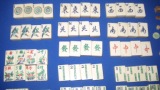
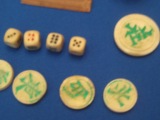
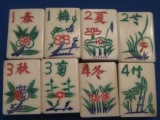
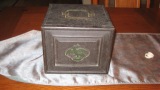
Hello Kathleen,
I can't believe you sent me FORTY-THREE PICTURES?! What were you THINKING? And they're so tiny I need a microscope to see them! And your email is extremely long, without being broken down into bulleted or numbered lists. Much too much information. So I didn't read every word. I just looked for the questions.
I would like to see if you can tell me it’s approximate age,
It looks like a common ordinary 1920s set.
what type of set it is
My guess is: a common ordinary 1920s bone and bamboo set.
( I guess Chinese), if you would know what region it might be from
I guess China.
what it’s worth might be.
It's too much work trying to read through all the words you wrote. I can't tell if it's worth $50 or $150 or what.
is there a way to determine what type of bone it might be made of?
DNA analysis would be a sure way. Or you could take it to a specialist in identifying animal specimens. But why bother? Most, if not all, of the 1920s sets were made of cow bone. Why not just assume this is one of those?
This could just be a handmade set
All the 1920s sets were handmade. So what?
for personal use?
You mean by the carver? Unlikely. But possible.
There is one strange piece I do not see mentioned in any other set? A tetradecagon... I believe it to be a piece from another game mistakenly put into this set.
Your belief is tremendously plausible, don't you think? Have you read FAQ 7D?
And I appreciate any information you might have on this particular set.
Read FAQ 7P.
Tom Sloper
Author of "The Red Dragon & The West Wind," the definitive book on Mah-Jongg East & West.
Los Angeles, California, USA
May 23, 2011
Was she dead?
>From: "madeline s
>Subject: question
>Date: Mon, 23 May 2011 18:41:23 -0400
>Hi, my question is a player called a dragon she pick up the tile and also picked up the 6 dot by mistake. when I told her the 6 tile was not right and by now she had 14 tiles. she discarded the 6 dot and maj jong was called. the caller then put up her hand. now is the caller have to pay for the table because she discarded the 6 dot. and was the maj jong winner dead when she exposed her hand.??
>thanks
>Maddie
Hello Maddie,
I'm having difficulty following what happened. You wrote:
a player called a dragon she pick up the tile and also picked up the 6 dot by mistake.
I don't understand. So player A discarded a dragon and said its name, right? Then player B said "I want that," and picked up the dragon and a 6 dot? She picked up 2 tiles? I have never heard of such a thing happening.
when I told her the 6 tile was not right and by now she had 14 tiles.
You mean 15, don't you? She picked up the dragon and the 6D, so those in addition to her 13 makes 15.
she discarded the 6 dot
What? She can't discard. Taking the 6 dot was an illegal move, so she was simply putting it back on the discard floor from where she'd gotten it, wasn't she?
and maj jong was called.
Screw-up upon screw-up! Read FAQ 9 for what I recommend happen when so many silly errors cascade upon one another. The links to the Frequently Asked Questions are above left.
Scroll up and look for the blue and yellow flashing arrow (emblazoned "READ 1ST," like this ). Find the link to FAQ 9 and click it.
Answers to all of the most frequently-asked questions about mah-jongg are found in the FAQs -- Please always check the FAQs first, before asking a question. Thanks!
May the tiles be with you.
Tom Sloper
Author of "The Red Dragon & The West Wind," the definitive book on Mah-Jongg East & West.
Los Angeles, California, USA
May 23, 2011
This week's column
>From: linda m
>Sent: Mon, May 23, 2011 6:10:52 AM
>Subject: Column 488
>Good morning Tom,
>Couldn't #6 on the May 22, column 488 also be odd #2?
>Thanks for all your advice and enjoyable reading.
>Linda M
Quite right, Linda.  A tip o' the hat to sharp-eyed you! May the tiles be with you.
Tom Sloper
Author of "The Red Dragon & The West Wind," the definitive book on Mah-Jongg East & West.
Los Angeles, California, USA
May 23, 2011
Can you use two jokers in a pong?
>From: "Barbara T
>Subject: Mah-Jongg Q+A
>Date: Sun, 22 May 2011 19:37:50 -0700
>My mah-jongg question or comment is:
>Can you use two jokers in a pong?
Yes, I can, Barbara! (^_^)
Please read Frequently Asked Question 19L.
Scroll up and look for the blue and yellow flashing arrow (emblazoned "READ 1ST," like this ). Find the link to FAQ #19 (it's marked with a red, white, and blue flashing arrow, emblazoned "AMERICAN," like this ) and click it.
After you've landed at the FAQ 19 page, please bookmark it so you can easily return to it anytime you have a mah-jongg question. Answers to all of the most frequently-asked questions about American (NMJL) mah-jongg are found in FAQ 19. Please always check the FAQs first, before asking a question. Thanks!
May the tiles be with you.
Tom Sloper
Author of "The Red Dragon & The West Wind," the definitive book on Mah-Jongg East & West.
Los Angeles, California, USA
May 22, 2011
I know "hot wall" is not part of the official rules, but
>From: Dee Dee
>Subject: hot wall question
>Date: Fri, 20 May 2011 08:49:13 -0700
>I know "hot wall" is not part of the official rules, but my group has decided to start playing that if we're in a hot wall and someone discards a tile that gives someone mah jongg and the discarding player cannot account for 3 of those tiles, she pays for the entire table. My question is, what if the discarded tile is a Flower? Since there are 8 Flowers, it seems she should have to account for more Flowers to avoid the penalty, maybe 7 Flowers. I would appreciate hearing if you have a suggestion or opinion on that.
Hi Dee Dee,
Please read Frequently Asked Question #14.
Scroll up and look for the blue and yellow flashing arrow (emblazoned "READ 1ST," like this ). Good luck working out your table rules!
May the tiles be with you.
Tom Sloper
Author of "The Red Dragon & The West Wind," the definitive book on Mah-Jongg East & West.
Los Angeles, California, USA
May 20, 2011
My six sets, part 2
>From: "Hellster"
>Subject: Mah Jongg Set#1
>Date: Thu, 19 May 2011 20:55:18 -0600
>Hello (again) Tom,
>I am interested in learning more about my six sets, but I am sending you info about SET#1. I believe I have answered the questions completely. Think I did better this time.
>Set #1 – My best guess: This is a “mixed” set. I am inclined to say that this is the design of Met Games (distinctive white dragons). There are no natural jokers in the set and all eight are stickered (152 tiles). The tiles are a variety of shades of bright, light, buttery corn-on-the-cob colors, making it possible to play without recognizing any tiles from the reverse. This is a colorful set with very little paint loss. I would estimate condition as fine or excellent. Tiles measure approximately 1 ¼” x 7/8” x 7/16”. 152 tiles are in the original tray with four original wood racks (in good shape, considering their age; all the ‘flippies’ work). The metal shows signs of aging; the original ‘trumpet’ case shows it age (not in good shape – condition fair). I estimate it to be made before or in the early 60s since it has no natural jokers.
>SET AGE-DETERMINATION CHECKLIST:
>1. Write a factual detailed list of all the contents of your set. Describe all the contents, listing all dice, chips, racks, etc.
>152 (Bakelite/Catalin) tiles – no missing tiles. 4 wood racks with working flippies. A very beat up trumpet case. One large tray that accomodates all the tiles. A broken bettor (Bakelite/Catalin) and two red dice.
>2. If the set contains any paper materials, like an instruction booklet or scoring card, write the title, author's name (if any), and date (if any) of those materials.
>None of the above.
>3. What are the tiles made of?
>Bakelite/Catalin? Tested positive for Bakelite with Simichrome, but I understand that is not definitive. Probably Catalin.
>4. Describe what you know about when the set was made or purchased, if you know. Describe the history of the set to the best of your knowledge. See our FAQ 11 before you make any unsupportable claims (such as "this set is over a hundred years old!" or "this set is from the Qing Dynasty!"); the knowledgeable collectors can see through claims that are ignorant of the actual history of the game.
>Bought in a secondhand shop – no information available at all.
>5. What are the dimensions of the tiles?
>Tiles measure approximately 1 ¼” x 7/8” x 7/16”.
>6. How many tiles are there in the set?
>No natural jokers in the set and all eight are stickered (152 tiles) – complete Dot, Bam and Crak suits 1-9, 4 each NEWS, 12 dragons (red, green & white), 8 flowers
>7. What kind of container does the set come in? If it's wood, is it one of those flat boxes with a sliding top, or is it one of those squarish boxes with drawers, and if so how many drawers? Does the container have any clear signs of age?
>Beat up trumpet case with no markings.
>8. Which kind of craks are in this set -- the older kind or the later kind? Take a picture to provide to the appraiser.
>The later kind – please see attached image.
>9. Provide a picture of the One Bams. These tiles can sometimes tell a lot about which part of China the set came from.
>Please see attached image.
>10. Provide a picture of the dragons too. These tiles can sometimes tell a lot about which era of mah-jongg history the set came from.
>Please see attached image.
>11. And provide a picture of the flowers/seasons. These tiles are sometimes exotic and can provide information about the age of a set.
>8 flowers (please see attached image).
>12. How many jokers (if any) does the set have?
>8 stickered jokers
>If there are stickers, do they appear old and worn, are they coming detached?
>No – new stickers have been added to the tiles.
>Set#1.JPG

Hi Cyndi, you wrote:
I am interested in learning more about my six sets, but I am sending you info about SET#1. I believe I have answered the questions completely. Think I did better this time.
What more is it that you want to learn, Cyndi? What is your question for me? FAQ 7P.
May the tiles be with you.
Tom Sloper
Author of "The Red Dragon & The West Wind," the definitive book on Mah-Jongg East & West.
Los Angeles, California, USA
May 20, 2011
Looking for a teacher
>Date: Thu, 19 May 2011 22:26:13 -0400
>Subject: posting
>From: gail d
>Hi Tom,
>I am interested in learning to play Japanese style mah jong.
>Gail D
>Sarasota, Florida
Hi Gail,
I recognize your name. You've been to my site many times before. So you ought to know about the Frequently Asked Questions. (Answers to all of the most frequently-asked questions about mah-jongg are found in the FAQs -- right??) And this one is FAQ #15.
Please scroll up and look for the blue and yellow flashing arrow (emblazoned "READ 1ST," like this ).
Posting a "teacher wanted" announcement is unlikely to get you what you're looking for, especially in this case. You're in Florida and you want someone who teaches Japanese mah-jongg. I think it's unlikely that anyone like that is scanning my Find Players board looking for students. You have to go looking for teacher (not the other way around). Is there a Japanese community in your city? Are there Japanese groceries or restaurants where they have bulletin boards? Read the FAQ and get pro-active. Good luck!
Tom Sloper
Author of "The Red Dragon & The West Wind," the definitive book on Mah-Jongg East & West.
Los Angeles, California, USA
May 19, 2011
My six sets
>From: "Hellster"
>Subject: Mah Jongg questions - of course!
>Date: Thu, 19 May 2011 16:46:16 -0600
>Hello Tom,
>I am interested in learning more about the sets described below. I would be interested in their manufacture and age and of course, an educated guess about value. I have taken pictures and they are attached. Regrettable, Set#6 is not here and I did not have an opportunity to scan the tiles (the other images are scans done at high resolution which I resized for emailing and viewing. As far as papers, bettors, dice or any extras – nothing but the racks and cases described, noted when appropriate. I have learned a great deal from your site, but I still don’t know as much as I would like to about these six sets. I think all six sets are Bakelite/Catalin. They tested for Bakelite, but I understand that is not definitive.
>Many thanks for your time and your generosity in sharing your knowledge.
>Cyndi Heller
>Set #1 - This is a “mixed” set. I am inclined to say that this is the design of Met Games (distinctive white dragons). There are no natural jokers in the set and all eight are stickered (152 tiles). The tiles are a variety of shades of bright, light, buttery corn-on-the-cob colors, making it possible to play without recognizing any tiles from the reverse. This is a colorful set with very little paint loss. I would estimate condition as fine or excellent. Tiles measure approximately 1 ¼” x 7/8” x 7/16”. 152 tiles are in the original tray with four original wood racks (in good shape, considering their age; all the ‘flippies’ work). The metal shows signs of aging; the original ‘trumpet’ case shows it age (not in good shape – condition fair).
>Set #2 – I think this set is from Royal Depth Control prior to 1964; the majority of the tiles match RDC’s design; all tiles are the same size and color. There are no natural jokers in the set therefore all are stickered. This set has mellowed to a dark butterscotch color. All 152 tiles are a consistent shade so it is a perfect set for play. I would rate it as good. Tiles measure approximately 1 7/32” x 13/16” x 15/32”. Most of the colors are pretty vibrant, although a few would do nicely with a ‘touch-up’. There is no case or racks – just tiles.
>Set #3 – It looks like an Eastern Distributor’s set; the tiles are thinner than ‘modern’ tiles; they are 7/8 x 1 ¼ x 3/8 and are a buttery yellow color. There are 146 matching tiles, four sequenced flowers and four sequenced professions; the two other matching tiles are stickered over for jokers. Tiles are in fine/excellent condition, racks are in good condition as is the case. All tiles nest in two original trays; there and five vintage multi-color Bakelite/Catalin (?) racks.
>Set #4 - This might be a vintage Metro set made prior to 1964. There are no natural jokers in the set, therefore all are stickered. Tiles (152) are a butterscotch/pumpkin color. All the tiles are a consistent shade so it is a perfect set for play. I would rate the tiles as very good. Tiles measure approximately 1 7/32” x 13/16” x 3/8”. I have the trumpet case (pretty sad, but serviceable) and no racks.
>Set #5 – May be E.S. Lowe, based on the very distinctive ‘Sitting Sparrow’ 1-Bam (to my knowledge, was used only by Eastern Distributors and E.S. Lowe) and the design of the White Dragon. There are four ‘natural’ Flower tiles and four ‘Worker’ tiles. There are no natural jokers in the set and all eight are stickered and well matched making play possible (152 tiles total). Condition of tiles is good. Tiles measure approximately 1 7/32” x 13/16” x 11/32”. All 152 tiles are in the original tray with four vintage wood racks (they are in good shape; all the ‘flippies’ work quite well). The metal shows signs of aging; the original ‘trumpet’ case is pretty worn. I would say it is fair.
>Set #6 – I think this is Cardinal Mah Jongg set made prior to 1966. There are eight jokers (two natural and six perfectly matched stickered tiles) – a total of 156 tiles. Nice bright colors and minimal paint loss; it is a rich greenish butterscotch color. I would rate them as very good. All the tiles have a very consistent shade so it is a perfect set for play. All tiles nest in two original red trays with two red dice, a bettor (cracked) and five racks (they’re in decent shape; most of the ‘flippies’ work; the metal shows signs of aging). I think the case is an original Cardinal, worn and with a broken hinge. I would call the case fair.
>Set#1.JPG
>Set#2.JPG
>Set#3.JPG
>Set#4.JPG
>Set#5.JPG
>Set#6.jpg
Hello Hellster,
I'm going to have to ask you to start over again. Email me about ONE set. Then, after I have replied, email me again about ONE set. And so on. I really can't deal with one email about six sets! And I hope you have read FAQs 7G, 7H, and 7P?
By the way, I'm looking into adding a Donations function to my website. My services and information will continue to be free, at least for now, but donations would be very welcome.
May the tiles be with you.
Tom Sloper
Author of "The Red Dragon & The West Wind," the definitive book on Mah-Jongg East & West.
Los Angeles, California, USA
May 19, 2011
Urgent, we need to know this right away!!!!!!!!!!! Like, you know -- NOW, dig it?
>Date: Thu, 19 May 2011 16:44:23 -0500
>Subject: URGENT! Mah Jongg Chinese International Rules - Hand #54
>From: Rosemary S
>Cc: judith p, Kim E, Sarah F
>Dear MJ Master,
>A player Mah Jongged with hand 54 last week: "three concealed pungs", concealed, not declared. She did not have three concealed pungs in her pre-mah jongg hand. The tile she picked up completed the third pung. Some of us wondered: since it is possible to have 3 concealed pungs in a hand and draw to Mah Jongg by completing the other trio or the head, was this a legitimate Mah Jongg? Please enlighten. We play tonight. If you can set us straight by 7 central time we would appreciate it.
>Romi
Hi Romi,
An emergency on your part does not obligate me to being in a state of emergency too! No guarantees that you will get this reply on your timeframe.
I looked for documentation on this fine point about a pung being "concealed" even when it's completed by winning on a discard. The only precedent I could find was the post from Elizabeth U on March 21 ("MCR fine points," below or on a previous page). In that reply to Elizabeth, I wrote:
Although the freshly-completed pung is technically "exposed," the wording you quote indicates that it is permissible to declare four concealed pungs when you win on a discard when waiting with three concealed pungs and two pairs. In case it means anything, I should mention that I was involved in the writing of that wording, based on a translation provided by the WMO.
What I'm trying to say is that I do not know how the WMO would really rule on this. And I also do not claim to be the authority who declared how this ought to be ruled. It is possible that the wording (due to a flawed translation, and a reliance on how such matters are handled in other forms of mah-jongg) is misleading.
If you accept that Four Concealed Pungs (fan #12 in my numbering system) can be won with a discard completing a pung, then it does seem logical to accept that Three Concealed Pungs (fan #33 in my book) can be won with a discard completing a pung.
So there you have it. What time is it now? (^_^)
Tom Sloper
Author of "The Red Dragon & The West Wind," the definitive book on Mah-Jongg East & West.
Los Angeles, California, USA
May 19, 2011
I need an automatic table repairman
>From: Sandimans
>Date: Wed, 18 May 2011 18:15:04 -0400 (EDT)
>Subject: Mah-Jongg Q+A
>My mah-jongg question or comment is:
>Who can I hire to fix my automatic Mah Jongg table? I live in the Palm Springs area and will pay all expenses.
>Thank you,
>S. Friedman
Hello S.,
A couple of ideas:
You could contact the company who sold you the machine, and ask them.
You could look in the Yellow Pages under Repairs (any decent repairman ought to be able to figure it out), but...
 If it came with manuals, you should look to see if they're in English or not. If not, see if you can determine what language it's written in. If you don't know the difference between Chinese and Japanese, see if you can find a company name and address in the materials. If the machine was made in China, then a non-English manual is most likely in Chinese (you see where I'm going with this). You might need to be prepared to have a bilingual person help the repairman if he needs it. Or you might not need to do anything like that, if the repairman can figure out what's going on without a repair manual. Any decent repairman or mechanic should be able to figure out how the thing works (like I did with mine, and no, I will absolutely not come to Palm Springs to fix your machine for you).
May the tiles be with you.
Tom Sloper
Author of "The Red Dragon & The West Wind," the definitive book on Mah-Jongg East & West.
Los Angeles, California, USA
May 18, 2011
Was it really too late to change my exposure?
>From: Judyp
>Date: Tue, 17 May 2011 17:33:40 -0400 (EDT)
>Subject: Mah-Jongg Q+A
>My mah-jongg question or comment is:
>I was playing the FFFF 3333X5555=15 hand.
>I called for the fourth five and put in on my rack. Instantly, I realized my mistake and having several jokers wanted to replace one of the fives with a joker. The rest of the table said that I could not. Of course, I had not discarded.
>In the interest of harmony and time, I went along with the rest of the table. Could I have replaced the one five with a joker?
>And would your ruling be the same as that of the NMJL?
>Thank you for your answer.
>Judy P
Hi Judy, you asked:
Could I have replaced the one five with a joker?
Yes. Read Frequently Asked Question #19AF.
Please scroll up and look for the blue and yellow flashing arrow (emblazoned "READ 1ST," like this ). Since you had not discarded yet, you had every right to make the joker exchange. Only after you've discarded is it too late.
And you can't exchange it on a later turn, either, because there's no such thing as reverse redemption. Once you've exposed the "natural" (jokerless) kong of fives and discarded, your hand is dead if you can't change it to some other hand.
And would your ruling be the same as that of the NMJL?
I can't imagine what benefit there would be in ever giving a ruling contrary to official NMJL ruling. So, given my limited imagination, it is my practice to NEVER give rulings contrary to the rules.
May the tiles be with you.
Tom Sloper
Author of "The Red Dragon & The West Wind," the definitive book on Mah-Jongg East & West.
Los Angeles, California, USA
May 17, 2011
Dead links
>Date: Sun, 15 May 2011 12:42:02 -0700
>From: Brandi W
>Subject: FAQ update
> I was looking at FAQ section 7i about cards and kards, and I thought
> you might like to fix some links and get some new info:
> 1) "You can download simple mah-jongg kard images and print your own
> kards at http://www.geocities.com/rkcpek/mjcards1.zip and http://www.geocities.com/rkcpek/mjcards2.zip."
> Alas, Geocities is dead, and these sites do not seem to have been
> cached anywhere. (They seem to have been older versions of Robert
> Kalin's kards, anyway.)
> 2) There are some nice new kards out there at Amazon.com. This
> American set is apparently from Yellow Mountain Imports:
> http://www.amazon.com/American-Mahjong-Jongg-Playing-Cards/dp/B0031ATWXW/
> and they also carry a Chinese set:
> http://www.amazon.com/Chinese-Mahjong-Mah-Jongg-Playing-Kards/dp/B0029LXHVC/
> Furthermore, a shop called SkyBluePink is carrying some
> American-style kards (they mention 10 jokers) which might be popular
> with the vision-impaired (they have very large corner symbols):
> http://www.skybluepink.com/products6.html
>-- Brandi
Thanks, Brandi. I'll delete those dead links and append this fo the FAQ.
May the kards be with you.
Tom Sloper
Author of "The Red Dragon & The West Wind," the definitive book on Mah-Jongg East & West.
Los Angeles, California, USA
The Ides of May, 2011
What is playing with a future called?
>Date: Sun, 15 May 2011 11:04:32 -0400
>Subject: Mah Jongg question
>From: Marilyn T
>I have recently learned how to play American mah jongg - I was taught by my 93-year-old mother. She plays the game in a slightly different way than the National Mah Jongg League method of play and I was wondering if there's a name for it. In her game, we discard a tile first, then pick a tile. The tile that is picked remains on top of the rack - I've heard it called a "future" tile or "standing" tile. It does not become part of your hand until your next turn. So everyone has 13 tiles on the rack and one standing tile. When a discarded tile is called by one of the players, that player is given the tile they called plus the standing tile of the person who discarded the tile. The rest of the players pass around their standing tiles.
>I play the game both ways, but I'm trying to find out the history of the game I was taught. There doesn't seem to be any instructions for it online, yet I know a lot of people who play this way. My mother started playing the game in the 1960s. I couldn't find anything on your website regarding this, but maybe I missed it. You have a lot of (much appreciated) information out there!
>Thanks for any help or pointers you can give me.
>Marilyn T
Hi Marilyn, you asked:
I was wondering if there's a name for it... I've heard it called a "future" tile or "standing" tile. .. I couldn't find anything on your website regarding this, but maybe I missed it.
It's called "a table rule that will get you called dead when you play in a tournament." Read Frequently Asked Questions 14 & 19R.
Please scroll up and look for the blue and yellow flashing arrow (emblazoned "READ 1ST," like this ). Find the link to FAQ #19 (it's marked with a red, white, and blue flashing arrow, emblazoned "AMERICAN," like this ) and click it.
After you've landed at the FAQ 19 page, please bookmark it so you can easily return to it anytime you have a mah-jongg question. Answers to all of the most frequently-asked questions about American (NMJL) mah-jongg are found in FAQ 19. Please always check the FAQs first, before asking a question. Thanks! This week's column may be late; I have a lot on my plate today.
May the tiles be with you.
Tom Sloper
Author of "The Red Dragon & The West Wind," the definitive book on Mah-Jongg East & West.
Los Angeles, California, USA
The Ides of May, 2011
Our tournament
>From: "Lynn Huffman"
>Cc: "'Ethel Anthony'"
>Subject: Michigan Mah Jongg tourney
>Date: Sun, 15 May 2011 10:48:02 -0400
>Hey, Tom,
>I’m an avid reader of your website’s weekly column, and recommend your site to all MJ beginners/players.
>FYI, we hosted a Mah Jongg tournament on May 5, 2011, at a local temple in East Lansing, Michigan. We had 36 players at 9 tables, and included cash prizes for the 3 top point winners, had door prizes, and snacks. Everyone enjoyed the afternoon fun.
>Attached is a photo of the players.
>Wishing us many Jokers,
>Lynn Huffman
>Ethel Anthony
>Mah Jongg Tournament_East Lansing Michigan_May 2011.jpg

Cool, Lynn. Thanks for sharing. This week's column may be late; I have a lot on my plate today.
May the tiles be with you.
Tom Sloper
Author of "The Red Dragon & The West Wind," the definitive book on Mah-Jongg East & West.
Los Angeles, California, USA
The Ides of May, 2011
Tell me what you can, part 2
>From: barbara w
>Sent: Thu, May 12, 2011 7:52:22 AM
>Subject: RE:
>thanks for the info. I still am having trouble though. the tiles appear to measure the same as Japanese tiles. the tiles are in "very good" condition. The tiles have rounded edges which my other sets don't have. I can't tell what they're made of as they're slightly lighter than my other sets. the box is in terrible condition. the handle is genuine leather and the brass is intact although very old. I will resend the pix and dimensions. thank you again
>Barbara
Okay, Barbara.
Standing by for when you have a focused question for me.
May the tiles be with you.
Tom Sloper
Author of "The Red Dragon & The West Wind," the definitive book on Mah-Jongg East & West.
Los Angeles, CA (USA)
May 12, 2011
Tell me what you can
>From: barbara w
>Sent: Thu, May 12, 2011 7:05:32 AM
>Subject:
>I found this set at a senior citizen's center. I've never seen one like it before. I have other old sets from my mother and mother-in-law from the 50's. I'm 62 and remember my mother playing when I was very young.
>this set comes in a box measuring 4 1/2 x 6 1/2 x 19 1/4. I've included lots of pix. the tiles measure 9/16 x 1 1/16 x 7/16. please tell me what you can about it. thank you, Barbara
>7 Files View Slideshow Download All
>mah jongg 001.jpg (105KB); mah jongg 002.jpg (18KB); mah jongg 003.jpg (73KB); mah jongg 005.jpg (1795KB); mah jongg 004.jpg (1703KB); mah jongg 011.jpg (65KB); mah jongg 012.jpg (94KB)
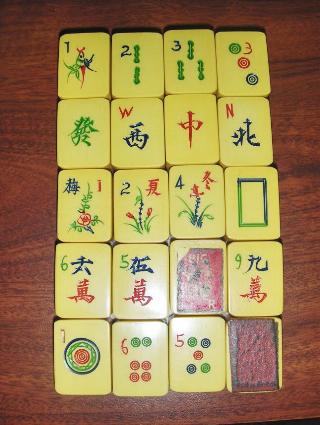
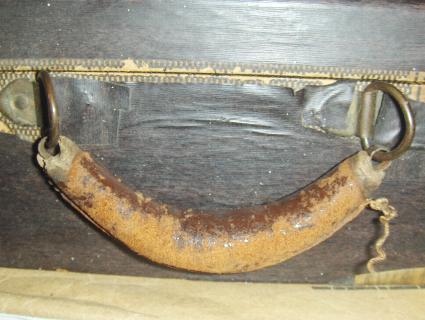
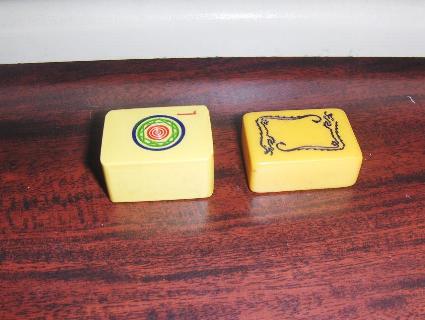
Hello Barbara,
Please read
Frequently Asked Questions #7P, 7A, 7C, 7G, & 7H.
Please scroll up and look for the blue and yellow flashing arrow (emblazoned "READ 1ST," like this ).
Answers to all of the most frequently-asked questions about mah-jongg are found in the FAQs.
After you have read those FAQs, you are welcome to ask narrowly focused questions.
Please always check the FAQs first, before asking a question. Thanks!
May the tiles be with you.
Tom Sloper
Author of "The Red Dragon & The West Wind," the definitive book on Mah-Jongg East & West.
Los Angeles, California, USA
May 12, 2011
Seat rotation, part 3
>From: Billie E
>Sent: Tue, May 10, 2011 5:55:41 PM
>Subject: Re: Rotating seats
>T>do you keep the same east for all games that day
>B>The dice (the role of "East") are constantly moving around the table. You don't actually keep the dice at the same seat for numerous hands in a row, do you? No, the dice keep circling 'round the table for 8 games. Beginning of 9th game, A&B swap seats. Another 8 games, A pivots into C's seat, another 8 games and A pivots into D's seat. Now you're back to the sequence you started with....ABCD. At this point, doesn't B become the new pivot person?
>1st 2 rds next 2 rds ..................and so on
>When the dice come back to A, s(he) changes seats.
> D D D A A A
>A C B C B A B D C D C B
> B A C C B D
>
><----------------A is pivot person----------------------------------><-------------B is pivot person--------
>A starts off as East, and the dice pass to B, and then to C and then to D, and back to A. Repeat around the table. When the dice come back to A, A moves to B's seat, B moves to A's seat and B rolls the dice. A will roll for the following game. (I understand you do your own version of this as a table rule).
Billie,
Read the rule again. "Pivot" does not change. The first person who was East in the first hand is the "pivot" around whom the rotations occur for the whole play session.
1. First East is designated "pivot" and deals first hand.
2. Dice move around the table twice. The third time the pivot becomes East, she gets up and exchanges seats with player at her right.
3. Repeat step 2.
4. Repeat step 2.
5. Repeat step 2. (And so on.)
See? Step 2 gets repeated repeatedly, but step 1 doesn't. "Pivot" does not get re-designated to somebody else.
May the tiles be with you.
Tom Sloper
Author of "The Red Dragon & The West Wind," the definitive book on Mah-Jongg East & West.
Los Angeles, CA (USA)
May 10, 2011
Who pays double? Part 2
>From: Lynn P
>Sent: Tue, May 10, 2011 5:33:08 PM
>Subject: Mah-Jongg Q+A
>My mah-jongg question or comment is: Concerning my email titled "Who pays double?" I didn't remember about the NMJL January bulletins but I have saved the "Q & A" sections since 2004 when I started playing mah jongg. I found the Q& A's you mentioned and sent them to the players and will now keep them with my "RD & WW" book. Thanks again. Lynn P.
Hi Lynn,
Yes!! I always say you should keep the yearly bulletins for this very reason. FYI: My book was published in 2007, and all bulletin Q&A's from previous years were included when I codified the rules.
May the tiles be with you.
Tom Sloper
Author of "The Red Dragon & The West Wind," the definitive book on Mah-Jongg East & West.
Los Angeles, CA (USA)
May 10, 2011
Who pays double?
>From: Lynn P
>Sent: Tue, May 10, 2011 10:01:59 AM
>Subject: Mah-Jongg Q+A
>My mah-jongg question or comment is: Playing American Mah Jongg: Player A across from me has 3 seven bams and 4 nine dots exposed on her top rack. I have 2 flowers and 2 jokers exposed on mine. Player D discards a 6 bam which player A calls and displays with 2 other 6 bams. She then redeems my 2 jokers with 2 flowers and exposes 1 eight dot with a joker plus the 2 redeemed jokers and calls mah jongg. Player D says she pays double because she gave her the 6 bam. I say her mah jong is self picked because she redeemed my jokers after Player D discarded 6 bam so we all owe her double. Player B agrees with player D and says it doesn't matter when she redeems the jokers only that Player D gave her the 6 bam and reads from back of mah jongg card, "Joker or Jokers may be replaced in any exposure with like tile or tiles by any player, whether picked from wall or in player's hand, when it is player's turn." I said that the player must first call a discard or pick from the wall so that she has 14 tiles in her hand before she can redeem joker or jokers which is on p. 91 #1 of "Red Dragon & West Wind" but the part about the 14 tiles is missing in the NMJL card explanation. Nowhere on the back of the card does it mention having 14 tiles in hand before redeeming jokers. Is this fact something that is just "understood" in playing mah jongg or should it be taught to new players? Here is another reason why mah jongg players should buy your book!! Thanks again and again for all your help. Lynn P.
Lynn, as for your group's disagreement as to who pays double, read FAQ 19AN.
As for your question about having 14 tiles before redeeming: the card is very small. It cannot contain a complete description of all the rules. [edit] If this isn't covered on page 19 in the official rulebook, it is covered in the League's January bulletin of 2006.[/edit]
May the tiles be with you.
Tom Sloper
Author of "The Red Dragon & The West Wind," the definitive book on Mah-Jongg East & West.
Los Angeles, CA (USA)
May 10, 2011
Seat rotation, part 2
>From: Billie E
>Sent: Tue, May 10, 2011 10:12:23 AM
>Subject: Re: Rotating seats
>Great....looks like we're on the money. Okay, I have egg on my face...I missed 19BB. Here's more...in red
>
T>I wish you had mentioned! Since I'm in the "business" (in quotes because I don't get paid) of providing information about services, it'd be good for me to know who not to recommend.
B>It wouldn't be fair to this person who may actually have sent them back and perhaps the Post Office destroyed/lost the envelope.
>
T>Great tip. I would have thought glue would soak into the sticker paper -- what glue do you use that doesn't?
B>What I did was coat a sheet of clear plastic with a thin layer of Elmers and let it set for a few minutes. I laid it on top of my paper jokers and smoothed it out. I also applied a thin layer of Elmers to the face of the tile and let it set for a few minutes so it would get tacky. Then I placed my "sticker" onto the tile and let it dry. After about 30 games, the clear plastic flaked right off, but the paper was already neatly sealed in with a layer of glue on top. One could use clear nail polish to make it adhere and to coat the surface....but I didn't want to permanently deface my antique tiles.
>
T>How could you not find FAQ 19BB? It's right there in FAQ 19.
B>Thank you. It doesn't mention the convention my mother plays with...that after east has pivoted all the way back to her original seat, after sitting in each seat, that a new person becomes east...the person to the right of the original east. Is that what you do, or do you keep the same east for all games that day (even if it's 40 games)? We must have a record of marathon mah jongg playing to play as many games as we do!
Hi Billie, you wrote:
It wouldn't be fair to this person
OK, fair enough.
What I did was...
Very interesting. Thanks for the thorough description. I assume it wasn't intentional that the clear plastic would fall off, but it's great that the result was to leave a smooth residue of Elmer's glue, providing a very good seal. I'll add this to FAQ 7T.
It doesn't mention the convention my mother plays with...that after east has pivoted all the way back to her original seat, after sitting in each seat, that a new person becomes east...
Yes it does. The FAQ describes both the original rule governing who will deal (who rolls the dice) and what I think is a better rule.
do you keep the same east for all games that day
The dice (the role of "East") are constantly moving around the table. You don't actually keep the dice at the same seat for numerous hands in a row, do you?
May the tiles be with you.
Tom Sloper
Author of "The Red Dragon & The West Wind," the definitive book on Mah-Jongg East & West.
Los Angeles, CA (USA)
May 10, 2011
Seat rotation
>From: Billie E
>Sent: Tue, May 10, 2011 8:17:13 AM
>Subject: Rotating seats
>Dear Tom,
>Thanks for all you do! I find myself coming back to your site again and again.
>Mathew Shimm (who I found through you) really helped me out with missing tiles to make Jokers, after I sent my tiles to someone (name left unmentioned) to match and never got them back. I have Granny's Rottgames bakelite set from late 1930's with her old instruction book and some of her 1940's 50s and 60s NMJL cards. I found cute Chinese men/fans designs on some website, printed them out to be the exact right size, and made my own stickers that I glued on with Elmer's glue. I coated them with lots of clear glue so the paper won't rub off easily.
>
>Now, my question. I searched all over your site and couldn't find info about rotating seats, except for what you describe in tournament play. We generally play 4-handed and find that always passing to the same people in the same order becomes biased, and the slower player always followed by the faster player is unruly, so we like to shake it up. I believe the NMJL recommends switching seats after 4 hands, when the dice come back to the original "east." Since we play for 5 or 6 hours at a time, that's too often, so our table rule is we go around the table twice.
>
>Are we doing this correctly? After the dice go around the table (twice) and come back to the original "east" (the person, not the seat), she and the person to her right (north?) switch seats. After the dice go around the table and return to Mrs. East again, she (currently sitting in north) switches seats with the person sitting in West. This continues until Mrs. East has pivoted all the way around the table, and is back to her original seat. I think that the player on her right becomes the new "east." For us, that would entail 32 games [8 games around before the first pivot (seat change) x sitting in each of the 4 seats. 8x4=32] With the length of time that we play, it is conceivable that we could have a second "east".
>Thanks,
>Billie
Hi Billie, you wrote:
Thanks for all you do! I find myself coming back to your site again and again.
>Mathew Shimm (who I found through you) really helped me out with missing tiles to make Jokers,
Excellent!
after I sent my tiles to someone (name left unmentioned)
I wish you had mentioned! Since I'm in the "business" (in quotes because I don't get paid) of providing information about services, it'd be good for me to know who not to recommend.
made my own stickers that I glued on with Elmer's glue. I coated them with lots of clear glue so the paper won't rub off easily.
Great tip. I would have thought glue would soak into the sticker paper -- what glue do you use that doesn't?
I searched all over your site and couldn't find info about rotating seats
How could you not find FAQ 19BB? It's right there in FAQ 19.
We... find that always passing to the same people in the same order becomes biased, and the slower player always followed by the faster player is unruly, so we like to shake it up.
Good reasons for rotating.
Are we doing this correctly?
Please read FAQ 19BB (now that you know where to find the info).
May the tiles be with you.
Tom Sloper
Author of "The Red Dragon & The West Wind," the definitive book on Mah-Jongg East & West.
Los Angeles, California, USA
May 10, 2011
Thanks
>From: "Anna K
>Cc: "Art K
>Subject: Mah-Jongg Q+A
>Date: Sun, 8 May 2011 19:08:24 -0400
>My mah-jongg question or comment is: THANKS FOR ALL YOU DO:)
Anna,
It's very good to get emails like yours! (^_^)
May the tiles be with you.
Tom Sloper
Author of "The Red Dragon & The West Wind," the definitive book on Mah-Jongg East & West.
Los Angeles, California, USA
Mother's Day, 2011
Where can I get them?
>Date: Sat, 7 May 2011 10:28:07 -0700 (PDT)
>From: sooze
>Subject: Old Mah Jongg Cards
>Hi Tom,
>I used to play Mah Jongg when I was much younger and I have been telling the women I play with now about how the hands seemed much different when I was younger. I am not sure if this is due to the fact that I am denser now, but was wanting to get a hold of some earlier cards to satisfy my curiosity. Do you have any idea where I might find some cards from between 1960-1965? I would even be happy with a xerox copy of one of two of them, because we are not using them to play with. Do you know anyone who would be willing to do this? You are my first try and then I was going to contact the National Mah Jongg League.
>Thanks,
>Sooze
Hi Sooze.
Same thing I told Donna earlier this morning: eBay. People are selling old cards on eBay all the time. Here's one I found right now:
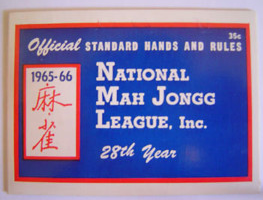
Go to http://toys.shop.ebay.com/Pre-1970-/19092/i.html?_catref=1&_fln=1&_trksid=p3286.c0.m282 and start exploring from there.
Tom Sloper
Author of "The Red Dragon & The West Wind," the definitive book on Mah-Jongg East & West.
Los Angeles, California, USA
May 7, 2011
Where can I get one?
From: "Donna Nowack"
Subject: Eddie Cantor Sheet Music :Since Ma Is Playing Mah Jong"
Date: Fri, 6 May 2011 13:47:30 -0400
Hi
I am new to your site and don’t know if this is appropriate to ask, but here goes!! I’m looking for a copy of “Since Ma Is Playing Mah Jong” by Eddie Cantor. I’ve been collecting Vintage Mah Jong for a couple of years and would love to own a copy of this sheet music. Any help you can give me would be greatly appreciated. Thanks, Donna Nowack Donnan at nowacksales.com
Hi Donna,
I got my copy on eBay. It may take some time, but that's probably the best place to start. And your request has been posted now on my (mah-jongg) Accessories Wanted bulletin board. Maybe somebody will contact you.
Tom Sloper
Author of "The Red Dragon & The West Wind," the definitive book on Mah-Jongg East & West.
Los Angeles, California, USA
May 7, 2011
The definition of a "kong"
>From: Kathy P
>Sent: Fri, May 6, 2011 4:38:46 PM
>Subject: ? about 2011 card
>Hi Tom, I have a ? about a Quint hand.
>1223 22222 22222. Is the first part of the hand considered a kong? If that is correct than a joker can be used?
>If not then is it considered a single, pair, single or pair, single, single or single, single, pair depending on the run you choose.
>Thank you,
>Kathy
Hello Kathy,
"Kong" is (perhaps inadequately) defined on the back of the NMJL card, and more fully defined in FAQ 19E. Please visit my Frequently Asked Questions above left (look for the blue and yellow flashing arrow, emblazoned "READ 1ST," like this ). Find the link to FAQ #19 (it's marked with a red, white, and blue flashing arrow, emblazoned "AMERICAN," like this ) and click it.
After you've landed at the FAQ 19 page, please bookmark it so you can easily return to it anytime you have a mah-jongg question. Answers to all of the most frequently-asked questions about American (NMJL) mah-jongg are found in FAQ 19. Please always check the FAQs first before asking a question. Thanks!
May the tiles be with you.
Tom Sloper
Author of "The Red Dragon & The West Wind," the definitive book on Mah-Jongg East & West.
Los Angeles, CA (USA)
May 6, 2011
Possibly genuine Ivory!
>From: "David K
>Subject: Possible Genuine Ivory set purchased in China
>Date: Wed, 4 May 2011 15:41:28 -0400
>My Cousin purchased this set in China during an official visit there in the
>1980's. Her husband has just passed away and she asked if I could sell the
>set for her. I was wondering what value it has and where it could be sold.
>The seller of the set claimed it to be genuine ivory. Here are the details:
>The set is in excellent as it has never been used. Unfortunately there is a
>minor tear in the cover of the case. It was purchased new during a visit to
>China in the 1980's. The set was sold as genuine ivory. While following
>your research methods, I doubt the bone claim and suspect the pieces are
>bone. I will check with friends at the museum who better can identify the
>material used for the tiles.
>The tiles are 21 cm by 31 cm and are 13 cm thick, including 10 cm of bamboo
>backing.
>There are 152 tiles including 8 blank tiles, 4 of which I guess are white
>dragons.
>In addition to the blank tiles, there are 120 scoring sticks, but no
>instructions.
>The case is a flat box with a handle. It is wood covered with green printed
>material which looks like silk. Inside are two containers to stack the
>tiles on top of each other and a central covered container for storing the
>blank tiles and the scoring sticks. As I mentioned earlier, the only damage
>to the set is a tear in the cover on the edge of the case.
>There are 4 jokers (at least I think they are jokers) shown with the seasons
>tiles,
>Attached are the requested pictures.
>Thanks for any help you can provide,
>David K
>IMG_0117.jpg
>IMG_0110.jpg
>IMG_0114.jpg
>IMG_0115.jpg
>IMG_0116.jpg

Hi David,
It looks to me like a common type of modern set made of reconstituted fish bone.
Frequently Asked Question #7c describes fish bone, and it also describes ivory. For even more definitive information about ivory, read FAQ 7c2. Please always check the FAQs first, before asking a question.
The set is worth about $60 but because the tiles do not have Western indices, it's of even less value to a player who can't read the Chinese symbols. You can sell it on eBay (there are many similar sets being sold there all the time) and if you want, you can post it on my Sets For Sale board (link above; note that I do not host pictures for sellers).
Good luck!
Tom Sloper
Author of "The Red Dragon & The West Wind," the definitive book on Mah-Jongg East & West.
Los Angeles, California, USA
May 5, 2011
Why slam the tile?
>Date: Thu, 28 Apr 2011 17:50:32 +0000 (UTC)
>From: weeziejen
>Subject: MJ Question
>Hi Tom,
>I was at a Chinese take-out awhile back. Four Chinese women were playing MJ. Not a word was spoken. Every once in a while, one of the women would bang a tile on the table. I wondered why she was doing that. The only thing I could think of was that she was "calling" for a discarded tile. Do you have another opinion?
>weezie
Hello Weezie,
I have played internationally, so I've encountered a variety of table practices. My Japanese friends who slam a tile down do it as a gesture of bravado; "I'm almost mah-jongg, and this wasn't the tile I needed to win." Or sometimes, "aha! I made mah-jongg!" It depends on the body language and facial expression that accompanies the motion. But I'm describing a uniquely Japanese (not Chinese) table move. I did not see your Chinese ladies, but if I had, I would be able to tell you what was going on from context. One thing for sure: she was not calling for a discard. When a Chinese player wants a discard, she says "pung" or "tsiao" (chow) or "gang" (kong) or even "hu" (I win).
May the tiles be with you.
Tom Sloper
Author of "The Red Dragon & The West Wind," the definitive book on Mah-Jongg East & West.
Los Angeles, California, USA
April 28, 2011
Redeeming a joker harmoniously
>Date: Wed, 27 Apr 2011 18:02:04 -0400
>From: Anne F
>Subject: Mah-Jongg Q+A
>My mah-jongg question or comment is: When I exchange a tile for a joker do I have to say “exchanging” or make a statement of some kind. Is it rude(inharmonious)to just take the joker and place it in your hand?Thanks Tom…
Hi Anne, you wrote:
When I exchange a tile for a joker do I have to say “exchanging” or make a statement of some kind.
No, you don't "have to."
Is it rude(inharmonious)to just take the joker and place it in your hand?
It could be, depending on whether you are playing with friends or strangers. In a tournament or when playing with a new group, I recommend that you do use your best table manners. You know, "please" and "thank you," stuff like that.
May the tiles be with you.
Tom Sloper
Author of "The Red Dragon & The West Wind," the definitive book on Mah-Jongg East & West.
Los Angeles, California, USA
April 27, 2011
Mumbai mahjong
>From: nicolas c
>Sent: Wed, April 27, 2011 5:44:34 AM
>Subject: [French Player] Mumbai road trip
>Hello Tom,
>I'm Nicolas 37 years old from France, I playing Riichi since less 1 year and I made some tournament (two in fact).
>I might, I'm addict about riichi :)
>anyway, I saw your website and your pictures about Mumbai.
>see again Elephant Island gives me chills ^^
>I went mumbaï and I lived too during 2 years. I wondering to know the rules about Mahjong india. I never heard before your article (Mumbai Mahjong).
>Thanks a lot
>Kind Regards
>Nicolas

Bonjour Nicolas,
Nice to hear from you. You can read about the rules used in India at:
FAQ 2b - http://www.sloperama.com/mjfaq/mjfaq02b.htm
Column 399 - http://www.sloperama.com/mahjongg/column399i.htm

I hope to meet you at a tournament sometime.
May the tiles be with you.
Tom Sloper
Author of "The Red Dragon & The West Wind," the definitive book on Mah-Jongg East & West.
Los Angeles, California, USA
April 27, 2011
I have a Cowen's Rack
>From: Letitia P
>Sent: Tue, April 26, 2011 9:05:15 AM
>Subject: Mah-Jongg Q+A
>Hello,
>I have a Cowen's Rack No. 411 patent date 1925. It is in a red wood box with all the coins and four racks, four black and one red. Can you tell me anything about this and is it worth anything?
>Letitia
>My mah-jongg question or comment is:
Hello Letitia, you wrote:
I have a Cowen's Rack No. 411 patent date 1925. It is in a red wood box with all the coins and four racks, four black and one red.
I am confused. How many racks do you have? Is it one, four, or five? And how many coin chips? Can you email me photos? What condition is the box in? What condition are the racks in? What condition are the coin chips in? Are there any paper materials included?
Can you tell me anything about this
No, not with the confusing information you have given me. And I do not answer "tell me anything" questions.
is it worth anything?
I have no idea -- you have not given me enough information.
May the tiles be with you.
Tom Sloper
Author of "The Red Dragon & The West Wind," the definitive book on Mah-Jongg East & West.
Los Angeles, California, USA
April 26, 2011
Thank you
>From: Ruth H
>Sent: Mon, April 25, 2011 8:33:29 AM
>Subject: Thank you
>Hello Tom,
>Just wanted to thank you for your excellent online Mah Jongg resource!
>All the best to you,
>Ruth
So nice to get emails like this, Ruth! (^_^)
Tom Sloper
Los Angeles, California, USA
April 25, 2011
Would you be averse, part 2
>From: terminusest
>Subject: Re: Mah-Jongg Q+A
>Date: Sat, 23 Apr 2011 15:54:04 -0400
>I did read the Q & A background and looked carefully at the photo of the ivory square. I also found old photos from an auction online of the money sticks touted as ivory, which were exactly the same as mine--but online auctions are not always reliable. I'd like to take a few shots of some of these--there are maybe 100 or so--to see what you think. The striations seem to be right.
>Donna
I can't promise that I can tell anything from your photos. Standing by...
Tom Sloper
Author of "The Red Dragon & The West Wind," the definitive book on Mah-Jongg East & West.
Los Angeles, California, USA
April 23, 2011
Would you be averse?
>From: "terminusest
>Sent: Sat, April 23, 2011 8:07:57 AM
>Subject: Mah-Jongg Q+A
>My mah-jongg question or comment is: Would you be averse to looking at photos of money sticks? I think they are ivory--like I'd have that kind of luck! I have lots of bone jewelry, but these look very different to me. I bought a box of opera programs at an estate sale, and they were in with them in an old velvet bag--no tiles, though.
>Donna
Donna, would you be averse to trying the Is It Ivory checklist yourself before trying to take photos of the difficult-to-photograph ivory grain?
You have to be a good photographer with sophisticated lighting to capture genuine ivory grain.
But to photograph Haversian system grain requires only a decent closeup photograph in regular light.
The Is It Ivory checklist is
Frequently Asked Question #7c2.
(Please scroll up and look for the blue and yellow flashing arrow (emblazoned "READ 1ST," like this ). Please always check the FAQs first.) You're welcome to email your photo afterwards.
Tom Sloper
Author of "The Red Dragon & The West Wind," the definitive book on Mah-Jongg East & West.
Los Angeles, California, USA
April 23, 2011
Comments on your latest column
>Date: Thu, 21 Apr 2011 13:59:21 -0400
>From: "khiori
>Subject: April 17 2011 column
>Regarding your April 17 2011 column: WWYD
>Really enjoy these types of columns, please do more.
>I have a few questions regarding your strategy in this one.
>In #3 - I would not discard 6D as it CAN be used in consecutive #5. As in 6666 77 77 77 8888.
>You already have one pair of 7's and a single. (I would discard 9C obviously).
>Either way one needs 7C, but in my plan I only need a pair. Not a good strategy?
>In #7 - I would lean toward 6's as the middle number for consecutive #5 as there is already two pair.
>I would consider consecutive #3 backup as in: 4 5 6 7 (using either C or B for the 6 7). Why not discard the 8C?
>In #8 - why not discard one of the many excess E's and keep both options open?
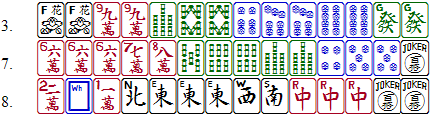
Hi Khiori,
Well, let's see. For those, I'd written:
6D is no good for Consec. #4 or #5, so it can go.
 I would not discard 6D as it CAN be used in consecutive #5. As in 6666 77 77 77 8888.
>You already have one pair of 7's and a single. (I would discard 9C obviously).
>Either way one needs 7C, but in my plan I only need a pair. Not a good strategy?
Let's take a look at these two visions of Consec. #5.
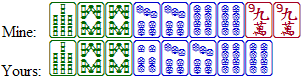
Keeping the 6, losing the 9, and going for 7 as the middle number leaves you with just 3 of 6 tiles for the difficult middle-number pairs. But throwing the 6, keeping the 9, and going for 8 as the middle number gives you 4 of the 6. Of my total 9 tiles, I will probably have to get rid of 3 (I can have my 7's and 9's in one suit only, and I'm not yet sure which), leaving me with 6 tiles toward the hand. Of your total 8 tiles, you will probably have to get rid of 2, leaving you with 6 tiles towards the hand. Mine, though, has more flexibility. I'd stay with the choice I wrote.
 Leaning towards Consec. #5 with 6 or 7 as the middle number; 4D can go.
I would lean toward 6's as the middle number for consecutive #5 as there is already two pair.
>I would consider consecutive #3 backup as in: 4 5 6 7 (using either C or B for the 6 7). Why not discard the 8C?
You're right, 8C is the better discard when considering Consec. #3 as fallback.
 Easy--throw R. 2011 #4 is much stronger than #3, or Honors #1.
why not discard one of the many excess E's and keep both options open?
Keeping the E's also keeps Honors #5 as an option. I should have mentioned that in the column.
2011 #3 - 6 tiles + the jokers
2011 #4 - 7 tiles + the jokers (strongest option)
Honors #1 - 5 tiles + the jokers (weakest option)
Honors #5 - 6 tiles + the jokers
May the tiles be with you.
Tom Sloper
Author of "The Red Dragon & The West Wind," the definitive book on Mah-Jongg East & West.
Los Angeles, California, USA
April 21, 2011
How would you play this, part 2
>Date: Thu, 21 Apr 2011 11:10:14 -0400
>From: Donna M
>Subject: Follow up to Q&A Post
>Hi Tom,
>Perhaps I should have given you more info.
>It was the 2011 card and she was (and was likely to be playing the Like numbers --only other hand is Winds and Dragons NNNN SSSSS like Pung odd numbers) with three 9 Bams exposed. Her pair was the soaps (which were not out on the table either) and thus the 9 Cracks for the Kong.
>Would you still have taken a chance and thrown the Reds?
>Best,
>Donna
Donna,
Nothing you say now changes what I would have been able to see and determine if I had been sitting in your place at that game you described last Saturday. In fact, you're wrong -- there is another hand she could have been doing (legally). She could have been doing Consec. #2.

This is all I can see of her hand. She might be doing Like Nos., or she might be doing Consec. #2. And if she's doing Like Nos., I do not have definite knowledge of what suit her pairs are in. And if she's doing Consec. #2, I do not have definite knowledge that she's ready to win if I discard Red (nor that her dragon is R). As I told you on Saturday, I do not have enough conclusive evidence that my Reds are dangerous to throw. Unless my hand is hopeless, I'm going to try to finish my hand.
May the tiles be with you.
Tom Sloper
Author of "The Red Dragon & The West Wind," the definitive book on Mah-Jongg East & West.
Los Angeles, California, USA
April 21, 2011
More purity
>Date: Thu, 21 Apr 2011 03:18:57 +0000 (UTC)
>From: Joanne R
>Subject: Mah Jongg
>Can a winning hand be made pure by one player exchanging a natural tile for a joker or does it have to be pure from the start?
>Joanne
Hi Joanne, you wrote:
Can a winning hand be made pure by one player exchanging a natural tile for a joker
I assume you are using the word "pure" to mean "jokerless," like Alice did earlier today. I don't know why all of a sudden I'm getting so many emails in which people use the term "pure" to mean "jokerless." But anyway: the answer to your question is "yes."
or does it have to be pure from the start?
No.
May the tiles be with you.
Tom Sloper
Author of "The Red Dragon & The West Wind," the definitive book on Mah-Jongg East & West.
Los Angeles, California, USA
April 20, 2011
Is the score doubled, part 2
>From: "Alice S
>Subject: Re: Maj jongg question
>Date: Wed, 20 Apr 2011 12:03:42 -0700
>Thanks Tom.
>We play American Mah Jongg, but don't use a rulebook. I learned to play from friends and remember some from my mother and grandmother. By pure, I do mean jokerless.
>Alice
Hi, Alice.
Please read the back of your NMJL card (upper left corner), and read Frequently Asked Question #19W.
Scroll up and look for the blue and yellow flashing arrow (emblazoned "READ 1ST," like this ). Find the link to FAQ #19 (it's marked with a red, white, and blue flashing arrow, emblazoned "AMERICAN," like this ) and click it.
After you've landed at the FAQ 19 page, please bookmark it so you can easily return to it anytime you have a mah-jongg question. Answers to all of the most frequently-asked questions about American (NMJL) mah-jongg are found in FAQ 19. Please always check the FAQs first, before asking a question. Thanks!
May the tiles be with you.
Tom Sloper
Author of "The Red Dragon & The West Wind," the definitive book on Mah-Jongg East & West.
Los Angeles, California, USA
April 20, 2011
Is the score doubled when the hand is pure?
>From: "Alice S
>Subject: Maj jongg question
>Date: Wed, 20 Apr 2011 10:46:59 -0700
>When paying for a "pure" hand...is the amount doubled? If so, then what about the hands on the lower right, that are all pairs, and therefore must be pure?
> Thanks
Hello Alice,
I can't answer your question until you tell me two things:
Which kind of mah-jongg do you play? If you use a rulebook, tell me the author's name; if you use a website, tell me the web address.
What does the term "pure" mean to you exactly? Does it mean "one suit only"? Or (going out on a limb based on your words "on the lower right, that are all pairs") does it mean "jokerless"?
May the tiles be with you.
Tom Sloper
Author of "The Red Dragon & The West Wind," the definitive book on Mah-Jongg East & West.
Los Angeles, California, USA
April 20, 2011
Mahjong for iOS, part 2
> From: "Lynn P
>Subject: Mah-Jongg Q+A
>Date: Wed, 20 Apr 2011 13:01:08 -0400
>My mah-jongg question or comment is: Re: email from Jo Vandeweghe's email of 4/20 about iOS true mah jongg games for iPod touch which I have too. The site is Greek to me as I am looking for a (free if possible) true American mah jongg game in English to download on my iPod to use on our 8 hour drives from mid FL to north GA. I clicked on a few of the ones she has listed and they say Japanese. Which one is the best one to download and how would I do this? I am not too computer literate and less so on the iPod. Any suggestions and/or help would be greatly appreciated since I already checked out iTunes and only found matching mah jongg. The price of the NMJL mah jongg game is now $40. Thanks, Lynn P.
Hi Lynn, you wrote:
The site is Greek to me
I see English, Chinese, and Japanese. (^_^)
I am looking for a (free if possible) true American mah jongg game in English to download on my iPod
Well, you're out of luck, then. It's not Jo's fault, and it's not my fault. American mah jongg is the weirdo of the mah jongg world, with less than half a million players. Very few software makers make American-style mah jongg software. I'm only aware of 3 games having ever been programmed! Shanghai Second Dynasty is now 10 years out of print, so that leaves you only two: the NMJL program and MahjongTime (neither of which work on iPod, I suppose). If somebody gives me half a million dollars, I can get one created, and if I did that, then I couldn't give it away for free, because I'd have to pay that investment back! The game business is a business -- we have to make money, else it's not worth doing.
May the tiles be with you.
Tom Sloper
Game Production & Design
Sloperama Productions. Services for game developers and publishers; "Making Games Fun, And Getting Them Done." http://www.sloperama.com/business.html
Los Angeles, California, USA
April 20, 2011
Mahjong for iOS
>From: Jo Vandeweghe
>Sent: Wed, April 20, 2011 8:50:45 AM
>Subject: iOS true mahjong games
>Hi Tom,
>I hope you're fine.
>Recently I bought an iPod Touch and discovered there are many many true mahjong games made for iOS ....
>Let's discover them on my new related webpage : http://www.dipching.com/iOSmj.html
>Let me know it this sounds interesting please
>Sorry I don't have anymore access to the mahjong forums
>Have a good day
>Regards
>Jo Vandeweghe
Hi Jo,
Good to hear from you. I've added your link to FAQ 5.
May the tiles be with you.
Tom Sloper
Author of "The Red Dragon & The West Wind," the definitive book on Mah-Jongg East & West.
Los Angeles, California, USA
April 20, 2011
That confusing Quints hand
>From: Marlys R
>Sent: Tue, April 19, 2011 10:55:49 AM
>Subject: Mah-Jongg Q+A
>My mah-jongg question or comment is:
>1223 22222 22222 (Any 3 consec. Nos. Pr. Any No. in run; Pr. & Quints Match)
>My group disagrees on how this can be played. Half think that the pair can be Any No. in the run, as written, (ex. 1123 or 1233) as long Quints match the Pair. Others say the pair can be the middle number only.
>Please help.
Hi Marlys,
So you're saying some of your players cannot read English! (^_^) If they have that much trouble reading a parenthetical on the card, I don't know if they will be able to make sense of FAQ 16.
Please scroll up and find the links to the Frequently Asked Questions (look for the blue and yellow flashing arrow, emblazoned "READ 1ST," like this ). Find the link to FAQ #16 (it's marked with a red, white, and blue flashing arrow, emblazoned "AMERICAN," like this ) and click it. Your question about the Quints hand is answered there.
Answers to all of the most frequently-asked questions about American (NMJL) mah-jongg are found in FAQs 16 & 19. Please always check the FAQs first before asking a question. Thanks!
May the tiles be with you.
Tom Sloper
Author of "The Red Dragon & The West Wind," the definitive book on Mah-Jongg East & West.
Los Angeles, CA (USA)
April 19, 2011
Automatic mahjong tables
>From: Julie B
>Sent: Mon, April 18, 2011 4:11:57 PM
>Subject: Automatic Mah Jong tables
>Hello Tom,
>I'm a long time admirer and reader of your book!
>I'm looking into purchasing an automatic Mah Jong table (some are folding too.) They are quite expensive and shipping is also high. What do you think of these tables? Are they worth the money? I live in the DFW, TX area (friend of Marlene S) and was also wondering about the frequency of repair for these tables. Who services them locally and what type of warranty is offered?
>I would love to hear from you soon!
>Best regards,
>Julie B
Hi Julie, you wrote:
I'm looking into purchasing an automatic Mah Jong table (some are folding too.)
I've heard of folding mahjong tables, but I've never heard of a folding automatic table. Automatic tables are usually fairly bulky and heavy. I don't see how one could fold.
What do you think of these [automatic] tables?
I like them.
Are they worth the money?
Worth is subjective, Julie. Only YOU can determine whether something is "worth it" to YOU. You might think a thing is "worth it," and your friend might think you're crazy. Who am I to say which of you is right?
wondering about the frequency of repair for these tables.
I don't know. I have an old one, I had to repair it to get it to work. My friend who has one has to do small repairs on it from time to time. I don't know about the reliability of newer models.
Who services them locally
Probably nobody!
and what type of warranty is offered?
You would have to ask the person selling you the machine.
May the tiles be with you.
Tom Sloper
Author of "The Red Dragon & The West Wind," the definitive book on Mah-Jongg East & West.
Los Angeles, CA (USA)
April 18, 2011
Can I use 66 99 instead of 33 66?
>From: Lynn P
>Sent: Mon, April 18, 2011 3:04:33 PM
>Subject: Mah-Jongg Q+A
>My mah-jongg question or comment is: Using the 2011 NMJLeague card under 369 # 5: this question came up today: Can 33 66 also be 66 99 in the same suit, then 33 66 99 in another suit and final kong of either 3,6,9 in the 3rd. suit? There are just too many hands using flowers so we are having a lot of wall games! Thanks, Lynn P.
No, Lynn. Read FAQ 19AJ.
May the tiles be with you.
Tom Sloper
Author of "The Red Dragon & The West Wind," the definitive book on Mah-Jongg East & West.
Los Angeles, CA (USA)
April 18, 2011
How would you play this?
>From: Donna M
>Sent: Sat, April 16, 2011 7:23:54 AM
>Subject: Strategy Question
>Hi Tom,
>I'm playing a hand and am three away from making my hand and it's about three quarters through the game --sitting with a pair of Red Dragons. The person on my right has three nine bams exposed. One green and one red are on the table as well as one 9 crack and one 9 bam.
>A tile is thrown and I want to call it but am hesitant about claiming it and throwing out the red. What would you do?
>Please see what I did and the rest of the story below (after you've weighed in!)
>Thanks,
>Donna
Hi Donna,
I guess that all the clues you're telling me are supposed to make me think about the Like Numbers hand. That isn't the only thing she might be doing, with an exposed pung of nines. I don't see enough evidence that the red is dangerous, so I'd go for it. Let's see what you did now...
>After not calling my tile, I then picked up a Joker and decided to break up my hand proceeding to pick yet another Joker! It was a wall game. The player with the 9 bams was waiting for a 9 crack to complete her Kong. Another player was holding the third Red.
So it wasn't dangerous, and calling that tile could have turned the tables. And maybe I'm thick, but I don't see what hand (from the 2011 card) she was making (since the Like Numbers hand wasn't it because she didn't have the red pair).
May the tiles be with you another time.
Tom Sloper
Author of "The Red Dragon & The West Wind," the definitive book on Mah-Jongg East & West.
Los Angeles, California, USA
April 16, 2011
But when I called the League I got a different answer
>From: Donna M
>Sent: Sat, April 16, 2011 7:04:01 AM
>Subject: Q & A April 8
>Hi Tom,
>I was catching up on your columns and came across a Q&A from April 8 about calling and claiming a discard. You mentioned:
>But the NMJL told Sandberg that in home games, a player may be permitted to put the discard back even if she has picked up the discard and placed it atop her rack, as long as she has not exposed any tiles from the hand.
>Interesting that I recently called the NMJL to clarify this and was told that once the tile was placed on the caller's rack, she could not change her mind. (The woman I spoke with is a regular in the office who I've spoken with before).
>I guess it wouldn't hurt to discuss this with our respective Mah Jongg groups and come up with a consensus of what the group wants.
>May the tiles be with you too!!
>Best,
>Donna
>P. S. I love your thinking and strategies!! I teach Mah Jongg and have successfully used your RALPH and LARRY in explaining the Charleston and plan to use your strategies for upcoming intermediate classes. I also plan to buy your book ( the least I can do for all your wonderful information) and will share this with my students. Thanks!!
Hi Donna,
I was not on the line when Sandberg asked this question of the League. I do not know if I would have come away with a different answer than she did, from the same call. For all I know, after she got the "official" answer, she may have pressed with a follow-up question about home rules versus tournament rules (I don't know how she came to get two answers from the League). She didn't get the answer in writing, either, if I recall correctly. But I took her result as official because she's a fellow author. I always recommend that when getting a ruling from the League, that you get it in writing, not verbally -- too much room for misunderstanding with a verbal ruling.
And it does not surprise me or concern me that when you called, all you got was the "official" answer, without the schizophrenic "home rules vs. tournament rules" answer that Sandberg got. I always teach my students to do things the official way -- I always teach them tournament practices, for the eventuality that they might attend a tournament -- AND I inform them that every table uses unofficial table rules of bewildering variety. I teach them that, in the absence of any mention of table rules, one should always expect that the official rules are in use. And I teach them to be gracious in accepting table rules when playing at someone else's table (even if not informed of the table rules in advance).
I hope you enjoy my book when you get it. If we ever meet, I'll gladly sign it.
May the tiles be with you.
Tom Sloper
Author of "The Red Dragon & The West Wind," the definitive book on Mah-Jongg East & West.
Los Angeles, California, USA
April 16, 2011
Doing a mah-jongg event at Barnes & Noble Westside Pavilion (Los Angeles) on Sunday!
Teaching and signing books. It'll be tons o' fun!
Tom Sloper
Author of "The Red Dragon & The West Wind," the definitive book on Mah-Jongg East & West.
Los Angeles, CA (USA)
April 15, 2011
Robbing the very last tile (part 3)
>Date: Thu, 14 Apr 2011 09:25:08 -0500
>From: Chris Schumann
>Subject: Odd Ending, Part 3
>Hi Tom,
>I did send email to the developers. They duplicated the result, found the problem, fixed it, and my phone now has the new version, but it's going to be tough for me to duplicate the situation!
>I'm stunned by the service (about 12 hour turnaround on a bug for a very rare situation) delivered by Cole and the whole team at ePoint Production, developer of Mahjong and Friends, and recommend the title - and its paid, ad-free version - to anyone wanting an MCR game for their Android device.
>Chris
I love a happy ending! (^_^)
May the tiles be with you.
Tom Sloper
Author of "The Red Dragon & The West Wind," the definitive book on Mah-Jongg East & West.
Los Angeles, California, USA
April 14, 2011
Nobody revealed the error until after the fact
>From: "Barbara W
>Subject: Question
>Date: Thu, 14 Apr 2011 09:32:25 -0400
>Tom,
>I researched my question on your site and did not find an answer. If it’s there and I missed it, I apologize in advance.
>A 1 bam was thrown. A player misheard the discard and, thinking it was a 9 bam, called it for Mah Jongg. She picked a 9 bam off the table and exposed. Nobody realized the error, all tiles were thrown in, and the player who called Mah Jongg was paid. East had already gotten up and the bettor had sat down when East, the person who had discarded the tile, announced that she had thrown a 1 bam, not a 9 bam. Several players agreed it had been a 1 bam. The decision was to void the Mah Jongg and take the money back. I disagreed. I thought it was too late and the Mah Jongg should stand. (I was the bettor, so I didn’t insist because it would have been self-serving.) Do you think it was proper to void the Mah Jongg?
>Thank you,
>Barbara
Hi Barbara,
You are correct. Once paid, "all bets are off." You don't go back and undo it after it's done. The problem should have been rectified at the moment, not after the fact. Everybody except you was not paying attention. The non-rescindable payment was just tuition -- the cost of not paying attention, a reminder to pay attention better going forward. FAQ 9 has some information on errors and when it's too late to take them back. Put that information together with the "change of heart" rules in FAQ 19, and let them stew together in your mind for a while.
May the tiles be with you.
Tom Sloper
Author of "The Red Dragon & The West Wind," the definitive book on Mah-Jongg East & West.
Los Angeles, California, USA
April 14, 2011
Robbing the very last tile (part 2)
>Date: Wed, 13 Apr 2011 19:04:44 -0500
>From: Chris Schumann
>Subject: Re: Robbing the Very Last Tile
>Hi, Tom,
>Thank you for the quick and detailed response!
>You asked "This isn't crucial to your question, but as a game software designer and producer I'm curious what you mean. After you clicked Win, he drew S again, and konged it again, the computer declared the game a draw again, and offered you the Win button again?"
>I'm not sure of the re-draw of the tile, but I press Win, and the game says (in its squeaky voice) "I win" then "kong" then "kong" (yes, twice) then "draw game" and presents the game ending dialog again. If I clear it, I get the same four buttons each time: Details, Next (as in next hand), Win, and Pass (to give up the chance to claim the tile).
>Chris
>PS - I do own your book, and I am now very eager to get it back from the friend I lent it to. Perhaps I will buy her a copy as a gift.
Thanks, Chris. In the game business, we often tell stories about the weird bugs we encounter. This one would be a hard one to reproduce without a way of forcing what tiles each player holds, so I can understand why the bug was never discovered. If you can find out how to contact the game's creator, he might appreciate hearing of the bug from you.
May the tiles be with you.
Tom Sloper
Author of "The Red Dragon & The West Wind," the definitive book on Mah-Jongg East & West.
Los Angeles, California, USA
April 14, 2011
Robbing the very last tile (MCR)
>Date: Wed, 13 Apr 2011 15:44:06 -0500
>From: Chris Schumann
>Subject: Robbing the Very Last Tile
>Hi Tom,
>MCR question for you:
>I was playing Mahjong and Friends (free version) on my Android phone, which is an MCR-style mahjong game. It's normally very fun, but the last hand I played was frustrating.
>I had a knitted straight and four single honors. I could go out with a red or white dragon, or a south wind. Things were not looking good for me because all four whites had been discarded, as had two of the reds. Further, the player to my right already had an exposed pung of south, and the wall was getting very short.
>The last tile in the wall was drawn by that very same player to my right, and of course it was the fourth south wind tile. The game has a bug of some kind because this is what happened: The player called kong, said the hand was a draw, and presented me with a Win button (which then just went through the same process over and over).
>I have re-skimmed the MCR rulebook, but have not found a definite answer, so my questions are as follows:
>1) Is the player who drew that last south tile allowed to call kong? My guess is he should not. If so, he cannot draw a replacement tile and will have a short hand. If not, he must discard something. I would hope he discards that same tile so I could call it for the win. (I'm pretty sure it would not be allowed at the World Series of Mahjong tournament, but that has unusually complete rules for irregularities.)
>2) If he is allowed to promote his pung to a kong, if not for that kong being robbed, would the hand end immediately because there is no wall left and no final discard?
>3) If this happened in your play group, and the other players looked to you for your best judgment, how would you handle this, and how would you score the hand? Here are the fan in question:
>34 - Lesser honors and knitted tiles, 12 points
>35 - Knitted straight, 12 points
>45 - Last tile claim, 8 points
>47 - Robbing the kong, 8 points
>0, 24, 32, or 40 points? (Any I missed?)
>58 - Last tile (of its kind) is implied by Robbing the kong, of course
>Thank you,
>Chris

Hi Chris,
Very interesting! You wrote:
then just went through the same process over and over).
This isn't crucial to your question, but as a game software designer and producer I'm curious what you mean. After you clicked Win, he drew S again, and konged it again, the computer declared the game a draw again, and offered you the Win button again?
Is the player who drew that last south tile allowed to call kong? My guess is he should not.
I understand the logic of your reasoning, but see rule 60 (page 138) in my book. The last tile is permitted to be konged. The game ends without that player needing to discard. So his hand is not short.
I would hope he discards that same tile so I could call it for the win.
Even better - you can rob it, as is.
(I'm pretty sure it would not be allowed at the World Series of Mahjong tournament, but that has unusually complete rules for irregularities.)
You can thank Alan Kwan for that. He's an unusually thorough man, focused like a laser on doing things correctly.
If he is allowed to promote his pung to a kong, if not for that kong being robbed, would the hand end immediately because there is no wall left and no final discard?
Yes.
how would you score the hand? Here are the fan in question:
>34 - Lesser honors and knitted tiles, 12 points
>35 - Knitted straight, 12 points
>45 - Last tile claim, 8 points
>47 - Robbing the kong, 8 points
>0, 24, 32, or 40 points? (Any I missed?)

Last Tile Claim is OK because when you rob the kong it's treated as win by discard. Besides, the intent is clear when you look at Last Tile Draw and Last Tile Claim -- the intent is that the last tile in play is worth 8 points for whoever wins on it, however it's won on. So your 40-point total is okay.
I'm glad you brought me this question! May the tiles be with you.
Tom Sloper
Author of "The Red Dragon & The West Wind," the definitive book on Mah-Jongg East & West.
Los Angeles, California, USA
April 13, 2011
FAQ 16 updated
Dear readers, FAQ 16 (Frequently Asked Questions about the National Mah Jongg League Card) has been updated to cover the new 2011 card.
May the tiles be with you.
Tom Sloper
Author of "The Red Dragon & The West Wind," the definitive book on Mah-Jongg East & West.
Los Angeles, California, USA
April 12, 2011
Scoring Japanese mahjong
>From: anthony l
>Sent: Tue, April 12, 2011 2:21:19 AM
>Subject: riichi majan. yaku question
>hello tom
>round: east Seat wind: west
>Closed
>2.3.4 (dots) 2.3.4.6.7.8.8 (Bamboo) W.W.W (west wind)
>Ron
>5 bamboo
>is it 2 han 40 fun? right?
>-> tanyao -- 1 han
>-> seatwind -- 1 han
>~fu~
>fūtei: 20 fu
>closed ron: 10 fu
>open wait: 0 fu
>closed tri honor: 8 fun

Hi Anthony,
The hand was concealed before winning on another player's discard. That's 30 fu (30 minipoints), not 20. Oh, I see -- you added 20 and 10. So, yes on the fu -- 38 rounded up to 40.
But how do you figure the hand is tanyao? That's wrong. It can't be "all simples" since there's a wind pung in the hand. This is 40 fu and 1 fan.
May the tiles be with you.
Tom Sloper
Author of "The Red Dragon & The West Wind," the definitive book on Mah-Jongg East & West.
Los Angeles, California, USA
April 12, 2011
The 2011 card, part 4
>From: A MICHAEL W
>Sent: Mon, April 11, 2011 7:50:39 PM
>Subject: Question about 2011 Mah Jongg card
>Could you tell me if the 998 99887 998877 hand can be done in these numbers only. It didn't say as it did in the quite hand 22 333 4444 5555?
>Laura W
Hi Laura,
One of these days I'm going to update FAQ 16 for the 2011 card. In the meantime, you can scroll down and see the answer I gave to Linda M. on March 28 when she asked this question (it's entitled "The 2011 card, part 2."
May the tiles be with you.
Tom Sloper
Author of "The Red Dragon & The West Wind," the definitive book on Mah-Jongg East & West.
Los Angeles, California, USA
April 11, 2011
How do I improve, part 2
>From: Lynn P
>Sent: Mon, April 11, 2011 7:25:15 AM
>Subject: Mah-Jongg Q+A
>My mah-jongg question or comment is: Re my email of 4/10 about your weekly columns: I was referring to the 2 entries you wrote in April -4/3 (2011 NMJL card) and 4/10 (WWYP offensive exercise with new card) which showed dealt tiles and you were supposed to chose the tiles you would pass (not discard/wrong word). I got to this site by clicking on the word "column" in your response to Molly's 4/10 email.
> Sorry if I confused you so early in the morning by using the word "discard" rather than "pass". I will now check out p.111 of "RD&WW" again and also FAQ 8e. Leaving for a mah jongg game in 2 hours and hoping not only the tiles but also the jokers will indeed be with me!! Lynn P.
How do I improve my strategy?
>From: Lynn P
>Sent: Mon, April 11, 2011 4:01:36 AM
>Subject: Mah-Jongg Q+A
>My mah-jongg question or comment is: Re: your April 2 weekly columns on the 2011 mah jongg card: 1. Now that you have explained how to use your column with the sets of tiles, I spent a few hours yesterday figuring out the plays and discards you gave. This week I hope to have time to actually use the tiles in setting up these games and try the alternative plays. Do you first look for your pairs, then for tiles to go with the pairs, then for odds and evens, high numbers vs. low numbers, etc? 2. I've marked my card with various symbols for clues for many of the sets (ex. dragons, concealed, jokers) to speed up my game. I did notice in last weeks' games that flower discards were few and far between as were the jokers. 3. I like your comment about singles being easier to get than pairs-I had never thought of it that way and shied away from trying singles and pairs sets. 4. Besides practice and playing do you have any other hints to make the game go faster and of course help me win? Oh I need those jokers though!!! Thanks, Lynn P.
Hi Lynn, you wrote:
Re: your April 2 weekly columns
I wrote only one column the weekend of April 2 (that column being dated April 3, Sunday).
Now that you have explained how to use your column with the sets of tiles, I spent a few hours yesterday figuring out the plays and discards you gave.
In April 3's column, I did not do that. That week's column was nothing more than an analysis of the 2011 card. And yesterday's column did not have any discard exercises -- yesterday's column was all about the first pass of the Charleston (not discarding -- it was a WWYP* column, not a WWYD** column). So if you were working with discard exercises, I don't know which of my columns you were working with, but it would have had to be with the 2010 card or earlier.
Do you first look for your pairs, then for tiles to go with the pairs, then for odds and evens, high numbers vs. low numbers, etc?
That's an imprecise and far from complete description of what I described in yesterday's (April 10) column. What I do should be self-evident from a reading of the April 10 column. Still, though, some strategy principles can be trumped by other strategy principles. For example, if there's a pair in the hand but it has no friends, then sometimes I'll break up my only pair. Rather than try to get me to sum up my principles (which are already stated on page 111 of my book, and in FAQ 8E, and which are evident in past columns), you can try to come up with some of your own.
I like your comment about singles being easier to get than pairs-I had never thought of it that way and shied away from trying singles and pairs sets
The S&P hands are hard to make. Go for them when you get a lot of the tiles of one of those hands and no jokers (well, maybe one joker, but if I had more than one joker I probably wouldn't go for an S&P). But yes, there are S&P "sets" (as you say) outside of the S&P section of the card.
 Besides practice and playing do you have any other hints to make the game go faster and of course help me win?
You've heard the old joke. This guy is walking through Grand Central Station when a young lady carrying a violin case asks him for directions. "How do I get to Carnegie Hall?" she asks, fluttering her eyelashes. He glances at the violin case and answers, "Practice, practice, practice."
May the tiles be with you.
Tom Sloper
Author of "The Red Dragon & The West Wind," the definitive book on Mah-Jongg East & West.
Los Angeles, California, USA
4/11/11
* - What Would You Pass; ** - What Would You Discard
Mah Jongg Tournament on May 1 in Brewster, NY
>From: "Linda S
>Subject: Mah Jongg Tournament on May 1 in Brewster, NY
>Date: Sun, 10 Apr 2011 20:27:15 -0400
>Please add the following to your bulletin board.
>Date May 1
>Charity Temple Beth Elohim
>Location Brewster, NY
>Contact www.templebethelohim.org/mahjongg.htm
>Tournament to be held at Temple Beth Elohim, May 1, 9:30-5:00. Cash prizes and foods included in $40.00/person price. A great time will be had by all! Email for info. mahjtbe@gmail.com or call 845 278 3003. Download form at www.templebethelohim.org/mahjongg.htm.
>Many thanks.
Last week's column
>From: Molly A
>Sent: Sun, April 10, 2011 9:02:08 AM
>Subject: Your comments on the new card....thanks!
>Tom, I always love reading your take on the new card. You mentioned that the FF NNN EW SSS 2011 hand is likely to be easier than might appear. Any other insights into hands that might be “go to” hands this year? Or familiar hands that are harder this year? I like to become familiar with a new card by playing with three players, the tiles come faster, you have a better chance to win so can watch the hands develop…not to mention a better chance for jokers. Molly
Hi, Molly! I just now posted this week's column. You asked:
Any other insights into hands that might be “go to” hands this year?
As always, Consec. #3. It's usually in the #2 slot, and its configuration changes slightly from one year to the next, but it's the perennial "go to" hand. The Like Numbers hand is another.
Or familiar hands that are harder this year?
Like Numbers is a dead giveaway if you expose a dragon pung (since it's the only dragon pung on this year's card). Evens #2 might be a little harder to make this year since flowers are more in demand.
May the tiles be with you.
Tom Sloper
Author of "The Red Dragon & The West Wind," the definitive book on Mah-Jongg East & West.
Los Angeles, California, USA
April 10, 2011
Isn't this worth ryanhan (2 fan), part 2
>Date: Sat, 9 Apr 2011 15:12:06 -0700 (PDT)
>From: anthony l
>Subject: re: this is about calculate score on our hand
>Hello Tom
>First, thank you for your answer.
>I am sorry, Tom. I don't give detail about info.
>I play it (japanese mahjong) with real tiles
>There is revision about card on hand
>
>(Closed)
>678(character) 678 (dots) 56 (bamboo) 88 (Bamboo)
>(Open)
>White dragon (Open kan)
>(Ron)
>4 (bamboo)
>
>Thank you.
Hi Anthony,
Sorry to say, I don't quite understand what you're saying ("There is revision about card on hand"). I hope my answer told you what you needed to know! (^_^)
May the tiles be with you.
Tom Sloper
Author of "The Red Dragon & The West Wind," the definitive book on Mah-Jongg East & West.
Los Angeles, California, USA
April 9, 2011
Isn't this worth ryanhan (2 fan)?
>Date: Sat, 9 Apr 2011 08:53:07 -0700 (PDT)
>From: anthony l
>Subject: how to calculate han for yaku?
>Hello tom
>I have question about calculate han when i got this tittle.
>(Closed)
>667788 (Character) 56 (bamboo) 88 (Bamboo)
>(Open)
>White dragon (Open kan)
>(Ron)
>4 (bamboo)
>is it 2 han, right?
Sorry, Anthony.
Iipeikou (twin chows) must be concealed. You have an exposed kong, so the hand is not concealed. Therefore you do not earn a fan for iipeikou. You have 1 fan for the dragon kong, and that's all. Is that why you ask? Did the computer game only give you 1 fan? (I wish you would have provided that information, if so.)
May the tiles be with you.
Tom Sloper
Author of "The Red Dragon & The West Wind," the definitive book on Mah-Jongg East & West.
Los Angeles, California, USA
April 9, 2011
Combining fan in MCR
>From: Rosemary S
>Sent: Fri, April 8, 2011 1:38:42 PM
>Subject: Mah-Jongg Q+A
>Dear Master,
>Question 1.
>We are playing by the Chinese International Rules and last night Mah-Jongged with hand 58, a full flush, but the hand also contained hand 60: pure shifted pungs. Do I get 24 + 24 or just the score for the full flush?
>Question 2.
>And, thus the general question, may any of the 14 tile mah-jongg hands scores be added to by hands of lesser tile numbers contained within them, except where specifically excepted?
>We very much appreciate your response.
>Sincerly,
>Romi S
Hi Romi,
I'm not at home with my books at the moment, so I'm not sure which book (and therefore which fan numbering system) you use. In my book, Full Flush is Fan 22, and Pure Shifted Pungs is Fan 24. Yes, they certainly may be combined. The hand earns 48 points -- and any other points that may apply.
Yes. See FAQ 22 (link to FAQ 22 above left). MCR section 10.1.5, "Principles for Scoring the Hand," specifically states that any fan may be combined except for certain "exclusionary" rules. Those rules do not prohibit combining Full Flush with Pure Shifted Pungs.
May the tiles be with you.
Tom Sloper
Author of "The Red Dragon & The West Wind," the definitive book on Mah-Jongg East & West.
Los Angeles, CA (USA)
April 8, 2011
Nate's strange set, part 4
>From: Michael Stanwick
>Sent: Fri, April 8, 2011 1:57:15 PM
>Subject: Nate's strange set
>(Tom said)
>" I'm trying to envision what you're suggesting. The colors would be, um, colorful, if the colors had been applied after the artificial aging. But I don't see how original colors applied beforehand can survive an artificial aging process (seems to me they'd also be affected)."
>If you look at the colours they are somewhat dark, much darker than they should be. In fact, they seem, in tone, to be similar to the staining on the rest of the tiles.
>I think the staining was put on after the engravings were coloured. Some of the tiles have a slight colour run that also suggests this.
>What the ageing process might be is anyone's guess. But it does not necessarily mean that it is fatal to the engravings' colours.
>Regards
>Michael Stanwick
>Sent from my iPad
Thanks, Michael. Food for thought!
May the tiles be with you.
Tom Sloper
Author of "The Red Dragon & The West Wind," the definitive book on Mah-Jongg East & West.
Los Angeles, CA (USA)
April 8, 2011
Just heard about this new novel
Dear Readers,
I just read a review of a new book, "Clattering Sparrows," by Marilyn Land.
It's about two women who grow up together in Washington, with mah jongg as a thread that keeps them together throughout their lives. The review is at www.mahjongnews.com/...clattering-sparrows.html. I think many of my readers will enjoy this book.
May the tiles be with you.
Tom Sloper
Author of "The Red Dragon & The West Wind," the definitive book on Mah-Jongg East & West.
Los Angeles, California, USA
April 8, 2011
Nate's strange set, part 3
>Subject: Odd set and Jim May's site
>From: Michael Stanwick
>Date: Fri, 8 Apr 2011 17:07:35 +0100
>Hi Tom. I think you are bang on target regarding that odd set. I have seen other sets similar to it. The construction and engravings are so primitive that it can be impossible to tell whether it is a fake, unless you know what to look for based on the genuine article.
>Have you noticed that the engravings have all of their colour intact? This seems to me to be inconsistent with the discolouration and hence "age" of the tiles. They have the appearance of much age and use and yet the colours are intact. This seems to me to perhaps suggest artificial discolouration.
>Now I have seen and indeed own a couple of straight Chinese sets that have a very worn appearance on the tiles and the inks are very faded - consistent with much use. If you have no experience of what used sets lookmlike then the position to start from is 'what does the tiles' condition tell you?' As your correspondent has done, carefully examine the tiles and build up a picture of what your observations tell you.
>As a rule of thumb, I would seriously caution your readers - if I may be so bold - to be very suspicious of this type of set. As I noted, sets that have been well used show very worn and smooth tiles with much paint loss and well worn engravings. The wooden bases take on a lustre and patina from much handling and the bone portion takes on a slight patina as well.
>I hope these comments help.
>Do you have the web address for Faye Scher's site?
>Regards
>Michael Stanwick
>Sent from my iPad
Hi Michael, you wrote:
 They have the appearance of much age and use and yet the colours are intact. This seems to me to perhaps suggest artificial discolouration.
I'm trying to envision what you're suggesting. The colors would be, um, colorful, if the colors had been applied after the artificial aging. But I don't see how original colors applied beforehand can survive an artificial aging process (seems to me they'd also be affected).
The wooden bases take on a lustre and patina from much handling and the bone portion takes on a slight patina as well.
Yes, from skin oils. So you're saying that the artificial aging process would result in tiles without any skin oil patina.
Do you have the web address for Faye Scher's site?
Her main site is http://www.wherethewindsblow.com. She's also acquired Jim May's site, http://mahjongmuseum.com/.
May the tiles be with you.
Tom Sloper
Author of "The Red Dragon & The West Wind," the definitive book on Mah-Jongg East & West.
Los Angeles, California, USA
April 8, 2011
Can I change my mind?
>From: Jeri C
>Sent: Fri, April 8, 2011 7:12:01 AM
>Subject: change of heart rule
>I read the faq regarding this topic and didn't read what would be the answer to my question.
>What is the rule regarding a change of heart after "call' was announced and then that player
>states "never mind" ?
>Thanking you in advance for your answer.
>Jeri C
Hello Jeri,
I was surprised that you would ask this. I thought surely I'd stated the rule clearly in FAQ 19AM:
Under the NMJL tournament rule, after you've exposed tiles from your hand or put the taken discard atop your rack, then you may not change your mind and not make the exposure. (If you've only picked up the discard but haven't put it atop your rack and haven't exposed tiles from your hand, then yes - you can change your mind. But once you expose, or once you've touched the discard to your rack, you're committed, and there's no turning back.)
But the NMJL told Sandberg that in home games, a player may be permitted to put the discard back even if she has picked up the discard and placed it atop her rack, as long as she has not exposed any tiles from the hand.
The usual sequence of events after a discard has been made is:
What FAQ 19AM says is that, in a home game, even if you've gone as far as step 4 (as long as you haven't yet progressed to step 5), you can change your mind. I think it ought to be self-evident from the wording of FAQ 19AM that you can change your mind after any of steps 1, 2, 3, or 4 -- but that once you do step 5, you have to go through with the exposure.
And in a tournament, the bar moves one step closer: you can change your mind after any of steps 1, 2, or 3 - but not once you've done step 4.
If the wording of FAQ 19AM doesn't say that clearly enough, then I suppose I should change it.
May the tiles be with you.
Tom Sloper
Author of "The Red Dragon & The West Wind," the definitive book on Mah-Jongg East & West.
Los Angeles, California, USA
April 8, 2011
My strange set, part 2
>From: Nate S
>Date: Thu, 7 Apr 2011 15:27:38 -0500
>Subject: Re: Mah Jong ID / aging / description question; What, exactly, do you
> think I just bought?
>Tom,
>Thanks for the super-quick reply. :)
>>>counter-feited,
>>Not sure what you mean. It's really a mahjong set. How could a mahjong set be counterfeit?
>I didn't know if maybe you had seen a set similar in design / carving to this, and might be able to point out qualities that would indicate either "originality" or imitativeness of the set I picked up. It didn't seem to me the maker of this set was trying to model or imitate anything in particular [following his/her own muse, I suppose], but didn't know if there was a common style / theme you might have picked up on to indicate if the set was made to represent something other / older than what it is [or if it's just "a mahjong set", of uncertain age and origin].
>>>and how old [if at all] it might or might not be.
>>It might be from the 1930s or 1960s. Or it might not. It's also possible that the tiles are artificially aged, but it does appear to be old (i.e. not new manufacture).
>Cool. I'm not terribly concerned for the age, but it might be interesting for me to attempt to date it reasonably. Are there any tell-tale signs of artificial antiquing?
>>>Ridiculous inconsistency in carving / construction. Note the left-most of the "fa", "one bam", and "one dot" tiles in particular, all of which are subtly different from the rest.
>>Yes, those tiles are surely replacements made later.
>Given this, if by and by I decided I wanted to pick up different flowers or commission a domestic carpenter / engraver to re-create or re-construct certain of the tiles, are there any recommendations you might have for a) where to find similar sets [you mentioned having seen similarly constructed sets before; is there any particularly great way to find / search for them, other than just popping on eBay all the time?] to get blanks and b) what sort of specialist would be able to recreate something akin to these tiles [who should I look for on Craigslist]?
>>>I'd like to know [your] guess [as to] how or why it would have been constructed. [snip]
>>I think your guesses are perfectly fine. I haven't heard any lore or tales about cottage set makers, if that's what you're looking for.
>No, not fishing for anything in particular except information. When exactly did the "frame" for the white dragon come into common use? After the introduction of plastic sets? Was it common in both for-China and for-export sets?
>-Nate
Hi Nate, you asked:
Are there any tell-tale signs of artificial antiquing?
See if you can determine that the tile was soaked in mud and/or tea for any length of time.
if by and by I decided I wanted to pick up different flowers or commission a domestic carpenter / engraver to re-create or re-construct certain of the tiles, are there any recommendations you might have for a) where to find similar sets
I don't think you have to worry about it. As you said, the 1B is unique anyway. No telling what the flowers would have looked like. Besides, you aren't planning on passing it off as a complete "so-and-so set" from "such-and-such time or place" anyway, are you? It's unique. It still will be, whatever you do.
is there any particularly great way to find / search for them, other than just popping on eBay all the time?
That's a good way. And study everything on the Mahjong Museum site (formerly Jim May's, now Faye Scher's), and on CHarli's site (both are listed in FAQ 4a).
to get blanks
Read FAQ 7Q.
what sort of specialist would be able to recreate something akin to these tiles [who should I look for on Craigslist]?
A carver. Especially someone who carves whalebone, scrimshaw, ivory, etc.
When exactly did the "frame" for the white dragon come into common use? After the introduction of plastic sets?
Yes, as is explained in FAQ 7E.
Was it common in both for-China and for-export sets?
Yes. Where it's not common is Japan (and possibly Korea). They still use blank white dragons there.
Nate, you should continue watching this board. You may get followup comments from readers. And of course... "May the tiles be with you."
Tom Sloper
Author of "The Red Dragon & The West Wind," the definitive book on Mah-Jongg East & West.
Los Angeles, California, USA
April 7, 2011
My strange set
>From: Nate S
>Date: Thu, 7 Apr 2011 11:52:53 -0500
>Subject: Mah Jong ID / aging / description question; What, exactly, do you think I just bought?
>Hi Tom,
>I just picked up a quite strange Mah Jong set. I'm wondering if you can help me try to ID what it is [hand-made, factory-produced, counter-feited, what-not] and how old [if at all] it might or might not be.
>Here's your checklist:
>1) The only contents of the set are the 136 basic tiles.
>2) Nope, no paper rules or even identifying labelling.
>3) The tiles are made of rosewood [or some facsimile] and bone, though not the typical dove-tail construction. The bone is a fairly thin plate that is glued to the top of the rosewood block, then engraved and inked.
>4) I purchased the set just last week from eBay. The seller was a Chinese "antiques dealer", and I am well aware of the practices of such folks. He did have the "Qing dynasty" line, but he also did not have the typical other signs of scheisters from China: tons of duplicate sets, perfect quality, etc. His sets were quite varied in quality / construction / type, mostly in terrible shape, and ranging in price from $80 to $800 to $8,000 [yes, $8,000]. He also clearly identified some as modern and some as older. I paid around $120 + $80 shipping for this particular set.
>5) The dimensions of the tiles are: H = 1.25", W = .75", D = .5"
>6) Only 136. No flowers, no jokers, no seasons, no nothing.
>7) The container is a latch-top wood box [also rosewood-ish] with hinges. Fittings are brass or thereabouts.
>8) The craks are the older, simpler style of glyphs.
>9) I have not seen another one bam even close to this set. It is a crane / stork standing erect on two feet.
>10) The dragons are the "center" and "fa" glyphs, rather than pictures or the "dragon" and "phoenix" glyphs. The white dragon is a frame.
>11) None. No flowers / seasons.
>12) None. No jokers.
>I'm attaching a lot of pictures direct from the listing [the set isn't even in my hands yet; if you want more pics, I can take them in a week or so].
>Some other strange features of the set are as follows:
>- Either some type of inlaid gem [or gem-like thing] or shiny paint on the one bams [storks] and one dots.
>- Very simple wind glyphs, particularly the West wind.
>- It's hard to tell from the pictures, but the bamboo image seems to actually be made up of series of dot-like images [3 or 4 dots in a row, that is].
>- Ridiculous inconsistency in carving / construction. Note the left-most of the "fa", "one bam", and "one dot" tiles in particular, all of which are subtly different from the rest. Also note the horizontal, rather than typically vertical, orientation of the graining on some of the bones.
>- The weird construction [thin bone plate glued to wood tile backing] seems strange. I saw one other set like this in the past months, from a domestic seller, and picked it up also because it had numbered / lettered tiles and the season / flower tiles this set does not have.
>If you can venture a guess, I'd like to know how old you might guess this set to be and how or why it would have been constructed. With there being no numeralling / lettering, it obviously was never meant for sale outside China. But, it also doesn't match any traditional style of construction / carving that I've seen. My best, and completely uninformed guess, is that it must have been a set made by some folk craftsman for personal use... but maybe it was just a teenage craft project or something. I really don't know where or how to start guessing, so I guess that's where you come in.
>Any thoughts?
>-Nate
>e2280.jpg
>e2287.jpg
>e2288.jpg
>e2281.jpg
>e2283.jpg
>e2284.jpg
>e2286.jpg
>e2285.jpg
>e2282.jpg
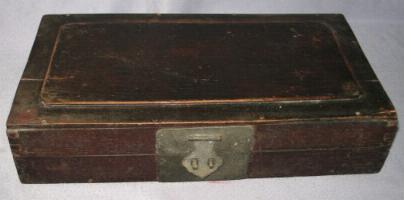
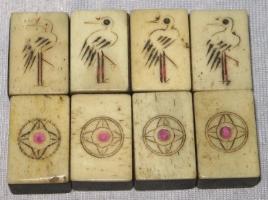
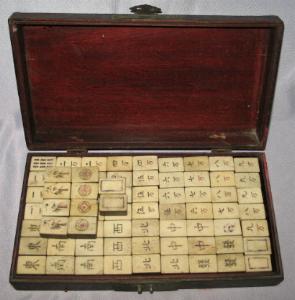
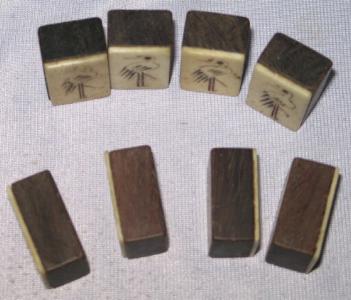
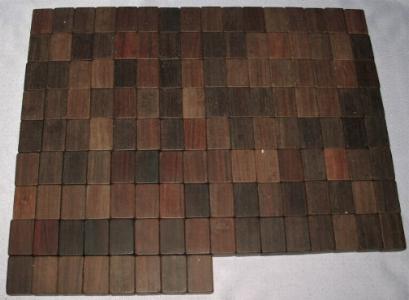
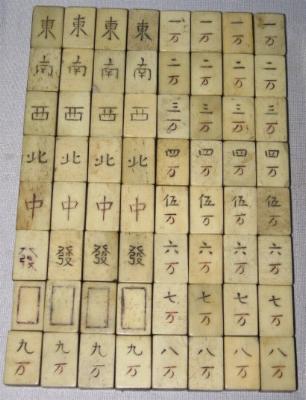
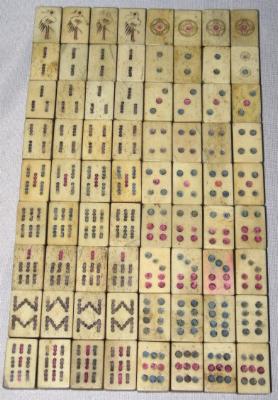
Hi Nate, you asked:
help me try to ID what it is [hand-made, factory-produced
Looks hand-made to me.
counter-feited,
Not sure what you mean. It's really a mahjong set. How could a mahjong set be counterfeit?
what-not]
Read FAQ 7P. I can't answer "what-not" questions. Too much work!
and how old [if at all] it might or might not be.
It might be from the 1930s or 1960s. Or it might not. It's also possible that the tiles are artificially aged, but it does appear to be old (i.e. not new manufacture).
You also wrote:
I paid around $120 + $80 shipping for this particular set.
Seems a little high to me.
7. The container is a latch-top wood box [also rosewood-ish] with hinges. Fittings are brass or thereabouts.
It looks like 10 of the tiles just rattle around atop the full layers. That's very odd. Could mean that the box wasn't made for the set, or that the original trays are missing. Might be a Frankenstein (tiles put together with a box for resale).
I have not seen another one bam even close to this set. It is a crane / stork standing erect on two feet.
I don't recall having seen that before, either.
Ridiculous inconsistency in carving / construction. Note the left-most of the "fa", "one bam", and "one dot" tiles in particular, all of which are subtly different from the rest.
Yes, those tiles are surely replacements made later.
Also note the horizontal, rather than typically vertical, orientation of the graining on some of the bones.
Interesting. Very observant of you. Clearly it was cheaply made. It could have been a measure taken by the maker, to make use of scrap pieces of bone unsuited for vertical grain.
The weird construction [thin bone plate glued to wood tile backing] seems strange. I saw one other set like this in the past months, from a domestic seller,
Yes, I've seen that before (I had or have a set like that). It's a cheap method of manufacture.
I'd like to know [your] guess [as to] how or why it would have been constructed. With there being no numeralling / lettering, it obviously was never meant for sale outside China. But, it also doesn't match any traditional style of construction / carving that I've seen. My best, and completely uninformed guess, is that it must have been a set made by some folk craftsman for personal use... but maybe it was just a teenage craft project or something. I really don't know where or how to start guessing, so I guess that's where you come in.
I think your guesses are perfectly fine. I haven't heard any lore or tales about cottage set makers, if that's what you're looking for.
May the tiles be with you.
Tom Sloper
Author of "The Red Dragon & The West Wind," the definitive book on Mah-Jongg East & West.
Los Angeles, California, USA
April 7, 2011
Bouquets of flowers in the Mandarin version
>From: HOLLY B
>Subject: Mah-Jongg Q+A
>Date: Thu, 7 Apr 2011 05:06:18 +0100
>Hi. I play the Mandarin version of Mah-Jong.
> Today someone came up with a bouquet of flowers. Our notes don't tell us how to count that. Question is:
> 1)if player has a bouquet and does not Mah-Jong do they get anything for having the bouquet
> 2)if player mah-jongs and has the bouquet is that like 500 extra points?
> Thanks for your answer.
> Holly
Hi Holly, you wrote:
I play the Mandarin version of Mah-Jong.
I don't know which one that is. You say you have "notes." Does that mean you don't have a book? If you have a book, I need to know its author. If your "notes" come from a website, I need the web address.
if player has a bouquet and does not Mah-Jong do they get anything for having the bouquet
Yes.
if player mah-jongs and has the bouquet is that like 500 extra points?
I don't know what scoring your "Mandarin version" uses. Do you have points and doubles (as per Chinese Classical rules)? If so, then the bouquet is worth one double (it doubles the score).
May the tiles be with you.
Tom Sloper
Author of "The Red Dragon & The West Wind," the definitive book on Mah-Jongg East & West.
Los Angeles, California, USA
April 6, 2011
Ascending as opposed to consecutive
>From: Sara C
>Sent: Wed, April 6, 2011 6:40:33 AM
>Subject: NMJL 2011 - Consecutive Run #6
>Dear Tom,
>The other night our group had a discussion about the sixth hand in Consecutive Run -
>11 22 33 4444 5555 (Any 3 Consec. Prs. Kongs Ascending Nos. Any 3 Suits)
>Some claimed that the entire run (Pairs and Kongs) had to be consecutive eg., 22 33 44 5555 6666 since it is in the "Consecutive Run" grouping. Others feel that something like
>22 33 44 7777 8888 or even 22 33 44 7777 9999 is ok since only the run of pairs has to be consecutive and the Kongs need only be ascending.
>What is your take?
>Thanks,
>Sarah
Hi Sarah, you wrote:
Others feel that something like
>22 33 44 7777 8888 or even 22 33 44 7777 9999 is ok since only the run of pairs has to be consecutive and the Kongs need only be ascending.
Ridiculous! One cannot read only the parenthetical and completely ignore the symbolic representation of the hand, and even ignore the name of the family of hands too. It's obvious and clear, from the symbolic representation of the hand and from the name of the family of hands, that the League means for the ascending kongs to be consecutive. A too-narrow reading of the parenthetical should never negate all the other clues and precedents that the League has provided.
May the tiles be with you.
Tom Sloper
Author of "The Red Dragon & The West Wind," the definitive book on Mah-Jongg East & West.
Los Angeles, California, USA
April 6, 2011
2 Qs about too many tiles
>From: Nancy S
>Sent: Tue, April 5, 2011 3:57:11 PM
>Subject: Mahjong question
>We did read the back of the card before emailing you. Still unclear.
>2 part question:
>First, if a player realizes she has either 12 or 14 tiles in her rack after discarding and nobody else notices, must she declare herself dead?
>And - if she has 14 tiles and declares herself dead, must she discard before play resumes among the remaining players?
>Thanks!
Hello Nancy, you asked:
if a player realizes she has either 12 or 14 tiles in her rack after discarding and nobody else notices, must she declare herself dead?
This is FAQ 19AC. Please scroll up and find the links to the Frequently Asked Questions (look for the blue and yellow flashing arrow, emblazoned "READ 1ST," like this ). Find the link to FAQ #19 (it's marked with a red, white, and blue flashing arrow, emblazoned "AMERICAN," like this ) and click it.
After you've landed at the FAQ 19 page, please bookmark it so you can easily return to it anytime you have a mah-jongg question. Answers to all of the most frequently-asked questions about American (NMJL) mah-jongg are found in FAQ 19. Please always check the FAQs first before asking a question. Thanks!
[if she is dead], must she discard before play resumes among the remaining players?
When a player is dead, she cannot do anything with her tiles (except return erroneous exposures to the sloping front of the rack) until the play has ended and it's time to pay, then shuffle and redeal. Discarding would be playing -- how can somebody who's dead play?
May the tiles be with you.
Tom Sloper
Author of "The Red Dragon & The West Wind," the definitive book on Mah-Jongg East & West.
Los Angeles, CA (USA)
April 5, 2011
FAQ 19AD2 ("What does 'racking' mean?")
>From: Lynne F
>Sent: Tue, April 5, 2011 2:13:33 PM
>Subject: MJ question
>This question is about tile racking. Is your tile considered "racked" if you merely tap the rack with the drawn tile and hold it in your hand? Or does the drawn tile have to actually sit in position on your rack with your other tiles to be considered "racked"?
Hello Lynne,
Please scroll up and find the links to the Frequently Asked Questions (look for the blue and yellow flashing arrow, emblazoned "READ 1ST," like this ). Find the link to FAQ #19 (it's marked with a red, white, and blue flashing arrow, emblazoned "AMERICAN," like this ) and click it.
After you've landed at the FAQ 19 page, please bookmark it so you can easily return to it anytime you have a mah-jongg question. Answers to all of the most frequently-asked questions about American (NMJL) mah-jongg are found in FAQ 19.
You should also read FAQ 14.
Please always check the FAQs first before asking a question. Thanks!
May the tiles be with you.
Tom Sloper
Author of "The Red Dragon & The West Wind," the definitive book on Mah-Jongg East & West.
Los Angeles, CA (USA)
April 5, 2011
Computer game with simplified rules?
>From: Rudi B
>Sent: Tue, April 5, 2011 9:34:28 AM
>Subject: online game for beginners
>Dear Tom,
>Today I came across your website as I was searching for the rules of MahJong.
>I live in Guangdong, China for three years now and decided to learn the game. After reading your FAQ10 with the simplied Chinese MahJong rules for beginners I would like to test my knowledge with a computer game based on these simplied rules.
>Is there any online or offline game for this? Or, a game with a step based tutorial /campaign to learn the Chinese MahJong rules by playing?
>Thanks.
>Greets from Shenzhen,
>Rudi B
Hi Rudi,
Every program I know about is listed in FAQ 5. Just start trying them out until you find something you like. Let me know if you run across dead links, and I'll delete those.
May the tiles be with you.
Tom Sloper
Author of "The Red Dragon & The West Wind," the definitive book on Mah-Jongg East & West.
Los Angeles, California, USA
April 5, 2011
Small tiles with no jokers
>From: Lynn P
>Sent: Mon, April 4, 2011 4:31:59 PM
>Subject: Mah-Jongg Q+A
>My mah-jongg question or comment is: One of the ladies with whom I play mah jongg called me and said she saw a mah jongg set at an antiques store. The set had small tiles in a nice case but didn't have any jokers. I told her it must be a travel set for either Chinese or Japanese mah jong and that she wouldn't be able to play American mah jongg without the jokers. I checked your site 7a. types of sets and think I gave her the correct answer. Am I correct in my answer to her? Thanks, Lynn P.
Probably.
May the tiles be with you.
Tom Sloper
Author of "The Red Dragon & The West Wind," the definitive book on Mah-Jongg East & West.
Los Angeles, California, USA
4/4/2011
Why am I dead if I pickandrack?
>Date: Sun, 03 Apr 2011 22:18:35 -0400
>From: Donna M
>Subject: Fw: pickandrack rules
>From: Donna M
>To: Donna M
>Sent: Sunday, April 03, 2011 10:17 PM
>Subject: Re: pickandrack rules
>This question has "everything" to do with pick and rack rules which you have outlined. What I'm saying (sorry I wasn't clear), is that it's my turn to pick from the wall...instead of looking at the tile before I rack or discard, I simply place it on my rack, rather than giving another player the opportunity to call a discarded tile which she decides she needs after I've already seen the joker I just picked from the wall, but now have to return . The local JCC says this is a no no and I would be dead if this joker gave me mah jongg. I am aware that a discarded tile that I pick up for an exposure must be placed directly on the rack, along with my other tiles to complete the pung, kong or mj.
>Thanks
>Donna M
Hi Donna,
Okay, it looks like I misunderstood what you were saying the first time. It sounds like you are saying that your local tournament organizer enforces a strict no-pickandrack rule. I don't know how exactly they can enforce it, but I say "more power to'em." In your first email you asked how I justify their rule. Then you offered a perfectly plausible and worthy explanation, which (apparently) you think is insuffient justification for the rule? I don't know if you ever read the yearly NMJL bulletin, but in the 2008 bulletin they quoted what I wrote about it in my book:
"The practice to pick and rack a tile makes it extremely difficult for anyone to claim the previous discard. It is ungracious and aggressive."
- Tom Sloper
The League is in agreement.
In my FAQs I state a better way to ensure that you don't have to knowingly put a joker back on the wall. After the player at your left discards, and before you pick the tile, just pause a second or two. This small pause gives other players time to call the discard. Then nobody has grounds to complain if you pick a tile from the wall and, without looking at it, put it among your racked tiles.
Since I misunderstood what you were saying the first time, I probably haven't satisfactorily answered your question. You're welcome to rephrase it if necessary.
May the tiles be with you.
Tom Sloper
Author of "The Red Dragon & The West Wind," the definitive book on Mah-Jongg East & West.
Los Angeles, California, USA
April 3, 2011
From Lynn
>From: "Lynn P
>Subject: Mah-Jongg Q+A
>Date: Sun, 3 Apr 2011 21:30:16 -0400
>My mah-jongg question or comment is: 1. Re Donna M.'s email of 4/3: As I read her question: she picks a tile, racks it, then declares mah jongg and then is called dead which doesn't seem correct. She has to be able to call mah jongg after picking a tile that completes her hand since if she didn't she would have to discard a tile to keep hand at 13 tiles. It sounds like you are telling her not to rack a discard (which she called) and I understand that is a no-no so she is dead if she does. She doesn't say how she got the tile in her rack as far as I can see. 2. Isn't it just easier for you to answer the emailer's question rather than refer her/him to a particular FAQ ? You must have them all memorized or spend time looking up each question for the correct reference number. BTW the new card (first time I used it) worked well for me and the tiles/jokers were with me to the tune of $4.10 this past Friday. Looking forward to a good year with 2011 mah jongg card!! Thanks, Lynn P.
Hi Lynn,
No. A great deal of thought and care (and refinement after getting follow-up questions) had to go into each FAQ. For each question I would have to go get the answer, copy it and paste it. And if each newcomer gets an answer direct from me, then she'll just come back every time she has a question and ask me, and I'll have to go copy and paste it every time. I much prefer it if users learn to catch their own fish so I don't have to catch fish for them every time.
May the tiles be with you.
Tom Sloper
Author of "The Red Dragon & The West Wind," the definitive book on Mah-Jongg East & West.
Los Angeles, California, USA
April 3, 2011
Why am I dead if I rack and declare mahj?
>Date: Sun, 03 Apr 2011 18:21:45 -0400
>From: Donna M
>Subject: pickandrack rules
>I attend tournaments at a local JCC and one of their rules is that if you rack a tile and then declare mah jongg on the same turn, you are dead.
>How do you justify this? I can't think of an explanation for this other than to discourage the aggressive nature of those who want to close the window of opportunity for others.
>Thanks
>Donna M
Hello Donna, you wrote:
Subject: pickandrack rules
Your question has nothing to do with "pickandrack." This tournament rule is not about picking from the wall. And "pickandrack" is not a rule. It's a term I created to describe an aggressive unofficial practice.
I attend tournaments at a local JCC and one of their rules is that if you rack a tile and then declare mah jongg on the same turn, you are dead.
>How do you justify this?
Read Frequently Asked Question #19K.
Please scroll up and look for the blue and yellow flashing arrow (emblazoned "READ 1ST," like this ). Find the link to FAQ #19 (it's marked with a red, white, and blue flashing arrow, emblazoned "AMERICAN," like this ) and click it.
After you've landed at the FAQ 19 page, please bookmark it so you can easily return to it anytime you have a mah-jongg question. Answers to all of the most frequently-asked questions about American (NMJL) mah-jongg are found in FAQ 19. Please always check the FAQs first, before asking a question. Thanks!
I can't think of an explanation for this other than to discourage the aggressive nature of those who want to close the window of opportunity for others.
WRONG. It's to prevent cheating. It's very important which tile you won on and who you got it from. If you take a discarded tile and put it into your rack... first of all, you should never do that anyway -- you can take a tile from the wall and put that into your rack, that's fine. But you should never take a discard and put that into your rack at all. It's very easy to mischaracterize which tile you won on (and thereby which player you got it from), so some tournaments penalize it.
May the tiles be with you.
Tom Sloper
Author of "The Red Dragon & The West Wind," the definitive book on Mah-Jongg East & West.
Los Angeles, California, USA
April 3, 2011
Payment in American mahj
>From: Ruth Z
>Sent: Sun, April 3, 2011 9:20:06 AM
>Subject: question about payment
>I enjoy reading all your information online and your book as well. Just want to check a point about payment in American mah jongg. Our group of five was taught that if there is one person who is the bettor and East rolls an even number on the dice, then the payment is double whatever the card says. Is that true? Does it also mean that if the winner has a jokerless hand, it is double again? If the winner picks her own tile for mah jongg does that also mean double payment. Would a 25 cent payment then become $1.50 for 3 different double payments? If the bettor bet on the winner, does the winner split the $1.50 with the bettor, or does everyone pay the bettor a separate $1.50 meaning that each player actually pays $3.00 for that hand. Also is it correct that if there is no one serving as bettor, then the even number roll of the dice does not qualify for double payment?
Hello Ruth, you asked:
Our group of five was taught that if there is one person who is the bettor and East rolls an even number on the dice, then the payment is double whatever the card says. Is that true?
Is it true that she said that? Yes, I suppose it is.
Is it true that it's a rule of American mah jongg? Read Frequently Asked Questions 14 & 19BK.
Please scroll up and look for the blue and yellow flashing arrow (emblazoned "READ 1ST," like this ). Find the link to FAQ #19 (it's marked with a red, white, and blue flashing arrow, emblazoned "AMERICAN," like this ) and click it.
After you've landed at the FAQ 19 page, please bookmark it so you can easily return to it anytime you have a mah-jongg question. Answers to all of the most frequently-asked questions about American (NMJL) mah-jongg are found in FAQ 19. Please always check the FAQs first, before asking a question. Thanks!
Does it also mean that if the winner has a jokerless hand, it is double again?
Yes.
If the winner picks her own tile for mah jongg does that also mean double payment.
Yes. Read FAQ 19W.
Would a 25 cent payment then become $1.50 for 3 different double payments?
What am I, a math teacher? Sheesh! 25¢ doubled once is 50¢. 50¢ doubled (the 2nd double) is $1.00. $1.00 doubled (the 3rd double) is $2.00.
How you came up with $1.50 I'll never know!
If the bettor bet on the winner, does the winner split the $1.50 with the bettor, or does everyone pay the bettor a separate $1.50 meaning that each player actually pays $3.00 for that hand.
See the rulebook, page 21, and see FAQ 19W. Whatever you pay the bet-on winner, you pay the exact same amount to the bettor. Whatever the bet-on loser pays the winner, the bettor pays the exact same amount to the winner.
Also is it correct that if there is no one serving as bettor, then the even number roll of the dice does not qualify for double payment?
Read FAQ 14. Please always check the FAQs for answers before emailing me a question. Thanks!
May the tiles be with you.
Tom Sloper
Author of "The Red Dragon & The West Wind," the definitive book on Mah-Jongg East & West.
Los Angeles, California, USA
April 3, 2011
Set evaluation, part 2
>From: Leah M
>Subject: Mah Jong Set reply
>Date: Sat, 2 Apr 2011 20:24:40 +0000
>Hi Tom,
>Thank you for your email.
>Advice that I was after was, from your experience and knowledge,what kind of set do you think t I have and is it worth anything? I want to sell it and was wondering what value you may think it is worth.
>I like your humour of my math! I guess what I was saying was it is meant to be a 148 set but it is missing a blank tile. Do you know if I can purchase one to replace it?
>Cheers
>Leah
Hi Leah, you asked:
what kind of set do you think t I have
A standard 1920's bone and bamboo set, with somewhat unattractive Haversian system evident in the tiles. See FAQ 7c.
what value you may think it is worth.
It would be worth below $100 here in the US, but it may be that it could go for more in the UK. Your actual results could vary greatly, depending on the quality of your presentation and who happens to be looking for a 1920s set at the time.
Do you know if I can purchase one to replace it?
Read FAQ 7Q.
May the tiles be with you.
Tom Sloper
Author of "The Red Dragon & The West Wind," the definitive book on Mah-Jongg East & West.
Los Angeles, California, USA
April 2, 2011
Set evaluation
From: Leah M
Subject: Mah Jong Set Evaluation
Date: Sat, 2 Apr 2011 17:05:58 +0000
>Hi there,
>I have been reading all about Mah Jong sets on your web site and I was wondering if you would give me some of advice from your knowledge on Mah Jong sets.
>I have attached pictures for you.
>About the set:
>Location: UK
>1920's 148 Tile Set
>Box
>Height 7inch
>Width 9.5inch
>Depth 6.5inch
>5 Drawers
>Front lid that slides on
>Im not sure of wood type.
>Brass doodads on all corners and in tact.
>Chunky brass handles that swivel
>Tiles
>Height 3cm
>Width 2.1cm
>Depth 1.1cm
>Bone:Bamboo Ratio - 5mm:6mm (I assume its bone as I cant see no cross hatching)
>Simple Tiles
>Circles/Dots 1-9: x36 (8 Dot Tiles are Blue)
>Characters 1-9: x36
>Bamboos 1-9: x36
>Honour Tiles
>Winds N, E, W & S: x16
>Dragons White, Green & Red: x12
>Spares: x3 (x1 missing) - will this drastically reduce its value?
>Bonus Tiles
>Four Flowers: x4
>Four Seasons: x4
>Sticks: 110
>Dice: 3 with slide lid little box
>Dice shaker: 1
>Tokens: 4
>Instructions:
>"Directions of Playing Chinese Game of Four Winds"
>Evaluation
>I think I have most info above
> What are the tiles made of ?
> Bone:Bamboo Ratio - 5mm:6mm (I assume its bone as I cant see no cross hatching)
> Describe what you know about when the set was made or purchased, if you know.
> Dont know anything, I bought it from a Market.
> Going by your website I suggest that it is in the era of 1920's.
> What are the dimensions of the tiles?
> Height 3cm
> Width 2.1cm
> Depth 1.1cm
> How many tiles are there in the set?
> 148 but missing 1 blank tile
> What other pieces (besides tiles) are included with the set?
> Sticks: 110
> Dice: 3 with slide lid little box
> Dice shaker: 1
> Tokens: 4
> What kind of container does the set come in?
> Box
> Height 7inch
> Width 9.5inch
> Depth 6.5inch
> 5 Drawers
> Front lid that slides on
> Im not sure of wood type.
> What condition is the container in?
> Box is in fine condition, all brass doodads are intact. There are no cracks or chips.
> Does the set have any paper materials.
> Paper instruction is in fine conditions, no rips or tears. Font looks like and old font (looks like the old type writter has been used).
> Which kind of craks are in this set -- the older kind or the later kind?
> Older Kind
>Do you reply to me via this email or do you reply straight to the forum?
>Regards
>Leah
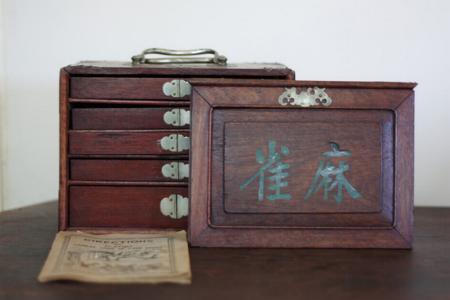
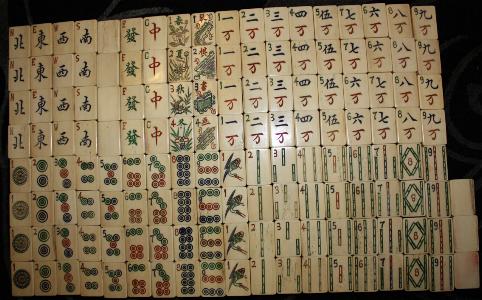
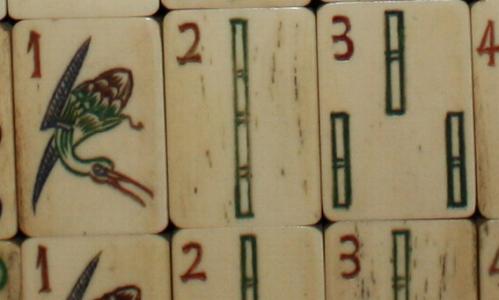
Hello Leah, you wrote:
I was wondering if you would give me some of advice from your knowledge on Mah Jong sets.
Sure. What kind of advice do you want exactly?
How many tiles are there in the set?
> 148 but missing 1 blank tile
Is that a strange way of saying "147"? Or are you saying there's a replacement tile or extra tile present?
Do you reply to me via this email or do you reply straight to the forum?
This forum.
Tom Sloper
Author of "The Red Dragon & The West Wind," the definitive book on Mah-Jongg East & West.
Los Angeles, California, USA
April 2, 2011
Quints #2, part 2
>Subject: Mah-Jongg Q+A
>From: Stephanie S
>Date: Sat, 2 Apr 2011 10:23:24 -0500
>My mah-jongg question or comment is:
>In your response about quints #2, you stated that it could be any of the three configurations you listed. Since it says "any 3 consecutive numbers" couldn't there also be many other options? For example, 4556 55555 55555 or 7899 99999 99999?
Yes, Stephanie. In fact, there are 21 possible numeric configurations of that hand. Do I really have to list them all? Does the League have to put them all on the card? Does it really matter which one the League puts on the card?
May the tiles be with you.
Tom Sloper
Author of "The Red Dragon & The West Wind," the definitive book on Mah-Jongg East & West.
Los Angeles, California, USA
April 2, 2011
The 2011 NMJL card (Quints #2)
>Subject: 2011 NMJL card
>From: elainec
>Date: Thu, 31 Mar 2011 22:52:56 -0400 (EDT)
>Well, they brought back one of the most confusing hands, the second one under Quints. Personally I always enjoyed it. This year they don't list the first possible hand according to the directions. They post 1223 22222 22222. According to how I read it, it should have been 1123 11111 11111 . Am I reading that right?
>Thanks, Elaine C, Melbourne Florida
Hi Elaine, you wrote:
This year they don't list the first possible hand according to the directions. They post 1223 22222 22222. According to how I read it, it should have been 1123 11111 11111 . Am I reading that right?
What difference does it make which of the 3 possible configurations they show? These are all valid:
1123 11111 11111
1223 22222 22222
1233 33333 33333
So what difference does it make which one they show on the card?
May the tiles be with you.
Tom Sloper
Author of "The Red Dragon & The West Wind," the definitive book on Mah-Jongg East & West.
Los Angeles, California, USA
March 31, 2011
Still fishing
>From: traceyma
>Subject: Mah-Jongg Q+A
>Date: Thu, 31 Mar 2011 08:05:45 -0700
>My mah-jongg question or comment is:
>We are playing Western rules from the book "Improve Your Mah Jong" by Patricia A. Thompson and Betty Maloney.
>If a player is fishing (has a ready hand), has called "fishing", and another player goes mahjong does the player with the fishing hand still receive points for fishing? In fact, if more than one player is fishing and called so do they all receive points for fishing even though not one of them has called mahjong?
>Thank you very much.
Hi traceyma,
According to Thompson and Maloney in their better (more comprehensive/detailed) book, "The Game of Mah Jongg Illustrated," on page 24, they delineate their recommendations for who should be paid, depending on whether you are a beginner group, intermediate, or advanced group. They do not recommend paying fishing hands for beginner players. But they do recommend paying fishing hands if your group is playing at the intermediate or advanced level. On page 32 they go into detail on how to calculate payments to fishing players.
If you're playing by Thompson and Maloney rules, I strongly recommend you get that book to supplement your understanding.
May the tiles be with you.
Tom Sloper
Author of "The Red Dragon & The West Wind," the definitive book on Mah-Jongg East & West.
Los Angeles, California, USA
March 2, 2011
Fishing
>From: traceym
>Sent: Wed, March 30, 2011 6:02:54 PM
>Subject: Mah-Jongg Q+A
>My mah-jongg question or comment is:
>If a player is fishing (has a ready hand), has called "fishing", and another player goes mahjong does the player with the fishing hand still receive points for fishing? In fact, if more than one player is fishing and called so do they all receive points for fishing even though not one of them has called mahjong?
>Thank you very much.
Hello Traceym,
What kind of mahjong do you play? Western/British rules? Japanese rules? I can't tell you how your rules are supposed to work if you don't tell me which kind of mahjong you play... And if you use a book or website as your rulebook, I need to know that too (if you tell me a book, give me the author's name, not just the title).
May the tiles be with you.
Tom Sloper
Author of "The Red Dragon & The West Wind," the definitive book on Mah-Jongg East & West.
Los Angeles, California, USA
March 30, 2011
Dark times in Japan
Dark times in Japan
Even so, natsukashii!
I wish I was there.
Tom Sloper
March 30, 2011
Shake, rattle, and roll
>From: Cha Liang C
>Date: Wed, 30 Mar 2011 22:22:46 +0200
>Subject: Mahjong tile construction
>I ordered a Take set on this site: http://[DELETED] and received it today. But I noticed a slight difference in weight between some tiles (4m is heavier than others). What could cause this?
>Also, it seems like there's something in some of my tiles. If I shake them, I can hear something moving/rattling. I checked all my tiles. The ones making noise are:
>1p 2p 4p 5p 9p
>1s 2s 5s 6s 8s(2x)
>3m 4m 5m 8m(2x)
>haku, hatsu, ton, nan(2x), xia(2x), red 5p
>That's 24 tiles! I expected these tiles to be of some high quality, but these inconsistencies prove otherwise. And they make another noise when rubbing them to feel which ties they are or when tapping them compared to the "normal" ones.
>I thought the tiles were solid. What could possibly cause this/how is a tile constructed?
>Cha Liang C
Hi Cha Liang,
Wow, that's strange. I have a Take set too; my tiles are all quite solid. I have a theory about what might be going on.
You may be aware that most people who play Japanese mahjong play using dealing machines. Well, the way those tiles work is that the tiles have magnets inside them, and the machines use magnets to align the tiles for stacking them face-down.
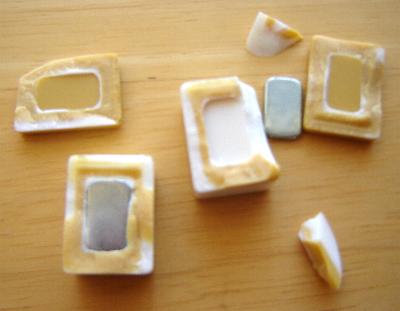
Japanese machine tiles have magnets inside them
The tiles are accordingly heavier than plain plastic tiles. You may be wondering, why am I talking about machine tiles, when your Take set is not made for using in a machine? Well, I don't know if you've noticed, but all Japanese tiles are heavier than plain plastic tiles! I'm sure that your Take tiles have metal inside -- not necessarily magnetized. I just now performed a small experiment with my Take set. I have a magnet tool (used to retrieve dropped screws and other metal parts in tight spaces) and I pulled it along a tray of Take tiles. I could feel and see a slight magnetic pull on the tool's tip as it moved from tile to tile, confirming that there is iron inside the tiles.
Apparently your tiles were made with overly large spaces for the metal pieces (or with too-small metal pieces). It's unfortunate that your set should not have passed inspection and wound up making its way into your possession.
Let the good tiles roll...
Tom Sloper
Author of "The Red Dragon & The West Wind," the definitive book on Mah-Jongg East & West.
Los Angeles, California, USA
March 30, 2011
I need racks
>Date: Mon, 28 Mar 2011 16:35:15 -0700 (PDT)
>From: Debra S
>Subject: replacement racks
>Hi - I'm going to be in Los Angeles later this week and wondered if you could suggest a place to buy racks (presumably in Chinatown). Thanks.
>Debra S
>dleesh
Debra,
Sorry, but that won't fly. They don't sell racks separately in Chinatown. You can find American-style mah-jongg sets in Chinatown if you look hard, but not racks. You'll have to buy them online. See Frequently Asked Questions 4a and 7k.
Please scroll up and look for the blue and yellow flashing arrow (emblazoned "READ 1ST," like this ). You'll find the links for FAQs 4a and 7k there.
May the tiles be with you.
Tom Sloper
Author of "The Red Dragon & The West Wind," the definitive book on Mah-Jongg East & West.
Los Angeles, California, USA
March 30, 2011
All those tiles overwhelm me
>From: Bonnie A
>Sent: Tue, March 29, 2011 11:10:03 AM
>Subject: Mah-Jongg Q+A
>My mah-jongg question or comment is: I’m always so overwhelmed when I first see all my tiles and don’t seem to Maj as much as the others …what is the best way to arrange my tiles when I first get them to create a hand? Any tips? Thanks
>******************************************************************************
>This e-mail is intended only for the use of the individual or entity
>to which it is addressed and may contain information which is
>privileged, confidential, and exempt from disclosure under applicable
>law. If you are not the intended recipient, or an employee or agent
>of the intended recipient, you are hereby notified that any
>dissemination, distribution, or copying of this communication is
>strictly prohibited. If you have received this communication in error
>please notify us immediately by replying to postmaster@[DELETED]
>******************************************************************************
Hello Bonnie,
I recommend you arrange your tiles this way:

Flowers at the left (since all flowers on this year's card are almost always at the left), then all the tiles of any one suit (in numerical order), then all the tiles of the other two suits, then winds, dragons, and jokers.
Then you can count up types of tiles to see what you have most of: evens? odds? lotta winds? Most of the time you'll probably want to work Consecutives. If you have multiple pairs, see if there's something you can make using those (there might not be). If you have just one pair, see if it has any "friends," and weed out the rest by moving them to the right, the other side of the jokers (if any). It's just a process of elimination, during the first pass or two -- your tiles might not suggest a specific hand just yet.
Try what I suggested to Lynn P, on Monday. Her post is entitled "As easy as 1, 2, 3" (see my response #4).
Don't worry too much about winning right now. If you're overwhelmed by your tiles, you don't want to spoil the fun for everybody else by dawdling too long during the Charleston. The winning will come in time. Enjoy the company while you're "paying tuition."
 For more, see FAQ 8e. You can link to the Frequently Asked Questions above left. You can also read my strategy column (purple banner above) -- now that there's a new card, I'll have lots to write about. And you can also buy my book, or Elaine Sandberg's book (see FAQ 3).
 "When you email me, I own it." Answers I give are given only in this public forum. Emailing me a question constitutes your implied consent for the question and answer to be given on this bulletin board. Claims of confidentiality are voided in view of this implied consent (as publicly and clearly stated on this site).
May the tiles be with you.
Tom Sloper
Author of "The Red Dragon & The West Wind," the definitive book on Mah-Jongg East & West.
Los Angeles, California, USA
March 29, 2011
The 2011 card, part 3
>From: linda m
>Sent: Tue, March 29, 2011 8:42:16 AM
>Subject: thanks
>Hi Tom,
>Thanks for the explanation of Singles and Pairs #6 and the reference to card 2006, (I've only been playing 3 years). Based on FAQ 19AJ would you say that the parenthetical in Quint #1 in the new 2011 card is redundant since "no parenthetical" would mean the hand exactly as it is printed?
>Hope I'm not being too picky.
>Love the column---
>Linda
Hi Linda, you wrote:
would you say that the parenthetical in Quint #1 in the new 2011 card is redundant
Yes.
May the tiles be with you.
Tom Sloper
Author of "The Red Dragon & The West Wind," the definitive book on Mah-Jongg East & West.
Los Angeles, California, USA
March 29, 2011
Web page wider than the monitor, part 5
Dear readers,
I found the problem. As I said to Jackie yesterday, in the past this problem has been caused by very long URLs. And that's what the problem was in this case, too. The long URL was in my reply to "the suffocated (aloneinthefart)" on Tue, 25 Jan 2011 ("History of mahjong"). 
That has been fixed, and my friend Trina fixed some other "deprecated" HTML tags, so you may notice that the board looks a little different now. Thanks one and all for alerting me to the problem. The board now works properly in all browsers -- no need for anyone to switch browsers on my account! 
May the tiles be with you.
Tom Sloper
Author of "The Red Dragon & The West Wind," the definitive book on Mah-Jongg East & West.
Los Angeles, California, USA
March 29, 2011
Web page wider than the monitor, part 4
>From: "jackie.b
>Sent: Tue, March 29, 2011 6:52:55 AM
>Subject: Mah-Jongg Q+A
>My mah-jongg question or comment is:
>Tom,
>Web page wider than the monitor
>FYI---Firefox readable ---Microsoft Internet Explorer same issue.
>Let me know if you want me to check this out from time to time
>Played with the new card last night nice change!
>Jackie B
Hi Jackie,
Yes, I know. I checked it last night with IE and Chrome -- the problem shows up in both. At present only Firefox doesn't exhibit the problem. Now that I'm aware of the problem, I'll always use "not Firefox" when checking the board.
May the tiles be with you.
Tom Sloper
Author of "The Red Dragon & The West Wind," the definitive book on Mah-Jongg East & West.
Los Angeles, California, USA
March 29, 2011
The 2011 card, part 2
Linda M. had written earlier (below):
>Subject: monitor problem
>Hello Tom,
>... My new card arrived today. ... What about Singles and Pairs #6? While it says "3 suits", it doesn't say "these numbers only" as in Quint #1, but it also doesn't say "any 3 consec. nos." as in Singles and Pairs #1. How would you interpret Singles and Pairs #6? Any 3 consec. nos. or only the specific nos. 7,8 and 9?
Hi Linda,
OK, I've had a chance to open the envelope and look at the new card. The S&P#6 hand has been seen before. It was in the 2006 card. I wrote an FAQ on this hand five years ago. To read the answer, go to FAQ 16, scroll down to the bottom, and click the link to the 2006 card. Also read FAQs 19AJ and 19AK.
After I've had more time with the 2011 card, I will update FAQ 16 to include answers to most of the common questions that it may generate.
May the tiles be with you.
Tom Sloper
Author of "The Red Dragon & The West Wind," the definitive book on Mah-Jongg East & West.
Los Angeles, California, USA
March 28, 2011
Web page wider than the monitor, part 3
>From: linda m
>Sent: Mon, March 28, 2011 7:58:08 PM
>Subject: monitor problem
>Hello Tom,
>I have the same monitor scrolling issue as Jacki B. who wrote to you earlier today (March 28). I just assumed that my own particular computer was the cause so I was actually happy to hear that someone else had to scroll back and forth to read your "words of wisdom." Thanks for a lot of good advice.
>My new card arrived today. I understand Quint #1 must be done only with the numbers 2,3 4 and 5 because that is clearly stated in the parentheses. My question is this. What about Singles and Pairs #6? While it says "3 suits", it doesn't say "these numbers only" as in Quint #1, but it also doesn't say "any 3 consec. nos." as in Singles and Pairs #1. How would you interpret Singles and Pairs #6? Any 3 consec. nos. or only the specific nos. 7,8 and 9?
>Thanks.
>Linda M.
Hi Linda, you wrote:
I have the same monitor scrolling issue as Jacki B. who wrote to you earlier
I have been using Firefox to check the bulletin board, and now I see that this too-wide problem exists in most other browsers! At the office I use an iMac, and I saw the problem only when I switched browsers from Firefox to Safari. Now here at home when I try Chrome and Internet Explorer, I see the problem exists in those too. I've consulted an expert and am still trying to fix it. Sorry that everyone will have to bear with the problem until I get it figured out.
My new card arrived today. I understand Quint #1 must be done only with the ...
Dude! I just got home and found the envelope in my mailbox. South Park is on, then STNG comes on and it's bedtime! Give me time to, like, you know, open the envelope and have a look at the new card! I should be able to interpret the new card tomorrow. (No guarantee I can have the too-wide problem fixed by then. Everybody should just switch to Firefox until I get it fixed, that'd remove the problem real good!) So stay tuned, come back same Bat-time, same Bat-channel, tomorrow, okay?
May the tiles be with you.
Tom Sloper
Author of "The Red Dragon & The West Wind," the definitive book on Mah-Jongg East & West.
Los Angeles, California, USA
March 28, 2011
As easy as 1, 2, 3
>From: Lynn P
>Sent: Mon, March 28, 2011 3:15:36 PM
>Subject: Mah-Jongg Q+A
>My mah-jongg question or comment is: 1. RE email of 3/28 by Jackie b.: I too have been having the same problem seeing your emails on your Q&A site. I am not that computer literate so how do you change browsers like she did?
>2. Re my email of 3/28 on the dragon tail: 1. Guess I need to keep reading your book or I would have known about "mish" on p.239 of "Red Dragon & West Wind". Glad it is only a table rule.
>3. I am sometimes the announcer for my groups and always the designated "looker upper" since I have "RD&WW" with me at the mah jongg games. I agree with you on #5. I should have realized the discrepancy in using the word discard (throw away) for the mish!! Got 2011 mah jongg card today and will spend the rest of the week memorizing it-lol-so I will be ready to use it on Friday. Have a great week. Lynn P.
>PS Is there any way to somehow practice or "learn" the card in a short time? Just thinking ahead!
Hello Lynn, you wrote:
I too have been having the same problem seeing your ... Q&A site.
I saw the problem myself when I switched to the Safari browser here on my office computer. I wish I'd known this problem existed before. Looking into what it'll take to fix it.
how do you change browsers like she did?
You click on a different program (not the one you've been using). You might have to download something. The most common browsers are IE (Internet Explorer comes with Windows), Firefox, Chrome, Safari, Opera. And maybe AOL still has its own browser too.
Guess I need to keep reading your book or I would have known about "mish"
If you'd read the glossary, I suppose. I don't recommend you confuse things by reading about the Red Dragon part of the book (the Chinese competition rules); you should stick with the West Wind part (American mahj).
Glad it is only a table rule.
Pretty much anything you run into that isn't in my book is surely a table rule (or a variant).
Got 2011 mah jongg card today
Apparently a lot of people have. I'm at the office and won't know if I got it until tonight.
Is there any way to somehow practice or "learn" the card in a short time?
I suppose there are a lot of ways. What I always recommend is to get out your tiles and practice making each hand with real tiles.
May the tiles be with you.
Tom Sloper
Author of "The Red Dragon & The West Wind," the definitive book on Mah-Jongg East & West.
Los Angeles, CA (USA)
March 28, 2011
Color key
Blue = an FAQ, a question that's been asked frequently.
Purple = an unhappy email from a dissatisfied reader.
Green = a happy email from a grateful reader.
Red = a technical support question about a computer game.
Orange = a weird or off-topic email.
Black = none of the above. Regular question or comment.
MORE Q&A!!
 CLICK HERE to go back in time and read older Mah-Jongg Q&A postings!
 CLICK HERE to return to the present and see the latest Mah-Jongg Q&A postings!


 SITE LINKS


 Sloperama.com. I answer mah-jongg questions that are submitted by email only - telephoned questions are not welcome. And don't ask me to click links, either. Give me all the information in your email.

 Jacqueline,