FAQ 7b. Do I Have All The Tiles I'm Supposed To?
So... you are the happy owner of a mah-jongg set, and you are wondering if all the tiles that are supposed to be there are there. The purpose of this FAQ is to help you determine if all your tiles are present. Other FAQs are available to help you figure out other things about your set.
To determine if you have all the tiles you're supposed to, the first thing you should do is take all the tiles out of the mah-jongg case. In this FAQ, our focus is just on the tiles, so leave all other pieces in the case. Arrange the tiles by suit and number.

The suit of dots is numbered 1 through 9. There are 4 of each tile. 36 tiles.
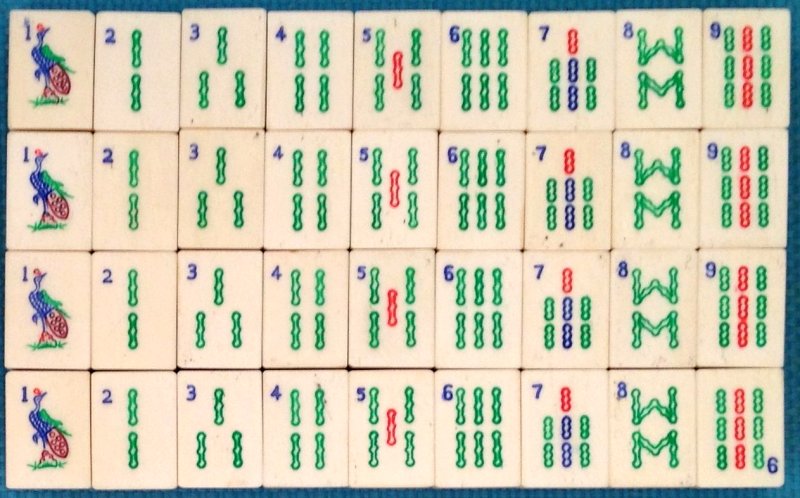
The suit of bams is numbered 1 through 9. There are 4 of each tile. 36 tiles. The One Bam usually depicts a bird.

The suit of craks is numbered 1 through 9. There are 4 of each tile. 36 tiles.

There are 4 different winds (East, South, West, North), 4 of each. There are 3 different dragons (White, Green, Red), 4 of each.
There are 8 flower tiles (right), which can depict all kinds of things; some of them might be named for the 4 seasons. Total: 36 tiles.
The above 144 universal tiles make up the basic Chinese set. Your set might have more than that. If you do have additional tiles, arrange those at the side, as in the picture below.

This set has 160 tiles. You can tell because, in addition to the "normal" 144-tile Chinese set (dots, bams, craks, winds, dragons, 8 flowers) it has 8 additional jokers, 4 Chinese jokers, and 4 blanks. 144+16=160. Simple math.
Count all the tiles. The easy way to count so many tiles is to organize everything in four rows (like the picture above). Then you don't have to count each piece -- you can count the columns of four (and multiply by four). It's a lot like a trick I learned from my grandpa, who was a dairy farmer. He taught me that the quick way to count cows is to count the legs, and divide by four. Oh, wait. I'm trying to remember. Maybe it wasn't the legs that he counted...? (^_^)

Another way of arranging your tiles is "the big square," as shown above.
The Chinese Set
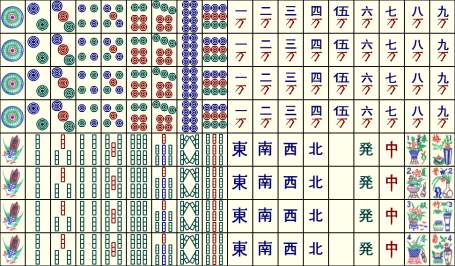
The normal Chinese set has 144 tiles: the dots, bams, craks, winds, dragons, and 8 flowers.
The American Set
The modern American set has 152 tiles: essentially, it's a Chinese set, plus 8 jokers (right).

A couple things you'll notice in the above images:
- Dragons can differ. American sets often (but not always) show pictures of dragons rather than Chinese characters. Older sets and Japanese sets use blank tiles for white dragons. For more on different dragon types, see FAQ 7E (the "Mystery Tiles" FAQ).
- One Bams can differ. Different bird graphics (and sometimes not birds at all).
- Flowers can differ. Flower tiles might depict flowers, or structures, or scenes, or personages, or animals or objects. See FAQ 7E (the "Mystery Tiles" FAQ). Every flower tile in your set looks different from every other flower tile in your set. And your flowers look different from my flowers. Get used to it!
- Jokers can differ. Your jokers probably look different from the ones pictured above. In a set, all the jokers probably look alike.
- Chinese sets don't necessarily have Western indices (Roman letters E, S, W, N, and Arabic numerals 1, 2, 3, etc.). Without Western indices, you have to be able to read the winds and craks in Chinese.
A couple things you might find in your set that differ from the above images:
- Sometimes sets come with extra tiles: extra flowers, extra jokers, extra blank tiles. Don't get all a-twitter (or all a-Facebook) over it -- it's perfectly normal for a manufacturer to add more tiles. And sometimes a previous owner may have acquired extra tiles and thrown those in, too.
- You might have stickered jokers or stickered flowers. This is due to the fact that the National Mah Jongg League changed its rules over the years, and players had to modify tiles to suit. See Column 509.
Overview of different types of sets (more details, and pictures, can be found in FAQ 7a):
- Chinese -- 144 or 148 tiles (usually includes 4 blanks in addition to the 144-tile basic set, or if you're lucky, may also include four Chinese jokers for a total of 152 tiles), with Western indices (made for export)
- Chinese -- 144 or 148 tiles (usually includes 4 blanks in addition to the 144-tile basic set, and might have Chinese "100 uses" jokers), withOUT Western indices (made for use in Asia)
- Japanese -- 144 tiles (four flowers, not eight, and four "Red Fives" -- the Japanese game is played with 136 tiles)
- Vietnamese Classical -- 160 tiles (in addition to the basic 144, there are also 8 special jokers and 8 extra flowers)
- Vietnamese Modern -- 176 tiles (in addition to the basic 144 and the extra flowers, the 8 special jokers are triplicated)
- Thailand -- 168 tiles (in addition to the 160 tiles used in Vietnamese Classical, there are another 8 extra flowers)
- Malaysian/Singaporean -- 148 or 152 tiles (four of the flowers are marked with special pictures: cat/rat, fisherman/fish, for example -- and there are 4 Chinese jokers and there may also be 4 blanks).
- Malaysian 3-player -- Sets are made specifically for use by 3 players. These sets have only 88 tiles (no Craks or Bams; 8 jokers and 16 flowers).
More stuff you don't really need to know, but can be of interest (may include some repetitive stuff):
- See FAQ 11 for an interesting side note on the origins of the three suits of mah-jongg, from the older Chinese card game of Matiao.
- The red character on the Chinese red dragon tile is chung, meaning center. The Chinese name for China is Central Nation -- this character is part of the country's name! In the East, players do not call this tile dragon; that is a Western practice. See FAQ 11 for an interesting side note on this tile, which may originally have been the fifth wind tile!
- The green character on the Chinese green dragon is pronounced faht and means fortune. The Chinese do not call this tile a "dragon"--only we Westerners call them that. See FAQ 6 for more on the variety of names people use in reference to the dragon tiles (and other tiles in the game).
- The Chinese call the white dragon tile bai ban which means white tile. Originally, these tiles were always blank. See FAQ 7e for more on the white dragons.
- Flowers come in bewildering varieties and are used in many different ways. See
See FAQ 7e-F, all about the varieties of Flower tiles in mah-jongg sets.
- Jokers usually (but not always) have the English word "Joker" written on them. Chinese jokers say "100 Uses" on them (in Chinese); some rulebooks included with sets erroneously say that these tiles are White Dragons. See FAQ 7e-J for some special joker tiles.

- The particular type of peacock shown above indicates that this set was made in Shanghai, in the 1920s (or possibly as late as the 1930s). Other types of One Bams give clues as to where a particular set was made.
- Use FAQ 7a to figure out what type of set you have. Do the tiles have Western indices? If not, it's an Asian set (Japanese, Chinese, or Vietnamese). Does the set include jokers? If it has more than four jokers and they say "joker" in English on them, it's an American set. Does the set include red fives? If so, it's a Japanese set.
- Use FAQ 7c to determine what the tiles are made of.
- Use FAQ 7d to figure out what all the other bits & pieces are.
- Use FAQ 7e to identify any "mystery" tiles. If you have identified all the suit tiles (including the One Bam, which usually represents a bird), the winds and the dragons (and there don't seem to be any of those basic tiles missing), then your other mystery tiles are probably either flowers or jokers (or you may have both).
- Missing some tiles? See the
Tiles For Sale bulletin board and the
Tiles Wanted bulletin board.
- Want blanks? See FAQ 7Q.
- Need jokers? See FAQ 7R.
- Make your own joker stickers: see FAQ 7T.
- Another way to organize your tiles (instead of the way I organized them above) is to lay them out in "The Big Square." That's the way I have my students organize them when I'm teaching new players. See
Column 492.
Got a question not answered above? Visit
the Mah-Jongg Q&A Bulletin Board
to get answers to your mah-jongg questions.
If you appreciate the free information on this site, your donation would be gratefully accepted, and would help keep this site running as a free service.
Thank you!
 DONATE!

Copyright 2001-2014, 2023, 2024 Tom Sloper. All rights reserved.