
|
By Tom Sloper
May 25, 2026 Column #818 |
|
|
By Tom Sloper
May 25, 2026 Column #818 |
American Mah Jongg (NMJL rules). Third review of books, again a hunt for books written by AI... or with the aid of AI.
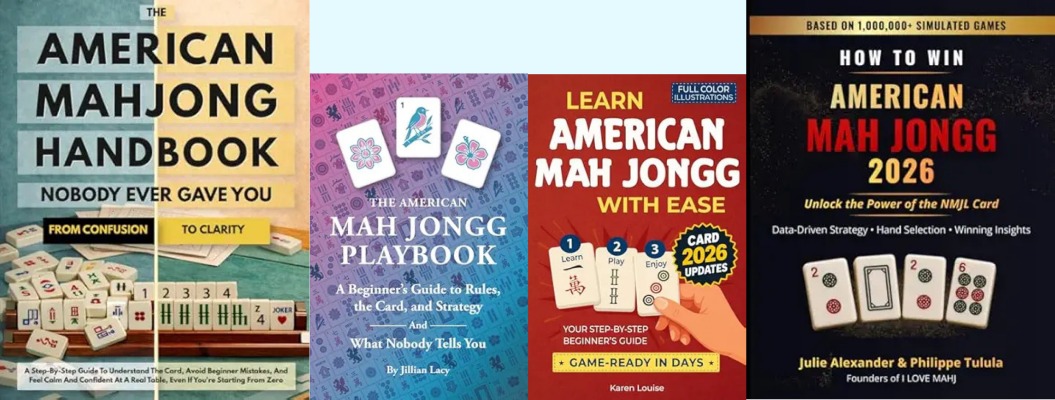
The American Mahjong Handbook Nobody Ever Gave You (subtitle omitted), attributed to Meredith F. Halloway. A large-format book with an odd title and odd-looking tiles. And it's very odd that the author's name is only on the spine - not on the cover, front or back - not on the title page, no, wait - there is no title page - not on the copyright page, and not on the last page, and noplace in between.
The writing sounds human. Encouraging words: don't be scared or overwhelmed, you can learn mah-jongg - and the writing flows. But the images. The images! Inside the 193-page book there are only 36 images of mah-jongg tiles, and of those 36, only 7 show actual mah-jongg tiles. The rest are AI-generated tiles with nonsense designs or faux Chinese characters.

One has to wonder why a human who understands American mahj would tolerate such obviously incorrect tiles. As if that alone wasn't enough of a red flag, let me tell you about some things I found inside. The title of chapter 2 is "Make Peace With the Cards," but the chapter is not about the card - it's all about the tiles. In Chinese, the word for "card" is the same as the word for "tile." Does that tell you something? Another: an illustration of an exposed hand shows exposures standing on the table rather than flat atop the rack - and the exposure is NWW! An illustration of a concealed hand shows 18 tiles in two sloping rows on a rack (presumably, a Siamese Mahjong rack, but without any flat surfaces for exposures). There are a lot of words in this book, and many or most of them might be okay information about playing American mah-jongg, but the AI-generated tiles and other incorrect images make the book very confusing for learners. Do not buy.
The American Mah Jongg Playbook (subtitles omitted), by Jillian Lacy. This is another book with a tiles problem. But with a difference. This book uses one set of tiles consistently throughout, but the tile designs are a little off from the traditional. The dots look pretty standard, until you come to the 6 and the 7. Traditionally, there is a tight cluster of 4 circles at the bottom of both tiles, with a slight space cushion above. The 6 has a pair of circles above the space cushion, and the 7 has a slanted line of three circles. But in the Playbook's 6 and 7 dots, there's no space cushion, so the 6 is two columns of three, and the 7... well, see the image (bottom right corner).
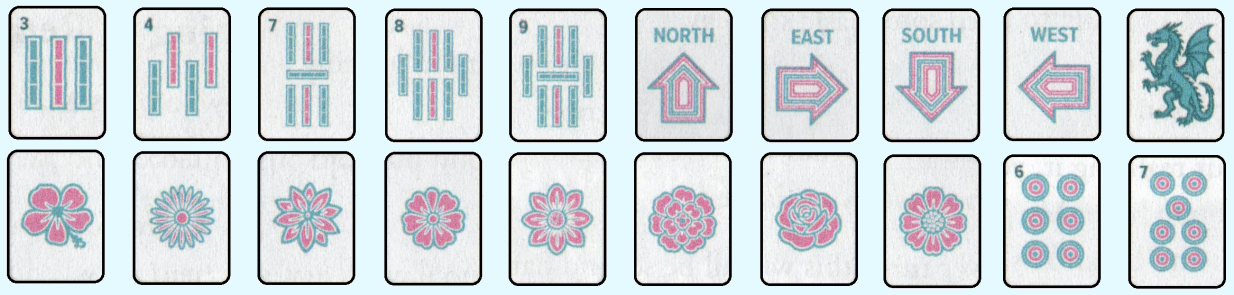
As for the bams: only the 1, the 2, the 5 and the 6 look like the traditional bams (see the image for the others). The craks, surprisingly, are traditional (no need to picture them here). The winds are just arrows pointing in the four directions - no kanji. "Sometimes," the author says of mah-jongg wind tiles, "they each have a Chinese graphic on them." For old-timers like me, that "sometimes" is jarring. I guess we're in a new mah-jongg age now, and designer sets have apparently become the norm. New players might be introduced to the game with designer tiles, but at some point, when faced with traditional wind tiles, they could well find themselves at a disadvantage. But enough about the Playbook's tile graphics. At least they're consistent throughout.
The writing largely looks reasonable, far from AI mishmosh, but there is wrong advice in the chapter about dealing. After rolling dice, breaking the wall, and serving out the first wall, the author says to shift the remaining tiles (the last short wall) to the left end of East's rack. The rules of NMJL mah-jongg say specifically that the last short wall is to remain at the right end of East's rack (MJME 2023/24, p. 10). And there's a very good reason for this. In the last phase of the game, as the last long wall (player 2's wall) is running out, some players think the game is ending. Because that last wall is not physically near the corner of the table where player 2's wall originated from, they don't see that last wall, so they start dogging. That's why the last wall should stay at the right side of East's wall.
Another thing that bothers me is in the scoring section. The author says "some" groups score double for double dice. What bothers me is that there's no differentiation between official rules and house rules here.
Final note on this book. The author uses the term "rouging" as "the informal term players use for everything that happens before the first discard." I never heard this term before. I learned something! Other than the slightly-off designer tiles, the shift-the-last-wall-left thing and the double dice thing, this book looks okay to buy.
Learn American Mah Jongg With Ease, by Karen Louise. Oh hey, that rhymes! I believe this author to be human (and I even believe she looks like the photo on the back). Her writing is easy to read and I found no factual errors. But I was surprised to learn that there are two common scoring methods: "winner-only scoring" (winner adds, others do not subtract) and "shared scoring" (winner earns base value, others may or may not earn or lose points depending on table rules). I never heard of anyone using either method, but I haven't played in every state. Or maybe this (like designer tiles) is a new thing in the modern mah-jongg scene. So I learned another thing! Okay to buy.
How to Win American Mah Jongg 2026 | Based on 1,000,000+ Simulated Games, by Julie Alexander & Philippe Tulula, founders of the online game I Love Mahj. I wasn't looking for AI in this book - I bought it because I'm a game developer myself, I've designed and produced mah-jongg games, I instantly grokked what the authors were doing, it's a unique premise for mah-jongg books, and I had to have it. The book contains statistics and analysis based on data collected from bots playing over a million games with the 2026 NMJL card. The data is used to examine and question common wisdom about the card and to derive statistics-based strategies, whether you play an online game or in person. Not for nervous newbies. Master the basics of play and the card before you venture into this hardcore book. Definitely written by humans, so okay to buy. But you'll need to buy a new copy every year.
*
Funny. In the last column I reviewed 5 books and rated "do not buy" for all but one of them. This time I reviewed 4 books and rated "do not buy" for only one. I still have a couple of 2025 books I haven't reviewed yet. If you know of an AI-written book that I haven't mentioned yet, please email me.
More "is it AI?" book reviews!
Column 813
Column 817
COMMENTS
Email  . Hit me with your best shot!
 |

|

|
© 2026 Tom Sloper. All rights reserved. May not be reproduced without express written permission.
 Nobody has commented yet. You can be the first!